
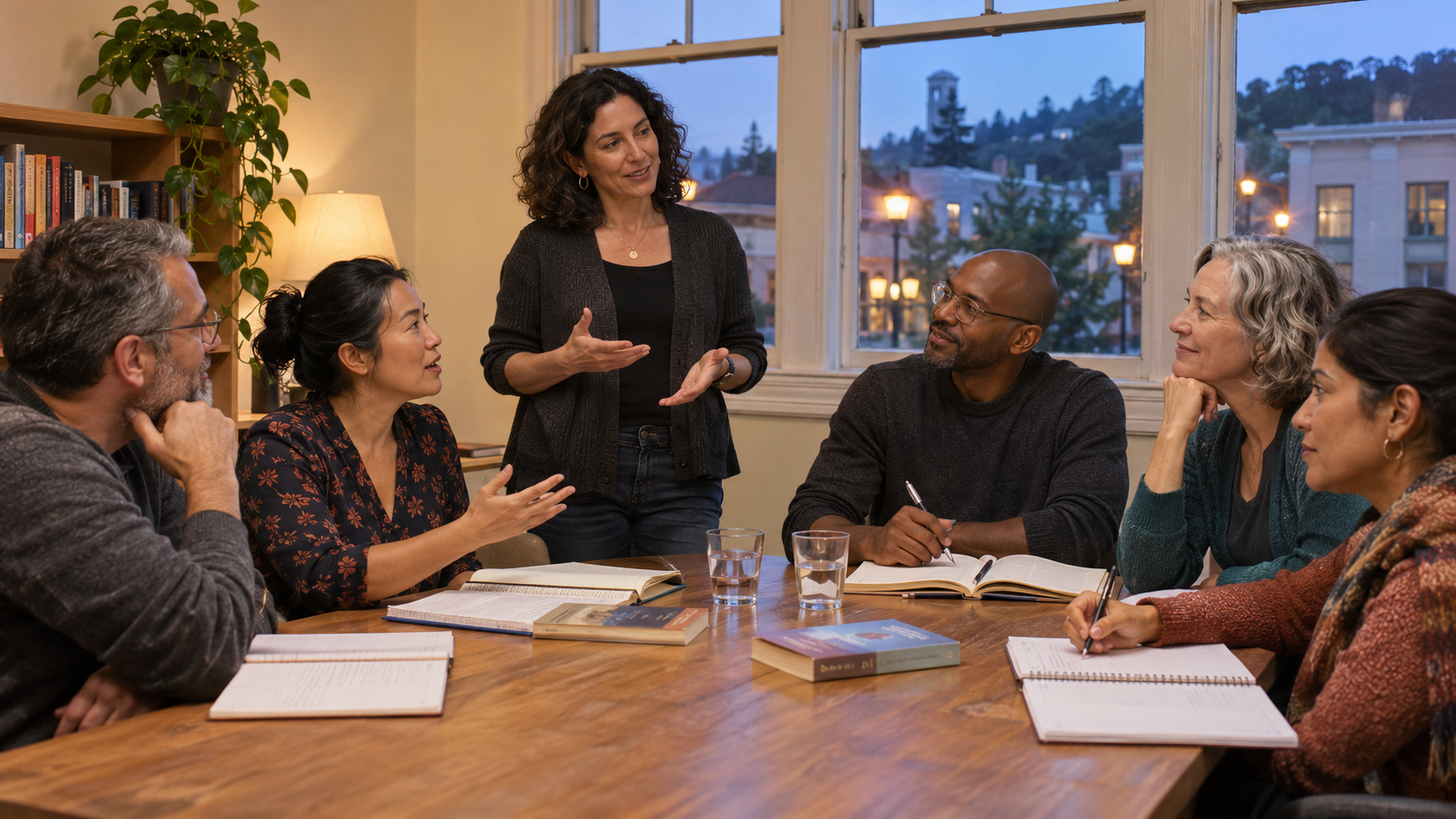
A Spanish class can look perfectly manageable until the first Thursday arrives. Work runs late, dinner has not happened, and the journey that looked short on a map suddenly involves finding parking and locating a second-floor classroom.
For adults looking for Spanish classes near Albany and El Cerrito, Berkeley is a practical place to include in the search. But the useful question is more specific than “How close is it?” It is “Can this class fit into the week I actually have?”
That means weighing the route, the level, the amount of speaking practice, and the small stretch of time available between lessons. A nearby class is valuable when attending it feels repeatable—even on an ordinary, slightly inconvenient Tuesday.
Start with the journey you would actually make
Albany and El Cerrito are close enough to Berkeley that a city boundary need not define the search. Still, “a class in Berkeley” could mean several different journeys. A classroom near Shattuck Avenue is a different proposition from one in the hills or west of San Pablo Avenue.
Before comparing courses, find the actual classroom address. Then plan the trip from wherever the day will leave you: home, an office, a school pickup, or a BART station on the way back from work.
From El Cerrito, look at the station connection
Downtown Berkeley is two stops south of El Cerrito Plaza on BART, with North Berkeley in between. From El Cerrito del Norte, it is three stops. The BART system map makes the connection easy to see, while the trip planner gives the schedule for the day and time being considered. bart.gov
The train ride, however, is only part of the appointment. Walking to the station, waiting for a train, and reaching the classroom all belong in the calculation. So does getting home afterward.
For someone already traveling through Downtown Berkeley after work, a class might fit naturally into the return journey. For someone who must first come down from the El Cerrito hills, the same class may require more planning. Neither experience is captured by the distance between the two city names.
From Albany, compare the whole route
El Cerrito Plaza station serves northern Albany as well as southern El Cerrito and surrounding areas. Depending on the starting address, it may be a useful way into downtown Berkeley. For other Albany residents, a bus, bicycle, or car may make more sense. Bay Area Rapid Transit
AC Transit’s Line 72 serves Albany, El Cerrito, and Berkeley along the San Pablo Avenue corridor. But a bus that enters Berkeley does not necessarily deliver a student to a downtown classroom. Check the final walk or transfer rather than stopping the search at “Berkeley.” Alameda-Contra Costa Transit District
Drivers should make the same distinction between reaching downtown and reaching their seat. Downtown Berkeley BART has no station parking, so driving to a class nearby requires a separate parking plan. Check garage hours or street restrictions against the actual class time. Bay Area Rapid Transit
A useful test is to make the journey once at roughly the proposed hour. It reveals more than an optimistic estimate made on a quiet Sunday morning.
Choose a time that leaves room to arrive
An early evening class can look ideal because it finishes before the night disappears. It becomes less attractive if work regularly ends ten minutes before the lesson starts.
A later class may offer a calmer arrival but leave a long gap after work. A morning class can suit someone with flexible hours, yet compete with appointments or caregiving. Weekend classes avoid some work conflicts and create others.
There is no universally convenient time. There is a time that requires fewer negotiations with the rest of life.
Look at the whole term before registering. Mark travel, recurring commitments, and any dates already likely to cause an absence. Check whether holiday breaks alter the end date. If two of six meetings conflict with existing plans, an attractive start time will not solve the problem.
Also leave a little space before the lesson. Even ten unhurried minutes can be useful for opening the book, recalling the previous topic, and shifting attention away from work. Arriving breathless and mentally finishing an email makes the first speaking activity harder than it needs to be.
The right level matters more than a perfect time slot
“I took Spanish in high school” is useful background, but it is not a placement level. One returning student may remember verb endings and struggle to understand a question aloud. Another may talk comfortably with relatives but feel uncertain about reading or writing.
The question is what the learner can do now, and how much support that requires.
These are rough descriptions to help start a placement conversation, rather than standardized labels used identically by every school:
Starting pointWhat to discuss with the schoolLittle or no previous SpanishA complete beginner course that teaches pronunciation and first exchanges from the beginningFamiliar phrases and some basic verbs, but difficulty answering spontaneouslyA lower beginner class, with details about what the current group has coveredShort conversations about familiar subjects, with pauses and mistakesA higher beginner or early intermediate option, depending on listening and grammarComfortable discussion but difficulty sustaining detail or understanding different speakersAn intermediate or advanced class with appropriate conversation demands
A useful placement email includes a concrete example: “I can introduce myself and talk about my work, but I cannot follow a conversation about what someone did last weekend.” That tells an instructor more than “I am rusty.”
Ask which textbook chapters or skills the group has already covered. A class called Low Beginner may be continuing from an earlier term; it may assume knowledge that the title alone does not reveal.
Choosing a class far above the right level because its time is convenient can make the entire week feel heavier. Homework takes longer, preparation becomes anxious, and speaking turns feel like tests. A manageable stretch is useful. Spending most of the lesson lost is a reason to revisit placement.
Look for what students get to do during class
A course description can promise conversation without explaining how it happens. It is worth asking what a typical lesson includes.
Do students answer only when called on, or work in pairs? Do they ask follow-up questions? Is there time to try again after feedback? How does the instructor help someone who knows the answer on paper but cannot retrieve it aloud?
Consider a simple exchange:
—¿Qué haces después del trabajo?
—Voy a casa.
—¿Y los jueves?
—Tengo clase de español.
“What do you do after work?” “I go home.” “And on Thursdays?” “I have Spanish class.”
The grammar is modest. The useful work is listening to a question, choosing an answer, and adjusting when the question changes. Recognizing tener on a worksheet and producing tengo clase during an exchange are related abilities, but they need different kinds of practice.
Small groups can create room for that work, although class size alone does not describe the teaching. A well-planned lesson gives students reasons to listen to one another and something meaningful to say.
For an adult making a weekly trip from Albany or El Cerrito, that is a sensible standard: the classroom time should include opportunities that are difficult to recreate with a book alone.
Give Spanish a small place between lessons
A weekly class provides a meeting point. The rest of the week does not need to become a second academic program.
Start by asking the instructor how much homework to expect. Then add a few brief reviews of the material already being taught. Beginners rarely need another five unrelated resources competing for attention.
Here is one possible rhythm around a Thursday lesson. It is a planning example, not a school timetable or a promise that every course assigns this amount of work.
WhenA manageable taskFriday, 10 minutesRevisit the lesson and mark one point that is still unclearSunday, 20 minutesComplete part of the assigned homework and say several answers aloudTuesday, 10 minutesListen again to a short course dialogue, then try without the transcriptThursday, 5 minutes before leavingRecall a few phrases and prepare one question for class
Add the remaining assigned homework wherever it fits. If the actual workload consistently needs more time than the calendar allows, discuss that early.
The most useful review often changes something familiar. After learning Trabajo los lunes—“I work on Mondays”—try No trabajo los domingos and ¿Trabajas los sábados? The vocabulary stays manageable while the sentence changes purpose.
This is also a good way to make a commute useful without turning every journey into homework. On the train, a student might look at three questions from class and silently prepare answers. At home, those answers can be spoken aloud. Listening or cycling through flashcards is optional; there is no requirement to make every spare minute productive.
Learn the Spanish needed to manage a conversation
Adults often prepare for a class by reviewing greetings, numbers, and verb tables. A few phrases for handling difficulty deserve a place beside them:
¿Puede repetirlo, por favor? — Could you repeat that, please?
Más despacio, por favor. — More slowly, please.
¿Qué significa esta palabra? — What does this word mean?
No sé cómo decirlo en español. — I don’t know how to say it in Spanish.
These expressions help a beginner stay involved when understanding breaks down. They also give the instructor more information than a polite nod.
Puede in the first example uses the usted form of address. With someone addressed as tú, the question becomes ¿Puedes repetirlo? The appropriate choice depends on the relationship and setting; age alone does not settle it across the Spanish-speaking world. An instructor can explain the form used in class and introduce alternatives as they become relevant.
That small distinction captures something useful about learning Spanish with people: a phrase has a meaning, but it also belongs to a situation.
The same care applies outside the classroom. Speaking Spanish with a neighbor or acquaintance can be rewarding when there is mutual interest. A person’s name or appearance does not establish their preferred language, and a busy employee may need to finish a transaction rather than help with an impromptu lesson. Friends who welcome practice, organized exchanges, and classroom partners offer clearer expectations.
When an online class fits the week better
Sometimes the obstacle is not finding a Berkeley classroom. It is being able to reach it reliably.
A live online class can work well for a resident with unpredictable commuting demands, limited mobility, or responsibilities at home. It can also make a particular level available when nearby in-person times do not fit.
Check the format carefully. A live group lesson involves interaction at a scheduled time; a recorded course or an app asks for a different kind of commitment. Also check the listed time zone, especially when joining from outside California.
Online attendance still needs protected time and a place to speak. Listening quietly while handling another task leaves little room for the very practice many adults are seeking. The practical comparison is between two actual arrangements: a classroom that can be reached consistently and an online lesson that can receive full attention.
Before registering, settle the small questions
Alongside dates and placement, confirm the full term cost, lesson length, required materials, and absence policy. Ask whether textbooks are included and whether there is assigned work after a missed lesson. Do not assume that an in-person class can be attended online occasionally; that requires a specific arrangement.
If the classroom is upstairs, anyone who needs step-free access should confirm the building arrangements in advance. Likewise, check how to enter for an evening or weekend lesson rather than discovering the procedure at a locked door.
These details are mundane. They are also what allow the language itself to become the interesting part of the evening.
A Berkeley option to explore
Polyglottist Language Academy offers live language classes for adults, including online classes and selected in-person classes in Berkeley, California. Its Spanish groups emphasize practical communication, with opportunities to speak, listen, ask questions, and understand how Spanish is used in context.
The Berkeley classroom is at 2161 Shattuck Avenue, Suites 234–235, on the second floor, near Downtown Berkeley BART. Spanish groups typically have three to six students. The current Spanish class listings give dates, levels, formats, instructors, and tuition; online availability varies by level and term. Polyglottist Language Academy
For someone coming from Albany or El Cerrito, the next step can be quite small: compare a suitable level with a real opening in the calendar, then work out the journey. The aim is to have enough room in the week to arrive, take part, and return with a question worth asking at the next lesson.