
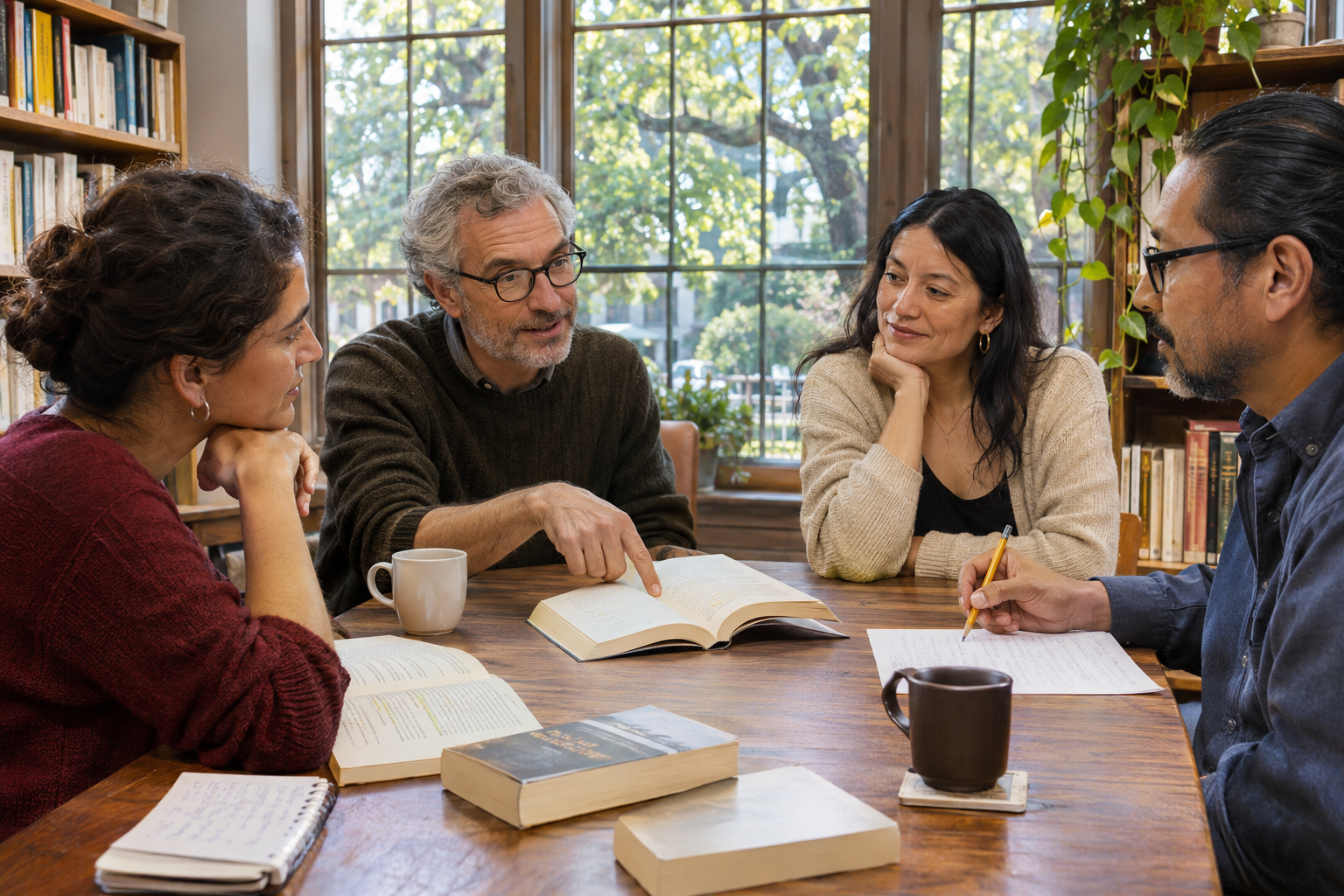
Everyone has finished the story. Someone asks, “What did you think?” Suddenly, the room gets very interested in its coffee.
The problem may have little to do with reading comprehension. An adult learner can understand what happened, have a strong opinion about it, and still struggle to find an opening sentence in Spanish. Meanwhile, the person who speaks most easily may be deciding what everyone talks about.
A good first reading group plans for that moment.
For adults organizing Spanish book discussions in Berkeley, a short story offers a manageable shared experience: something everyone can finish, reread, and disagree about. But choosing a short text is only half the work. The other half is making room for people to think aloud before their Spanish feels polished.
This four-meeting plan starts with a tiny story, spends two meetings with a second, and offers a more demanding third as an optional stretch. It suits a few friends meeting locally, classmates reading together, or an online group whose members live around the East Bay. No literature degree required. A willingness to return to the page helps considerably.
Choose for the conversation the story can sustain
A famous author’s name is a poor placement test.
So is page count. A one-page story may ask readers to identify an unnamed speaker, notice a shift in perspective, and understand an ending that quietly changes everything before it. A longer graded reader may be much easier to follow.
For a first group, choose a text that leaves members enough attention to form an opinion. If everyone spends the week decoding sentences, the meeting tends to become a translation workshop.
The original literary texts below are best approached by intermediate learners, often around B1–B2, with preparation and support. Those are planning estimates, not official level ratings. Confident readers may need little help; someone returning to Spanish after years away may want a glossary, audio, or a translation nearby.
An A2 group can use the same discussion structure with a graded reader written for that level. Choose a self-contained story with adult interests—an awkward decision, a misunderstanding, a secret—rather than assuming adults need children’s material because their Spanish is elementary. Complete beginners will generally benefit from more language preparation before attempting an independent literary discussion.
A useful trial: read the opening paragraph, then explain in simple Spanish who is present and what seems to be happening. If that is impossible even after a few essential lookups, choose an easier text or arrange guided reading.
The aim is a story people can discuss while still sounding like themselves.
A four-meeting Spanish short-story reading plan
Allow about an hour per meeting. For the longer selections, begin with two short preparation sessions during the week, perhaps 20 minutes each, and adjust after the first meeting.
MeetingReadingMain purpose1Augusto Monterroso, “El dinosaurio”Separate what the text says from what readers imagine2Ana María Matute, “El niño al que se le murió el amigo”Establish events and discuss one character’s response3Reread the same Matute storySupport an interpretation and respond to someone else4Julio Cortázar, “Continuidad de los parques,” if the group is readyTrack perspective and reconsider an initial reading
If the fourth selection would require too much help, substitute a level-appropriate story and repeat the familiar discussion format. A first month should establish a workable habit, not culminate in an endurance test.
Meeting 1: Start with what is missing
Monterroso’s “El dinosaurio” contains just seven words. Its brevity makes it easy to put the whole text in front of a group, but its omissions leave substantial work for the reader. The Instituto Cervantes has also used it as the basis for an adult language-learning activity. cvc.cervantes.es
Look for it in Monterroso’s collection Obras completas (y otros cuentos), then divide a page into two columns:
Lo que sabemos — What we know
Lo que imaginamos — What we imagine
Have everyone add one observation to each. The distinction matters: a plausible interpretation is still an interpretation.
Useful questions include:
¿Qué sabemos con seguridad? — What do we know for certain?
¿Qué información falta? — What information is missing?
¿Es la única explicación posible? — Is that the only possible explanation?
Accept modest language. No sabemos quién es—“We don’t know who it is”—can be a perfectly worthwhile contribution.
Finish by asking pairs to invent two different situations that could surround the story. Their task is to show how differently the same words might be understood.
Meeting 2: Read Matute without rushing toward a moral
Ana María Matute’s “El niño al que se le murió el amigo,” from Los niños tontos, concerns a child confronting the death of a friend. Agree on that subject before assigning it; a group may reasonably prefer a different selection. Spain’s public broadcaster, RTVE, provides a recorded reading through its LiterCast program. rtve.es
First establish the sequence of events. Then consider the child’s attachment to familiar objects and the mother’s response. The story’s concrete details give readers something to discuss before approaching its more elusive emotional meaning. resources.finalsite.net
Prepare three sentences:
Al principio… — At the beginning…
Después… — Then…
Al final… — At the end…
During the meeting, compare those summaries. Differences may reveal a missed detail, but they can also reveal what each reader considered important.
Then try one focused question:
¿Cómo interpretas la reacción de la madre? — How do you interpret the mother’s reaction?
Ask members to point to a detail before explaining their view. Avoid requiring anyone to connect the story to a personal bereavement. Discussion can remain attentive and emotionally serious without becoming autobiographical.
Meeting 3: Keep the story; change the task
Assign the Matute story again.
Rereading can feel suspiciously like insufficient homework to adults who measure progress by pages completed. Here, it creates room for a different kind of work. The plot is familiar, so more attention can go toward listening, phrasing an opinion, and responding to another reader.
Before meeting, everyone chooses one detail they now notice differently and prepares a sentence beginning:
En la primera lectura pensé…, pero ahora… — On the first reading I thought…, but now…
This time, skip the full plot summary. Begin in pairs, then ask each person to report something their partner said.
That small change prevents the discussion from becoming a series of unrelated speeches. It also gives quieter members a route into the larger conversation: someone has already listened carefully to their idea.
End by asking which question remains unresolved. The group does not need to agree before moving on.
Meeting 4: Try Cortázar when the group has room for difficulty
“Continuidad de los parques,” by Argentine writer Julio Cortázar, begins with a man reading a novel. Its handling of the boundary between the reader’s surroundings and the story he reads makes it especially rewarding to revisit. It also contains dense vocabulary and long sentences; its short length should not be mistaken for simplicity.
The story appears in Final del juego; Penguin Libros offers a publisher-hosted excerpt containing it.
For a prepared intermediate group, use two headings in the notes: the man reading, and the events in his novel. Mark changes in setting and perspective.
Discuss the ending only after everyone has read the whole story:
¿Qué detalle te hizo volver al principio? — What detail made you return to the beginning?
¿Cambió tu interpretación al releerlo? — Did your interpretation change when you reread it?
A facilitator can clarify difficult vocabulary beforehand. Keep explanations of the ending until the group has had time to develop its own reading.
If members are still struggling to express basic reactions, save Cortázar for later. The previous meetings have already provided a complete introduction to literary discussion.
Prepare one page, not a miniature dissertation
A useful preparation sheet contains four things: a brief summary, one interesting detail, one question, and a few words worth keeping.
That is enough.
On the first read, follow events and relationships. Mark an unknown word when it blocks understanding, then continue where possible. On the second, investigate the obstacles that matter.
A practical dictionary rule is to prioritize words that change who did what, reveal a character’s attitude, or recur. An unfamiliar object mentioned once may be less urgent than a common verb used in a surprising way. There is no virtue in misunderstanding a crucial sentence just to avoid looking something up.
Save vocabulary in a small phrase:
cambiar de opinión — to change one’s mind
darse cuenta de algo — to realize something
tener la impresión de que… — to have the impression that…
These are useful beyond the assigned story. A notebook full of obscure nouns can look impressive while offering very little help when someone asks for an opinion.
Translations can help resolve a difficult passage after an initial attempt in Spanish. Compare them selectively. Reading a published translation is useful support; copying its interpretation into discussion notes can make it harder to discover what the Spanish actually suggests.
The same applies to automated summaries. They may settle an ambiguity the author deliberately left open. Keep the story itself within reach.
Learn the phrases that let a thought enter the room
Literary discussion does not require literary-sounding speech.
An English speaker may have an elaborate interpretation in mind and then stall while trying to reproduce every qualification in Spanish. Often the better move is to divide the thought into two or three manageable sentences.
La madre parece práctica. Pero su respuesta también me parece fría. No sé si intenta ayudar.
The mother seems practical. But her response also seems cold to me. I don’t know whether she is trying to help.
The idea survives. The syntax can grow later.
Keep a few expressions visible during the meeting:
Spanish English
A mí me parece que… It seems to me that…
No me queda claro por qué… I’m not clear on why…
¿Qué te hace pensar eso? What makes you think that?
Yo lo entendí de otra manera. I understood it differently.
¿Te refieres a…? Do you mean…?
Necesito un momento para explicarlo. I need a moment to explain it.
He cambiado de opinión. I’ve changed my mind.
The ability to ask for thinking time deserves a place alongside the ability to express agreement. Otherwise, the fastest speaker can appear to have the strongest interpretation.
Notice, too, how certainty changes with a phrase:
El personaje está mintiendo. — The character is lying.
Me parece que el personaje está mintiendo. — It seems to me that the character is lying.
Both are grammatical. The second makes the speaker’s degree of certainty explicit and leaves a little more conversational space.
There is no need to force every newly learned structure into the discussion. A useful phrase becomes useful through repeated, appropriate use.
Give the hour a shape that protects thinking time
For a first group, four to six participants is a manageable starting size. Everyone should have time to speak without the meeting feeling like a sequence of presentations.
A simple 60-minute arrangement works well:
First 5 minutes: everyone offers one reaction or question.
Next 10 minutes: clarify essential events and language.
Next 10 minutes: discuss a focused question in pairs.
Next 25 minutes: compare interpretations as a group.
Final 10 minutes: revisit an unresolved point and choose a phrase to reuse.
The structure can loosen once members know one another. Initially, it helps prevent one difficult paragraph from consuming the evening.
Agree on correction before starting. A sensible default is to clarify errors that obstruct meaning immediately and save a few other recurring points for the end. Constant correction makes it difficult to finish a thought; no feedback at all may leave a learner’s actual question unanswered.
Allow brief English clarification when necessary, then help the speaker restate the essential point in Spanish. A rigid rule can produce silence where a small amount of support would produce another sentence.
For mixed groups, give confident speakers a worthwhile responsibility: ask follow-up questions, paraphrase someone else’s idea, and leave time for an answer. Heritage speakers and second-language learners may bring very different strengths in conversation, reading, and formal grammar. No member needs to serve as the group’s unpaid dictionary.
Bring cultural curiosity without making a story represent a country
Reading authors associated with different Spanish-speaking places can broaden a group’s sense of the language. It should also sharpen its sense of individual authorship.
A fictional mother’s response is evidence about that character in that story. It cannot establish how mothers throughout Spain respond to grief. Nor does an unsettling narrative device explain an entire national temperament.
A better cultural question is: What context would help us read this particular passage more carefully? Sometimes the answer involves a historical reference or regional expression. Sometimes the uncertainty comes from the writer’s style.
Distinguish literary narration from everyday conversation as well. The language surrounding a scene may be more elaborate than anything a person would say over lunch. Readers can appreciate it without adopting every phrase as conversational Spanish.
For the next reading cycle, broaden the selection deliberately. Ask a librarian, teacher, or bookseller about contemporary writers from Mexico, Central America, the Caribbean, or U.S. Latino communities, then assess the actual text for difficulty. Nationality does not supply a reading level.
Make the Berkeley part practical
For a local group, the most useful location is one where people can hear each other and comfortably occupy a table for an hour. Choose a quiet setting, confirm any venue arrangements, and select a repeatable meeting time.
Before fixing the reading dates, make sure everyone can obtain the text. Search by both author and story title; short fiction often appears inside a collection rather than as a separate catalog entry. Berkeley Public Library’s catalog guidance explains how to check availability and place holds. Ask library staff for help locating a Spanish-language edition, without assuming that a particular title or enough copies will be available. Berkeley Public Library
Agree on the same version wherever possible. An original, an abridgment, and a graded adaptation may differ substantially. With different editions, refer to an opening phrase or paragraph rather than relying entirely on page numbers.
This is a plan for arranging a discussion with other readers. Anyone seeking an existing Berkeley Spanish book club should check the organizer’s current schedule, expected proficiency, and reading requirements before attending.
Leave with something worth saying next time
After a first month, count more than finished stories. Did someone ask an unscripted question? Did a quieter reader disagree? Could members explain why they changed their minds?
Those are substantial achievements. They are also reasons to keep reading together.
For adults who would welcome more structured speaking practice alongside independent reading, Polyglottist Language Academy offers live language classes for adults, including online classes and selected in-person classes in Berkeley, California. Classes emphasize practical communication and understanding how the language is actually used. The current Spanish class listings are a useful place to explore formats and levels. Polyglottist Language Academy
The next story can wait until the group has decided what it wants to attempt. For now, it is enough to leave the table with a sentence that was difficult to say at the beginning of the hour—and another reader’s idea still in mind.