
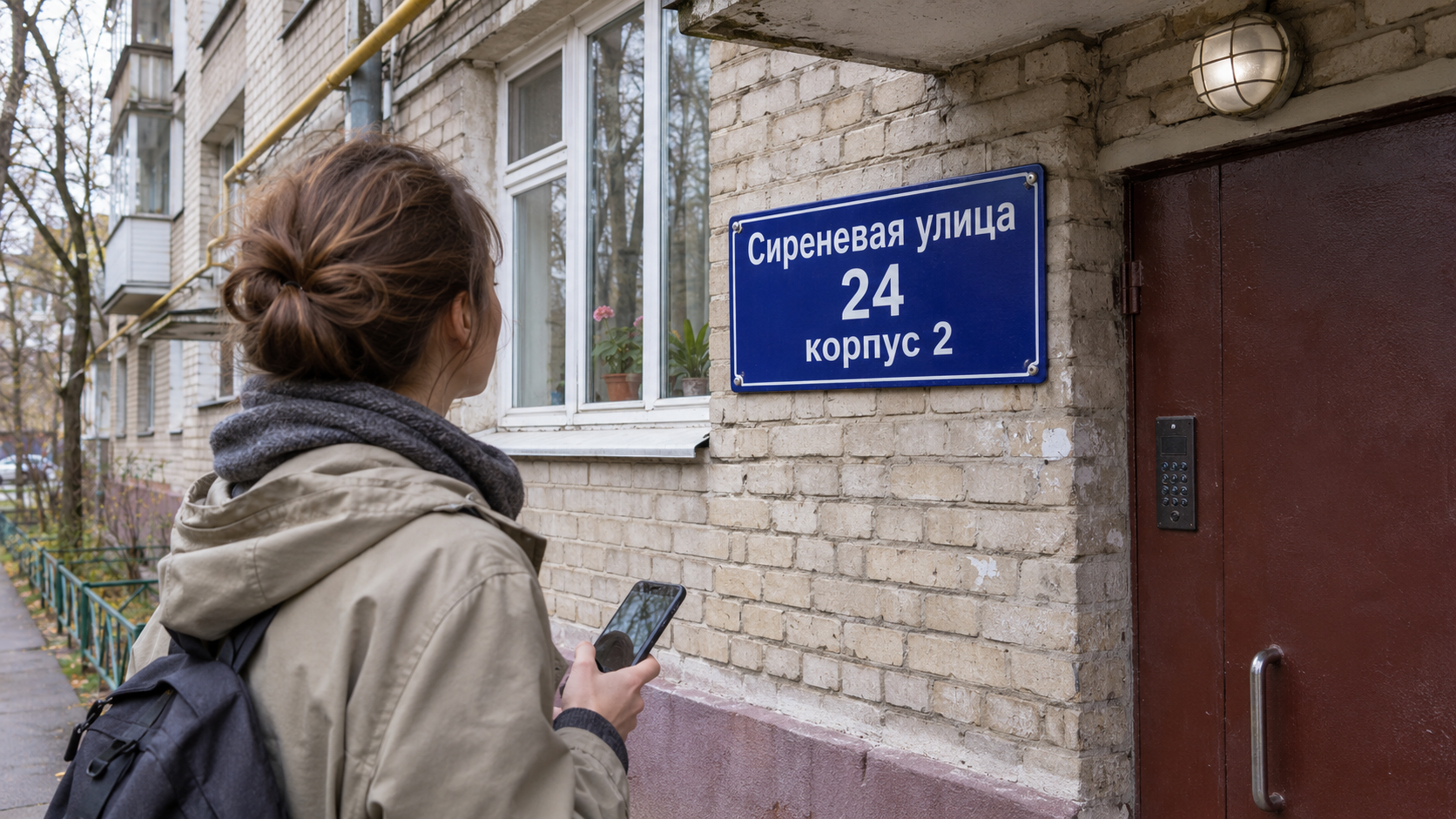
Your taxi stops at number 24. The number on the building matches the one in your message, but the person you’re meeting texts back Вы у второго корпуса? — “Are you at building two?” You look at the address again. Right after д. 24 is a small к. 2. You’ve made it to the right street and the right house number. There’s still one building to find.
That little к. is worth learning before you need it. A Russian address can contain several numbers, and the word or abbreviation next to each one tells you what to look for. Дом gets you to the main address number. Корпус, when it appears, narrows that down to a particular building or block. Квартира tells you which apartment to look for once you’re inside.
Read the labels before you read the numbers
Here’s a made-up example you might see in a message.
ул. Сиреневая, д. 24, к. 2, кв. 56
Read it as Сиреневая улица, дом двадцать четыре, корпус два, квартира пятьдесят шесть. In English, that’s Sirenevaya Street, number 24, building 2, apartment 56.
In the addressFull wordWhat it tells youул. Сиреневаяу́лица (úlitsa)The street is Sirenevaya.д. 24дом (dom)The main building or house number is 24.к. 2 or корп. 2ко́рпус (kórpus)Look for building or block 2 at that address.кв. 56кварти́ра (kvartíra)The apartment number is 56.
The abbreviations д., к., and кв. appear in the published Russian address standards. In a text or on a map, punctuation and spacing can be more compact. 24к2 is a form you may see for дом 24, корпус 2. Read the two numbers separately when saying it aloud. Russian address abbreviations
Улица is one of several street types
You may see the street type before or after the name. ул. Сиреневая and Сиреневая улица identify the same street in the example above. The type matters when you’re copying an address. Улица is a street, переулок is a lane, проспект is an avenue, and набережная is an embankment or waterfront road. A name alone can leave you with more than one search result, especially if the city is missing too.
Keep the street name in Cyrillic when you can copy it directly into a map. If someone sends you Сиреневая, search that spelling. Transliteration is useful when you’re reading aloud or filling in a Latin-script form, but it adds a step when you already have the name the map is likely to display.
Дом can be an apartment building
Outside an address, дом can mean “house” or “home.” On an address label, дом 24 simply gives you the number assigned to the building or main address. It could be a detached house or a large apartment building. If a host says дом двадцать четыре, look for the number. The word itself tells you little about what the building will look like.
Корпус and строение can send you to different doors
Think of корпус as “building” or “block” in this context. Several apartment blocks might share the base number 24, with each корпус identified separately. The map pin for 24 may leave you short of the door at 24к2. If the address includes a корпус, search for the full number and compare it with the building sign when you arrive.
You’ll also see строе́ние (stroyéniye), often written стр., especially in addresses for places within a larger property. д. 24, стр. 2 reads дом двадцать четыре, строение два. The English word “building” can translate both корпус and строение, which is exactly why translating the address can hide a useful distinction. Preserve the Russian label in the map search or when passing the address to a driver. Moscow’s house-sign guidance treats the two as separate labels and specifies that the words be written out on the signs it covers. Moscow house-number signage guidance
A letter or slash belongs to the address too. Copy 24А with its letter and 24/2 with its slash. If a message just says “24, building 2” and the map turns up several plausible pins, ask Это корпус два или строение два? — “Is that korpus two or stroyeniye two?”
Квартира tells you the apartment. Подъезд tells you where to go in.
Once you’ve found the right building, you may still be facing several identical entrances. That’s when подъе́зд (pod-yézd) becomes more useful than the street name. In an apartment building, it means the entrance or stairwell serving a group of apartments. A host might send the directions in a second message.
Второй подъезд, пятый этаж. На домофоне наберите 56.
Entrance two, fifth floor. Dial 56 on the intercom.
Эта́ж means floor, and домофо́н is the entry intercom. A sign beside an entrance may list a range of apartment numbers. If the sign reads кв. 41–80, apartment 56 falls in that range. If you can’t see the numbers, Какой подъезд? (“Which entrance?”) will usually get you a more useful answer than repeating the whole address.
The same address calls for different details depending on who needs it. A taxi driver needs the right building and a sensible place to stop. A courier coming to your door may also need the entrance, floor, and intercom instructions. If you’re meeting either one outside, Я буду у второго подъезда means “I’ll be by entrance two.”
A postal address and a map search have different jobs
In a booking confirmation or a map, the city can appear first. In Russian Post’s mailing guidance, the recipient’s name comes first, followed by the street and building details, then the locality and other geographic details as applicable. A Russian postal code, почто́вый и́ндекс, has six digits. For an actual mailing, use the recipient’s complete address and the format your carrier asks for. The Universal Postal Union publishes examples for both large cities and regional addresses. Russian Post addressing guide · Universal Postal Union address examples
For a map search, start with the city, street, and full building number, including any корпус, строение, letter, or slash. Keep the apartment and entry instructions handy for when you arrive. If a form has no separate field for корпус, look for a second address line or another building field that lets you retain the detail. Ask the carrier how to enter it if the form won’t accept the full number.
The two questions worth practicing out loud
Recognizing к. 2 on a screen is one thing. Asking for it while you’re standing outside takes a different kind of practice. These two questions cover the moment when you’re close enough to see the building numbers and still unsure where to go.
Извините, где второй корпус? — Excuse me, where’s building two?
Какой подъезд нужен? — Which entrance do I need?
You may hear во дворе (“in the courtyard”) or со стороны улицы (“on the street side”). Even if the rest of the reply goes by too fast, catching one of those phrases can tell you whether to walk around the building or stay where you are. That’s a satisfying moment in learning Russian. A few words you can hear and act on are enough to get you the rest of the way.
We practice exchanges like these at Polyglottist Language Academy, where live Russian classes for adults focus on using the language in everyday situations. Explore online and selected in-person Russian classes in Berkeley, California.