
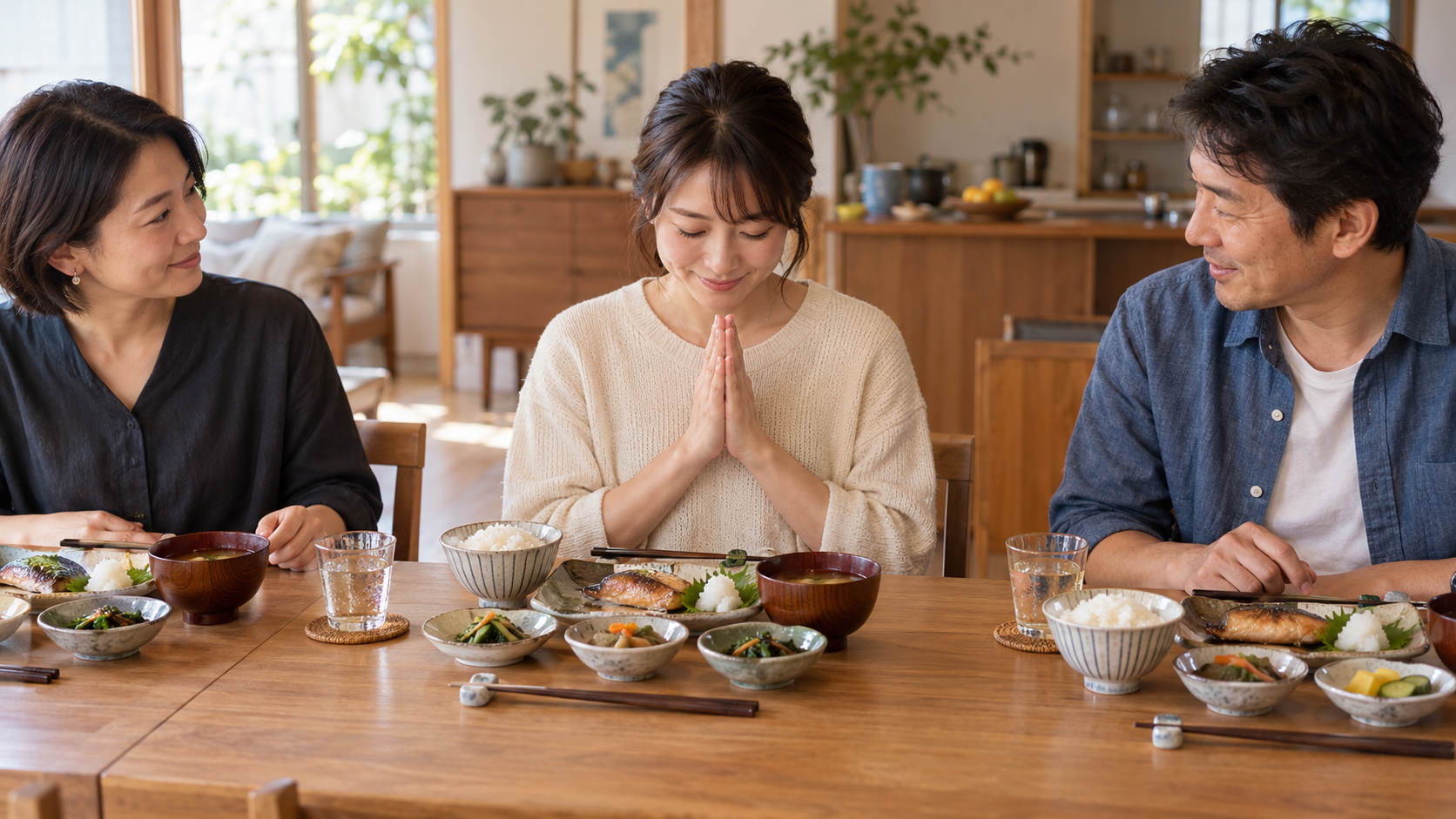
A Japanese meal often begins before anyone takes a bite.
Someone says いただきます (itadakimasu). Chopsticks are picked up. Shared dishes may be passed around. There is an order to things, but most of it is less rigid than visitors imagine.
Japanese dining etiquette has a reputation for being complicated because people tend to encounter it as a list of warnings:
Do not stick chopsticks upright in rice.
Do not pass food from chopsticks to chopsticks.
Do not pour your own drink.
Do not eat while walking.
Do not do this. Do not do that.
Some of those rules matter. Others are situational. And many make much more sense when understood as part of a broader idea: a meal is a shared social space, and good manners reduce discomfort for everyone at the table.
For travelers and Japanese learners, that is more useful than memorizing twenty isolated prohibitions.
Before eating: what does itadakimasu actually mean?
One of the first expressions Japanese learners encounter around food is:
いただきます
itadakimasu
It is commonly translated as “Let’s eat” or “Thank you for the food.”
Neither translation is quite complete.
The verb いただく (itadaku) is a humble form meaning “to receive.” Before a meal, itadakimasu acknowledges receiving the food and, more broadly, the effort and life involved in producing it.
In ordinary use, nobody needs to give a philosophical speech about this every time they eat lunch.
People simply say:
いただきます。
Then they begin.
At home, children learn it early. At school lunches, everyone may say it together. At restaurants, people may say it quietly before eating.
If you are eating with Japanese people, saying itadakimasu is natural and appreciated.
Do you always have to say itadakimasu?
No one is likely to stop a foreign visitor for forgetting.
It is also not always performed ceremonially.
At a casual restaurant, a person might simply say it quietly while picking up chopsticks. In a group, one person may say it clearly and everyone else follows.
The important thing is not to turn it into a performance.
A simple:
いただきます。
Itadakimasu.
is enough.
Wait until everyone has their food, unless someone tells you not to
In many Japanese dining situations, it is polite to wait until everyone is served before starting.
But there are exceptions.
Some dishes are best eaten immediately. Ramen, tempura, grilled food, and other hot dishes can suffer if left sitting.
If one person's food arrives first, others may say:
先にどうぞ。
Saki ni dōzo.
“Please go ahead.”
or:
先に食べて。
Saki ni tabete.
“Go ahead and eat first.”
If someone tells you to start, start.
Letting excellent tempura go cold in the name of etiquette is not especially polite.
Chopsticks are where most visitors become nervous
Japanese chopstick etiquette gets more attention than almost any other dining custom.
The good news is that most mistakes are minor.
No one expects a visitor to handle chopsticks with perfect elegance.
A few habits are worth knowing because they have strong cultural associations.
Do not stick chopsticks upright in rice
This is probably the most important chopstick rule for visitors to remember.
Placing chopsticks vertically into a bowl of rice resembles a practice associated with Buddhist funeral rites.
So when resting your chopsticks, place them on the chopstick rest if one is provided.
If there is no rest, use the edge of your plate or the paper wrapper in a way that keeps them tidy.
Do not leave them standing upright in the rice.
Do not pass food directly from chopsticks to chopsticks
This also has a funeral association.
After cremation in Japan, family members traditionally use chopsticks to transfer bone fragments.
Because of that, passing food from one person's chopsticks directly into another person's chopsticks is avoided.
If you want to give someone food, place it on their plate.
This is one of those rules that initially seems arbitrary until the cultural context is understood.
Do not point with chopsticks
Chopsticks should not become miniature conducting batons.
Avoid using them to point at people or objects.
Likewise, waving them around while talking looks careless.
Set them down if the conversation becomes animated.
Do not spear food unless there is a practical reason
Beginners sometimes stab slippery pieces of food with a chopstick.
That is generally not the intended technique.
Use the chopsticks to pick food up.
That said, Japanese dining is not an etiquette competition. If something genuinely difficult is falling apart, nobody benefits from watching it launch across the table.
Do not hover over every dish deciding what to choose
There is even a term for moving chopsticks indecisively over dishes:
迷い箸
mayoi-bashi
literally, “wandering chopsticks.”
It is considered poor manners to hover repeatedly over shared food while deciding what to take.
Choose first, then reach.
This is the kind of rule most visitors do not need to obsess over, but it reveals something about Japanese table manners: unnecessary fuss and disruption are often what etiquette tries to prevent.
What about rubbing disposable chopsticks together?
Disposable wooden chopsticks sometimes have rough edges.
Visitors may instinctively rub them together after separating them.
This can imply that the chopsticks are cheap or poorly made.
At a very casual restaurant, nobody is likely to be devastated by it, but it is better to avoid the habit.
Separate them cleanly and use them.
How to eat from shared dishes
Japanese meals often include multiple dishes shared among the table.
In casual family settings, people may simply take food with their own chopsticks.
In more formal situations, serving utensils may be provided.
Sometimes people reverse their chopsticks and use the clean ends to take shared food.
You will occasionally hear this recommended as formal etiquette, but it is not a universal rule and can itself feel awkward depending on the setting.
The easiest approach is to follow the table.
If serving chopsticks are provided, use them.
If everyone is casually using their own chopsticks, you usually do not need to invent a more formal system.
Small bowls are often lifted
One difference between Japanese and much Western table etiquette is that certain small bowls are meant to be picked up.
A rice bowl is commonly held in one hand while eating.
A small soup bowl may also be lifted directly to the mouth.
This is normal.
Bending your entire upper body down toward a bowl while leaving it on the table can actually look less graceful.
Larger plates and bowls generally remain on the table.
Drinking miso soup without a spoon is normal
Miso soup is often served without a spoon.
Lift the bowl with both hands or one hand and drink the broth directly from it.
Use chopsticks for pieces of tofu, seaweed, or other solid ingredients.
To visitors accustomed to soup spoons, this can feel unusual the first time.
In Japan, it is entirely ordinary.
Slurping noodles is not the etiquette disaster Americans expect
Western children are often taught that slurping is rude.
In Japan, slurping noodles is common and socially acceptable.
With ramen, soba, and udon, you may hear quite a lot of it.
Does that mean visitors should force themselves to slurp loudly?
No.
You are not required to imitate anyone.
But do not assume the person next to you is being rude.
Slurping can help cool hot noodles and brings air into the mouth while eating.
It is simply not coded as impolite in the same way it often is in the United States.
Do not be afraid to make some noise with noodles
Trying to eat ramen in absolute silence can become surprisingly difficult.
The point is not to create theatrical noise.
The point is that the sound itself is not something you need to suppress obsessively.
Japanese dining etiquette is full of these reversals. Behavior that seems informal in one culture may be perfectly acceptable in another.
Soy sauce has its own etiquette
At sushi restaurants, visitors sometimes fill a small dish with far more soy sauce than they can use.
A better approach is to pour a small amount and add more if necessary.
Wasting food and condiments is generally discouraged.
With nigiri sushi, it is also common to dip the fish side rather than soaking the rice in soy sauce.
This prevents the rice from absorbing too much liquid and falling apart.
At some high-end sushi restaurants, the chef has already seasoned the sushi appropriately.
In that case, additional soy sauce may not be necessary at all.
Sushi can be eaten with your hands
This surprises many visitors.
Nigiri sushi may traditionally be eaten either with chopsticks or with the fingers.
Both are acceptable.
Sashimi, however, is normally eaten with chopsticks.
You do not gain extra cultural points for struggling to pick up a delicate piece of nigiri with chopsticks if using your hand would be easier.
Ginger is not a sushi topping
The thin slices of pickled ginger served with sushi are called:
ガリ
gari
They are intended primarily as a palate cleanser between different pieces.
They are not normally piled on top of each piece of sushi like another condiment.
Again, nobody is likely to intervene if you do this, but it changes the intended balance of flavors.
Wasabi is not always meant to be mixed into soy sauce
At casual restaurants, people sometimes mix wasabi into soy sauce.
But this is not necessarily the preferred way to eat high-quality sushi or sashimi.
With nigiri, the chef may already place wasabi between the fish and rice.
For sashimi, a small amount can be placed directly on the fish before dipping.
Japanese dining etiquette often becomes more relaxed in casual restaurants and more restrained as the setting becomes more specialized.
The restaurant itself tells you a lot about what is expected.
Eating ramen has its own rhythm
Ramen etiquette is relatively relaxed.
The main expectation is practical: eat it while it is hot.
The noodles continue cooking in the broth and become softer as they sit.
So ramen is not usually a meal to linger over for ninety minutes.
You can lift noodles with chopsticks, slurp if comfortable, and use the spoon for broth.
Picking up the bowl to drink the remaining broth is also common, though finishing every drop is not required.
And there is no cultural requirement to finish the broth.
That may be reassuring after seeing how much salt is in some bowls of ramen.
Saying oishii is useful, but do not overperform it
A common Japanese word for delicious is:
おいしい
oishii
At dinner with friends or family, saying:
おいしい!
Oishii!
is completely natural.
Another casual expression is:
うまい
umai
which can mean “delicious” or “good,” though it is more informal and its tone varies by speaker.
Visitors sometimes learn oishii and then say it dramatically after every bite.
That can start sounding like a television food program.
A genuine compliment once or twice is enough.
What do you say when someone serves you food?
A simple:
ありがとうございます。
Arigatō gozaimasu.
“Thank you.”
works perfectly well.
At someone's home, you might also compliment the food naturally.
For example:
とてもおいしいです。
Totemo oishii desu.
“It’s very delicious.”
or simply:
おいしいです。
Oishii desu.
“It’s delicious.”
Sincerity is more important than elaborate vocabulary.
Drinking etiquette can be more formal than food etiquette
At dinners involving alcohol, especially business dinners, there may be more attention to who pours for whom.
Traditionally, people pour drinks for one another rather than only serving themselves.
If someone pours for you, you may hold your glass slightly.
You can then return the gesture when appropriate.
In formal professional settings, seniority may influence the order and manner of pouring.
Among close friends, these rules can become much more relaxed.
Modern Japan is not frozen in a business-etiquette manual from 1985.
Watch the people around you.
What do people say before drinking?
A group will often raise glasses and say:
乾杯!
Kanpai!
“Cheers!”
At a group dinner, it is usually better to wait for the first toast before drinking.
Once everyone says kanpai, begin.
This is especially true at work dinners, parties, and celebrations.
You do not have to drink alcohol
Japan has a strong social drinking culture in some settings, but nobody should assume that drinking is mandatory.
If you do not drink, you can simply say:
お酒は飲みません。
Osake wa nomimasen.
“I don't drink alcohol.”
or:
お酒は飲めません。
Osake wa nomemasen.
“I can't drink alcohol.”
The second can imply inability or a personal limitation.
You can still participate in the toast with a nonalcoholic drink.
At someone's home, bringing a small gift is thoughtful
If invited to a Japanese home, bringing a small gift is a good idea.
This is often called:
手土産
temiyage
A box of sweets, fruit, or another modest specialty is common.
The gift does not need to be expensive.
In fact, an excessively expensive gift can create discomfort because it may make the host feel obliged to reciprocate.
Presentation matters.
Nicely packaged food is especially common because it can be shared and does not create permanent clutter.
Shoes come off before the dining room in many homes
This is not strictly dining etiquette, but it matters if you are eating in someone's home.
Shoes are normally removed at the entrance, in the genkan (玄関).
Do not step onto the raised interior floor wearing outdoor shoes.
The host may provide slippers.
If there is a tatami room, slippers are usually removed before stepping onto the tatami.
This is one of the few household customs visitors should try to get right because the distinction between outside and inside space is culturally significant.
Sitting on tatami is less rigid than it looks
Traditional meals may involve sitting on tatami around a low table.
The formal kneeling position is called:
正座
seiza
with the legs folded underneath the body.
For people unaccustomed to it, seiza can become painful quickly.
Foreign guests are generally not expected to spend an entire meal suffering silently.
In casual situations, sitting cross-legged or adjusting your position is usually fine.
Follow the host and use common sense.
Good manners do not require losing circulation in both feet.
What should you do if you cannot eat something?
This comes up often for travelers with allergies, religious restrictions, or dietary preferences.
Japanese food can contain ingredients that are not visually obvious, including fish stock, soy, shellfish, and alcohol-based seasonings.
Useful expressions include:
これは何が入っていますか。
Kore wa nani ga haitte imasu ka?
“What is in this?”
エビは入っていますか。
Ebi wa haitte imasu ka?
“Does this contain shrimp?”
魚は食べられません。
Sakana wa taberaremasen.
“I can't eat fish.”
For a serious allergy, it is better to state that clearly rather than trying to be excessively polite.
Etiquette should never override health.
Do you have to finish everything?
Finishing what you take is generally appreciated.
Wasting food is discouraged.
But that does not mean you should force yourself through an enormous portion because leaving a spoonful would create an international incident.
At buffets and shared meals, take modest portions first.
You can always take more.
This is both good etiquette and good strategy.
Paying at restaurants works differently than many Americans expect
Tipping is generally not customary in Japan.
At most restaurants, you pay the amount on the bill.
Leaving additional money on the table can cause confusion.
In many restaurants, the bill is brought to the table and payment is made at a register near the exit.
At others, especially newer or more casual businesses, payment may happen through a tablet or automated machine.
Cash is still useful in Japan, although card and contactless payment have become much more common.
Splitting the bill is possible, but context matters
Among friends, dividing the bill is common.
One phrase you may hear is:
割り勘
warikan
splitting the bill.
But people do not always calculate every person's consumption with perfect precision.
Groups may divide the total evenly.
At business meals, the senior person or host may pay.
If someone insists on treating you, a polite initial protest may be normal, but endless resistance can itself become awkward.
Accept graciously.
You can reciprocate another time.
After eating: gochisōsama deshita
The expression said at the end of a meal is:
ごちそうさまでした
gochisōsama deshita
This is often translated as:
“Thank you for the meal.”
That captures the practical meaning well.
It acknowledges the food and the person or people responsible for it.
You can say it after eating at someone's home.
You can also say it while leaving a small restaurant.
At a counter restaurant, a customer may say:
ごちそうさまでした。
to the staff while heading out.
It is a small phrase, but using it naturally can make an interaction feel noticeably warmer.
Itadakimasu and gochisōsama are not really prayers
Visitors sometimes compare itadakimasu to saying grace.
There is a similarity in that both occur around meals and express gratitude.
But itadakimasu is not ordinarily a religious prayer.
It does not require belief in a particular faith.
Likewise, gochisōsama deshita is not a ritual blessing.
Both are deeply ordinary expressions built into everyday Japanese eating culture.
That ordinariness is part of what makes them interesting.
Convenience stores and casual meals are still real meals
Visitors sometimes become so focused on traditional etiquette that they forget how ordinary people actually eat.
Japan contains formal kaiseki restaurants, tea ceremony traditions, sushi counters, and carefully structured meals.
It also contains office workers eating convenience-store rice balls at lunch.
A teenager eating fried chicken outside a train station does not consult an etiquette guide first.
Context changes everything.
The manners expected at a formal dinner with a business partner are not identical to those at a ramen shop.
The best travelers learn a few important rules and then observe.
The biggest mistake is trying too hard
Japanese etiquette has become part of Japan's international image, which sometimes makes visitors nervous.
They enter restaurants worried about every chopstick movement.
Was that bowl lifted correctly?
Did I bow enough?
Was I supposed to say something before the first sip?
This anxiety is mostly unnecessary.
Japanese people do not expect foreign visitors to arrive with perfect knowledge of local customs.
What matters much more is obvious consideration.
Watch what others are doing.
Do not make a mess.
Do not disrupt other diners.
Treat staff politely.
Ask when genuinely unsure.
The same principle works in almost every culture.
Dining vocabulary that is actually worth knowing
A handful of expressions will take you a long way.
いただきます。
Itadakimasu.
Said before eating.
ごちそうさまでした。
Gochisōsama deshita.
Said after eating.
おいしいです。
Oishii desu.
“It’s delicious.”
乾杯!
Kanpai!
“Cheers!”
これをください。
Kore o kudasai.
“This one, please.”
おすすめは何ですか。
Osusume wa nan desu ka?
“What do you recommend?”
これは何ですか。
Kore wa nan desu ka?
“What is this?”
お会計お願いします。
Okaikei onegai shimasu.
“The bill, please.”
None of these is difficult.
More importantly, each belongs to a situation you are genuinely likely to encounter.
Japanese dining etiquette is really about reading the setting
A sushi counter, an izakaya, someone's home, a company dinner, and a ramen shop are all Japanese dining environments.
They do not operate according to identical rules.
That is why a list of “Japanese table manners” can only take a learner so far.
The deeper skill is noticing context.
Is everyone waiting before eating?
Are people sharing food?
Are drinks being poured for others?
Are diners eating quickly or lingering?
Are shoes coming off?
Is the restaurant formal or casual?
Japanese culture often rewards this kind of situational awareness. Dining is no exception.
At Polyglottist Language Academy, our Japanese classes for adults connect vocabulary and grammar with the settings where people actually use them. Polyglottist offers live online Japanese classes as well as selected in-person classes in Berkeley, California, with an emphasis on practical communication and cultural understanding.
Knowing itadakimasu and gochisōsama deshita takes only a few minutes.
Understanding why people say them, when the rules relax, and how to behave without turning dinner into an etiquette examination takes a little longer.
That is also when the meal becomes more enjoyable.
Frequently asked questions about Japanese dining etiquette
Is it rude to slurp noodles in Japan?
No. Slurping ramen, soba, and udon is common and socially acceptable. You do not have to slurp deliberately, but you do not need to eat noodles silently either.
Should I say itadakimasu at a restaurant?
You can. It is commonly said before eating at home and in restaurants, often quietly. Foreign visitors are not expected to perform it ceremonially.
Can I eat sushi with my hands?
Yes. Nigiri sushi can traditionally be eaten either with chopsticks or with the fingers. Sashimi is normally eaten with chopsticks.
Is tipping rude in Japan?
Tipping is generally not expected at ordinary Japanese restaurants. Pay the amount shown on the bill unless the business specifically has a different system.
Is it rude to leave food on the plate?
Avoid unnecessary waste and take modest portions when serving yourself. You do not need to force yourself to finish an unreasonable amount of food.
Why should chopsticks not be placed upright in rice?
The arrangement resembles a practice associated with Japanese Buddhist funeral rites, so it is avoided during ordinary meals.
What should I say after a meal in Japan?
Say:
ごちそうさまでした。
Gochisōsama deshita.
It expresses appreciation for the meal and is appropriate at someone's home and in many restaurant situations.