
The Complete Guide to Bowing in Japan: When, How Deep, and What It Means
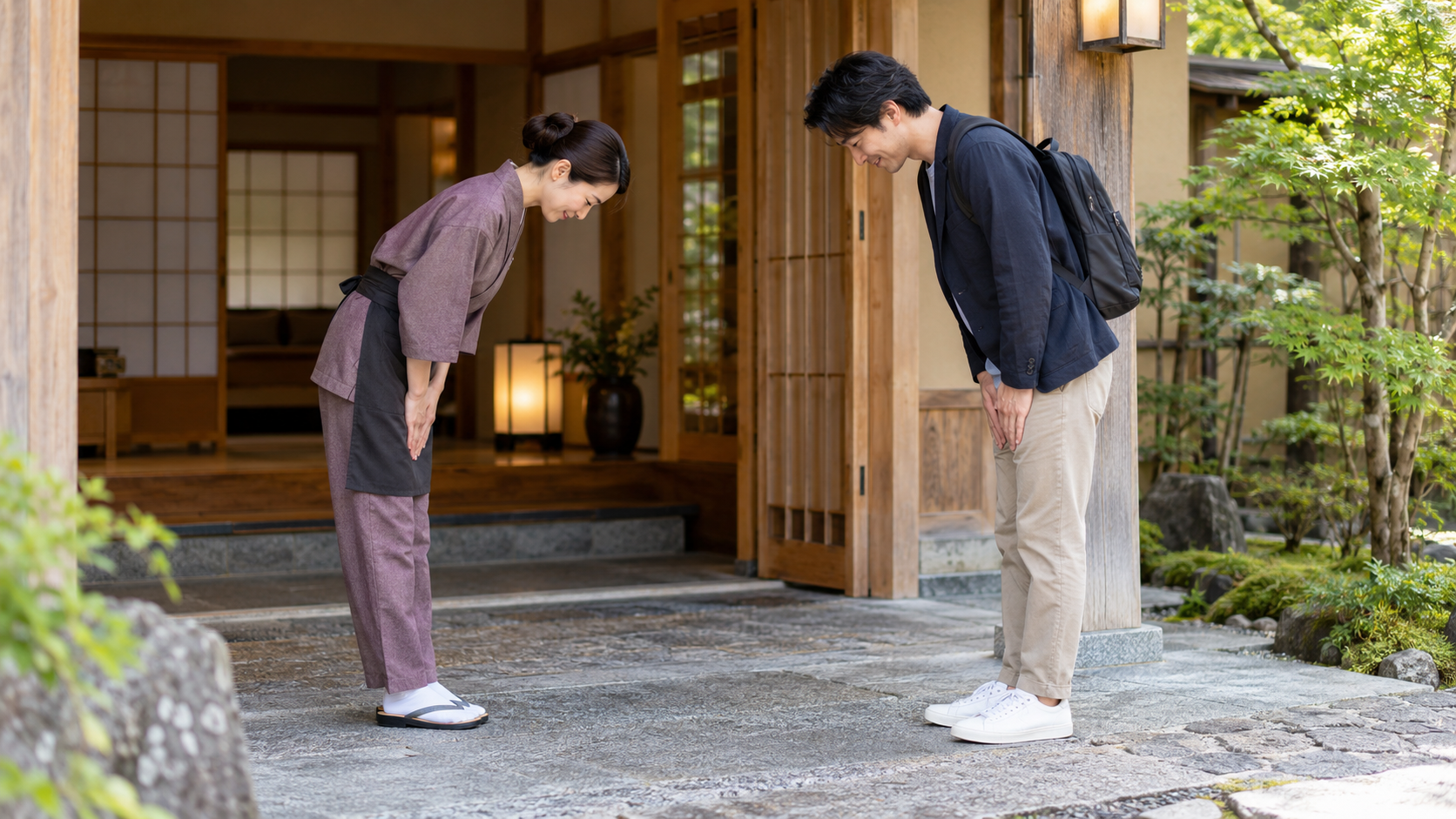
An American businessman meets his Japanese counterpart in a Tokyo conference room for the first time. Instinct takes over, and he extends his right hand. The Japanese executive pauses for a fraction of a second, then reaches out to shake—while his upper body simultaneously dips forward. The result is a slightly awkward hybrid gesture that exposes the central confusion most foreigners have about bowing in Japan: they know they're supposed to bend, but they don't know when, how far, or how to reconcile it with the handshake they've been doing their whole lives.
In Japan, bowing is not simply a greeting. It is a complete nonverbal communication system that encodes social relationships, the formality of the occasion, and even the speaker's psychological state. What's counterintuitive is that this highly formalized system exists precisely because it's practical. In a society that places enormous weight on hierarchical relationships, the bow offers a way to confirm each person's position without saying a word.
Three Angles, Three Social Grammars
The bows Japanese people actually use day to day fall into roughly three tiers. Understanding the differences between them is more useful than memorizing any etiquette manual.
Eshaku (会釈) — the casual bow, around 15 degrees. This is the most common. It's what you use when passing a colleague in the hallway, running into a neighbor in the elevator, or accidentally bumping someone on a crowded train. The gaze falls somewhere around the other person's waist. The key quality here is lightness—it's not dismissive, but it signals "I've noticed you, and this doesn't need to be a big production."
Keirei (敬礼) — the standard bow, around 30 degrees. This is the workhorse of business settings. Greeting a client, exchanging business cards, introducing yourself, entering or leaving a meeting room—this is the angle for all of it. The gaze lands near the other person's knees. One useful feature of the 30-degree bow is its adjustability: if the other person bows first or deeper, you can shift to match or slightly exceed them without looking theatrical.
Saikeirei (最敬礼) — the deepest bow, 45 degrees or more. This is the highest level of deference, reserved for profound gratitude, sincere apology, or addressing someone of significantly higher status in a very formal context. The gaze drops toward your own feet. Those images of corporate executives bending deeply at scandal press conferences—that's this.
These angles are not precise science. Japanese people themselves don't pull out protractors. Many bow shallower than they think—someone who believes they're doing a 30-degree bow is often bending only about 20. A practical rule: go slightly deeper than you think you need to.
The Breathing Rhythm Matters More Than the Angle
Here's something most guides for foreigners skip entirely: what makes a bow look utsukushii (美しい, beautiful) is not the angle but the rhythm.
The traditional approach follows a principle called rei sansoku (礼三息)—three breaths for one bow. You inhale as you bend, exhale at the deepest point, hold for a beat, then inhale again as you rise. This rhythm ensures the bow isn't a mechanical bob but a complete action with a beginning, middle, and end.
There's something deeper in what happens after you straighten up. A well-trained bower holds brief eye contact after rising—a detail rooted in martial arts tradition called zanshin (残心), literally "remaining heart." The idea is that respect shouldn't end the moment your body returns to vertical; it should linger.
Many Japanese people don't consciously know this tradition. Schools often teach simplified versions like "bow and count to three in your head." But understanding the breathing logic underneath makes your bow feel more natural—and, more importantly, it helps explain why some bows read as sincere while others look like someone simply completing a motion.
Where Your Hands Go Determines the "Style" of the Bow
Hand placement during a bow is an easily overlooked detail with an outsized effect.
In general business settings, men typically keep both hands relaxed at their sides, fingers straight. Women may bring their fingertips lightly together in front of their thighs. A common mistake is crossing your arms in front of your body—this makes the bow look defensive rather than respectful.
Staff at hotels, upscale restaurants, and department stores use a distinctive style: hands folded together in front of the abdomen. This is common in modern Japanese service culture, but its history is younger than many assume—some trace it to service etiquette reforms at the predecessor of Mitsukoshi department store, making it a relatively modern "invented tradition."
One misconception worth clearing up: placing your palms together in front of your chest (like the Thai wai) is not how you bow in greeting in Japan. That gesture is used before meals (*itadakimasu*) or when visiting a shrine. Using it to greet a person would confuse most Japanese people.
The Handshake Dilemma: When Two Body Languages Collide
For visitors from handshake cultures, the most awkward moments tend to arrive when the other person extends a hand while your body instinctively wants to bow.
Japanese people are generally tolerant of foreigners' handshaking habits. Most who deal with international visitors expect a hand might be extended and rarely take offense if no bow is offered. Japan's official tourism guidance explicitly notes that visitors are more likely to receive bows than to be expected to initiate them.
But there's one error to avoid absolutely: do not shake hands and bow at the same time. The combination is physically awkward—a handshake calls for eye contact, while a bow directs the gaze downward. When President Obama attempted both with Emperor Akihito in 2009, it drew criticism in both Japanese and American media as neither a proper handshake nor a proper bow.
If you're unsure what to do, a reliable strategy is to wait. Let the other person make the first move. If they extend a hand, shake it. If they bow, respond with a slight nod or a shallow bow. In purely formal business settings, Japanese people typically bow; in international contexts, they tend to adjust based on your response.
The Bow That Persists When No One Is Watching
One detail reveals how deeply bowing is embedded in Japanese culture: many Japanese people bow unconsciously while talking on the phone.
The person on the other end can't see it, of course. But the habit is so ingrained that even the most rational person will dip their head slightly when saying mōshiwake gozaimasen (申し訳ございません, "I am truly sorry"). These phone bows rarely exceed a slight nod, but they happen.
This phenomenon points to an important cultural logic: bowing isn't only "for show." The Japanese word for bow, ojigi (お辞儀), contains the character ji (辞), which carries connotations of "yielding" or "stepping back." The physical act of bending is understood as the externalization of an internal attitude—even when no one is watching, the gesture confirms to yourself that a certain social relationship exists.
## When Not to Overthink It
For most travelers and beginners, the single most useful piece of advice about bowing might be this: don't overthink it.
Japan's tourism authorities and multiple etiquette guides repeat the same point: most Japanese people don't expect foreigners to master the precise rules of bowing. A friendly nod, a konnichiwa (こんにちは, hello), and an appropriate smile will carry you through the vast majority of daily situations.
In shops, staff will bow to you and say irasshaimase (いらっしゃいませ, welcome). You don't need to return an equal bow—a smile and a nod are perfectly fine. When receiving change, the cashier will bow slightly; you can respond with a similar shallow bow or a simple arigatō gozaimasu.
The occasions that genuinely call for careful attention are formal business meetings, meetings with elders, and any moment when you want to express particular respect. In those situations, remember one simple principle: the higher the other person's status, the older they are, and the more formal the relationship, the deeper, slower, and more deliberate your bow should be.
The Point Is the Relationship, Not the Angle
The angle chart is easy to memorize, and it's easy to walk away feeling like you've "learned" bowing. But anyone who has spent time in Tokyo eventually notices that everyday bowing is far more flexible and subtle than the 15-30-45 formula suggests.
A colleague's nod in the hallway might be five degrees. A delivery worker handing over a package at the door might bow less than ten degrees, but quickly. A shop clerk might bow as you leave even when your back is already turned. These small variations aren't taught in textbooks; they're absorbed through observation and immersion.
For anyone wanting to genuinely understand Japanese language and culture, bowing offers an excellent entry point. It reminds us that language isn't just vocabulary and grammar, and culture isn't just festivals and food. The small, repeated physical gestures often encode a society's deepest values.
Polyglottist Language Academy offers live Japanese classes for adults, including online courses and selected in-person sessions at our Berkeley, California location. Our classes focus on practical communication and include the cultural details that textbooks tend to skip—the things you actually need in real situations. If you'd like to practice Japanese in context rather than just memorizing word lists, you might take a look at our Japanese class schedule.
Frequently Asked Questions
Can you shake hands and bow at the same time?
It's not recommended. Handshaking and bowing involve different gaze directions and body postures, and combining them looks awkward and insincere. Choose one, or shake hands and then add a slight nod.
Will Japanese people be offended if a foreigner bows incorrectly?
Generally, no. Most Japanese people are forgiving about foreigners' bowing etiquette. The key isn't angle precision but a willingness to show respect. A sincere shallow bow is better than a perfunctory deep one.
Should you make eye contact while bowing?
The gaze typically drops during the bow—direct eye contact while bending can read as aggressive in Japanese culture. After straightening up, a brief glance before looking away is appropriate.
Why do Japanese people bow when talking on the phone?
It's an internalized habit. Bowing is so deeply ingrained that many people unconsciously dip their heads when expressing apology or gratitude, even when the other person can't see them. The motion is usually slight, closer to a nod.
When is the 45-degree bow (saikeirei) actually used?
Mainly for deep apology, sincere gratitude, or addressing someone of clearly higher status in a very formal setting. In everyday business, the 30-degree keirei is sufficiently polite—you don't need to go to 45 degrees every time.
What is dogeza?
Dogeza (土下座) is the extreme form of bowing: kneeling on the ground with your forehead touching the floor. It expresses the deepest level of apology or request and is extremely rare in modern Japanese society, typically appearing only at press conferences during serious scandals or in extreme pleading situations.
Related Articles