Tagalog Classes in Honolulu: What Adult Learners Should Know
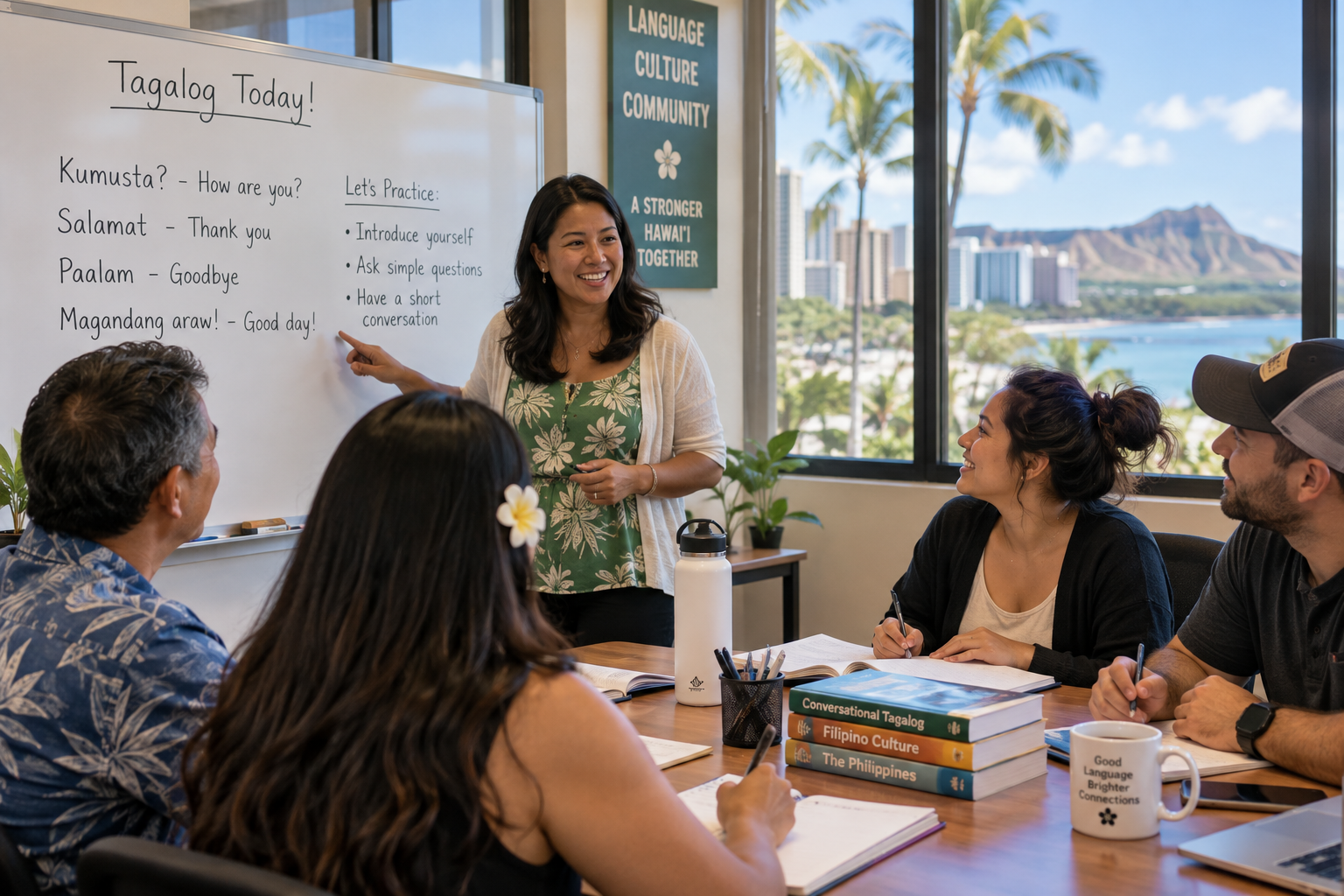
An adult in Honolulu can find more formal university-level study of Philippine languages than learners in many U.S. cities. The unusual part is that the first decision may not be “Which Tagalog class should I take?”
It may be “Is Tagalog actually the language I want?”
That question matters in Hawaiʻi because Filipino American history in the islands is deeply connected to migration from Ilocos and other regions of the Philippines. Many families use or remember Ilokano, not Tagalog, as the language of grandparents and older relatives. Others use Tagalog/Filipino, or a mixture of several languages and English.
Honolulu is therefore a very good place to learn a Philippine language, but it rewards learners who are specific about their goals.
UH Mānoa has a substantial Filipino language program
The University of Hawaiʻi at Mānoa offers one of the strongest academic Filipino-language environments in the United States.
Its Filipino program includes a sequence beginning with FIL 101 Beginning Filipino and continuing through intermediate, third-level, and fourth-level Filipino, along with courses in aural comprehension, translation, structure, film, literature, and culture.
For a serious learner, that depth is unusual. You are not limited to one beginner course that disappears after a semester. The university has an institutional pathway for sustained study.
Beginning Filipino develops listening, speaking, reading, and writing and connects language to cultural activities. More advanced courses move into conversation, composition, translation, literature, and authentic audio.
For an enrolled student, this is an obvious resource. For a working adult who is not pursuing a degree, the practical question is access. University courses operate through academic registration systems and fixed semester schedules. Contact the program or relevant university enrollment office to ask what options exist for non-degree study rather than assuming that a public course catalog functions like an evening community school.
Honolulu learners should look at the Ilokano program before choosing automatically
UH Mānoa also has an extensive Ilokano language program, from beginning through advanced levels.
That is more than an academic curiosity. It reflects Hawaiʻi’s Filipino history.
A heritage learner may begin studying Tagalog because it is the national language of the Philippines and the language most commonly encountered in Filipino media. Then a conversation with relatives reveals that the grandparents’ strongest language was Ilokano.
What should the learner do?
It depends on the goal.
If you want broad communication in the Philippines, Filipino/Tagalog is extremely useful. If your primary motivation is speaking more directly with a particular family member, learning that person’s heritage language may be more emotionally and practically relevant.
Some learners eventually study both.
The mistake is assuming that Tagalog equals “the Filipino language my family must have spoken.” The Philippines is multilingual, and Hawaiʻi makes that reality especially visible.
“Tagalog” and “Filipino” are often used differently in classes
Adult learners also encounter terminology that seems inconsistent.
Tagalog is the language historically rooted in Tagalog-speaking regions and forms the primary basis of Filipino, the national language. In everyday U.S. course listings, the terms can be used somewhat loosely. A course called “Filipino” may teach what a beginner searching for “Tagalog classes” expects to learn.
Rather than rejecting a class because of the label, read the curriculum. Ask which language variety is taught, what materials are used, and whether the course is intended for true beginners or heritage speakers.
Heritage learners should expect uneven skills
Honolulu has many adults who grew up around Philippine languages without receiving formal instruction.
A heritage learner may understand relatives very well and still be unable to write a paragraph. Another may have a strong accent and household vocabulary but little experience discussing work, politics, health, or abstract topics. Someone else may understand Ilokano and know only a few Tagalog phrases from television.
These learners should not be placed automatically into the same category as complete beginners.
If you are considering a university course or private class, describe your skills separately:
listening comprehension;
spontaneous speaking;
reading;
writing;
grammar knowledge;
the languages actually used in your household.
The result may be a placement that looks “uneven” on paper but fits you much better.
Community life can become part of the curriculum
Honolulu’s advantage is not only academic. Philippine languages exist in daily community life through churches, food, family networks, cultural organizations, media, and multigenerational households.
That means learners can connect classroom vocabulary to real relationships relatively easily.
If you are studying family terms, notice what people actually call older adults. If you are learning food vocabulary, listen to which terms remain in Tagalog or Ilokano even when the rest of the conversation is English. If you attend a cultural event, pay attention to announcements and greetings rather than treating the language as background sound.
This is especially helpful for heritage learners who already have passive knowledge waiting to be activated.
Online instruction can fill the scheduling gap
A university sequence may be academically excellent and still be impossible for someone who works full time, has family responsibilities, or needs a class that begins in a different month.
Live online Tagalog classes can fill that gap, particularly for adults who want small-group speaking practice and a clear beginner-to-intermediate path without enrolling in a university program.
Polyglottist Language Academy offers live online Tagalog instruction for adults, including true beginners and students with previous family exposure.
For Honolulu learners, the strongest plan may be deliberately mixed: structured Tagalog instruction, local community practice, and—when it matches family history—some Ilokano study as well.
The most useful first question is therefore not “Where can I learn Tagalog in Honolulu?” It is “Which Philippine language connects most directly to what I want to do?” Honolulu happens to be one of the few U.S. cities where you can take that question seriously and still have substantial academic options in more than one answer.