Where to Learn Russian in Northern Virginia and Washington, DC
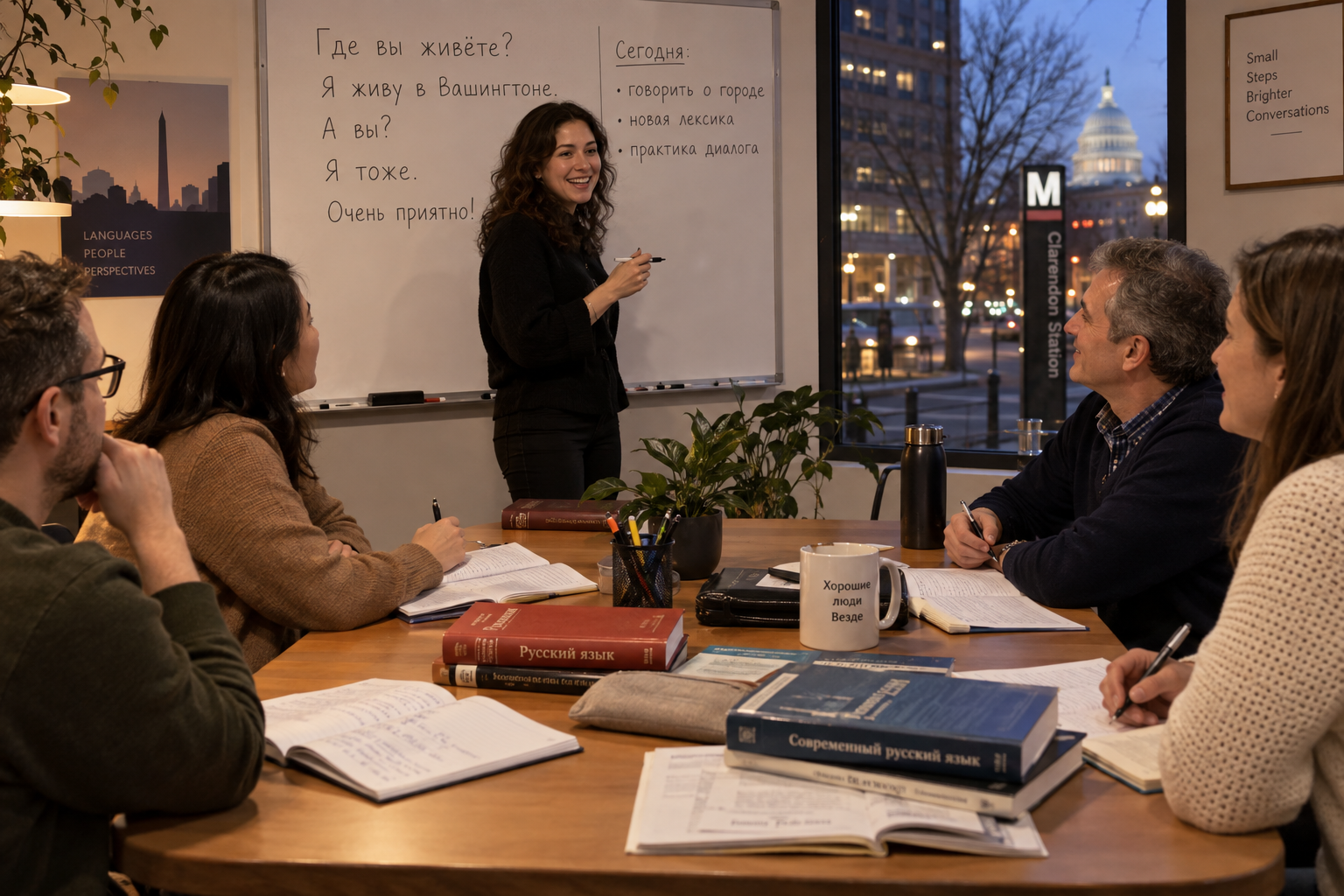
The Washington area is one of the easier places in the United States to find serious Russian instruction for adults, but the options are scattered across very different systems. A beginner in Arlington can take a community-education evening class. A learner in Fairfax can look at county adult education. Someone who wants a multi-level language-school sequence can study in DC. A professional interested in policy may prefer an academically oriented program.
That variety is useful only if you understand what each format is designed to do.
Arlington Community Learning: a straightforward adult beginner option
Arlington's adult-education program currently lists Russian - Beginning 1 as an 18+ evening course. For fall 2026, the course is scheduled for eight Wednesday evenings at Washington-Liberty High School. The published description starts with Cyrillic, basic grammar, introductions, occupation, family, and hobbies.
This is the kind of option many working adults are actually searching for: fixed dates, a local classroom, no university admission process, and a clearly defined beginner level.
The limitation is that community programs depend on enrollment and term-by-term scheduling. If the timing does not fit your week, the fact that the class exists locally does not help much.
Fairfax County ACE: useful for people farther west or south
Fairfax County Public Schools' Adult and Community Education program offers world-language courses for adults and currently lists Russian among the languages offered during the year. Classes may be online or in person at multiple Fairfax County locations.
For learners in Springfield, Fairfax, Reston, Herndon, Vienna, or nearby communities, this can be more practical than driving into DC after work. ACE also distinguishes introductory classes from higher levels, which matters for someone who has prior experience.
Because adult-education schedules change, search the live course catalog for the current Russian level and format rather than assuming every level runs every term.
International Language Institute in Washington, DC: a fuller level sequence
The International Language Institute in DC currently advertises Russian group classes from beginner through advanced. Its program is organized into multiple levels, with ten-week terms, evening or Saturday schedules, small classes, and both downtown and online options.
That continuity is a significant advantage. Adult learners often find a beginner class somewhere and then discover there is no next course. A program with an established sequence makes it easier to continue without rebuilding your study plan every few months.
For someone commuting from Northern Virginia, however, location still matters. A downtown class may be convenient if you already work near Metro. It may be much less convenient if you live and work in western Fairfax County and would be crossing the region during rush hour.
The Institute of World Politics: Russian in an academic policy environment
The Institute of World Politics in Washington lists Russian language courses from beginning through advanced levels and allows them to be taken through its Continuing Education Program.
This is a more specialized environment than a neighborhood language class. It may appeal to people interested in foreign policy, national security, international affairs, or regional studies. That does not mean it is automatically the best choice for a person who mainly wants conversational Russian for family or travel.
The setting should match the goal.
Northern Virginia Community College: credit-bearing study
NOVA maintains Russian coursework, including beginning Russian. Credit classes can provide systematic instruction, more contact hours, and a conventional academic progression.
The tradeoff is the one adult learners often underestimate: a college course is a college course. It may involve more weekly hours, assignments, assessments, registration requirements, and semester pacing than someone seeking a casual evening class wants.
Returning learners should also ask about placement rather than automatically starting over. NOVA's course information for Beginning Russian II, for example, recognizes prior study or demonstrated experiential learning as possible preparation.
DC-area learners have a particular advantage: Russian can connect to professional life
The Washington region is unusual because foreign languages are not confined to cultural interest. Russian may connect to diplomacy, federal work, defense, intelligence, journalism, NGOs, international law, research, and policy organizations.
That can shape how you choose a class. If your goal is professional, ask whether the course eventually develops reading and listening beyond travel conversation. Can you work with news? Can you summarize a text? Does the program teach formal registers as well as casual speech?
If your goal is family, heritage, or personal interest, those priorities may be different. You may need more spontaneous conversation and less policy vocabulary.
Do not choose a class by ZIP code alone
Northern Virginia learners routinely cross jurisdictional boundaries, but traffic makes theoretical distance misleading. A class twelve miles away can be easier or harder to attend than one twenty miles away depending on the time and direction.
Before registering, map the actual trip at the class meeting time. Add parking or Metro walking time. Then ask yourself whether you would still make that trip on a dark Wednesday in February after a long workday.
If the answer is no, a live online class is not a compromise. It may be the format you attend consistently.
Polyglottist Language Academy offers live online Russian classes for adults, which can fit learners across Northern Virginia and DC who want a scheduled small-group course without another regional commute.
The DC area gives Russian learners more choices than many U.S. cities. The challenge is not finding any Russian at all; it is choosing the kind of Russian class that matches your geography, your current level, and what you actually want to do with the language.