
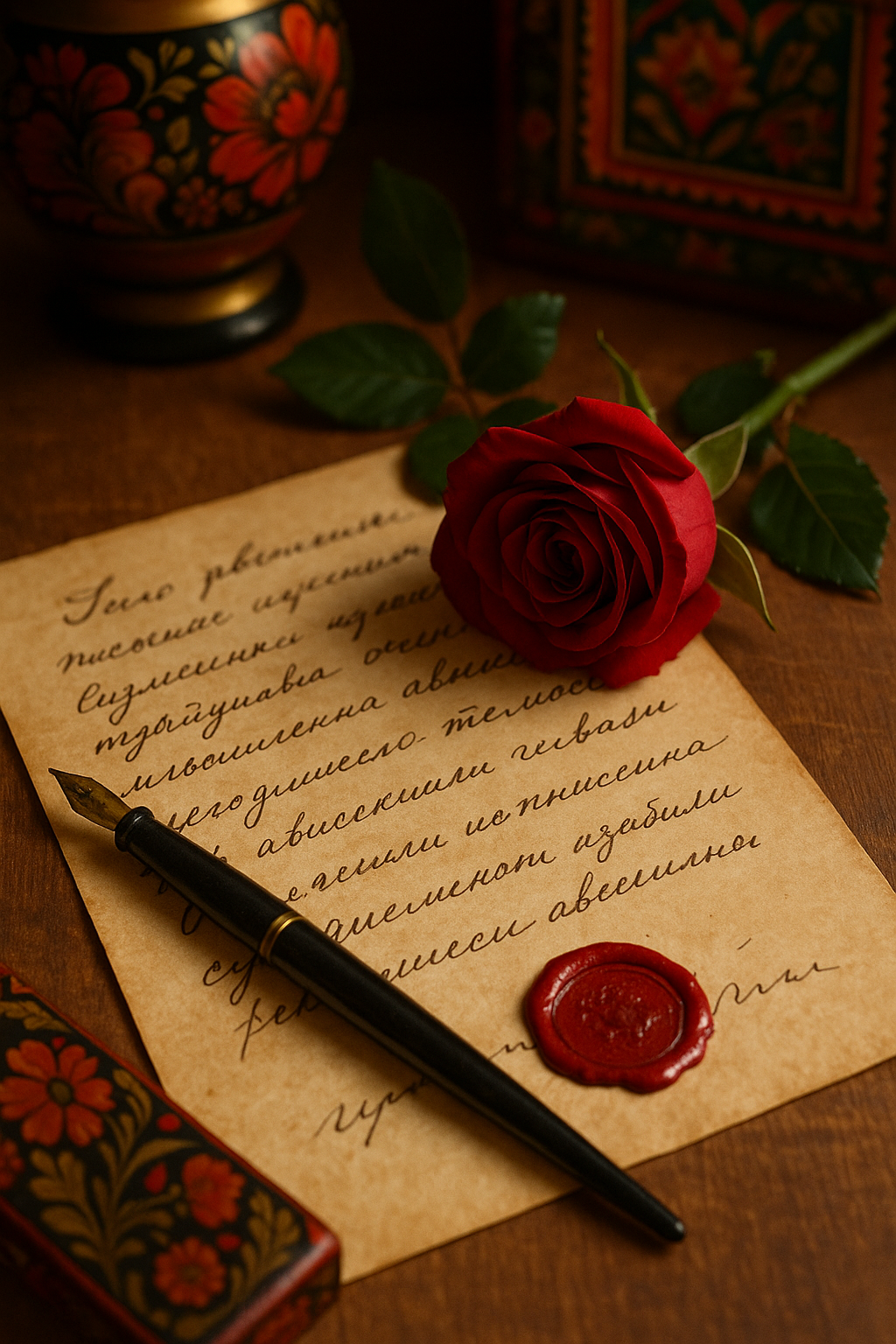
Love has many languages, but when expressed in Russian, it carries a depth, intensity, and poetic rhythm that makes even the simplest words feel monumental. To write a love letter in Russian is to step into a literary tradition shaped by centuries of poets, novelists, and lovers who treated words as both weapons and gifts. Pushkin wooed his beloveds with lyrical prose, Chekhov’s characters exchanged tender notes filled with longing, and soldiers at the front wrote fragile letters home that kept relationships alive across thousands of kilometers. Today, the art of the Russian love letter survives not only in old yellowed pages but also in emails, text messages, and even Instagram captions—each one infused with uniquely Russian expressions of passion, devotion, and tenderness.
For language learners, exploring Russian love letters is more than a cultural curiosity; it is an intimate way to understand how Russians articulate emotion. The Russian language is famous for its nuanced verbs, endless synonyms, and delicate shades of formality. These qualities make love letters particularly fascinating to study. They reveal not just how to say I love you (Я тебя люблю), but how to convey subtle differences between flirtation, longing, playful affection, and deep devotion. By studying the etiquette, styles, and common phrases of Russian love letters, you gain both linguistic insight and cultural sensitivity.
This article will guide you through the world of Russian love letters: their history, stylistic traditions, key vocabulary and phrases, and the cultural etiquette behind them. Along the way, you will see how writing a letter in Russian is not just an act of translation, but an act of cultural immersion—an opportunity to experience firsthand the passionate soul of the Russian language.
The History of Russian Love Letters
Writing letters has always been central to Russian culture. In the 19th century, letter-writing was not just communication but a refined art, especially among the aristocracy and educated classes. Love letters were composed with elegance, restraint, and a literary quality that echoed the prose of the great writers.
Pushkin’s Legacy: Alexander Pushkin, Russia’s most beloved poet, elevated love letters into poetry. His verses often mirrored the tone and cadence of private correspondence. Lovers of the time aspired to emulate his eloquence.
19th-Century Romance: In an age without phones, letters were the lifeline of romance. Long waits between deliveries only heightened their value. A single love letter might be read dozens of times, memorized, and cherished like a treasure.
War-Time Letters: In the 20th century, during World War II, love letters from the front carried raw emotion. They often combined romantic devotion with stoic patriotism: “Жди меня, и я вернусь” (Wait for me, and I will return), a phrase immortalized in poetry.
Modern Adaptations: Today, Russian love letters appear as emails, texts, or even voice messages. But the cultural tendency toward deep, expressive language remains strong. Unlike English, where brevity is often valued, Russian love communication still embraces emotional richness.
Styles of Russian Love Letters
Russian love letters vary widely in tone and style. Here are some of the most common traditions:
1. Formal and Poetic
Flowery, elaborate, almost literary in style.
Uses classical vocabulary and often references literature, nature, or fate.
Example opening:
Моя бесценная и единственная…
(“My priceless and only one…”)
2. Playful and Lighthearted
Filled with humor, teasing, and affectionate diminutives.
Might include wordplay or rhymed phrases.
Example:
Ты мой котёнок, мой зайчик, мой медвежонок.
(“You are my kitten, my bunny, my little bear.”)
3. Passionate and Intense
Uninhibited and raw, focusing on longing and desire.
Often written in bursts of emotion.
Example:
Без тебя я не живу, я существую.
(“Without you I do not live, I merely exist.”)
4. Tender and Everyday
Simple expressions of daily affection.
Short and sweet but heartfelt.
Example:
Доброе утро, любимая. Пусть твой день будет таким же светлым, как твоя улыбка.
(“Good morning, my love. May your day be as bright as your smile.”)
Vocabulary of Russian Love Letters
Here are some common words and phrases that appear often in Russian love writing:
Любовь (lyubov’) – love
Любимый / любимая – beloved (masculine / feminine)
Скучать по тебе – to miss you
Ты мне дорог(а) – you are dear to me
Судьба (sud’ba) – fate, destiny
Нежность (nezhnost’) – tenderness
Я думаю о тебе – I think of you
Ты всегда в моём сердце – you are always in my heart
Мой ангел – my angel
Моя душа – my soul
Lovers in Russia frequently use diminutives to add warmth:
котёнок (kitten)
солнышко (little sun)
рыбка (little fish)
лапочка (little paw)
Etiquette of Writing Russian Love Letters
Russian love letters follow unwritten rules. Understanding them helps learners write authentically.
Formality vs. Intimacy
Russians often distinguish between formal Вы and informal ты. In love letters, shifting to ты can signify growing closeness.Opening and Closing
Letters usually start with affectionate addresses: Дорогая моя, Любимая моя, Милый мой. Closings often include wishes for well-being: целую тебя крепко (kissing you tightly).Emotional Depth
Russian culture values sincerity. Superficial compliments may feel empty. Instead of “You’re pretty,” a Russian letter might say, “Your smile gives me strength to endure the hardest days.”Length and Detail
Brevity is rare in traditional love letters. Russians often write long, detailed messages, recounting memories, dreams, and feelings.Cultural Symbols
References to Russian literature, nature, or history enrich letters. Quoting Pushkin or mentioning birch trees (берёзы) adds depth.
Examples of Love Letter Fragments
Here are examples with English translations:
Любимая моя, каждую ночь я засыпаю с мыслью о тебе и просыпаюсь с твоим именем на губах.
(“My beloved, every night I fall asleep thinking of you and wake up with your name on my lips.”)Без тебя даже солнечный день кажется серым.
(“Without you, even a sunny day seems gray.”)Ты — моё счастье, моя судьба, моя вечность.
(“You are my happiness, my destiny, my eternity.”)Целую тебя тысячу раз, хотя в письме это всего лишь слова.
(“I kiss you a thousand times, though in a letter these are only words.”)
How to Practice Writing Russian Love Letters
Start Small
Write short notes with simple phrases: “I miss you,” “I’m thinking of you.” Build confidence gradually.Use Diminutives
Try calling your partner солнышко or котёнок. These affectionate nicknames are integral to Russian romance.Borrow from Literature
Quoting a line from Pushkin or Akhmatova can elevate your letter.Mix Past and Future
Share a memory (“I remember our walk…”) and a dream (“I look forward to our next meeting…”).Read Aloud
Reading your letter aloud helps practice pronunciation and rhythm.
FAQs About Russian Love Letters
Q: Are Russian love letters still common today?
A: Yes, though they’ve shifted from handwritten letters to digital messages. Russians still value expressive, emotional language in love communication.
Q: Do Russians prefer poetic or simple letters?
A: Both. Some value grand poetic declarations; others prefer sincere, everyday tenderness. Personality and context matter.
Q: What’s the difference between “Я люблю тебя” and “Я тебя люблю”?
A: Both mean “I love you,” but the latter places emphasis on “I.” It can sound more personal or emphatic.
Q: Is it appropriate to use diminutives if I’m not a native speaker?
A: Yes, but use them carefully. Overusing may sound childish. Start with one or two common ones like солнышко.
Q: Do men and women write differently?
A: Traditionally, women’s letters were more detailed and poetic, men’s more direct. Today, the style depends on the individual.
Q: How formal should I be?
A: With a new relationship, start more formal (Вы). As intimacy grows, switch to ты.
Q: Are quotes from literature expected?
A: Not required, but appreciated. Russians admire cultural references.
Q: Can I practice writing love letters even if I don’t have a Russian partner?
A: Absolutely! It’s an excellent exercise in vocabulary, style, and cultural understanding.
Final Thoughts
Writing Russian love letters is a way of entering the cultural heart of the language. Each phrase, whether tender, passionate, or poetic, reflects not only personal emotion but also a tradition that values depth, honesty, and artistry. As you learn to write them, you don’t just practice grammar—you step into the rhythm of Russian thought, where love is not casual but profound, not fleeting but eternal.
At Polyglottist Language Academy, we bring this cultural depth into our Russian classes. Whether you want to master conversational phrases, read Russian literature, or write a moving love letter in Cyrillic, our experienced instructors will guide you. Sign up today and take your Russian learning to the next level, with lessons that go far beyond textbooks.
Explore More on Our Blog
If you enjoyed this article, check out:
How Russians Navigate Public Space—And Why Americans Struggle With It
What It’s Like To Be The Only Foreigner In A Russian Dacha Community
The Cultural Importance Of Grandmothers (Babushki) In Russian Society
Russian Weddings, Toasts, And Table Traditions You Didn't Know Existed
What Watching Soviet Cartoons Teaches You About The Russian Mindset