
How to Ask for Directions in French—and Understand the Response
Introduction: Lost in Translation…Literally
Imagine this.
You’ve finally made it to Paris. Or Lyon. Or that tiny medieval village you read about in a travel magazine. You’re standing on a cobblestoned street, baguette in one hand, phone battery at 3%, and no idea how to find your hotel, the museum, or the nearest restroom.
You gather your courage, walk up to a smiling French passerby, and say in your best classroom French:
“Où est la rue… euh… la rue… um… la rue…”
You trail off. Your mind goes blank. The person answers you—in rapid-fire French. You catch a droite (right), maybe a gauche (left), and then… nothing. They wave vaguely, smile again, and disappear into the crowd. You’re left standing there, sweating, possibly facing the wrong direction.
Sound familiar?
You’re not alone.
Even seasoned travelers and intermediate French speakers can freeze when it comes to two of the scariest parts of real-life travel:
✅ Asking for directions
✅ Understanding the French person’s answer
Because the problem isn’t only how to ask. It’s also recognizing—and decoding—the avalanche of words that often follows. Locals speak fast. They gesture. They assume you know how streets connect. And suddenly your carefully memorized phrases crumble under the pressure of real-world communication.
But here’s the good news: you can absolutely master this.
In this ultimate guide, you’ll learn:
How to politely and naturally ask for directions in French
Essential vocabulary and phrases locals actually use
How to understand the answers—even when spoken quickly
Tips to avoid classic misunderstandings
Cultural dos and don’ts when stopping strangers
By the end, you’ll have the tools to navigate any French town or city like a pro. Let’s make sure that next time you’re lost, you’re also confident.
Part 1 – The Polite Way to Start: Greetings and Openers
In France, politeness is crucial. Walking up to someone and immediately blurting out your question can feel abrupt—even rude.
Always start with:
Bonjour, excusez-moi… → Hello, excuse me…
Or, if it’s evening:
Bonsoir, excusez-moi…
Politeness opens doors—and makes locals far more willing to help you.
Here’s a natural way to start:
Bonjour, excusez-moi de vous déranger…
Hello, sorry to bother you…
Part 2 – Key Phrases to Ask for Directions
Let’s cover the core ways to say “Where is…” and other essential questions.
2.1 The Classic “Où est…?”
Simple but effective:
Où est la gare, s’il vous plaît ?
Where is the train station, please?
If the noun is plural:
Où sont les toilettes, s’il vous plaît ?
Where are the restrooms, please?
2.2 “How do I get to…?”
A bit more advanced:
Comment puis-je aller à la cathédrale ?
How can I get to the cathedral?
Or in simpler spoken French:
Comment on va à la cathédrale ?
2.3 “Is it far?”
Very useful follow-up question:
C’est loin ?
Is it far?
Or:
Est-ce que c’est loin ?
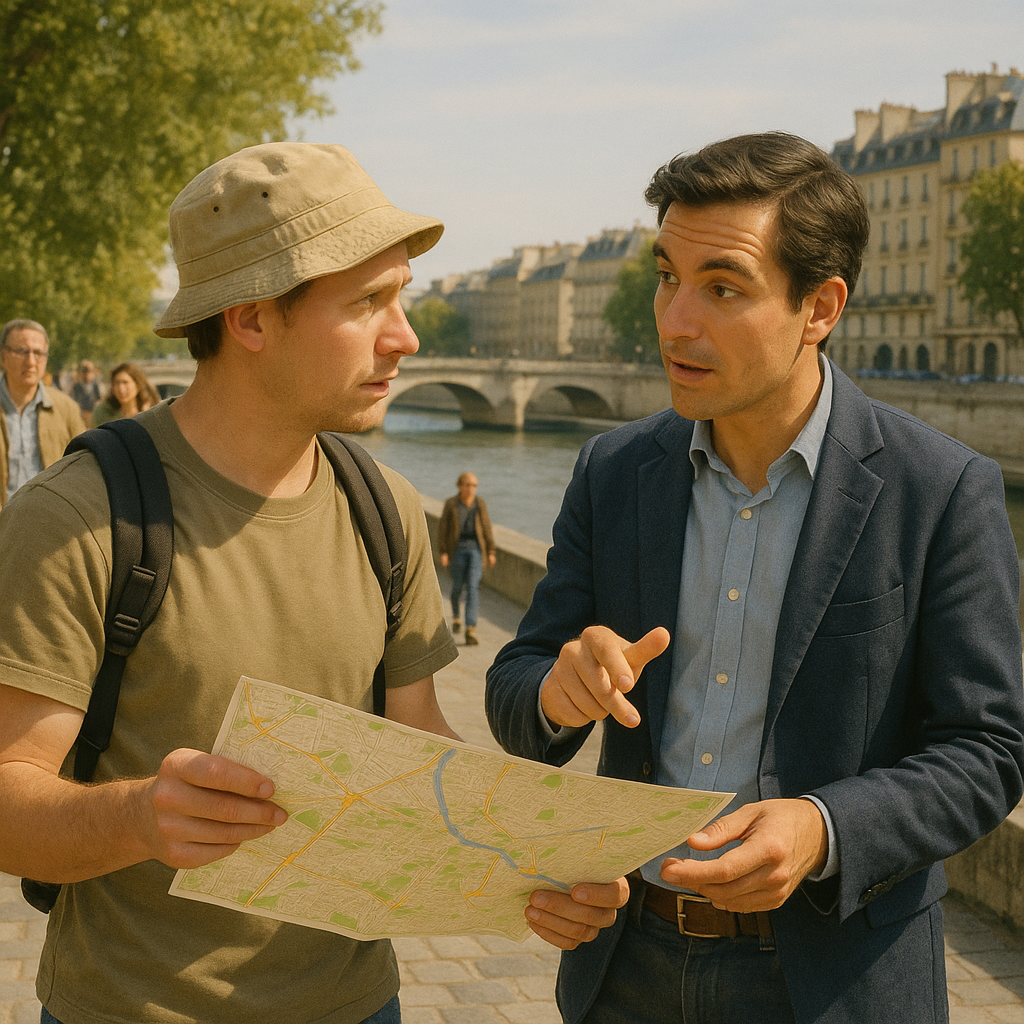
2.4 “Can you show me on the map?”
When you’re totally lost:
Pouvez-vous me montrer sur la carte ?
Can you show me on the map?
2.5 “I’m looking for…”
Je cherche la rue Victor Hugo.
I’m looking for Victor Hugo Street.
Or:
Je cherche un hôtel près d’ici.
I’m looking for a hotel nearby.
2.6 “Is there a … nearby?”
Y a-t-il une pharmacie près d’ici ?
Is there a pharmacy near here?
More colloquial:
Il y a une pharmacie près d’ici ?
Part 3 – How the French Give Directions (And How to Understand Them)
Even if you ask your question perfectly, the answer might come back in a flood of rapid French. Here’s how to manage it.
3.1 Typical Patterns in Responses
A French person might say:
Alors, vous allez tout droit jusqu’au feu rouge. Ensuite, vous tournez à gauche, puis c’est la deuxième rue à droite.
Translation:
So, you go straight ahead until the traffic light. Then, turn left, then it’s the second street on the right.
3.2 Common Connectors
Listen for these “connecting” words that organize the explanation:
puis → then
ensuite → next
après → after
jusqu’à… → until
c’est là → it’s there
vous verrez… → you’ll see…
Example:
Vous continuez jusqu’à la pharmacie, puis vous tournez à droite.
3.3 Tips to Cope with Fast Speech
Ask them to repeat.
Pouvez-vous répéter, s’il vous plaît ?
Ask them to speak slower.
Pouvez-vous parler plus lentement ?
Ask for shorter instructions.
Pouvez-vous me dire étape par étape ?
Can you tell me step by step?
Repeat back what you understood.
Donc, je vais tout droit, puis à gauche ?
So I go straight ahead, then left?
This helps catch misunderstandings.
Part 4 – Real-Life Scenarios
Let’s bring this all together with examples.
Scenario 1 – Looking for the Train Station
Bonjour, excusez-moi, où est la gare, s’il vous plaît ?
Hello, excuse me, where is the train station, please?
Possible response:
Vous allez tout droit jusqu’au rond-point, puis vous tournez à gauche. La gare est en face de la poste.
Translation:
You go straight until the roundabout, then turn left. The station is across from the post office.
Scenario 2 – Finding the Toilets
Bonjour, excusez-moi, où sont les toilettes, s’il vous plaît ?
Answer:
C’est au bout du couloir, à droite.
Translation:
It’s at the end of the hallway, on the right.
Scenario 3 – Seeking a Pharmacy
Bonjour, il y a une pharmacie près d’ici ?
Response:
Oui, vous prenez la deuxième rue à gauche, elle est juste à côté de la boulangerie.
Translation:
Yes, you take the second street on the left, it’s right next to the bakery.
Part 6 – Cultural Tips for Asking Directions
6.1 Be Polite
Don’t forget:
Greet first.
Apologize for disturbing.
Always say s’il vous plaît.
6.2 Accept Gestures
French people often gesture with their hands rather than give long verbal explanations. Watch where they point!
6.3 Don’t Be Afraid to Admit Confusion
If you don’t understand, say so:
Je ne comprends pas très bien. Pouvez-vous répéter ?
6.4 Check Written Addresses
Especially in small villages, streets might be unmarked. Always keep addresses written down!
Part 7 – How to Practice Before You Travel
7.1 Listen to Videos
Search YouTube for:
“Donner des directions en français”
“Demander son chemin”
These real-life clips help tune your ear.
7.2 Role-Play
With a language partner, practice scenarios like:
Asking for a hotel
Finding the metro
Looking for a café
7.3 Flashcards
Make cards with direction words:
à droite
à gauche
en face de
Quiz yourself daily!
7.4 Repeat Sentences Aloud
Repeat real sentences like:
Je cherche la rue Victor Hugo.
C’est loin ?
Build muscle memory!
Part 8 – The Confidence Factor
The single biggest reason travelers panic when asking directions?
Lack of confidence.
Yes, French people might speak quickly. But most are thrilled you’re trying their language—and will slow down if you ask politely.
Remind yourself:
✅ It’s normal not to understand everything.
✅ You can ask them to repeat.
✅ A smile and polite greeting go a long way.
Next time you’re lost, you’ll be ready. Not just to ask—but to understand the answer.
FAQs: How to Ask for Directions in French
Q1: What’s the simplest way to ask “Where is…”?
Où est… ? e.g. Où est la gare ?
Q2: How do I ask if it’s far?
C’est loin ?
Q3: How can I ask someone to repeat?
Pouvez-vous répéter, s’il vous plaît ?
Q4: How do I say “Turn right”?
Tournez à droite.
Q5: How can I ask for directions politely?
Start with: Bonjour, excusez-moi…
Q6: How do I say “straight ahead”?
Tout droit.
Q7: What if I’m completely lost?
Ask: Pouvez-vous me montrer sur la carte ?
Q8: Is it rude to stop people in the street?
Not if you’re polite and say Bonjour first!
Ready to Travel Confidently in French?
At Polyglottist Language Academy, we help you master real-life French—the kind you need in shops, streets, and stations. Our interactive classes train you to ask questions confidently and understand native responses.
➡️ Sign up for our French classes today!
Check Out More Articles From Our Blog!
Want more French survival skills? Read these next:
Why Fluent French Isn’t Perfect French—And Why That’s A Good Thing
A Crash Course In “French Filler Words” (Eh Bien, Tu Vois, Genre...)
Street French Vs. School French: What You’ll Hear Vs. What You Learn
What Learning French Teaches You About English (Yes, Really!)
10 “Invisible Words” In Spoken French That Aren’t In Your Textbook
The Sound Of French: How To Train Your Ear To Understand Spoken French Fast
From Oui To Oops: The Funniest Mistakes French Learners Make (And What They Teach Us)