
Navigating French Elevators, Doors, and Everyday Details as a Foreigner
Introduction: The Devil’s in the Details (Especially in France)
Imagine this: you’ve arrived in Paris, suitcase in tow, brimming with enthusiasm and ready to dive into la vie française. You’ve practiced your “Bonjour, Monsieur” and “Je voudrais un café, s’il vous plaît.” You’ve memorized the metro map and even learned a few polite phrases for small talk.
Then you step into the lobby of your charming Haussmannian building. You find the elevator, squeeze inside, press the button—and nothing happens. You try again. Nothing. You’re stuck in a tiny metal box, praying nobody else shows up to witness your confusion.
Or you’re fumbling at a café bathroom door. You see “WC” on the sign and push confidently—only to realize it requires a token from the barista. Or worse, it opens inward when you’re pulling outward, earning you puzzled stares.
Or maybe you’ve rented an Airbnb and keep forgetting which direction to turn the ancient key in a stubborn 19th-century door lock, rattling the knob until your neighbors glare through the peephole.
Welcome to France, where the little details—elevators, doors, keys, light switches, toilets—can become surprisingly significant hurdles for foreigners.
It’s not that French life is impossibly complex. It’s that everyday systems are often just slightly different from what you’re used to. Enough to leave you feeling foolish, frustrated, or secretly anxious about simple tasks. Even seasoned travelers who breeze through airports and subways can stumble when facing a French door handle that works backwards or a mysterious elevator that refuses to budge without a key.
Yet these details aren’t just minor inconveniences—they’re part of the cultural landscape. Understanding them isn’t only practical; it’s key to feeling at home in France. And, believe it or not, they’re also a fascinating glimpse into how French design, architecture, and social norms shape daily life.
In this article, we’ll explore the seemingly mundane but surprisingly important details of French living. From elevators that demand codes to doors that open the “wrong” way, we’ll decode the mysteries and give you language tips to handle awkward situations with confidence. Whether you’re moving to France, staying short-term, or simply dreaming of your next vacation, this guide will save you countless moments of confusion—and possibly spare you some embarrassed blushes.
So grab a café crème, settle in, and let’s demystify the little quirks of French everyday life—one door, one button, and one polite phrase at a time.
1. The Enigma of French Elevators
Small and Slow
The first thing you’ll notice about many French elevators, especially in older buildings, is their size. They’re tiny. Think one person and a suitcase—two people if you’re very friendly.
Don’t be shocked if the weight capacity sign reads:
Capacité: 3 personnes ou 225 kg
(Capacity: 3 people or 225 kg)
Manual Doors
Unlike modern elevators with automatic sliding doors, older French elevators often have two doors:
✅ An outer metal gate you swing open.
✅ An inner wooden or glass door you must close behind you.
If you forget to close the doors properly, the elevator won’t move—and you’ll hear shouts from frustrated neighbors who can’t call it to their floor.
Language Tip:
Pardon, l’ascenseur est bloqué ?
(Excuse me, is the elevator stuck?)
The Key or Code Mystery
In some buildings, the elevator only works with:
A key you insert and turn.
A code you punch into a keypad.
If you’re renting an apartment, always ask how to operate the elevator.
Floor Number Confusion
In France:
Ground floor = Rez-de-chaussée (RC)
First floor = 1er étage
So if your Airbnb is on the “2nd floor,” you’ll press 1 in the elevator.
2. Doors: Push or Pull? Left or Right?
Reversing Your Instincts
French doors often open inward instead of outward, especially in public spaces. At restaurants, shops, or apartment buildings, try pushing gently first rather than pulling.
Locking and Unlocking Doors
French door locks often require two full turns of the key to lock or unlock completely.
Mistake: turning the key halfway, then pushing the door only to find it jammed.
Heavy Doors
Entrance doors to buildings, especially in cities like Paris, are solid and heavy. They may slam shut if you don’t hold them, a faux pas that neighbors dislike.
Entry Codes
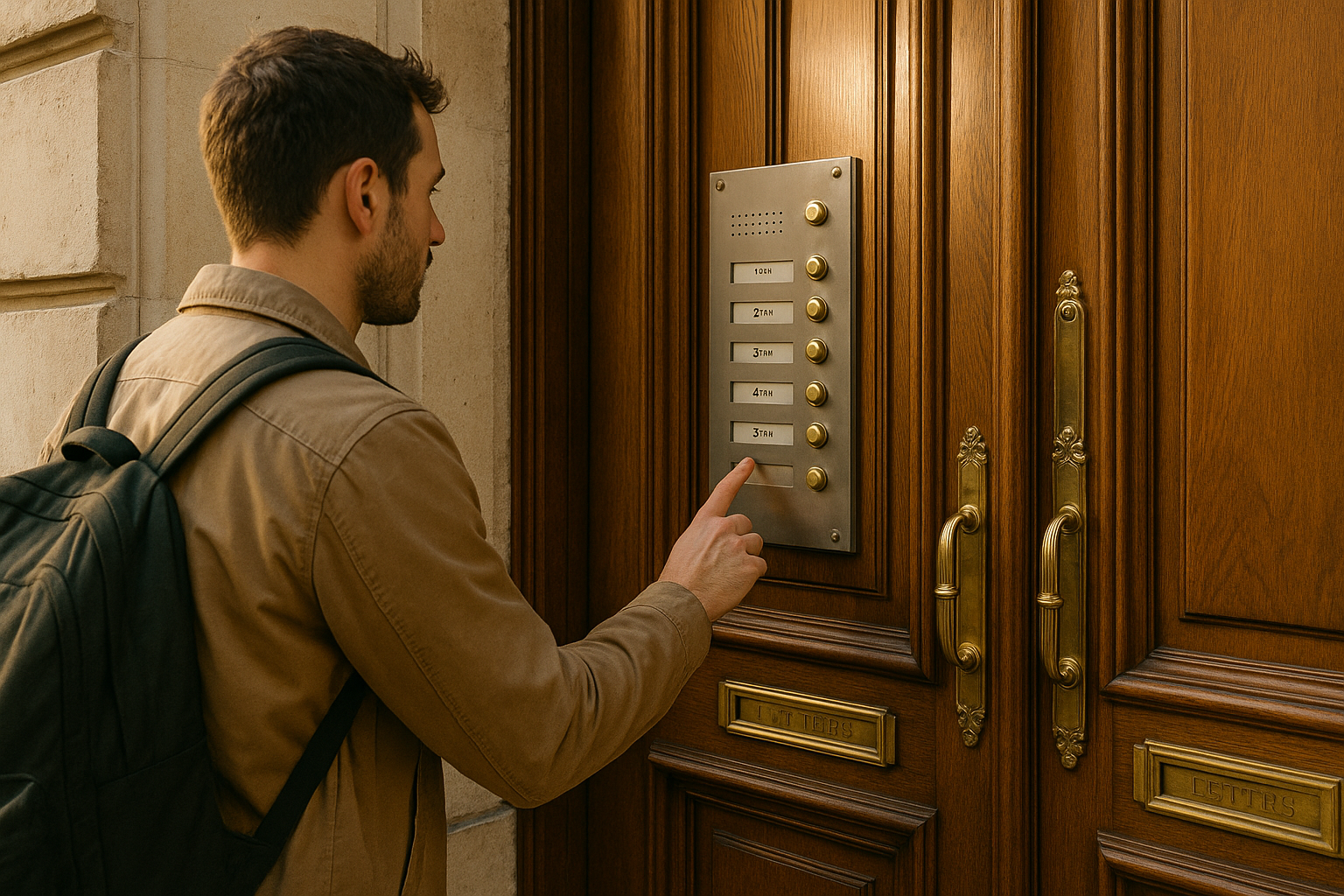
Many French apartment buildings have digicodes on the front door.
Common scenario: you press the code, the door buzzes faintly, and you have 3 seconds to push it open. Hesitate too long, and it locks again.
Language Tip:
Pouvez-vous me rappeler le code d’entrée ?
(Could you remind me of the entry code?)
3. Bathroom Mysteries
WC ≠ Toilet
Signs often say “WC” (water closet). Some foreigners mistakenly expect a full bathroom. In public places, a WC is simply the toilet.
Paying for Toilets
Public toilets in France sometimes require:
A coin (usually €0.50 to €1)
A token from a cashier (especially in cafés)
Don’t assume café bathrooms are free unless you’re a paying customer.
Language Tip:
Est-ce que je peux utiliser les toilettes ?
(May I use the restroom?)
Lights on Timers
Many public toilets—and even stairwells in older buildings—have lights that automatically turn off after a minute. Don’t panic. Wave your arms near the sensor or press the switch again.
4. Lights, Switches, and Other Quirks
Timer Switches
In older buildings, lights in hallways and staircases are often on timers. You press a switch that lights up for 30 seconds to 2 minutes before going dark again.
European Light Switches
French light switches flip down to turn on, the opposite of American ones. A small but disorienting detail.
Electrical Outlets
French plugs are different (Type E). Bring an adapter. Also, French outlets often have a small button nearby to reset them if there’s a surge.
5. Trash and Recycling Systems
Trash Schedules
Many apartment buildings have strict schedules for when you can take out trash. In Paris, signs often read:
Sortie des poubelles: entre 19h et 21h.
(Trash out between 7 pm and 9 pm.)
Color-Coded Bins
Yellow bin = recyclables
Green/black bin = general waste
Learning this helps you avoid disapproving looks from neighbors.
6. Practical Language Tips for Everyday Details
Here’s your survival toolkit of French phrases:
Comment fonctionne cet ascenseur ?
(How does this elevator work?)Je crois que la porte est coincée.
(I think the door is stuck.)Pouvez-vous m’aider avec la serrure ?
(Could you help me with the lock?)Est-ce que c’est payant ?
(Is there a fee?)Où sont les toilettes, s’il vous plaît ?
(Where is the restroom, please?)Je suis désolé(e), je ne savais pas.
(I’m sorry, I didn’t know.)
7. Embracing the Quirks
Here’s the good news: once you understand these everyday details, they become endearing quirks rather than obstacles. In fact, many foreigners find they develop a kind of affection for France’s peculiarities:
The thrill of finally mastering the elevator code.
The satisfaction of unlocking a stubborn old door.
The delight in discovering your favorite neighborhood café’s bathroom is free—and doesn’t require a token.
It’s these small victories that transform you from a tourist to someone living à la française.
8. Cultural Mindset: Politeness Over Frustration
Even when frustrated, try to stay polite. French people appreciate:
Apologies for mistakes.
A polite greeting before asking for help.
Patience in dealing with quirks.
A calm “Pardon, je ne comprends pas” goes a long way.
9. Your French Life Gets Easier
The first few weeks in France can feel like an obstacle course of odd details. But soon, you’ll be:
✅ Pressing elevator buttons confidently.
✅ Unlocking your door without hesitation.
✅ Navigating public toilets without panic.
✅ Pushing rather than pulling doors on the first try.
And most importantly, you’ll feel at home.
FAQs: Everyday Details in France
Q: Why do French elevators have two doors?
A: Older elevators require manual doors for safety. Both must be closed for the elevator to operate.
Q: Do all public bathrooms in France require payment?
A: Not all, but many do—especially in train stations, parks, and busy tourist areas.
Q: Why do French doors open inward instead of outward?
A: It’s often a matter of building codes and historical design. Inward doors provide better insulation and security in older buildings.
Q: How do I know if I should push or pull a door?
A: There’s rarely a sign. Gently push first—that’s often the correct direction in France.
Q: What should I do if I get stuck in an elevator?
A: Press the emergency button, or call out for help: “Pardon, je suis coincé(e) !” (Excuse me, I’m stuck!)
Q: Are there light switches on timers in modern buildings too?
A: Mostly in older buildings, but you’ll occasionally find them in newer ones for energy savings.
Q: Can I throw trash out anytime?
A: No. Many cities, especially Paris, have specific times for taking out trash. Check posted signs in your building.
Q: Do French people mind helping foreigners with everyday details?
A: Usually not—especially if you’re polite and start with a greeting.
Live Confidently in France with Polyglottist Language Academy
At Polyglottist Language Academy, we believe speaking French is about more than grammar—it’s about navigating everyday life confidently. From elevator etiquette to cultural quirks, our classes prepare you not just to talk, but to live in France.
Our small-group and private classes integrate real-life scenarios and cultural insights to help you feel at ease in every situation—even when the elevator refuses to budge.
✨ Ready to make France feel like home? Join Polyglottist Language Academy and learn French for real life. ✨
Check Out More Articles on Our Blog!
Explore more guides to French culture and language: