
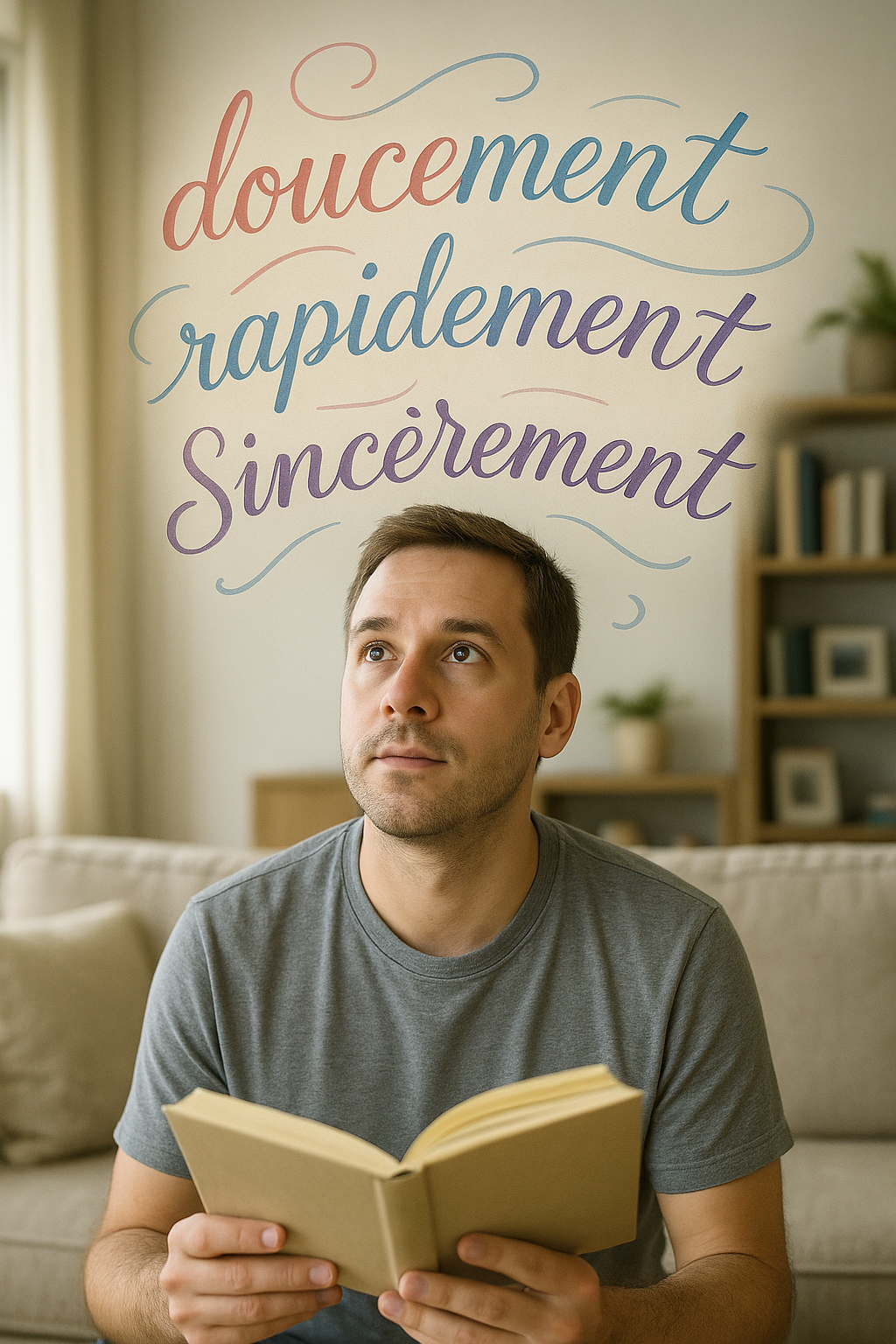
Introduction: The Small Words That Make Big Differences
Let’s be honest. When you first started learning French, you probably fixated on the big-ticket items: nouns, verbs, adjectives. Those felt tangible, important, essential for basic conversation. You memorized chien (dog), manger (to eat), grand (big). You learned how to say “I am American” or “Where is the bathroom?” and felt like you were making real progress.
Then one day, you listened to native French speakers chatting over coffee or watched a French movie without subtitles. You heard phrases like:
Franchement, je ne sais pas. (Honestly, I don’t know.)
Il parle trop vite. (He speaks too fast.)
Elle est partie soudainement. (She left suddenly.)
C’est absolument magnifique ! (It’s absolutely magnificent!)
Suddenly, your confident French started to feel… incomplete. You were catching the nouns and verbs—but missing the music, the rhythm, the nuance that makes French sound authentic and alive. The secret ingredient? Adverbs.
Adverbs are the unsung heroes of the French language. They’re the seasoning that transforms a bland sentence into something delicious and sophisticated. They convey attitude, intensity, time, frequency, and subtle shades of meaning that simply don’t come through with just nouns and verbs. Yet learners often push adverbs to the sidelines, assuming they’re optional or too tricky to master.
The truth is, adverbs deserve far more attention than they typically get. Not only are they essential for precision, but they’re also vital for sounding natural, expressive, and—dare we say it—French.
In this article, we’re going to give French adverbs the spotlight they deserve. We’ll explore why they’re so crucial, how they function, the different categories you need to know, and how to use them confidently in conversation. Whether you’re a beginner just venturing beyond basic phrases or an advanced learner seeking finesse, this guide will show you why mastering adverbs might be the game-changer in your French journey.
So settle in, grab your coffee (or perhaps a glass of Bordeaux), and get ready to discover the small words that make a big impact.
1. Why Are Adverbs So Important in French?
Adding Color and Emotion
Consider the difference between:
Je suis content. (I’m happy.)
Je suis vraiment content. (I’m really happy.)
Je suis un peu content. (I’m a little happy.)
The adverb completely changes the tone and emotion of the sentence. In real conversations, these small distinctions matter enormously.
Giving Precision
Adverbs help you be precise about how, when, where, and why something happens:
Elle chante magnifiquement. (She sings beautifully.)
Il est arrivé tôt. (He arrived early.)
Ils travaillent ensemble. (They work together.)
Without adverbs, your French risks sounding robotic or overly simplistic.
Sounding Natural
Native speakers sprinkle adverbs liberally into conversation, especially words like vraiment (really), un peu (a bit), bien(well), très (very), and toujours (always). Knowing how to use these instinctively is a huge step toward fluency.
2. Types of French Adverbs You Need to Know
French adverbs fall into several categories. Let’s look at some essential groups:
Adverbs of Manner (Comment?)
These describe how something happens.
doucement — gently
rapidement — quickly
brillamment — brilliantly
facilement — easily
Example: Il parle clairement. (He speaks clearly.)
Adverbs of Time (Quand?)
These tell when something happens.
hier — yesterday
aujourd’hui — today
bientôt — soon
toujours — always
jamais — never
Example: Je le verrai demain. (I’ll see him tomorrow.)
Adverbs of Place (Où?)
These describe where something happens.
ici — here
là-bas — over there
partout — everywhere
dedans — inside
Example: Ils vivent ailleurs. (They live elsewhere.)
Adverbs of Quantity or Degree (Combien?)
These describe how much or to what extent.
très — very
assez — enough
trop — too much
un peu — a little
presque — almost
Example: C’est trop difficile. (It’s too difficult.)
Adverbs of Affirmation and Negation
These confirm or deny something.
oui — yes
non — no
certainement — certainly
absolument — absolutely
pas — not
Example: Je ne sais pas. (I don’t know.)
Adverbs of Opinion
These express a personal judgment.
heureusement — fortunately
malheureusement — unfortunately
probablement — probably
évidemment — obviously
Example: Malheureusement, il est parti. (Unfortunately, he left.)
3. Forming French Adverbs: The -ment Ending
Many French adverbs are formed by adding -ment to the feminine form of an adjective.
heureux → heureusement (happy → happily)
lent → lentement (slow → slowly)
sérieux → sérieusement (serious → seriously)
However, not every adjective works this way. Irregular adverbs like bien, mal, vite, and peu have their own unique forms and must be memorized.
4. Placement Rules for Adverbs in French
Simple Tenses
In simple tenses (like the present or imperfect), adverbs usually come after the verb:
Elle chante bien. (She sings well.)
Nous travaillons toujours. (We always work.)
Compound Tenses
In compound tenses like the passé composé, short adverbs often go between the auxiliary and the past participle:
Il a déjà mangé. (He has already eaten.)
Longer adverbs may follow the past participle:
Elle a parlé franchement. (She spoke frankly.)
Negation
Adverbs usually come after “pas” in negative sentences:
Je n’ai pas encore vu le film. (I haven’t seen the film yet.)
5. Common Mistakes with Adverbs
Using Adjectives Instead of Adverbs
Many learners say:
Elle parle clair. ✗
Correct:
Elle parle clairement. ✓
Remember: adjectives describe nouns; adverbs describe verbs, adjectives, or other adverbs.
Misplacing Adverbs
In French, word order matters. Compare:
J’ai déjà vu ce film. (I’ve already seen this film.)
J’ai vu ce film déjà. (Sounds awkward unless for emphasis.)
Learning proper placement is key to sounding fluent.
Overusing “très”
While très (very) is useful, native speakers often vary their adverbs. Instead of always saying très bon, try:
délicieux (delicious)
merveilleux (wonderful)
incroyable (incredible)
Enriching your adverb vocabulary makes your speech more colorful and natural.
6. Must-Know French Adverbs for Everyday Speech
Here’s a starter list that will instantly elevate your French:
vraiment — really
toujours — always
encore — still, again
déjà — already
peut-être — maybe
souvent — often
rarement — rarely
soudainement — suddenly
particulièrement — particularly
exactement — exactly
Sprinkle these into conversations, and you’ll sound instantly more native.
7. How to Practice French Adverbs
Listen Actively
Pay attention to adverbs when watching French films, listening to music, or tuning into podcasts. How do speakers use words like vraiment, peut-être, or absolument?
Shadow Sentences
Repeat sentences out loud, matching rhythm and intonation. For example:
Je suis absolument d’accord.
Write Journals
Practice writing about your day using adverbs:
Aujourd’hui, j’ai travaillé rapidement et j’ai mangé trop de chocolat.
Flashcards
Create flashcards for new adverbs and test yourself regularly.
8. Why Adverbs Are the Secret to Sounding Native
Adverbs are the glue that holds French sentences together. They add life, subtlety, humor, and emotion to your speech. Without them, your French remains grammatically correct—but often flat, mechanical, and not quite natural.
By dedicating time to learning and practicing adverbs, you elevate your language skills from “textbook French” to real-life, flowing, expressive French.
FAQs: Mastering French Adverbs
Q: Do I really need adverbs to speak French?
A: Yes! Adverbs are crucial for precision, emotion, and sounding natural. Without them, your speech risks being bland and overly simplistic.
Q: Are all adverbs formed with -ment?
A: Many are, but not all. Common irregular adverbs like bien, mal, vite, and peu don’t follow the -ment pattern.
Q: Where do adverbs go in French sentences?
A: It depends on the tense and the adverb’s length. Short adverbs often go between the auxiliary and past participle in compound tenses; longer ones may come after the past participle or at the end of the sentence.
Q: How can I learn adverbs faster?
A: Listen to native media, shadow sentences, and write daily journals using adverbs. Repetition and exposure are key.
Q: Can adverbs come at the beginning of a sentence?
A: Yes! For emphasis, adverbs often lead sentences: Franchement, je ne comprends pas.
Q: Are adverbs different in formal vs. informal French?
A: Some adverbs are more casual, like vachement (very, slang), while others like absolument work in all contexts.
Q: Why is “trop” tricky?
A: Trop can mean “too much” (negative) or, in slang, “really/really awesome” (positive). Context matters!
Q: What’s the best way to expand my adverb vocabulary?
A: Expose yourself to native content—movies, songs, podcasts—and note new adverbs you hear repeatedly.
Discover the Nuances of French at Polyglottist Language Academy
At Polyglottist Language Academy, we’re passionate about helping you speak French confidently and authentically. We know it’s not just about grammar—it’s about rhythm, nuance, and the little words that make big differences, like adverbs.
Our small-group and private French classes dive deep into real-life conversations, cultural insights, and practical tools to help you communicate naturally. Whether you’re a beginner eager to go beyond textbook basics or an advanced learner polishing your style, we’ll help you master the magic of French.
✨ Ready to elevate your French and learn the secrets of sounding native? Join us at Polyglottist Language Academy today—and let’s bring your French to life! ✨
Check Out More Articles on Our Blog!
Continue your French learning journey with these fascinating reads: