
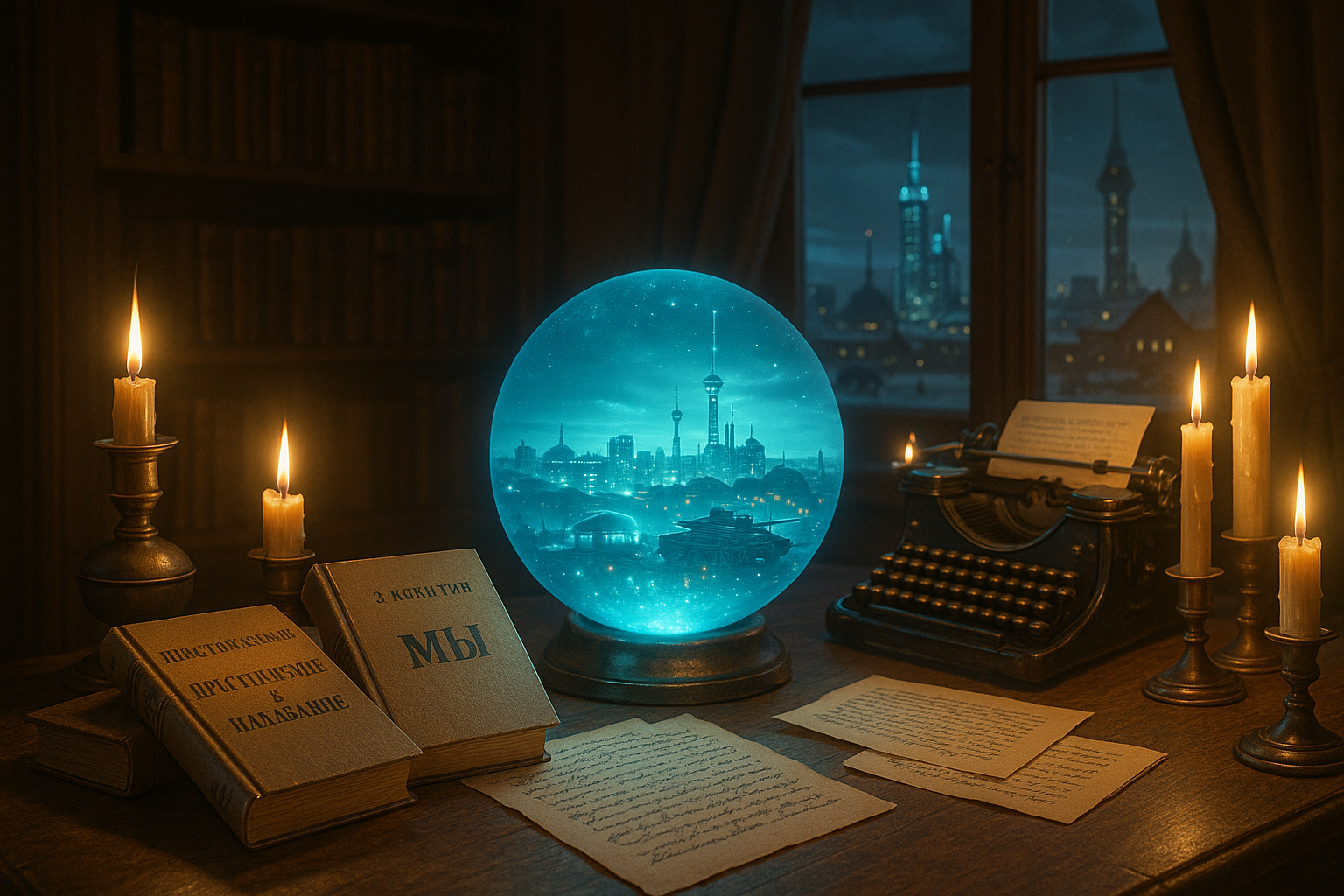
Long before mass surveillance, social credit systems, and the algorithmic manipulation of truth became part of our daily lives, Russian writers were warning us. Not with data charts or manifestos—but with novels, plays, and poems that seemed to peer through the veil of their own turbulent times and glimpse something terrifyingly familiar: our present.
What makes these literary prophecies so haunting isn’t just that they came true—it’s how eerily specific they were. In a country marked by repression, revolution, and constant reinvention, Russian writers learned to read between the lines of their society. They paid attention to patterns of power, the psychology of crowds, and the consequences of ideological purity. They didn’t predict flying cars or space tourism. Instead, they foresaw how totalitarian regimes would manipulate language, how the human spirit could be engineered, and how the very idea of truth could be dismantled and rebuilt at the whim of the state.
These were not dystopian writers because it was fashionable. They lived through censorship, exile, imprisonment, and secret police. They saw firsthand how ideas could become weapons, how belief systems could turn deadly, and how the line between utopia and nightmare is often thinner than we think.
And yet, their work is not merely grim. Within the warnings are acts of artistic resistance—unflinching attempts to preserve human dignity, memory, and conscience in the face of oblivion. To read them now is to realize that literature is not just a reflection of the past. It is a flashlight pointed at the road ahead.
In this article, we’ll explore Russian authors whose fiction didn't just speak to their times—it transcended them. Their words, once read in secret or smuggled across borders, now echo louder than ever in our hyperconnected, increasingly surveilled world. These writers saw the future. The chilling part is: they got it right.
1. Yevgeny Zamyatin – We (1921)
Prediction: Total surveillance, data-driven conformity, algorithmic control of love and desire
Zamyatin’s We is the original blueprint for dystopia. Written in 1921 and quickly banned in the Soviet Union, the novel paints a sterile future society known as the One State, where citizens live in glass houses, are assigned numbers instead of names, and even romantic encounters are scheduled by the government.
In this society, privacy doesn’t exist, individuality is seen as a sickness, and logic is worshipped as divine. The state tracks every movement, emotion, and thought. And if you deviate, there’s a solution: brain surgery to remove the imagination.
Nearly a century later, Zamyatin’s predictions feel uncannily real. From China’s social credit system to our own willingness to trade privacy for convenience, We foresaw how technological efficiency could turn into a form of soft, insidious tyranny. Even the idea of love being managed by the state—once absurd—echoes in dating apps, algorithmic compatibility tests, and digital relationship scores.
Zamyatin didn’t just invent dystopia. He saw where blind faith in progress, mathematics, and collectivism could lead when untethered from moral conscience. His legacy lives on in Orwell’s 1984—but the sharper edge belongs to him.
2. Fyodor Dostoevsky – The Devils (Demons) (1872)
Prediction: Radicalization, ideological terrorism, and political extremism as a form of moral vacuum
Dostoevsky’s The Devils is not just a philosophical novel—it’s a dissection of revolutionary psychology. Inspired by real events (specifically, a political murder by a secret group of Russian radicals), the novel examines how idealism curdles into extremism.
In a provincial Russian town, a group of young intellectuals begin as passionate reformers and end as nihilistic conspirators plotting violence for violence’s sake. Their leader, Pyotr Verkhovensky, manipulates others into chaos under the guise of liberation. But the real theme is moral rot—how the absence of spiritual grounding opens the door to ideological possession.
Fast-forward to the 20th and 21st centuries, and Dostoevsky’s vision has aged with alarming precision. Whether it’s extremist cells, cultish political movements, or online radicalization pipelines, the patterns he saw remain. Today’s ideologies may be wrapped in new symbols and hashtags, but the psychological mechanics—alienation, rage, identity crisis—are hauntingly the same.
Dostoevsky didn’t fear revolution. He feared what happens when revolutionaries forget the human soul.
3. Alexander Herzen – From the Other Shore (1849)
Prediction: The emptiness of Western liberalism, the disillusionment of progress, and the cyclical nature of history
Though less widely read than Tolstoy or Dostoevsky, Herzen was one of the most influential thinkers of 19th-century Russia. His essays and memoirs, especially From the Other Shore, are filled with sharp observations about the illusions of Western rationalism and the dangers of political absolutism.
Writing from exile in Europe after fleeing Tsarist repression, Herzen dismantled the notion that history inevitably bends toward justice. He warned that the blind pursuit of progress—especially in the name of ideology—would lead not to utopia, but to disillusionment and repeated failure. “History has no libretto,” he wrote. That single line undermined generations of Marxist, nationalist, and even neoliberal faith.
In today’s climate of rising authoritarianism, failed revolutions, and widespread civic burnout, Herzen’s skepticism feels prophetic. He predicted not a specific future, but a permanent one: the human tendency to seek certainty in systems, only to discover they are haunted by the very chaos they claim to fix.
Herzen’s works remain essential for anyone who’s ever asked: “Why do we keep making the same mistakes?”
4. Vladimir Nabokov – Invitation to a Beheading (1935)
Prediction: Absurd authoritarianism, the collapse of objective reality, and psychological manipulation through meaningless bureaucracy
Though best known for Lolita, Nabokov’s Invitation to a Beheading may be his most prescient work—written in Berlin while he watched the rise of both Nazism and Stalinism from exile. The novel’s protagonist, Cincinnatus C., is sentenced to death for the crime of “gnostical turpitude”—a charge so absurd it might as well be a punchline. The state that imprisons him is surreal, dreamlike, and disturbingly familiar.
In this world, reality is dictated by whim. Language is weaponized. Truth is a performance. The system doesn’t need to make sense—it only needs to dominate. Cincinnatus, isolated and philosophical, waits for his execution as everything around him dissolves into a performance of control.
Sound familiar?
In an age of alternative facts, deepfakes, Kafkaesque bureaucracy, and performative governance, Nabokov’s novel now reads like a warning label for the post-truth era. Invitation to a Beheading doesn’t just explore political repression—it explores the erasure of meaning itself.
5. Mikhail Bulgakov – The Master and Margarita (written 1928–40, published posthumously)
Prediction: The collision of truth and propaganda, artistic censorship, spiritual suppression under totalitarianism
Set in Stalinist Moscow, The Master and Margarita is a surreal, darkly comic novel about a devil who descends on the Soviet capital, exposing its hypocrisy, fear, and spiritual emptiness. But beneath the absurdism and fantasy lies a sharp critique of totalitarian culture—especially the fate of truth and art under censorship.
The Master, a writer driven to madness after his novel is rejected by Soviet authorities, becomes the symbolic heart of the novel. His disappearance, erasure, and eventual redemption hint at what happens when a society crushes creativity in the name of conformity.
Bulgakov understood that authoritarian regimes don’t just silence dissent—they create alternate realities. His devil, Woland, isn’t merely an agent of chaos; he’s an ironic force revealing that in a world ruled by fear, only the absurd remains sane.
Today, as artists and journalists across the world still face censorship, surveillance, and manipulation, Bulgakov’s vision holds its power. In some places, the manuscript may no longer burn—but the impulse to destroy inconvenient truths persists.
6. Andrei Platonov – The Foundation Pit (written 1930, not published until decades later)
Prediction: Dehumanization through bureaucracy, dystopian state planning, and the moral collapse of revolutionary utopias
Platonov was a true Soviet believer who became one of its most devastating literary critics—not by denouncing it, but by taking its promises seriously. In The Foundation Pit, workers dig a massive hole for a grand socialist building that will never be completed. Their efforts grow more meaningless and their lives more miserable, but the rhetoric of progress never stops.
The novel is filled with broken language, broken logic, and broken people. Its brilliance lies in how it captures the spiritual erosion that occurs when words lose their meaning, and when grand plans crush the individual.
Platonov’s dystopia wasn’t science fiction. It was documentary poetry. He saw early what others realized only after gulags and famines: that utopia, imposed from above, turns to ruin beneath the surface.
In today’s world of faceless institutions, disillusioned youth movements, and algorithmic planning detached from human needs, The Foundation Pit feels both historical and frighteningly contemporary.
7. Boris Pasternak – Doctor Zhivago (1957)
Prediction: The personal costs of history, the disappearance of private life under state ideology, and the fragility of beauty in times of upheaval
Unlike the overt dystopias of Zamyatin or Platonov, Pasternak’s Doctor Zhivago is a haunting, human-scale vision of history’s brutality. Through the eyes of Yuri Zhivago—a physician, poet, and man of conscience—we witness the Russian Revolution, the Civil War, and the suffocating rise of Soviet orthodoxy.
Zhivago’s tragedy isn’t just political. It’s existential. He tries to live a meaningful life, to love honestly, to write truthfully. But the state invades everything: art, emotion, memory. Even love becomes political.
The novel was banned in the Soviet Union but smuggled abroad, becoming a global phenomenon. Pasternak was awarded the Nobel Prize in Literature but was forced to decline it under pressure. His novel became not just a work of art but a symbol of resistance.
In our era of eroding civil liberties and politicized private life, Doctor Zhivago reminds us of what we risk losing: the right to think quietly, love freely, and live as individuals.
Frequently Asked Questions (FAQ)
Were these writers really “predicting” the future—or just writing about their own times?
Both. Most of these authors were responding to events they saw unfolding in their lifetimes—revolutions, censorship, propaganda, and repression. But in doing so, they tapped into universal patterns of human behavior and political systems. Their “predictions” arise from deep psychological and philosophical insight, not crystal balls.
How did these writers get away with publishing such controversial work?
Many didn’t. Zamyatin’s We was banned. Bulgakov’s works circulated underground. Platonov and Pasternak were suppressed, exiled, or silenced. Others were published posthumously or smuggled out of the Soviet Union. Often, they paid for their truth-telling with careers, freedom, or health.
Are these books still relevant today?
Absolutely. If anything, they’ve become more relevant. In the digital age, we face new forms of surveillance, disinformation, and ideological extremism. These authors offer insight into how systems collapse, how language can be weaponized, and how individuals survive—or fail to.
Which of these should I read first?
Start with Zamyatin’s We or Bulgakov’s The Master and Margarita if you enjoy surrealism and satire. For something more philosophical, Doctor Zhivago or Dostoevsky’s The Devils offers deep psychological and ethical inquiry. If you want a short, piercing experience, try Nabokov’s Invitation to a Beheading.
Do I need to know Russian history to enjoy these books?
No, but it helps. Understanding the historical context adds depth, but these works also stand on their own. Many modern editions include introductions or footnotes that can guide you through the cultural and political background.
A Final Thought: Learn the Language Behind the Vision
These writers saw what others couldn’t—or wouldn’t. They took enormous risks to express truths that institutions wanted buried. Their words, even in translation, retain extraordinary power. But to read them in Russian is to experience their work in full color: the poetry of their syntax, the richness of their metaphor, the subtle defiance encoded in every verb choice.
At Polyglottist Language Academy, we offer Russian language classes for passionate readers, aspiring writers, and culturally curious learners. Whether you’re a beginner hoping to read Doctor Zhivago one day or an advanced student navigating Platonov’s poetic despair, our instructors will guide you with cultural insight, historical background, and real fluency.
👉 Ready to discover the language that shaped some of the greatest visions of the 20th century? Join a class today and start your Russian journey with us.
Want to explore more about Russian language and culture?
Check out our full collection of articles on the Polyglottist Language Academy Blog, where we dive into everything from why fluent Russian isn’t fast Russian to how to survive a Russian toast and what it’s like to be the only foreigner in a Russian dacha community. Whether you're curious about grammar tips, cultural faux pas, or how Russians navigate public space, our blog offers fresh, engaging insights to support your learning journey.