
Understanding French Gender: Logic Behind the Chaos
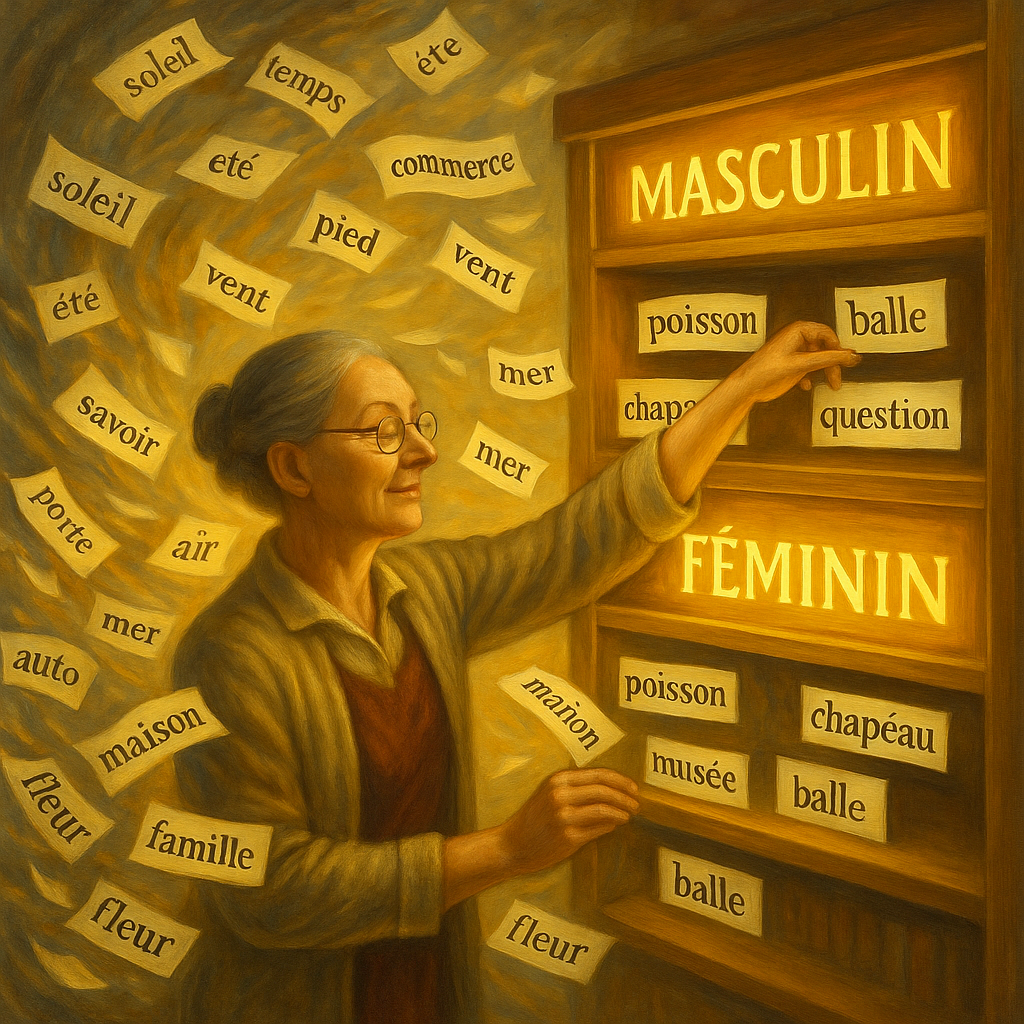
Introduction: A Wall of “Le” and “La”
You open your French textbook full of motivation. You breeze through greetings, colors, and days of the week. Then suddenly, there it is—the wall. Le chien. La voiture. Le fromage. La liberté. Masculine? Feminine? Is there a rhyme or reason? And why, in a language spoken by millions, does a table (la table) need a gender at all?
If you’ve ever shouted at your flashcards or second-guessed every noun you’ve used in a conversation, you’re not alone. For English speakers especially, French grammatical gender can feel infuriating. It seems arbitrary, contradictory, and worst of all—memorization-heavy.
But here’s the truth most textbooks don’t tell you: French gender isn’t pure chaos. There’s a structure, a rhythm, a hidden logic that—once understood—can transform the way you approach the language.
In this article, we’ll explore why gender exists in French, where it comes from historically, how to predict it more often than not, and how native speakers actually think about gender in daily use. More importantly, we’ll help you shift your mindset from fear and frustration to curiosity and clarity.
Whether you're just beginning your French journey or you've been learning for years and still trip up on le problème vs. la solution, this guide will equip you with tools, insight, and a few “aha!” moments to make French gender feel not just manageable—but almost elegant.
Let’s dive into the beautiful, bizarre, and surprisingly structured world of le genre français.
1. Why Does Gender Exist in the First Place?
Grammatical gender in French isn’t about biology—it’s about linguistic categories inherited from Latin and other Indo-European languages. Many ancient languages divided nouns into classes (some with two, some with three or more), which over time morphed into what we now call “masculine” and “feminine” in French.
It helps to reframe the concept entirely. Think of gender in French not as an expression of “male” or “female,” but simply as category A and category B. The French just happen to call them masculin and féminin.
And these categories affect everything: not just the article (le, la), but also adjectives, possessives, pronouns, and even some verb agreements. That’s why it’s so important to internalize gender early—because it’s baked into the structure of the language.
2. The Logic of Endings: Clues Hidden in Plain Sight
Here’s where the chaos starts to feel less… chaotic. Around 70–80% of French nouns follow predictable patterns based on their endings. Here are a few helpful rules:
Common Masculine Endings:
-age → le fromage, le village
-ment → le gouvernement, le moment
-isme → le tourisme, le réalisme
-oir → le miroir, le pouvoir
-é → le marché, le café (but beware exceptions like la clé)
Common Feminine Endings:
-tion / -sion → la solution, la télévision
-té / -ée → la liberté, la beauté, la mariée
-ure → la voiture, la culture
-ade / -ude → la limonade, la certitude
Once you start noticing these patterns, gender becomes much more predictable. It’s like learning to read a secret code.
Of course, there are exceptions—but they’re exceptions, not the rule. Don’t let them overshadow the larger patterns.
3. Meaning-Based Categories: When the Gender Matches the Concept
Sometimes, the logic is semantic. That is, certain meanings tend to be grouped by gender:
Languages: almost always masculine (le français, le chinois)
Days, months, seasons: masculine (le lundi, le janvier, le printemps)
Trees and metals: masculine (le chêne, le cuivre)
Sciences and disciplines: often feminine (la chimie, la philosophie)
Nouns ending in -té or -ité: typically feminine (la société, la réalité)
While not 100% consistent, these tendencies offer another layer of predictability—and context can often tip you off.
4. Compound Nouns, Animals, and Abstract Concepts
This is where things get more complex, but also more interesting:
Compound Nouns:
Often, the gender of compound nouns (un porte-monnaie, une pomme de terre) is based on the gender of the primary noun in the phrase. Sometimes it follows older grammatical rules or fossilized expressions.
Animals:
Some animals have different words for male and female versions (e.g., le coq and la poule), but many use one word with grammatical gender not necessarily linked to biological sex (la girafe can be male).
Abstract Nouns:
Abstract ideas are frequently feminine (la liberté, la joie), possibly due to Latin roots. But again—there are always exceptions (le bonheur = happiness, masculine).
5. Why Native Speakers Rarely Think About It (and You Shouldn’t Obsess)
One of the most mind-blowing realizations for learners is that native French speakers rarely consciously “know” the gender of every word. They don’t memorize le/la—they just internalize the full noun phrase.
French kids don’t learn “stylo = masculine.” They learn “un stylo.” Just like English speakers don’t think, “Table is singular”—we just know to say “the table is” and not “the table are.”
This is a powerful mindset shift: learn the noun and article together, as one inseparable unit. Don’t isolate the noun—build “chunks” of language instead.
6. Mistakes That Don’t Matter (Much)
Yes, gender agreement errors can lead to misunderstandings or grammatical awkwardness. But in casual conversation, many slip-ups are tolerated—especially from foreigners.
Saying le solution instead of la solution won’t ruin the conversation. Most French speakers will understand you and might even gently correct you. Focus more on fluency and comfort than perfection.
7. Smart Strategies to Master Gender Without Memorizing Lists
So how do you actually learn gender in a way that sticks?
📌 Think in Pairs
Always learn nouns with their articles: un livre, une maison—not livre = book. This trains your brain to associate the article naturally.
🟢 Color-Code Your Notes
Many learners highlight masculine nouns in blue and feminine ones in red/pink. Visual reinforcement works!
🧠 Use Spaced Repetition
Apps like Anki can help you drill gender patterns using smart flashcard systems.
🎯 Focus on High-Frequency Words
Start by mastering the 200–300 most common nouns. These are the ones you'll use every day.
🗣️ Say It Out Loud
Practice full sentences with the correct gender and agreement. Reinforcement through speech builds muscle memory.
8. The Joy of Mastery: Gender as a Window into French Culture
Once you stop resisting gender and start embracing its logic, something magical happens: you begin to feel the language rather than analyze it.
You’ll start noticing how la douceur (softness) and la tendresse (tenderness) have a feminine cadence that matches their meaning, or how le courage and le progrès carry a masculine weight. These aren’t just grammatical rules—they’re reflections of how French conceptualizes the world.
You begin to notice music in the language.
FAQs
Q: Why does French use only two genders—why not three like German?
French evolved from Latin, which had three genders. Over time, the neuter merged with the masculine, simplifying the system.
Q: What happens when I refer to a group of people of mixed gender?
French uses the masculine plural as the default in mixed-gender groups—e.g., les étudiants even if there’s only one male among many females.
Q: Do I need to use gender correctly to be understood?
Usually, yes. But minor mistakes (like saying le instead of la) are common and won’t derail communication.
Q: Are there any gender-neutral forms in French?
There’s no official neutral article, but some inclusive writing attempts exist—like étudiant·e·s. Spoken French, however, still leans binary.
Q: Is it true that adjectives must match gender too?
Yes! Adjectives agree in gender and number. Example: un petit chien, une petite maison.
Q: Are all countries feminine in French?
No, but many are. Countries ending in -e are often feminine (la France, la Belgique), but not all (le Mexique is masculine).
Q: Do names of cities have gender?
Most cities are considered neutral or feminine (e.g., Paris est belle), but it depends on context and expressions.
Q: Is it ever OK to ask a native speaker about gender?
Absolutely! Just phrase it naturally: “C’est le ou la…?”
Ready to Make Peace with French Grammar?
At Polyglottist Language Academy, we understand the real challenges adult learners face. Our French classes don’t just teach you what to memorize—we help you understand how French works from the inside out.
💬 Our expert instructors make gender rules intuitive, interactive, and even fun. With small class sizes and a conversation-focused approach, you'll gain confidence—not just vocabulary.
🌍 Sign up for in-person or online French classes today and start thinking—and speaking—like a native.
You Might Also Like…
Keep deepening your French learning journey with these insightful reads:
Learning French For Travel: The Fast-Track Plan For Last-Minute Trips
Must-Know French Gestures And Body Language For Travelers
How To Shop At A French Market Like A Local
What Americans Find Most Surprising About France (And How To Prepare)
Using Your French In Real Life: From Check-In To Check-Out
French Supermarket Survival Guide: What To Expect And What To Say
Avoiding Tourist Mistakes In Paris: Cultural Tips That Make A Difference
Navigating French Trains, Metros, And Buses Like A Local
French Etiquette 101: Do’s And Don’ts For Visitors
What To Pack For France: A Seasonal Guide For Smart Travelers
How Much French Do You Really Need To Know For A Trip?
How To Order At A French Café Without Embarrassing Yourself