
Do You Really Need Subjunctive? What to Master First in French Grammar
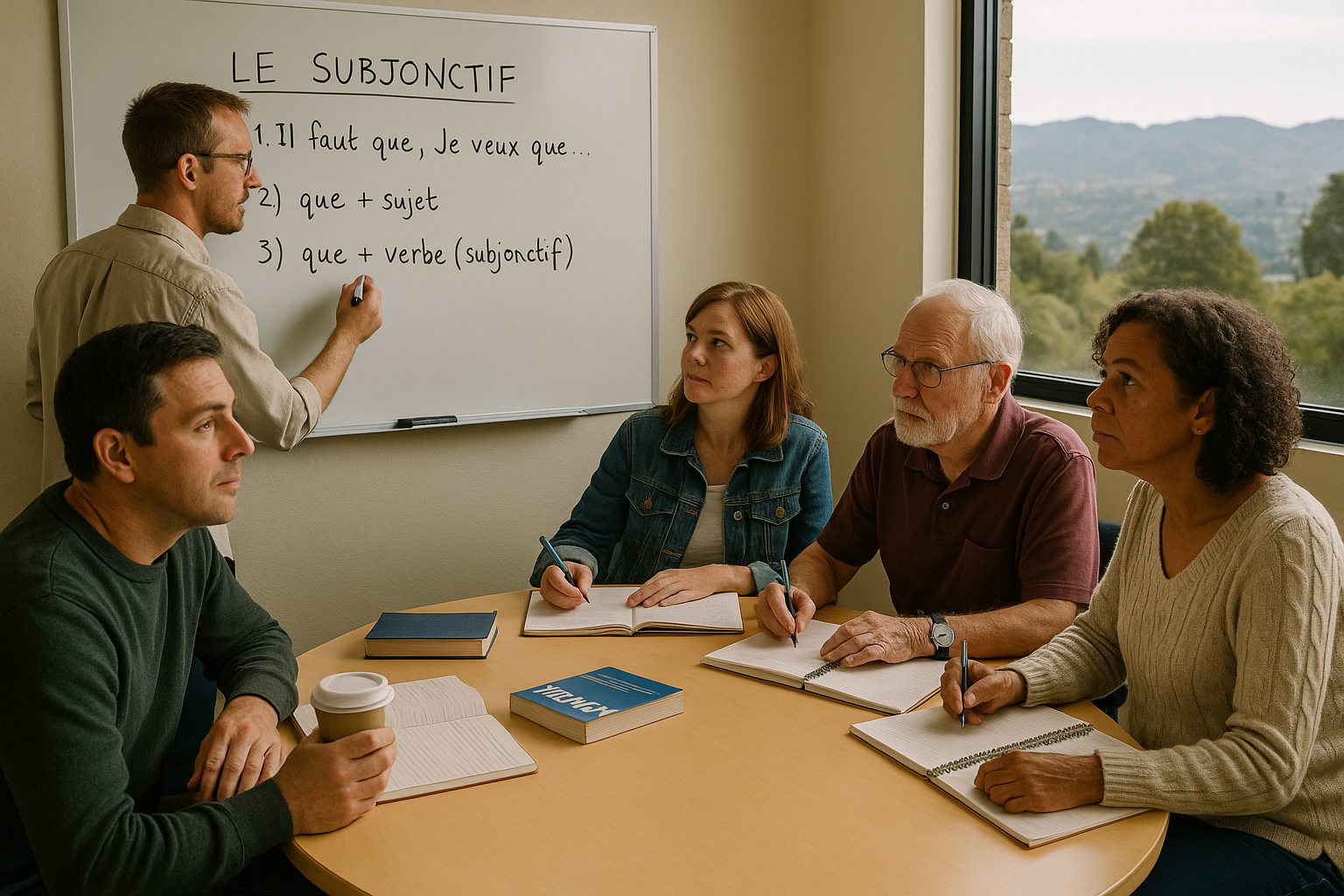
Is the subjunctive essential in French? Discover what grammar points to focus on first—and when you actually need the subjunctive to sound fluent.
Introduction: When the Subjunctive Feels Like a Wall
You’re cruising along in your French studies. You’ve got basic sentence structures down, you’re chatting about your weekend plans, and you’re even starting to understand French TV—sort of. Then suddenly, your textbook drops a bomb: le subjonctif.
Cue the confusion, frustration, and perhaps a strong desire to switch to Spanish.
The French subjunctive has long been the “grammar villain” for learners. It sounds intimidating, it behaves strangely, and it’s introduced with little explanation of why it matters. You might even start asking yourself: “Do I really need to learn this right now?”
Here’s the good news: No, you don’t need to master the subjunctive in your early stages. In fact, there are far more important—and immediately useful—grammar topics to focus on first. But when the time is right, the subjunctive opens up a whole new world of expression: emotions, opinions, hopes, doubts, and polite persuasion.
This article will guide you through the real priorities in French grammar. We’ll look at what to master first, when the subjunctive becomes essential, and how to make your grammar journey less painful and more empowering.
Part 1: What French Grammar You Should Master First (Before the Subjunctive)
Before you dive into the deep waters of the subjunctive, make sure you’ve built a strong foundation. Here's what to focus on first:
1. Present Tense of Regular and Irregular Verbs
Why it matters: The present tense is the workhorse of everyday conversation. You’ll use it in greetings, routines, descriptions, and plans.
✅ Learn:
Regular -er, -ir, -re verb conjugations
Common irregulars like être, avoir, aller, faire, venir, prendre, vouloir, pouvoir, and devoir
Example:
Je vais au marché tous les samedis. (I go to the market every Saturday.)
2. Definite and Indefinite Articles
Why it matters: Articles like le, la, un, une, and des are everywhere in French, and misusing them instantly marks you as a beginner.
✅ Learn:
When to use definite vs. indefinite
Gender agreement
How articles change in negative sentences (e.g., pas de)
Example:
J’ai une voiture. → Je n’ai pas de voiture.
3. Gender and Number Agreement
Why it matters: Every noun in French has a gender—and adjectives, articles, and past participles must agree. Mastering this will make your speech more accurate and polished.
✅ Learn:
Common endings that signal masculine or feminine
Making adjectives agree in gender and number
Irregular forms (e.g., beau → belle)
Example:
Un petit garçon, une petite fille
4. The Passé Composé (Past Tense)
Why it matters: You’ll need to talk about what you did yesterday, last week, or in the past—and the passé composé is how you do it.
✅ Learn:
Avoir vs. être as auxiliary verbs
Agreement of past participles with être
Irregular past participles
Example:
J’ai mangé une crêpe. (I ate a crepe.)
Elle est allée au cinéma. (She went to the movies.)
5. The Futur Proche
Why it matters: It’s the easiest way to talk about the future without having to learn the complex futur simple.
✅ Learn:
Conjugating aller + infinitive
Using it naturally in conversation
Example:
Je vais apprendre le français. (I’m going to learn French.)
6. Direct and Indirect Object Pronouns
Why it matters: They make your speech more natural and fluent, and they appear constantly in both spoken and written French.
✅ Learn:
How to use le, la, les and lui, leur
Placement before the verb
Using them with passé composé
Example:
Je la vois. (I see her.)
Je lui ai parlé. (I spoke to him.)
7. Basic Prepositions
Why it matters: Prepositions help you express time, place, and relationships—essentials for everyday conversations.
✅ Learn:
à, de, dans, en, chez, pour, avec, sans, sur, sous, devant, derrière
Example:
Je suis chez moi. (I’m at home.)
Il est derrière la porte. (He’s behind the door.)
Part 2: So… Do You Actually Need the Subjunctive?
Let’s be honest: native speakers don’t use the subjunctive every five seconds. But they do use it—and often—in the following situations:
When Is the Subjunctive Used?
The subjunctive is triggered by:
Emotions: Je suis content que tu sois ici.
Wishes: Je veux qu’il vienne.
Doubt: Je ne pense pas qu’il ait raison.
Necessity/obligation: Il faut que tu partes.
Possibility: C’est possible qu’il soit malade.
It’s typically used in dependent clauses that start with que.
Can You Avoid It?
At the beginner or lower-intermediate stage, yes. Native speakers will understand you just fine without it. You can often rephrase:
Instead of:
Je veux que tu fasses ça.
Try:Tu peux faire ça, s’il te plaît ?
But eventually, if you want to:
Sound polite and nuanced
Express subtle emotions or formal opinions
Understand literature, news, or more complex conversation
…you’ll need to understand and use the subjunctive.
How to Ease Into It
Rather than learning every conjugation all at once, start with the most common verbs and phrases that require the subjunctive:
Start with:
être, avoir, aller, faire, pouvoir, vouloir, savoir
Practice phrases like:
Il faut que…
Je veux que…
Bien que…
Je doute que…
Focus on high-frequency expressions. Use them often. Gradually expand.
Part 3: Common Subjunctive Myths (And What’s Actually True)
❌ Myth 1: “You need to be advanced to use the subjunctive.”
✅ Truth: You can start using it early—in limited contexts. Just like you learned “I’m going to” before “I shall,” you can master a few subjunctive chunks before diving deep.
❌ Myth 2: “It’s impossible to learn.”
✅ Truth: It’s challenging, yes—but it follows patterns. The endings are mostly consistent. If you’ve mastered the passé composé, you can handle the subjunctive.
❌ Myth 3: “Only snobs or writers use the subjunctive.”
✅ Truth: Everyday people use it—especially in polite requests, expressions of doubt, or emotionally charged statements.
FAQs: French Grammar and the Subjunctive
Q: Is it okay to ignore the subjunctive until I’m fluent?
A: You can get quite far without it—but if your goal is fluency, you’ll need it eventually, especially for expressing emotions, doubts, or formal ideas.
Q: What’s the best way to practice the subjunctive?
A: Learn it in chunks with set expressions (like il faut que, je veux que, bien que). Practice speaking and writing with them often.
Q: Do French people always use it correctly?
A: Surprisingly, no. In informal speech, even native speakers sometimes drop it or avoid it—but in writing and polite conversation, it’s expected.
Q: What are the most useful subjunctive verbs to learn first?
A: Start with être, avoir, faire, aller, pouvoir, vouloir, and savoir—they appear constantly.
Q: Can I use Google Translate to learn it?
A: Be cautious—automatic translations often skip over nuances. Better to learn from real French usage and teachers who explain why it's used.
Want to Learn French Grammar the Smart Way? Join Us at Polyglottist!
At Polyglottist Language Academy, we help learners at every level build strong grammar foundations—and make sense of the tricky stuff like the subjunctive.
Whether you’re just starting out or finally ready to tackle complex structures, our expert teachers offer:
Friendly, small-group or individual classes
Practical grammar that you’ll actually use
Clear explanations and real-time feedback
In-person and online classes available in Berkeley, Oakland, San Francisco, and beyond
👉 Ready to go from confused to confident in French grammar? Join our French classes today and speak with clarity and confidence.