
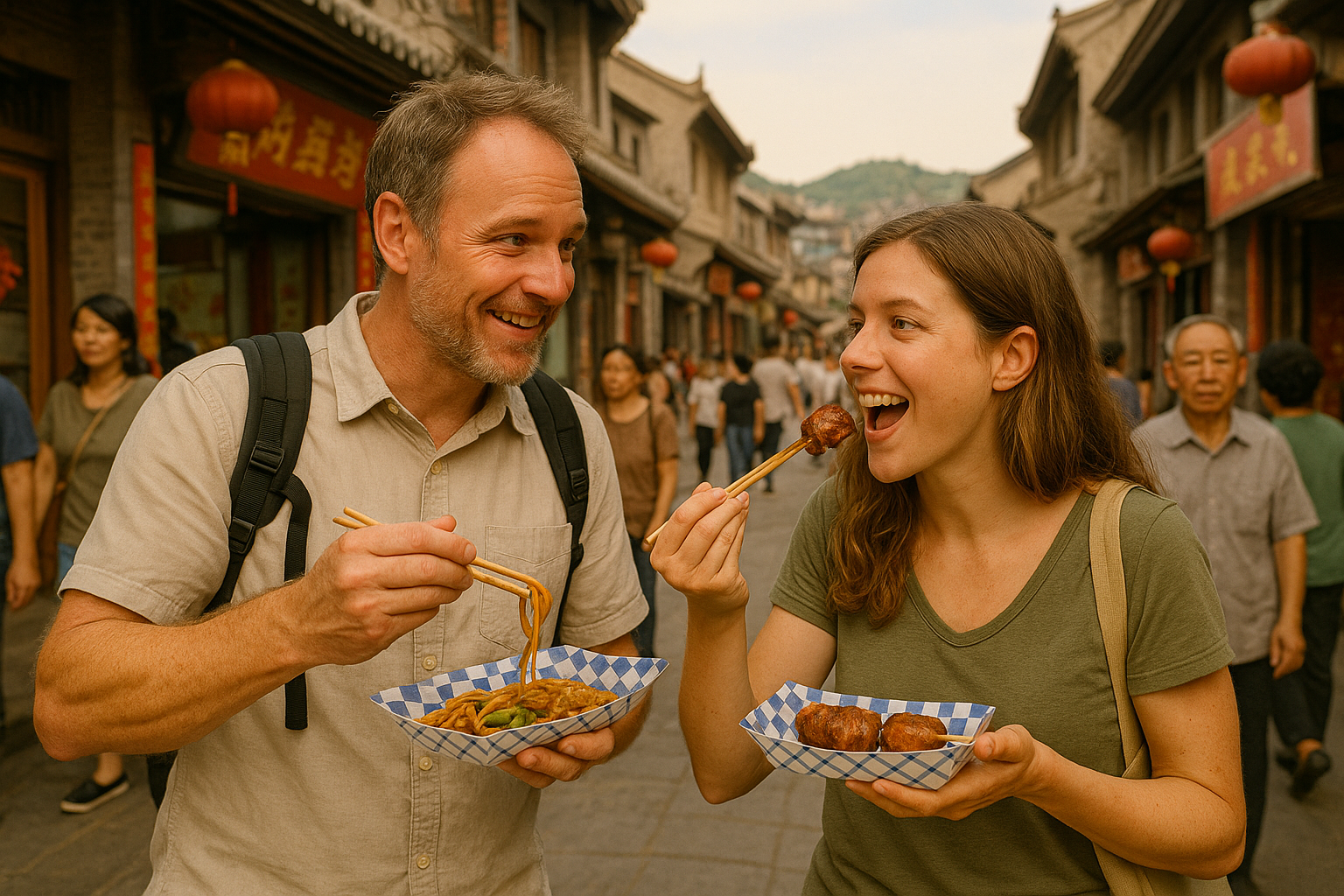
Your complete guide to navigating the sizzling, steamy, and wildly flavorful world of Chinese street food.
Introduction: Welcome to China’s Real Dining Room
If you really want to understand China, don’t start in a five-star hotel. Don’t even start in a fancy restaurant.
Start on the street.
Follow the scent of sizzling scallion oil down a narrow alleyway. Let your ears guide you to the crackle of a wok over open flame. Watch a vendor deftly twist ribbons of dough into skewers or plop rice noodles into steaming broth. Street food in China isn’t just a snack—it’s a way of life. And it’s one of the best ways to explore the country’s soul.
Street food is where Chinese culinary traditions come alive, where local flavors thrive, and where dishes are prepared fresh, fast, and with flair. It’s where grandparents and night-shift workers alike line up for late-night bowls of spicy noodles or smoky skewers. It’s where you’ll find ancient recipes passed down for generations—sometimes prepared with more care than what you'd get in a sit-down eatery.
Whether you’re traveling to China for the first time, brushing up on your Mandarin for business, or just a serious foodie, this guide will introduce you to the must-try dishes of Chinese street food culture, broken down by region and flavor profile. We’ll also share tips on how to order like a local, what to avoid, and the best cities for specific dishes.
Let’s dive into the wok-fried world of Chinese street food.
1. What Makes Chinese Street Food So Special?
Chinese street food is defined by:
Regional Diversity: Every province has its own signature snack culture.
Freshness: Vendors often make everything to order, from dumplings to noodles.
Speed and Skill: Street chefs are masters of efficiency, often with theatrical flair.
Affordability: You can eat like royalty on a backpacker’s budget.
Social Vibe: Streetside meals are informal, communal, and full of local character.
Unlike chain restaurants or mall food courts, street food brings you closer to real life in China.
🔥 In other words: skip the guidebook dinner recommendations. Follow the locals to the nearest night market.
2. Street Food Classics You Can’t Miss
Here are some iconic dishes to start with, along with what makes each one unforgettable:
A. Jianbing (煎饼) – The Chinese Breakfast Crêpe
Where: Found across northern China, especially Beijing and Tianjin
What’s in it: A thin eggy pancake spread with fermented bean paste, chili, green onions, cilantro, and a crispy fried cracker (baocui) folded inside.
Why it’s special: A textural masterpiece—crispy, savory, spicy, and fresh all at once.
B. Chuan’r (串儿) – Grilled Skewers
Where: Xinjiang-style skewers are popular nationwide, especially in northern and western cities.
What’s in it: Lamb, beef, mushrooms, or even tofu, rubbed in cumin, chili, and salt, grilled over hot coals.
Why it’s special: Street barbecue done right. Smoky, spicy, and perfect with a cold beer.
C. Roujiamo (肉夹馍) – The “Chinese Hamburger”
Where: Xi’an, Shaanxi province
What’s in it: Shredded braised pork or beef stuffed into a crispy wheat bun.
Why it’s special: It’s a thousand years older than the burger—and arguably better.
D. Stinky Tofu (臭豆腐) – Love It or Leave It
Where: Changsha (Hunan) and Nanjing, but found all over China
What’s in it: Fermented tofu deep-fried until golden and topped with chili sauce.
Why it’s special: It smells strong, but tastes rich and funky—like blue cheese meets barbecue.
E. Baozi (包子) – Steamed Stuffed Buns
Where: Nationwide
What’s in it: Fluffy white buns filled with pork, vegetables, red bean paste, or egg and chive.
Why it’s special: Portable, filling, and endlessly customizable.
F. Liangpi (凉皮) – Cold Noodles for Hot Days
Where: Shaanxi province, especially Xi’an
What’s in it: Chewy, cold wheat noodles with vinegar, garlic, cucumber, chili oil, and sometimes gluten cubes (mianjin).
Why it’s special: Refreshing, spicy, and perfectly balanced.
G. Tanghulu (糖葫芦) – Candied Fruit on a Stick
Where: Beijing and northern China
What’s in it: Hawthorn berries or grapes coated in hard sugar glaze.
Why it’s special: Sweet and tart, with a satisfying crunch.
H. Malatang (麻辣烫) – Choose-Your-Own Adventure Hotpot
Where: Found in almost every Chinese city
What’s in it: Pick your own skewers of veggies, tofu, meat, and noodles; they’re cooked in spicy Sichuan broth and served with sesame sauce.
Why it’s special: Street hotpot without the fuss—perfect for late-night cravings.
3. Best Cities for Street Food in China
Xi’an (西安) – Ancient Capital, Flavor Capital
Must-try: Roujiamo, Liangpi, Biang Biang noodles
Go to: Muslim Quarter (回民街)
Chengdu (成都) – Spicy, Funky, Fearless
Must-try: Malatang, rabbit head (!), dan dan noodles
Go to: Jinli Street or Wenshu Monastery food stalls
Beijing (北京) – Northern Bites
Must-try: Jianbing, baodu (tripe), tanghulu
Go to: Wangfujing Night Market, or better, hutong alley vendors
Guangzhou (广州) – Dim Sum Meets Street Food
Must-try: Cheung fun (rice noodle rolls), claypot rice, roast meats
Go to: Local morning markets and roadside dim sum spots
Nanjing (南京) – Subtle and Savory
Must-try: Salted duck, stinky tofu, duck blood soup
Go to: Confucius Temple area (夫子庙)
4. How to Order Street Food Like a Local
A. Learn a Few Key Phrases
“这个多少钱?” (Zhège duōshǎo qián?) – How much is this?
“不要辣。” (Bù yào là.) – No spice, please.
“来一个!” (Lái yī ge!) – I’ll take one!
“谢谢!” (Xièxiè!) – Thank you!
B. Don’t Worry About a Menu
Most stalls have pictures or dishes out in view. Just point, smile, and say what you want.
C. Carry Small Bills
Most vendors prefer WeChat or Alipay, but small cash is still helpful in rural areas or with older vendors.
D. Go Where It’s Crowded
Locals know where to eat. A line usually means the food is hot, fresh, and safe.
5. Safety Tips and Cultural Etiquette
Eat where it’s busy – turnover = fresh ingredients.
Stick to cooked foods if you have a sensitive stomach.
Use disposable chopsticks or bring your own.
Avoid raw shellfish unless you're in a reputable, coastal area.
Don’t haggle—food prices are generally fixed and cheap.
🧼 Bring tissues and hand sanitizer—public restrooms and handwashing stations are not always nearby.
6. The Culture Behind the Cuisine
Street food isn’t just about taste—it’s about ritual, rhythm, and daily life.
Morning markets buzz with breakfast vendors and early risers.
Evening stalls are places to wind down after work or study.
Night markets feel like mini carnivals with lights, smells, and crowds.
There’s often no boundary between private and public eating—families, coworkers, and students all sit side by side on low stools, slurping noodles and sharing skewers.
🌍 It’s one of the few places where cultural, social, and economic lines blur—everyone eats street food.
FAQs: Eating Chinese Street Food
Is Chinese street food safe for tourists?
Generally yes, especially at busy stalls with high turnover. Avoid lukewarm or reheated items. Stick to freshly made, piping hot dishes.
Can vegetarians enjoy Chinese street food?
Options exist (baozi with vegetables, tofu skewers, cold noodles), but be aware that many dishes include meat-based sauces or broths.
How much does street food cost in China?
Most items range from ¥5–¥20 ($0.70–$3 USD). You can enjoy a full meal for under $5.
Do vendors speak English?
Rarely. But pointing, basic Mandarin, or even translation apps like Pleco or Google Translate can go a long way.
When is the best time to eat street food?
Breakfast (6–9 am), lunchtime (11–1 pm), and evening (6–10 pm) are prime times. Night markets may stay open past midnight.
Do I need to tip street food vendors?
No. Tipping is not customary in China, and may even be politely refused.
What if I have food allergies?
Be very cautious—many vendors use shared oil and soy-based sauces. Have key phrases translated on your phone or card.
Can I find street food outside big cities?
Absolutely. In fact, some of the most authentic, regional food is found in smaller towns and rural areas.
Ready to Eat—and Speak—Like a Local?
There’s no better way to understand a culture than through its food—and no better way to understand Chinese food than by learning the language behind it.
At Polyglottist Language Academy, we offer Mandarin classes for travelers, food lovers, and culture-seekers. Whether you're heading to Beijing’s backstreets or a night market in Chengdu, we’ll help you speak with confidence, read menus with ease, and dive into local life like a pro.
👉 Sign up for our online or in-person Mandarin classes today in Berkeley, San Francisco, Oakland, San Jose, and beyond—and make your next trip to China the tastiest one yet.
📚 Hungry for More? Check Out These Articles:
What To Expect In Your First Adult Mandarin Class (And Why You’ll Love It)
How Mandarin Can Boost Your Career In The Bay Area Tech And Business Scene
Why Learning Mandarin As An Adult Is More Doable Than You Think
From Dumplings To Dialogues: How To Speak Mandarin At Bay Area Restaurants
Best Mandarin Classes For Busy Professionals In The Bay Area