
French Verb Moods Explained: Indicative, Subjunctive, Conditional, and Imperative
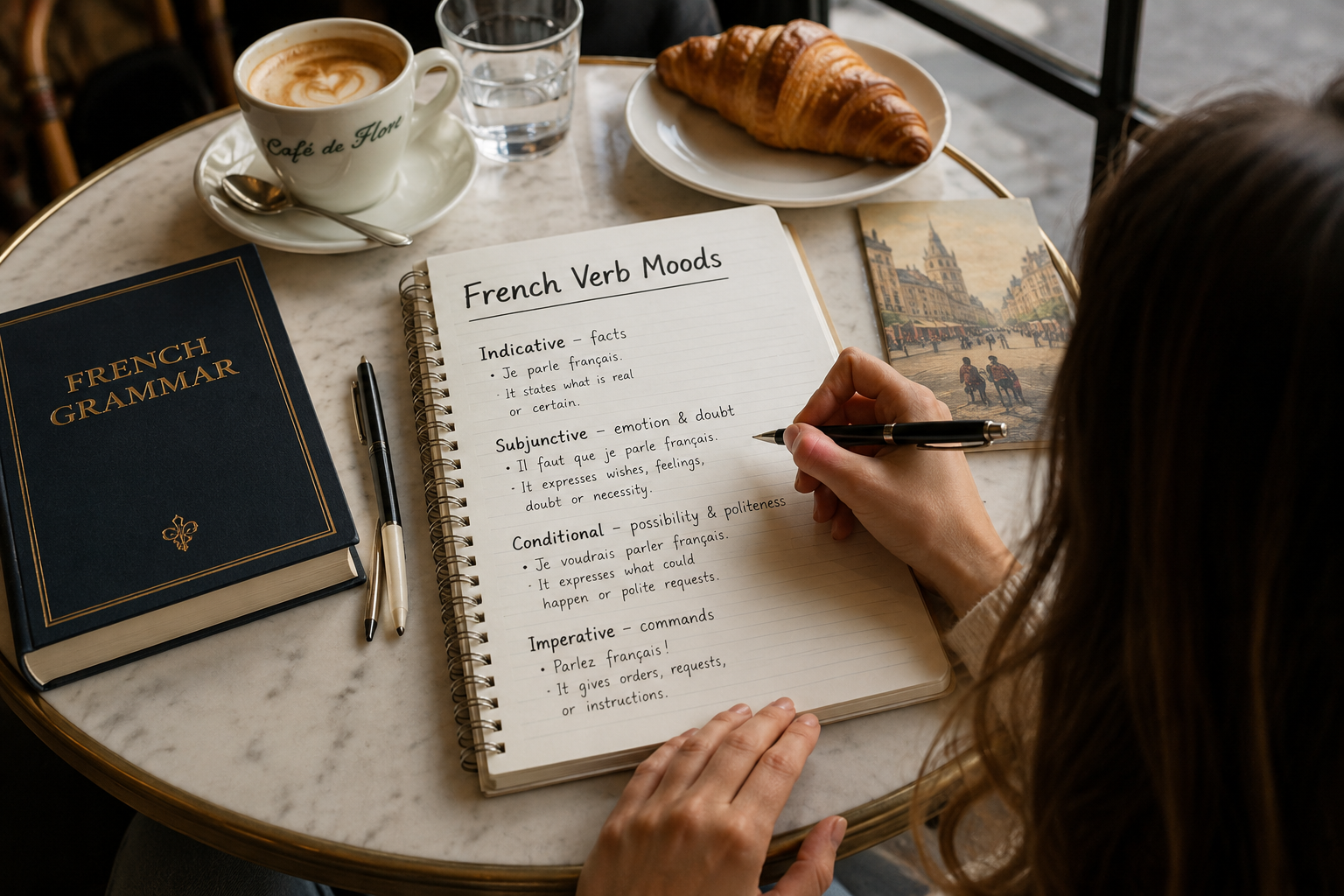
French grammar has a reputation for being elegant, precise, and, for many learners, slightly terrifying. At first, you might think the hardest part of French is pronunciation: the silent letters, the nasal vowels, the difference between u and ou, or the mysterious way French words seem to flow together in real conversation. Then you meet French verbs, and suddenly pronunciation seems like the easy part.
French verbs do a lot of work. They tell you who is speaking, who is acting, when something happened, whether something is complete or ongoing, whether something is certain or uncertain, and sometimes even how the speaker feels about it. This is why French verb charts can look so intimidating. You open a textbook and see labels like présent de l’indicatif, passé composé, imparfait, subjonctif présent, conditionnel passé, and impératif. It can feel as if French has built a grammar maze and left you at the entrance with no map.
But there is a much simpler way to understand what is going on.
When you study French verbs, you are not just memorizing endings. You are learning how French organizes meaning. French does not only ask, “When did this happen?” It also asks, “How does the speaker see this action?” Is it real? Desired? Doubtful? Hypothetical? Polite? Commanded? Imagined? Necessary? That is where verb moods come in.
A verb tense tells you when something happens: present, past, future. A verb mood tells you how the speaker is presenting the action. Is the speaker stating a fact? Expressing a wish? Giving a command? Imagining a possibility? Reacting emotionally? This distinction is one of the keys to understanding French grammar.
Think of tense as the timeline of a sentence. It tells you whether something is happening now, happened before, or will happen later. Mood is more like the lens through which the speaker views the action. The same action can appear in different moods depending on whether you are describing it as real, desired, hypothetical, or commanded.
For example, look at the verb venir — to come.
Il vient.
He is coming. / He comes.
Il faut qu’il vienne.
He has to come. / It is necessary that he come.
Il viendrait s’il pouvait.
He would come if he could.
Viens !
Come!
The basic idea is the same: someone comes. But each sentence has a different mood. The first states a fact. The second expresses necessity. The third imagines a hypothetical situation. The fourth gives a command or invitation. Same verb, different relationship to reality.
This is why French verb moods matter. They are not just decorative grammar labels. They shape the meaning, tone, and social effect of what you say. They help you sound certain, polite, emotional, doubtful, formal, direct, or nuanced. When you understand French moods, French stops feeling like a random collection of rules and starts feeling like a system.
In this guide, we will focus on the four major French verb moods that learners encounter most often: the indicative, the subjunctive, the conditional, and the imperative. Traditional grammar also discusses other forms, such as the infinitive and participle, but for everyday communication, these four moods are the ones that most directly affect how you speak, write, and understand French.
By the end of this article, you will understand what each mood does, when to use it, how it differs from the others, and why English speakers often confuse them. You will also see plenty of real French examples, because grammar becomes much easier when it is connected to actual sentences instead of isolated charts.
What Is a Verb Mood in French?
A verb mood is the grammatical form that shows the speaker’s attitude toward an action. In simpler terms, mood answers the question: “How is this action being presented?”
Is it presented as a fact?
Je parle français.
I speak French.
Is it presented as something necessary or desired?
Il faut que je parle français.
I need to speak French.
Is it presented as hypothetical?
Je parlerais français si j’habitais en France.
I would speak French if I lived in France.
Is it presented as a command?
Parlez français !
Speak French!
These sentences all involve the idea of speaking French, but they do not communicate the same thing. The first is factual. The second expresses necessity. The third imagines a condition. The fourth tells someone what to do.
That difference is mood.
French Moods vs. French Tenses
One of the biggest reasons learners get confused is that tense and mood often appear together. A textbook might say présent de l’indicatif, which means “present tense of the indicative mood.” Or it might say présent du subjonctif, which means “present tense of the subjunctive mood.”
So what is the difference?
A tense tells you when the action happens.
A mood tells you how the speaker views the action.
For example:
Je suis à Paris.
I am in Paris.
This sentence is in the present tense and indicative mood. The present tense tells us the action is happening now. The indicative mood tells us the speaker is presenting it as a fact.
Now look at this:
Je veux que tu sois à Paris.
I want you to be in Paris.
Here, sois is in the present subjunctive. The present tense still points to a current or future situation, but the subjunctive mood shows that the action is not being presented as a simple fact. It is being presented through someone’s desire.
This is why mood is so important in French. It does not simply change the form of the verb; it changes the feeling and logic of the sentence.
The Four Main French Verb Moods at a Glance
Before we look at each mood in detail, here is the basic idea.
The indicative is the mood of reality. It is used for facts, descriptions, habits, completed actions, and things the speaker presents as true.
The subjunctive is the mood of subjectivity. It is used after certain expressions of doubt, emotion, desire, necessity, possibility, and judgment.
The conditional is the mood of possibility and politeness. It is used for “would” statements, hypothetical situations, polite requests, wishes, advice, and reported information.
The imperative is the mood of action. It is used for commands, instructions, invitations, warnings, and advice.
Here is a simple comparison:
MoodWhat It ExpressesFrench ExampleEnglish TranslationIndicativeFacts and realityJe travaille aujourd’hui.I am working today.SubjunctiveDoubt, emotion, desire, necessityIl faut que je travaille aujourd’hui.I have to work today.ConditionalHypotheticals, wishes, politenessJe travaillerais si j’avais le temps.I would work if I had time.ImperativeCommands and instructionsTravaille !Work!
Now let’s look at each one more deeply.
The Indicative Mood: Talking About Reality
The indicative, or l’indicatif, is the most common French verb mood. If you are stating a fact, describing something, telling a story, asking a straightforward question, or explaining what happened, you are probably using the indicative.
The indicative is the mood of what the speaker presents as real.
For example:
Je suis fatigué.
I am tired.
Elle habite à Lyon.
She lives in Lyon.
Nous avons mangé au restaurant.
We ate at the restaurant.
Ils partiront demain.
They will leave tomorrow.
In each sentence, the speaker is presenting the information as factual. There is no doubt, wish, command, or hypothetical condition. The sentence says what is, what happened, or what will happen.
Common Indicative Tenses
The indicative includes many tenses, but learners usually begin with a few essential ones.
Présent de l’indicatif
The present indicative is used for current actions, habits, general truths, and sometimes near-future meaning.
Je parle français.
I speak French. / I am speaking French.
Nous étudions tous les jours.
We study every day.
L’eau bout à cent degrés.
Water boils at 100 degrees.
One helpful thing for English speakers to remember is that French does not have a separate present continuous form like “I am speaking.” Je parle can mean both “I speak” and “I am speaking,” depending on context.
Passé composé
The passé composé is used for completed past actions.
J’ai visité Paris.
I visited Paris.
Elle a fini ses devoirs.
She finished her homework.
Nous sommes allés au cinéma.
We went to the movies.
This tense is extremely common in conversation. If you are telling someone what you did yesterday, last week, or during your trip, you will use the passé composé often.
Imparfait
The imparfait is used for past descriptions, repeated past actions, habits, and background information.
Quand j’étais enfant, je jouais au tennis.
When I was a child, I used to play tennis.
Il faisait froid.
It was cold.
Nous habitions près de la mer.
We lived near the sea.
The difference between passé composé and imparfait is one of the classic challenges for French learners. In general, passé composé moves the story forward with completed events, while imparfait sets the scene or describes ongoing background.
Futur simple
The future indicative is used for future actions, predictions, promises, and plans.
Je partirai demain.
I will leave tomorrow.
Nous voyagerons en France l’année prochaine.
We will travel to France next year.
Tu comprendras bientôt.
You will understand soon.
In spoken French, people often use aller + infinitive for the near future:
Je vais partir demain.
I am going to leave tomorrow.
But the futur simple remains important in writing, formal speech, predictions, and more polished French.
Plus-que-parfait
The plus-que-parfait is used for an action that happened before another past action.
J’avais déjà mangé quand tu es arrivé.
I had already eaten when you arrived.
Elle avait fini son travail avant de sortir.
She had finished her work before going out.
This tense helps you organize past events clearly, especially when telling more complex stories.
When Should You Use the Indicative?
Use the indicative when you are talking about something that you present as real, factual, likely, or certain.
Je sais qu’il vient.
I know that he is coming.
Je pense qu’elle a raison.
I think she is right.
Il est certain que nous réussirons.
It is certain that we will succeed.
Notice that expressions of certainty usually take the indicative. If you believe something is true, French usually treats it as part of reality.
The indicative is your default mood. When in doubt, start there. Only move away from the indicative when the sentence has a reason to do so: doubt, emotion, desire, necessity, a hypothetical condition, or a command.
The Subjunctive Mood: Emotion, Doubt, Desire, and Necessity
The subjunctive, or le subjonctif, is probably the most famous French mood — and the one learners fear the most. But the subjunctive is not as mysterious as it seems. It is simply the mood French uses when an action is filtered through subjectivity.
The subjunctive often appears after expressions of:
emotion
desire
necessity
doubt
uncertainty
judgment
possibility
purpose
concession
In English, we often express these ideas without changing the verb much. French, however, often changes the verb form.
Compare:
Tu viens.
You are coming.
Je veux que tu viennes.
I want you to come.
The first sentence is indicative. The speaker presents your coming as a fact. The second sentence is subjunctive. Your coming is not presented as a fact; it is presented as someone’s desire.
That is the heart of the subjunctive.
Common Subjunctive Triggers
The subjunctive is often triggered by certain expressions. Instead of trying to understand the whole subjunctive at once, it helps to learn these expressions as chunks.
Necessity and obligation
Il faut que tu viennes.
You have to come.
Il est nécessaire que nous partions tôt.
It is necessary that we leave early.
Il est important que vous compreniez.
It is important that you understand.
The expression il faut que is one of the most common subjunctive triggers in French. You will hear it everywhere.
Desire and preference
Je veux que tu réussisses.
I want you to succeed.
Je préfère qu’elle reste ici.
I prefer that she stay here.
J’aimerais que nous parlions demain.
I would like us to talk tomorrow.
These sentences express what someone wants, not what is necessarily true.
Emotion
Je suis content que tu sois ici.
I am happy that you are here.
Elle est triste qu’il parte.
She is sad that he is leaving.
C’est dommage que vous ne puissiez pas venir.
It is a shame that you cannot come.
The event may be real, but the sentence focuses on someone’s emotional reaction to it. That emotional framing often requires the subjunctive.
Doubt and uncertainty
Je ne pense pas qu’il vienne.
I do not think he is coming.
Il n’est pas certain qu’elle ait raison.
It is not certain that she is right.
Je doute que ce soit possible.
I doubt that it is possible.
When certainty disappears, the subjunctive often appears.
Possibility and judgment
Il est possible que nous ayons tort.
It is possible that we are wrong.
Il est normal que tu sois nerveux.
It is normal that you are nervous.
Il est étrange qu’il ne réponde pas.
It is strange that he is not answering.
These expressions do not simply state facts. They evaluate, judge, or present something as possible rather than certain.
Conjunctions That Often Trigger the Subjunctive
Certain conjunctions are strongly associated with the subjunctive:
bien que — although
pour que — so that
afin que — in order that
avant que — before
à condition que — provided that
sans que — without
quoique — although
Examples:
Bien que ce soit difficile, je continue.
Although it is difficult, I continue.
Je travaille pour que tu sois fier de moi.
I work so that you will be proud of me.
Nous partirons avant qu’il arrive.
We will leave before he arrives.
The important thing is not just the word que. Many learners mistakenly think que automatically means subjunctive. It does not. The trigger is the expression or meaning before que.
Indicative vs. Subjunctive: The Mood Can Change the Meaning
Some expressions can take either the indicative or the subjunctive depending on certainty.
Je pense qu’il est là.
I think he is there.
Je ne pense pas qu’il soit là.
I do not think he is there.
In the first sentence, the speaker presents the idea as something they believe. In the second, the speaker expresses doubt. That doubt triggers the subjunctive.
Another example:
Il est certain qu’elle a raison.
It is certain that she is right.
Il n’est pas certain qu’elle ait raison.
It is not certain that she is right.
The difference is not the time of the action. It is the speaker’s attitude toward the action.
Is the Subjunctive Still Used in Modern French?
Yes. The subjunctive is absolutely used in modern French. It is not just literary, old-fashioned, or reserved for formal writing. Native speakers use it constantly in common expressions like:
Il faut que…
It is necessary that…
Je veux que…
I want…
Bien que…
Although…
Pour que…
So that…
Je suis content que…
I am happy that…
You do not need to master every rare subjunctive form as a beginner. But you should not ignore the subjunctive entirely. Start with the most common expressions, and you will quickly recognize it in real French.
The Conditional Mood: Hypotheticals, Wishes, and Politeness
The conditional, or le conditionnel, is the mood of “would.” It is used to express hypothetical situations, wishes, polite requests, advice, and information that is reported but not confirmed.
For English speakers, the conditional often feels more intuitive than the subjunctive because English uses “would” very clearly.
Je voudrais un café.
I would like a coffee.
J’aimerais visiter Montréal.
I would like to visit Montreal.
Si j’avais le temps, je voyagerais plus.
If I had time, I would travel more.
In each case, the action is not presented as a simple fact. It is imagined, desired, softened, or dependent on a condition.
The Conditional for Politeness
One of the most useful functions of the conditional is politeness. In French, the conditional can soften a request and make it sound more courteous.
Compare:
Je veux un café.
I want a coffee.
Je voudrais un café.
I would like a coffee.
The first sentence is grammatically correct, but it can sound too direct in many situations. The second is much more polite and natural.
Other examples:
Pourriez-vous répéter, s’il vous plaît ?
Could you repeat, please?
Auriez-vous une table pour deux ?
Would you have a table for two?
Je souhaiterais prendre rendez-vous.
I would like to make an appointment.
For travelers, professionals, and adult learners, the conditional is one of the fastest ways to sound more refined in French.
The Conditional for Hypothetical Situations
The conditional is also used in “if” sentences.
A very common pattern is:
Si + imparfait, conditionnel présent
For example:
Si j’avais plus de temps, j’apprendrais l’italien.
If I had more time, I would learn Italian.
Si nous habitions à Paris, nous irions souvent au théâtre.
If we lived in Paris, we would often go to the theater.
Si elle savait la réponse, elle nous le dirait.
If she knew the answer, she would tell us.
Notice that French does not use the conditional in both parts of this kind of sentence. English says “If I had time, I would travel.” French says the equivalent of “If I had time, I would travel” too — but the si clause uses the imparfait, not the conditional.
Correct:
Si j’avais le temps, je voyagerais.
Incorrect:
Si j’aurais le temps, je voyagerais.
This is one of the most common mistakes learners make.
The Conditional for Advice
The conditional can also express advice, especially with devoir.
Tu devrais te reposer.
You should rest.
Vous devriez pratiquer un peu chaque jour.
You should practice a little every day.
On devrait partir plus tôt.
We should leave earlier.
This is softer than a command. Instead of telling someone what to do directly, you are suggesting what would be wise.
The Conditional for Reported or Unconfirmed Information
In journalism and formal French, the conditional can signal that information is reported but not confirmed.
Le ministre aurait démissionné.
The minister is said to have resigned.
Il y aurait plusieurs témoins.
There are reportedly several witnesses.
This use is more advanced, but it is helpful if you read French news or formal writing.
Conditional vs. Future
The future expresses something the speaker presents as expected or planned.
Je partirai demain.
I will leave tomorrow.
The conditional expresses something dependent, hypothetical, polite, or uncertain.
Je partirais demain si je pouvais.
I would leave tomorrow if I could.
The forms can look similar:
Je parlerai.
I will speak.
Je parlerais.
I would speak.
In writing, the difference is only one letter. In pronunciation, the difference can be subtle depending on the accent. But in meaning, the distinction is very important.
Conditional vs. Subjunctive
Learners often confuse the conditional and the subjunctive because both move away from simple fact. But they do different jobs.
The conditional usually expresses an outcome, possibility, wish, or polite request.
Je voudrais venir.
I would like to come.
The subjunctive expresses a subjective attitude toward another action.
Je voudrais que tu viennes.
I would like you to come.
This sentence beautifully shows both moods together. Je voudrais is conditional because it expresses a polite wish. Tu viennes is subjunctive because it is the desired action.
Another example:
Si j’étais libre, je viendrais.
If I were free, I would come.
Il faut que je vienne.
I have to come.
The first sentence is hypothetical. The second expresses necessity. That is the difference.
The Imperative Mood: Commands, Instructions, and Invitations
The imperative, or l’impératif, is the mood used to tell someone to do something. It can be a command, but it can also be advice, encouragement, instruction, or invitation.
Examples:
Écoutez bien.
Listen carefully.
Parle plus lentement.
Speak more slowly.
Allons-y !
Let’s go!
Ne t’inquiète pas.
Don’t worry.
The imperative is direct because it does not use a subject pronoun. You do not say Tu parle ! or Vous écoutez ! when giving a command. You say:
Parle !
Speak!
Écoutez !
Listen!
The Three Forms of the Imperative
French imperative forms exist mainly for tu, nous, and vous.
Tu commands
Use tu commands with people you know well, children, close friends, family members, or in informal situations.
Regarde !
Look!
Viens ici.
Come here.
Ne parle pas trop vite.
Do not speak too fast.
For regular -er verbs, the final s disappears in the tu imperative:
Tu parles.
You speak.
Parle !
Speak!
Nous commands
The nous imperative means “let’s…”
Allons-y !
Let’s go!
Parlons français.
Let’s speak French.
Essayons encore une fois.
Let’s try one more time.
This form is useful because it sounds collaborative rather than bossy.
Vous commands
Use vous commands for formal situations, groups, strangers, clients, students, or polite instructions.
Écoutez bien.
Listen carefully.
Entrez, s’il vous plaît.
Come in, please.
Attendez ici.
Wait here.
This form is common in classrooms, public signs, customer service, and formal interaction.
Positive and Negative Commands
Positive commands are simple:
Fermez la porte.
Close the door.
Donne-moi le livre.
Give me the book.
Negative commands use ne… pas around the verb and place pronouns before the verb.
Ne fermez pas la porte.
Do not close the door.
Ne me donne pas le livre.
Do not give me the book.
Pronoun placement changes in affirmative commands:
Donne-le-moi.
Give it to me.
But in negative commands:
Ne me le donne pas.
Do not give it to me.
This detail takes practice, but it becomes easier once you learn the imperative as a pattern rather than as isolated forms.
Is the Imperative Rude in French?
The imperative is not automatically rude. It depends on context, tone, relationship, and wording.
A teacher saying Écoutez bien is perfectly normal. A friend saying Viens ! can sound warm and enthusiastic. A recipe saying Ajoutez le beurre is simply giving instructions.
But the imperative can sound abrupt if used with strangers or in situations where politeness is expected. For example:
Fermez la fenêtre.
Close the window.
This may be appropriate in a classroom or emergency, but in everyday conversation you might soften it:
Vous pourriez fermer la fenêtre, s’il vous plaît ?
Could you close the window, please?
Or:
Est-ce que vous pouvez fermer la fenêtre ?
Can you close the window?
French politeness often depends less on grammar alone and more on choosing the right level of directness.
Why English Speakers Struggle with French Verb Moods
French verb moods are not impossible, but they do require a shift in thinking. English speakers often struggle for several predictable reasons.
1. They confuse mood and tense
Many learners think “present,” “past,” and “future” are the main categories. But French asks you to notice both time and attitude.
Je viens and que je vienne may both refer to present or future meaning, but they belong to different moods.
2. They overuse the indicative
Because the indicative is the default mood, learners often use it everywhere.
Incorrect:
Il faut que tu viens.
Correct:
Il faut que tu viennes.
The learner understands the meaning but has not yet learned that il faut que requires the subjunctive.
3. They avoid the subjunctive
Some learners decide the subjunctive is too advanced and avoid it completely. But then they struggle with very common French expressions.
You do not need to master every subjunctive form immediately. But you should learn high-frequency phrases such as:
Il faut que…
Je veux que…
Bien que…
Pour que…
Je suis content que…
4. They translate directly from English
English and French do not always organize ideas the same way.
English: I want you to come.
French: Je veux que tu viennes.
A direct word-for-word translation can lead to mistakes. French often uses a que clause where English uses an object plus infinitive.
5. They use the conditional where French needs the subjunctive
Incorrect:
Je suis content que tu viendrais.
Correct:
Je suis content que tu viennes.
In English, learners may feel that “would come” expresses uncertainty or possibility. But in French, after an emotional expression like je suis content que, the subjunctive is required.
How to Practice French Verb Moods
The best way to learn moods is not to memorize huge charts all at once. It is to connect each mood to real communication.
Learn phrase patterns
Instead of learning “the subjunctive” in the abstract, learn:
Il faut que je…
Je veux que tu…
Bien que ce soit…
Pour que nous puissions…
Instead of learning “the conditional” in the abstract, learn:
Je voudrais…
J’aimerais…
Pourriez-vous…
Si j’avais…, je ferais…
These chunks help your brain predict the grammar naturally.
Practice one verb in four moods
Choose one common verb and use it in different moods.
Example with venir:
Il vient.
He is coming.
Il faut qu’il vienne.
He has to come.
Il viendrait s’il pouvait.
He would come if he could.
Viens !
Come!
This exercise helps you see that mood is not random. It changes the speaker’s relationship to the action.
Start with the most useful forms
Beginners should focus first on the present indicative, passé composé, and basic imperative forms. These are immediately useful for everyday communication.
Low intermediate learners can add the conditional for politeness and hypothetical sentences.
Intermediate learners should begin using common subjunctive triggers more actively.
Advanced learners can refine subtler uses, such as conditional in reported information, subjunctive after certain conjunctions, and differences between formal and informal usage.
Listen for moods in real French
When watching French videos, listening to podcasts, or reading dialogues, pay attention to expressions like:
Il faut que…
Je voudrais…
Tu devrais…
Bien que…
Allons-y…
Ne t’inquiète pas…
You will begin to notice that moods are everywhere. They are not hidden in grammar books; they are part of everyday French.
Why French Verb Moods Matter in Real Conversation
French moods are not just about correctness. They are about nuance.
The indicative helps you describe reality clearly.
Je comprends.
I understand.
The subjunctive helps you express emotion, doubt, and desire.
Je suis heureux que tu comprennes.
I am happy that you understand.
The conditional helps you sound polite and thoughtful.
Je voudrais comprendre.
I would like to understand.
The imperative helps you guide action.
Comprends bien ceci.
Understand this clearly.
Each mood gives you a different communicative tool. Without them, your French may still be understandable, but it can sound flat, overly direct, or imprecise. With them, you can express not only what happened, but how you feel about it, how certain you are, what you wish would happen, and what you want someone else to do.
That is the real beauty of French verb moods. They allow language to become more than information. They make it emotional, social, polite, persuasive, and human.
FAQ: French Verb Moods Explained
What are the four main French verb moods?
The four main French verb moods learners use most often are the indicative, subjunctive, conditional, and imperative. The indicative states facts and reality. The subjunctive expresses doubt, emotion, desire, necessity, or subjectivity. The conditional expresses hypotheticals, wishes, politeness, and “would” statements. The imperative gives commands, instructions, advice, or invitations.
What is the difference between tense and mood in French?
Tense tells you when an action happens: present, past, or future. Mood tells you how the speaker views the action: as a fact, a wish, a doubt, a command, or a hypothetical possibility. For example, je parle is present indicative, while que je parle may be present subjunctive. Both can refer to present time, but they express different attitudes.
Which French mood should beginners learn first?
Beginners should start with the indicative because it is the most common mood and appears in basic sentences, descriptions, questions, and everyday conversations. The imperative is also useful early because it appears in classroom instructions and travel phrases. The conditional and subjunctive can be introduced gradually as learners become more comfortable with sentence structure.
When do you use the subjunctive in French?
Use the subjunctive after many expressions of desire, emotion, doubt, necessity, possibility, judgment, and uncertainty. Common triggers include il faut que, je veux que, bien que, pour que, avant que, je suis content que, and il est possible que. The subjunctive usually appears in a dependent clause introduced by que.
Is the French subjunctive still used today?
Yes. The subjunctive is still widely used in modern French, both in speaking and writing. It appears in everyday expressions such as il faut que tu viennes, je veux que tu saches, and bien que ce soit difficile. Learners do not need to master every rare form immediately, but they should learn the most common triggers.
What is the difference between the conditional and the subjunctive?
The conditional usually expresses what would happen, what someone would like, or how to make a polite request. The subjunctive expresses doubt, emotion, necessity, desire, or subjectivity, usually in a dependent clause. For example, je voudrais venir uses the conditional, while je voudrais que tu viennes uses both the conditional and the subjunctive.
Is the imperative rude in French?
The imperative is not automatically rude. It is normal in instructions, recipes, classroom language, invitations, and friendly commands. However, it can sound too direct depending on the context. To sound more polite, you can use s’il vous plaît, the vous form, a question, or the conditional: Pourriez-vous fermer la fenêtre ?
How can I practice French verb moods?
Practice moods through real sentence patterns rather than isolated charts. Learn common phrases like je voudrais, il faut que, si j’avais, and allons-y. Try using the same verb in different moods: il vient, il faut qu’il vienne, il viendrait, viens !Reading, listening, and speaking with feedback are also essential.
Do French moods matter in conversation?
Yes. French moods help you express certainty, doubt, politeness, emotion, wishes, and commands. They make your French more precise and natural. Even if people understand you without perfect mood usage, learning moods helps you sound more fluent, educated, and socially aware.
What is the easiest French mood?
The indicative is usually the easiest because it is the default mood and the one learners use first. Most basic French sentences use the indicative. The imperative is also fairly easy once you learn the three main forms: tu, nous, and vous. The subjunctive usually takes more time because it depends on triggers and sentence structure.
Learn French with Polyglottist Language Academy
At Polyglottist Language Academy, we help students move beyond memorization and understand how French actually works in real life.
Our French classes are designed for adult learners who want clear explanations, practical speaking practice, and a deeper connection to French language and culture. Whether you are a complete beginner, a returning learner, an intermediate student trying to finally understand the subjunctive, or an advanced speaker refining your grammar and fluency, we can help you build confidence step by step.
Polyglottist Language Academy offers French classes online and in the Bay Area, along with classes in other world languages such as Italian, Spanish, German, Russian, Japanese, Portuguese, Dutch, Korean, Mandarin, Tagalog, Vietnamese, and more. Our small-group and private classes are warm, structured, and conversation-focused, so you can learn grammar without feeling overwhelmed by it.
If you are ready to make French grammar feel logical, elegant, and usable, we invite you to join one of our French classes at Polyglottist Language Academy. Learn with expert instructors, practice with real people, and discover how much more expressive your French can become.
Check Out Our Other Blog Articles
If you enjoyed this guide to French verb moods, you may also like these related articles from the Polyglottist Language Academy blog: