
Why Portugal Is the Oldest Nation in Europe (and Why That Matters)
Look at Portugal on a map and one of the most interesting things about the country is also one of the easiest to overlook. Its long eastern border with Spain seems completely ordinary. Portugal is on one side, Spain is on the other, and the Atlantic wraps around the rest of the country. Yet most of that line has been recognizable for more than seven centuries.
That is remarkable in Europe, where kingdoms have disappeared, empires have broken apart, and borders have repeatedly been redrawn. Portugal, by comparison, emerged as a separate kingdom in the 12th century, acquired most of its modern mainland shape during the Middle Ages, and established much of its frontier with Castile by the end of the 13th century.
This unusual continuity is behind the familiar statement that Portugal is the oldest nation in Europe, or sometimes the oldest nation-state in Europe. The claim needs some qualification. San Marino, Denmark, England, Bulgaria, Hungary, and France can all make older claims depending on whether we are talking about republican government, monarchy, political unification, or statehood. The modern idea of a nation-state does not fit neatly onto the political world of the 1100s either.
What makes Portugal unusual is the particular combination of early political independence, remarkably stable mainland borders, a language that developed with the support of its own royal institutions, and a strong sense of political separateness that survived repeated crises. That story is considerably more interesting than trying to decide which European country deserves the earliest birthday.
Portugal Did Not Break Away From a Unified Spain
One of the easiest mistakes to make when thinking about Portuguese history is to imagine that Portugal separated from Spain. Looking backward from a modern map, that seems logical, but medieval Iberia looked nothing like the two-country peninsula we know today.
There was no unified Spanish nation-state sitting beside a rebellious Portuguese territory in the early 12th century. The peninsula was divided among Christian kingdoms and Muslim-ruled territories whose borders, alliances, and dynasties changed repeatedly. León, Castile, Aragon, Navarre, Galicia, and the territory that became Portugal followed different political paths, while large parts of Iberia had belonged to various Muslim states since the conquest that began in 711.
Nor can modern Portugal simply be traced back to Roman Lusitania, despite the continuing cultural resonance of the name. Lusitania included much of what is now central and southern Portugal but also extended into present-day Spain, while areas of northern Portugal lay outside the Roman province. Roman rule mattered enormously, particularly because Latin eventually developed into the Romance languages of Iberia, but Roman Lusitania was not an early version of the Portuguese nation.
The more immediate political story begins in the Christian north. Around 1095 or 1096, Henry of Burgundy received control of the County of Portugal from Alfonso VI of León and Castile after marrying Alfonso's daughter Teresa. The county was formally subordinate to León and centered largely in the northwest, between the Minho and Douro rivers. Galicia lay to the north, León and Castile to the east, Muslim-controlled territories remained farther south, and the Atlantic formed its western edge.
This frontier county was not yet a country, although it contained the political base from which one would emerge.
Henry died in 1112, leaving Teresa to rule while their son, Afonso Henriques, was still young. As Afonso grew older, Teresa's close political relationship with the Galician nobleman Fernão Peres de Trava created tensions with sections of the Portuguese nobility, who increasingly rallied around her son.
The conflict culminated on June 24, 1128, at the Battle of São Mamede, near Guimarães. Afonso's supporters defeated Teresa's faction, giving him effective control of the county.
This helps explain why Guimarães is so strongly associated with the birth of Portugal. The connection is not simply a later tourism slogan. The region really was at the center of the political struggle from which the independent kingdom developed, and the castle and medieval streets make that early history unusually easy to visualize today.
Still, São Mamede did not produce Portugal in a single afternoon. Independence emerged over several decades, which is why there are multiple reasonable answers to the question of when Portugal was founded.
In 1139, Afonso's victory at the Battle of Ourique became associated with his assumption of the royal title. Later Portuguese tradition embellished the story with a miraculous appearance of Christ before the battle, but historians treat that religious narrative as a later development rather than straightforward contemporary evidence.
The more important diplomatic turning point came in 1143, with the Treaty or Conference of Zamora. Alfonso VII of León and Castile accepted Afonso Henriques's autonomy, which is why 1143 is so frequently used as Portugal's conventional foundation date.
Recognition was still developing, however. In 1179, Pope Alexander III issued the papal bull Manifestis Probatum, formally recognizing Afonso's royal title and Portugal as a kingdom. Papal approval carried considerable political weight in medieval Latin Christendom and strengthened Portugal's position among other Christian powers.
Rather than searching for a single birthday, it is more useful to see 1128, 1139, 1143, and 1179 as stages in the same process. Afonso first secured control of the county, claimed royal authority, gained acceptance from his Iberian rival, and finally received papal recognition.
How Portugal Acquired Its Familiar Shape
The kingdom ruled by Afonso Henriques was still much smaller than modern Portugal. Portuguese rulers continued expanding southward during the long and complicated process conventionally known as the Reconquista.
Santarém and Lisbon were captured in 1147. Lisbon's position on the Tagus would later make it one of Europe's most important Atlantic ports, but at this point it was part of a kingdom whose southern frontier was still moving.
That expansion continued for another century. In 1249, under Afonso III, Portuguese forces captured Faro. The conquest is traditionally treated as the completion of the Portuguese Reconquista and gave the kingdom most of the north-to-south mainland shape that is familiar today.
The eastern frontier still had disputed sections, and the crucial settlement came in 1297, when King Dinis of Portugal and Ferdinand IV of Castile concluded the Treaty of Alcañices. The agreement settled or confirmed much of the boundary between the two kingdoms.
A striking amount of that medieval frontier survives as the modern border between Portugal and Spain.
This is probably the strongest part of Portugal's claim to exceptional national longevity. Many European political entities have ancient origins, but far fewer combine those origins with a territorial outline that became recognizable so early.
The familiar claim that Portugal's borders have been completely unchanged since 1297 is nevertheless too neat. The most important exception is Olivença, or Olivenza in Spanish. The territory had belonged to Portugal but was occupied by Spain during the War of the Oranges in 1801. Spain administers it today, while Portugal has historically disputed Spanish sovereignty over the area.
Portugal's mainland frontier is therefore better described as exceptionally stable rather than literally unchanged.
The border itself also has a cultural history that is easy to miss when looking at a map. In Portuguese, the frontier region is commonly known as A Raia, and in Spanish as La Raya. For centuries, the people living there traded, married across the boundary, moved livestock, shared local customs and linguistic features, and sometimes smuggled goods when official regulations got in the way.
The line mattered politically, but daily life did not stop at it. Portugal developed a distinct political identity through its separation from neighboring Iberian kingdoms while remaining deeply connected to them culturally and economically.
The Portuguese Language Grew Up Alongside the Country
The history of Portuguese makes this relationship particularly clear. Portuguese did not begin as a western form of Spanish, nor did it develop in isolation from the rest of the peninsula. Its closest medieval relationship was with Galician.
Northern Portugal and Galicia once belonged to the same broad linguistic area, conventionally called Galician-Portuguese. During the Middle Ages, it became an important literary language, especially for lyric poetry, and was used on both sides of what eventually became the Portugal-Galicia border.
Political history gradually pushed the language in different directions. Independent Portugal developed its own court, administration, written traditions, and institutions. Galicia became increasingly integrated into the Crown of Castile, where Castilian gained greater political and linguistic influence.
The family relationship is still easy to see. Portuguese janela and Galician xanela both mean “window,” while Portuguese muito and Galician moito remain visibly related. They are distinct modern languages, but they preserve traces of a shared medieval linguistic world.
King Dinis, who ruled from 1279 to 1325, sits at an especially interesting point in this development. He was the Portuguese king associated with the Treaty of Alcañices, but his reign also saw Portuguese increasingly used in royal administration in place of Latin. Dinis himself wrote poetry in the Galician-Portuguese lyric tradition.
This means that around the same period Portugal was stabilizing its territorial frontier, Portuguese was gaining a stronger place in the institutions of government. The border did not create the language, and the language did not create the border, but political independence helped give Portuguese the institutional environment in which it could develop separately.
That connection between language and political history would eventually have consequences far beyond Iberia.
Independence Had to Be Defended More Than Once
Portugal's longevity can look almost effortless in retrospect. Once we see more than eight centuries of continuity on a timeline, it is tempting to assume that independence became permanent after the 12th century. In reality, there were moments when the kingdom could easily have followed a very different path.
One of the most serious came after King Fernando I died in 1383 without a legitimate male heir. His daughter Beatrice was married to John I of Castile, raising the possibility of a union of the crowns and much greater Castilian control over Portugal.
Portuguese political factions divided over the succession, with opposition eventually rallying around João, Master of Aviz, an illegitimate half-brother of Fernando. In 1385, the Cortes at Coimbra recognized him as King João I.
Castile attempted to settle the issue militarily. The decisive encounter came on August 14, 1385, at the Battle of Aljubarrota, where Portuguese forces defeated a larger Castilian army. João's position was secured, the Aviz dynasty survived, and Portugal remained politically separate.
Anyone visiting Portugal can still see how important that victory became in national memory. The Monastery of Batalhawas built in connection with João's vow commemorating Aljubarrota and remains one of the country's great Gothic monuments. A medieval succession crisis that might otherwise feel remote is preserved there on an enormous architectural scale.
Portugal faced another dynastic crisis almost two centuries later. After the deaths of King Sebastian and his successor Cardinal Henry, Philip II of Spain claimed the Portuguese throne. In 1580, he became Philip I of Portugal, beginning the 60-year period known as the Iberian Union.
It is sometimes described simply as the period when Portugal “became part of Spain,” but the arrangement was more complicated. Portugal and the Spanish monarchy shared Habsburg rulers while Portugal retained its own laws, institutions, administration, and significant aspects of its overseas empire. Over time, however, Portuguese interests became increasingly entangled with Spain's European conflicts, and dissatisfaction with Habsburg rule grew.
In December 1640, a revolt in Portugal placed the Duke of Bragança on the throne as João IV, beginning the Braganza dynasty and restoring independent Portuguese government.
These episodes matter because they show that Portugal's continuity was never guaranteed. The country's political separateness survived because it was repeatedly maintained, defended, and, in the 17th century, restored.
The Atlantic Gave Portugal a Completely Different Horizon
By the beginning of the 15th century, Portugal's mainland political geography had been comparatively stable for generations. To the north and east lay the Iberian frontier; to the west and south lay the Atlantic.
Portugal's position alone did not make overseas expansion inevitable. Royal investment, navigation, shipbuilding, commercial networks, military power, accumulated maritime knowledge, and access to finance all played essential roles. Still, the ocean offered an obvious direction in which a relatively small kingdom could expand without attempting to conquer its much larger Iberian neighbor.
The Portuguese capture of Ceuta in 1415 is often treated as an early marker of that expansion. Throughout the 15th century, Portuguese ships traveled progressively farther along the African coast, while Madeira and the Azores became important Atlantic territories.
In 1487–1488, Bartolomeu Dias rounded the Cape of Good Hope. Vasco da Gama reached India by sea in 1498 during his 1497–1499 voyage, and in 1500 an expedition led by Pedro Álvares Cabral reached Brazil. Portugal subsequently established trading posts, fortresses, settlements, and colonial possessions across parts of Africa, South America, the Indian Ocean, and Asia, including Goa and Macau.
For a European kingdom of Portugal's size, the geographical reach was extraordinary. Yet the traditional language of an “Age of Discoveries” can make this history sound cleaner and more heroic than it was.
Portuguese maritime expansion involved trade, navigation, cultural exchange, and genuine advances in geographical knowledge, but it also involved military conquest, coercion, colonial rule, forced labor, missionary activity, and slavery. Portuguese traders and navigators played an early and important role in the developing Atlantic trade in enslaved Africans.
Recognizing that history does not diminish the significance of Portugal's maritime expansion. It makes it possible to understand the global networks Portugal created without treating the people and societies encountered by Portuguese sailors as background characters in a European adventure story.
A Medieval Language Became a Global One
One of the most tangible connections between this medieval kingdom and the present day is the Portuguese language itself.
The language that developed from the Galician-Portuguese world of northwestern Iberia became the language of an independent court and administration. Portuguese maritime and colonial expansion then carried it across the Atlantic and Indian oceans.
Today, Portuguese has more than 265 million speakers worldwide according to UNESCO estimates. It has official status in Portugal, Brazil, Angola, Mozambique, Cabo Verde, Guinea-Bissau, São Tomé and Príncipe, Timor-Leste, and Equatorial Guinea, and it is also an official language in Macau.
That geographical spread makes the early history of the language much more than an interesting linguistic footnote. The political independence of medieval Portugal helped establish the institutional conditions in which Portuguese developed separately, and centuries later that language became one of the major international languages of the world.
For students learning European Portuguese, understanding some of this history can make features of the language and its relationship with neighboring Galician and Spanish much easier to place in context. Readers interested in studying Portuguese more systematically can also explore Portuguese classes at Polyglottist Language Academy.
Where You Can Still See This History in Portugal
One reason this story is particularly satisfying for travelers is that so much of it remains visible.
Guimarães is the natural place to begin. Its association with Afonso Henriques, São Mamede, and the beginnings of the kingdom makes the political world of the 12th century feel much less abstract.
Coimbra became an important royal center as Portugal expanded southward, while Santarém and Lisbon, both captured by Afonso Henriques in 1147, mark important stages in that expansion. Lisbon would eventually take on a completely different role as the capital of Portugal's Atlantic world.
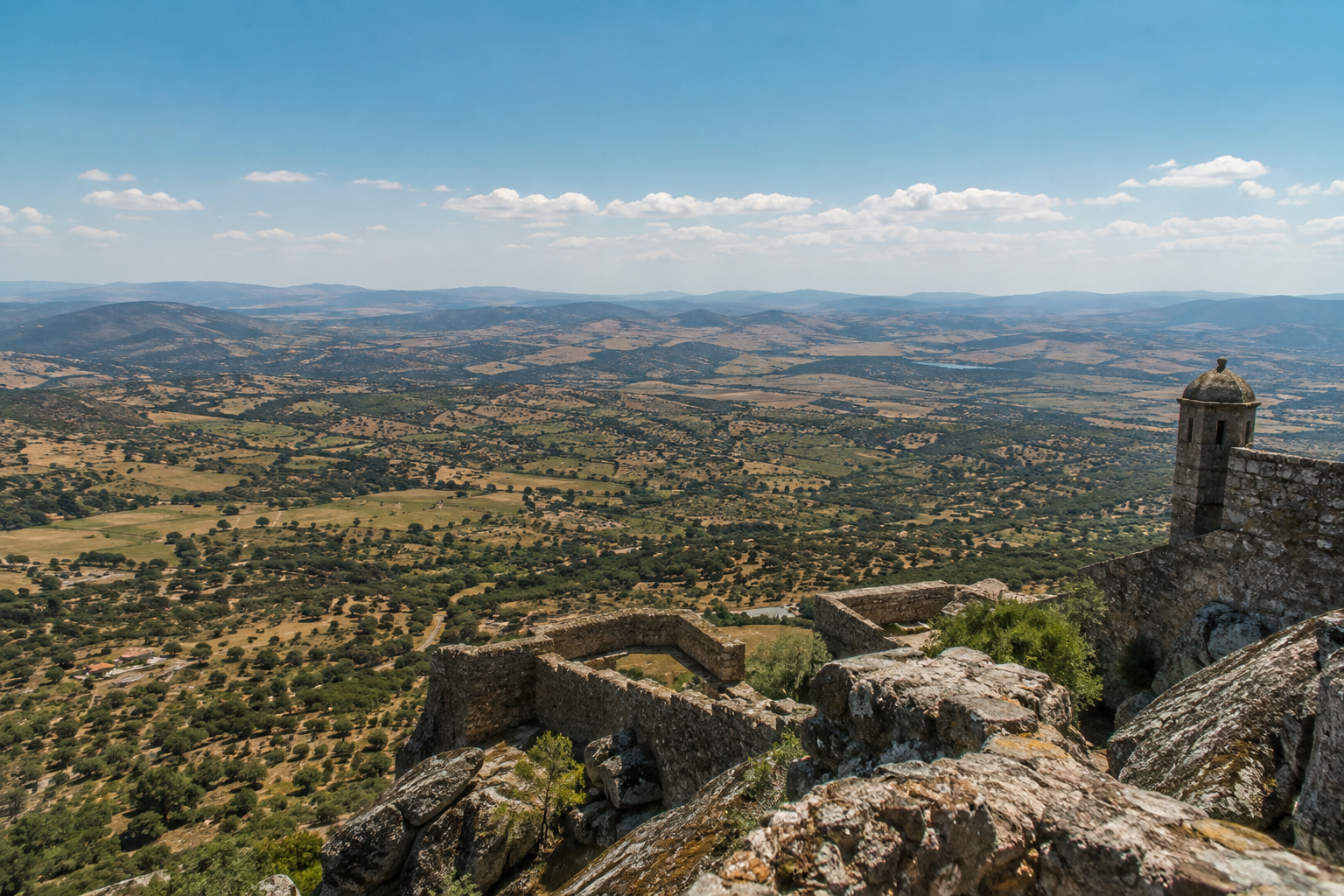
Near the Spanish frontier, Monsaraz and Marvão make the geography of medieval Portugal immediately comprehensible. Perched high above the surrounding countryside, both remind visitors that the modern border was once a militarized frontier where controlling roads, valleys, and high ground mattered.
At Elvas, enormous later fortifications show that defending the frontier remained important long after the Middle Ages. Batalha preserves the memory of Aljubarrota, while Évora, with its Roman, Islamic, medieval, and early modern layers, is a useful reminder that Portuguese history was formed through many different societies rather than beginning neatly with the first Portuguese king.
Then there is Belém in Lisbon. The Jerónimos Monastery and Tower of Belém belong to a very different Portugal from the castle at Guimarães, but that contrast tells much of the story. Guimarães evokes the difficult creation of a small medieval kingdom. Belém belongs to the moment when that same kingdom was looking thousands of miles beyond Iberia.
What “Europe's Oldest Nation” Gets Right
Portugal is not the only European country with very old political roots. San Marino traditionally traces its republic to 301 CE, Bulgaria dates its state tradition to 681, England was unified before Portuguese independence, Denmark has one of Europe's oldest monarchies, and Hungary became a Christian kingdom around the year 1000. France, too, can trace its political ancestry far deeper into the Middle Ages.
For that reason, “Portugal is definitely the oldest country in Europe” is too categorical to be historically useful.
What the phrase captures is Portugal's unusually early combination of political independence, linguistic development, territorial consolidation, and continuity. A kingdom that began taking shape in the 12th century had established most of its familiar mainland frontier by the end of the 13th. It then survived dynastic crises, Castilian pressure, the Iberian Union, and enormous changes in European politics while remaining recognizably Portugal.
Return to the map after knowing that history and the long border beside Spain no longer looks quite so ordinary. Much of it follows a political frontier negotiated by medieval kings more than seven hundred years ago, separating two countries whose people have traded, fought, married, migrated, and influenced one another across it ever since.
That old line on the map tells the story better than the slogan does.