
Where to Learn Tagalog in Oakland and the East Bay
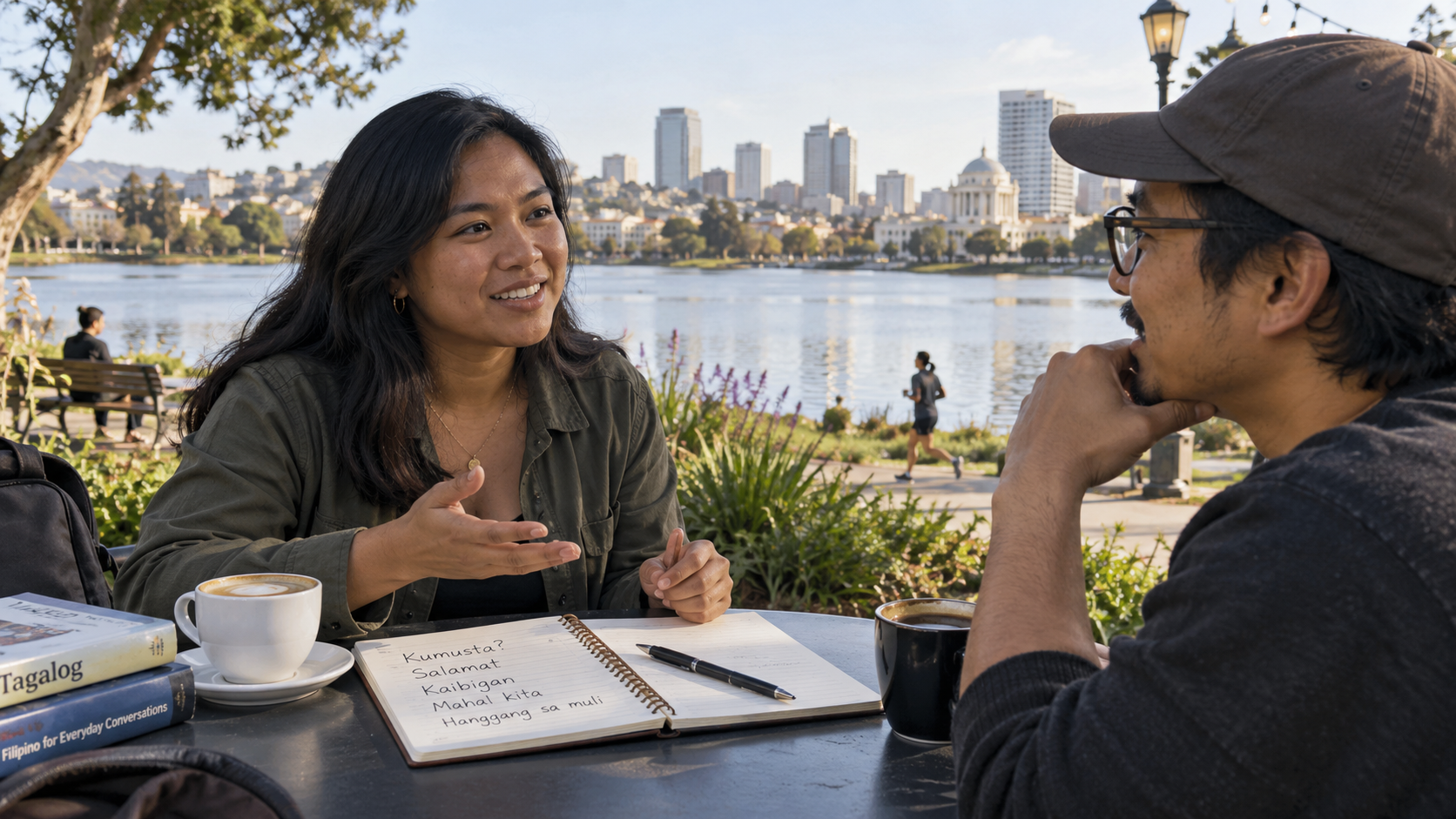
Search for Spanish classes in Oakland and you can spend an afternoon comparing schools. Search for Tagalog and the choices narrow considerably. There are places to study in the East Bay, but they do not all fit the same model. Some are university courses, some are private lessons, and some of the more practical options for working adults are live online classes rather than classrooms in Oakland itself.
That changes how you should approach the search. The closest class is not necessarily the most useful one. Someone living in North Oakland may find Berkeley easy to reach, while a learner farther south in the East Bay may care much more about avoiding an evening commute. A Filipino-American who understands conversations at home but rarely speaks Tagalog also needs something quite different from a student starting with no previous exposure.
For a language that is taught in relatively few places, the better question is often not “Where is the nearest Tagalog class?” but “Which available class actually fits the way I need to learn?”
Start With the Kind of Tagalog Course You Actually Want
Before comparing schools, it helps to decide what you expect from a class.
Some adults want a serious language course with grammar, writing, reading, and several hours of study each week. Others mainly want to speak more comfortably with relatives, prepare for a trip to the Philippines, or stop switching immediately to English when someone addresses them in Tagalog.
Those learners may all search for “Tagalog classes Oakland,” but they are not looking for the same experience.
The East Bay currently offers several different routes: academic Filipino courses at UC Berkeley, private instruction advertised in Oakland, independent Bay Area programs, small-group online classes, and individual online tutoring. The differences among them are large enough that it is worth looking beyond the word “Tagalog” on the course description.
UC Berkeley Is the Most Academic Local Option
UC Berkeley has an established Filipino language curriculum through its Department of South and Southeast Asian Studies. The current catalog includes introductory, intermediate, and advanced Filipino, as well as a separate introductory sequence for heritage learners.
This is not the equivalent of a casual once-a-week evening class. FILIPN 1A: Introductory Filipino, for example, is a five-unit university course. Berkeley describes it as a systematic introduction to grammar, sentence patterns, vocabulary, conversation, reading, and writing.
For someone who wants serious academic study, that depth is a major advantage. You are not simply learning enough expressions to get through a vacation or a family gathering; you are studying Filipino as a language across several skills.
For a working adult, however, the same depth can be a drawback. A university course requires a different level of time and commitment from a six-week adult language class.
Heritage learners have their own sequence
One of the most interesting aspects of Berkeley's program is FILIPN 1X: Introductory Filipino for Heritage Learners. Rather than treating heritage speakers as ordinary beginners, the course is designed to build on passive vocabulary and develop listening, speaking, reading, and writing.
That reflects a problem many Filipino-American learners encounter.
Someone may understand a parent or grandparent remarkably well but answer almost entirely in English. Another person may speak comfortably about food, family, and everyday routines but have difficulty explaining something outside those familiar subjects. Some heritage learners pronounce Tagalog naturally but have never studied its grammar.
Putting all of those students into the same complete-beginner class does not always make sense.
If you grew up hearing Tagalog, it is worth asking a school or instructor about placement rather than assuming you need the lowest available level.
You do not necessarily have to be a Berkeley degree student
UC Berkeley Extension's Concurrent Enrollment program allows members of the public to apply for regular Berkeley campus courses on a space-available basis without formal admission to the university. Approval depends on the academic department, and students apply and pay through the Concurrent Enrollment process.
For an adult who genuinely wants university-level Filipino, this creates a possible route into Berkeley's program. It is much less casual than registering for a language-school class, so it makes sense mainly for someone who wants the academic experience and can accommodate the workload.
Private Tagalog Lessons Are Available in Oakland
For learners who want to stay in Oakland and prefer individual instruction, private lessons are easier to find than recurring open-enrollment group classes.
Listen & Learn currently advertises Tagalog lessons specifically in Oakland, including private face-to-face instruction at a student's home, workplace, or another agreed location, as well as online lessons. It also offers private group arrangements for people learning together.
The appeal of private instruction is customization.
Suppose you grew up hearing Tagalog and do not need a lesson on basic greetings, but you freeze whenever you have to build a sentence yourself. A private teacher can spend more time on that specific gap. The same format can work well for someone preparing for a trip, learning to communicate with a partner's family, or trying to improve pronunciation.
Private lessons also make scheduling easier because you are not waiting for enough students at exactly your level to form a group.
What you give up is the group dynamic. Listening to several classmates, responding to people who phrase things differently, and realizing that other learners make the same mistakes can all be useful parts of a language class. Private instruction also usually costs more per hour.
Where Polyglottist Language Academy Fits
Polyglottist Language Academy is based at 2161 Shattuck Avenue in downtown Berkeley and offers both in-person and online language instruction for adults. (Polyglottist Language Academy)
At the time of writing, PLA's current Tagalog group offerings are online. The schedule includes Complete Beginner, Low Beginner, and Low Intermediate Tagalog, with group classes limited to three to six students. Individual Tagalog instruction is also available online. (Polyglottist Language Academy)
The distinction among those levels is useful because “beginner” can describe very different students.
A complete beginner may genuinely be starting from zero. A low beginner may already understand basic sentence patterns and vocabulary but still need substantial support. Someone at a higher beginner or intermediate stage should not have to restart with greetings every time a new term begins.
For adults who want more structure than occasional tutoring but do not want a five-unit university course, a short small-group format occupies a useful middle ground.
Because PLA is physically based in Berkeley, Oakland students should also check the current schedule when looking for in-person options rather than assuming that every language is offered in the classroom every term. The availability of less commonly taught languages changes with instructor schedules and enrollment.
Online Tutors Give You Much More Choice
Once you include individual online lessons, the number of available Tagalog teachers expands dramatically.
That can be particularly helpful for heritage learners, people with irregular schedules, and students who want a teacher with a specific approach.
The main advantage is choice: you are not limited to whichever instructor happens to be teaching locally. You can look for someone who specializes in conversation, beginners, grammar, heritage speakers, or another area that fits your goals.
The harder part is judging teaching quality.
Being a native Tagalog speaker and being able to teach Tagalog to an English-speaking adult are not the same skill. If you are interviewing or trying lessons with private tutors, pay attention to whether the instructor can explain patterns clearly, whether there is a plan from lesson to lesson, and whether you are actually spending meaningful time speaking.
A teacher who continually tells you that something “just sounds right” may be perfectly fluent but not necessarily the person who can best help you understand why your own sentence sounds wrong.
Heritage Learners Should Be Especially Careful About Placement
For Filipino-American adults, choosing a level can be harder than finding a class.
Imagine someone who has heard Tagalog since childhood. She understands her mother when the subject is dinner, relatives, errands, or family gossip, but she answers almost entirely in English. Put her beside someone who began studying Tagalog three weeks ago and their speaking ability may initially look similar. Their underlying knowledge is not similar at all.
The heritage learner already has years of listening experience, familiar sounds, household vocabulary, and expressions stored away somewhere. What may be missing is active sentence construction.
Another heritage learner may have the opposite profile: comfortable speaking informally but unable to read well or explain basic grammar.
That is why a school that offers several levels, a private instructor willing to assess the learner, or a dedicated heritage course such as Berkeley's can be preferable to choosing a class based solely on the word “beginner.”
Think About What Happens During the Class
When comparing programs, course descriptions can make almost every language class sound conversational. What happens during the hour is more important.
If speaking is your priority, ask yourself how much opportunity you will actually have to speak. In a small class, students can usually answer more questions, work with partners, and receive more individual correction than they can in a large lecture-style setting.
If grammar matters to you, find out whether the instructor explains the language or simply provides phrases to memorize.
It is also worth looking beyond the first course. If you complete an introductory session and want to continue, is there a next level? With a less commonly taught language, continuity can become a real issue. Students sometimes finish a beginner course only to discover that there is no follow-up class unless enough people happen to register.
In-Person Versus Online Looks Different in the East Bay
For someone living in Rockridge or North Oakland, a Berkeley class may barely feel like leaving the neighborhood. Someone traveling from San Leandro or Hayward after work may see the same course very differently.
That is why commuting belongs in the decision from the beginning.
An in-person class has real advantages. There is a physical separation between the rest of your day and the hour you spend studying. You meet classmates face to face, and some learners find it easier to stay engaged when they have actually gone somewhere for a lesson.
Online classes solve a different problem: they make it possible to choose by level and instructor rather than geography.
For Tagalog, I would place the quality of the fit above a small difference in distance. A well-taught online class at exactly the right level is generally more useful than an in-person class that is too elementary, too advanced, or difficult enough to reach that you start missing sessions.
Self-Study Can Fill the Gaps
Apps, YouTube videos, podcasts, textbooks, flashcards, and Filipino media can all be useful parts of learning Tagalog. They are particularly good for review because you can repeat material far more often than you could reasonably ask a teacher to repeat it.
Where self-study gets harder is real-time interaction.
Recognizing a word on a flashcard is one skill. Retrieving it when someone is looking at you and waiting for an answer is another.
Feedback matters too. Tagalog sentence structure differs enough from English that learners can become accustomed to constructions that are understandable but not especially natural if no one corrects them.
For many adults, a practical combination is to use a class or tutor for structure, conversation, and feedback, then use independent study to reinforce the same material between meetings.
So Where Should You Learn Tagalog if You Live in Oakland?
There is no single answer, and that is probably the most useful thing to know before you start searching.
If you want a demanding academic program, UC Berkeley offers one of the most comprehensive local routes, including a curriculum specifically designed for heritage learners. If you want individual face-to-face instruction, private Tagalog lessons are advertised in Oakland itself. If scheduling flexibility matters most, online private instruction opens up a much larger pool of teachers. And if you prefer an adult small-group format, live online courses can give you regular classmates and a clear progression without requiring a weekly commute.
Oakland and East Bay residents can also explore the current Tagalog classes at Polyglottist Language Academy, including beginner and continuing small-group options.
The best class is unlikely to be determined by ZIP code alone. With Tagalog, the more useful questions are whether the level is right, whether the instructor can explain the language clearly, whether you will actually get to speak, and whether the schedule is realistic enough that you will still be attending several months from now.