
Tagalog Classes in San Jose: How to Choose the Right Course
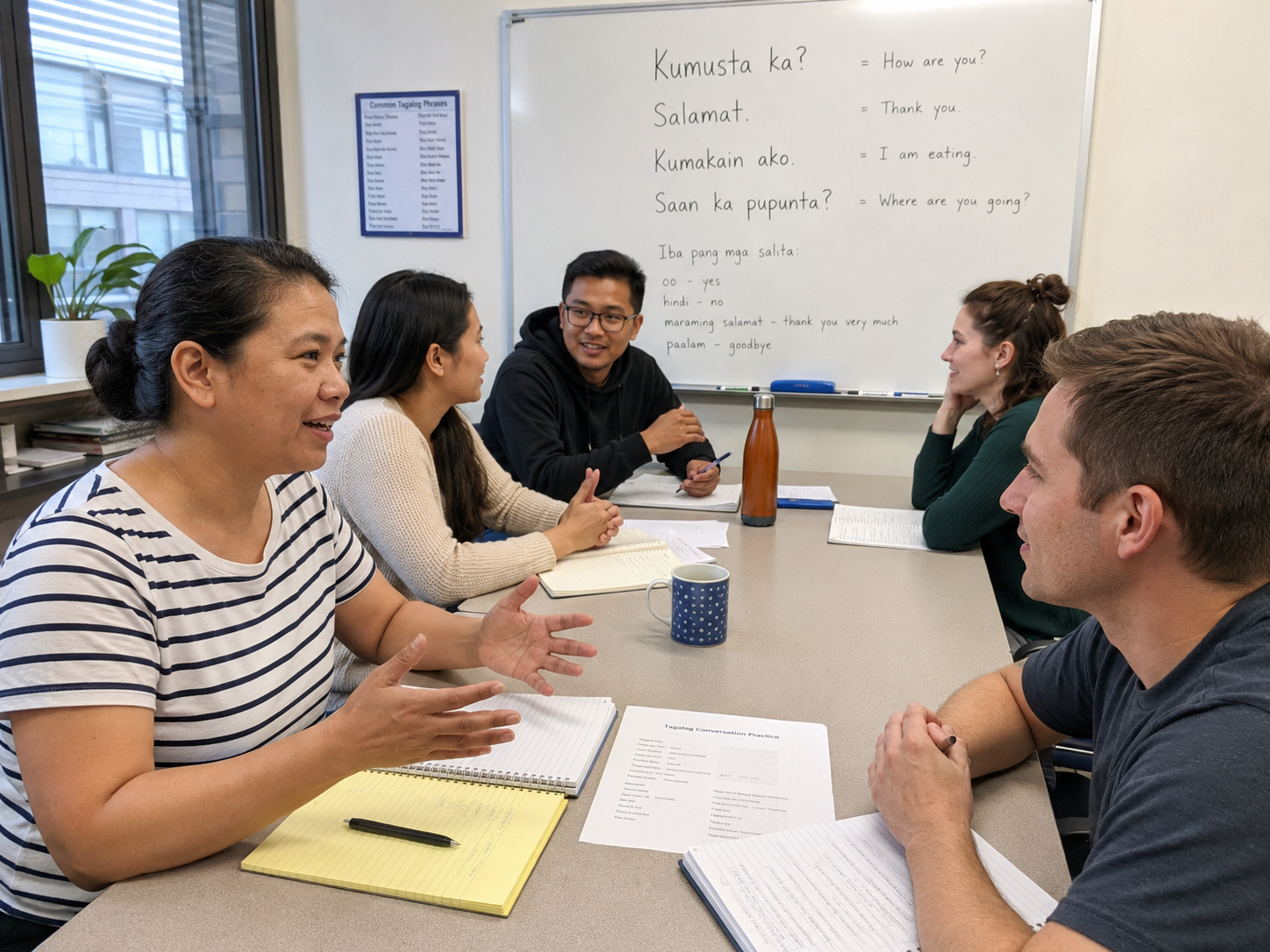
Two people can both search for “beginner Tagalog classes in San Jose” and need very different kinds of instruction.
One may know little beyond salamat and a handful of food words. Another may have spent years hearing parents or grandparents speak Tagalog, understand much of what is said at family gatherings, and still struggle to answer in anything longer than a familiar phrase.
Both may reasonably describe themselves as beginners, but they are not starting from the same place.
That is one of the main reasons choosing a Tagalog course involves more than comparing tuition, class times, and location. The more useful question is whether the course matches what you already know, how you learn best, and what you actually want to do with the language.
“Beginner” can mean several different things
Language schools use labels such as complete beginner, beginner, introductory, conversational, and heritage speaker, but those terms are not standardized.
A complete beginner may have almost no previous exposure to Tagalog. The sounds, sentence patterns, vocabulary, and grammar are all new, so a course that builds concepts in a logical sequence is usually the most useful starting point.
A heritage learner can look quite different. Someone who grew up in a Filipino household might immediately understand Kumain ka na? (“Have you eaten?”), recognize a great deal of family vocabulary, and have fairly natural pronunciation. Yet the same person may find it difficult to construct a sentence independently or explain why a familiar expression is grammatically correct.
Then there are learners who know some Tagalog from a spouse or partner, adults who have picked up phrases during visits to the Philippines, and people who have spent months studying vocabulary through apps without ever having a real conversation.
All of them may encounter a course called “beginner Tagalog.” Before registering, it is worth finding out what that label means in that particular program.
Heritage learners often need placement, not simply a beginner class
Tagalog attracts many heritage learners, and their skills are rarely even across speaking, listening, reading, grammar, and vocabulary.
A person may understand a parent or grandparent quite well but have trouble following unfamiliar speakers. They may know words connected with food, family life, and household routines while lacking the vocabulary to discuss work, travel, current events, or other adult subjects.
Some heritage learners read slowly because almost all of their exposure has been oral. Others can pronounce common expressions naturally but hesitate when asked to produce a new sentence.
That does not automatically make someone an intermediate student. Passive understanding and active speaking are different abilities.
Heritage learners are therefore often better served by asking about placement rather than automatically registering for the lowest available course because they have never formally studied Tagalog. It is also worth finding out whether a student can move to another level if the initial placement turns out to be too easy or too difficult.
Look at what actually happens during class
The phrase “Tagalog class” can describe very different experiences.
One program may use a structured curriculum that introduces grammar and vocabulary in sequence, with students practicing each new pattern in conversation. Another may operate more like a casual conversation group. A third might focus heavily on memorized dialogues and useful travel phrases.
Each format can serve a purpose, but they are not interchangeable.
A complete beginner generally needs more structure than someone who already understands basic grammar and simply needs opportunities to speak. If you are starting from zero, learning isolated phrases without understanding how sentences are formed can become frustrating fairly quickly.
Before registering, find out what a typical lesson looks like. Does the teacher explain grammar when it becomes relevant? Are students expected to form their own sentences? Is pronunciation corrected? Is there homework or another form of practice between lessons? Does the course follow a curriculum that continues beyond the first level?
These details tell you much more about the class than a description promising “fun and practical conversation.”
A good beginner course should explain how Tagalog works
One difficulty for English-speaking beginners is the temptation to treat Tagalog as English with different vocabulary.
That works for a surprisingly short time.
Tagalog organizes information differently, and students eventually encounter sentence patterns, pronouns, particles, and verbal forms that do not line up neatly with English. The language's focus system can be especially unfamiliar at first.
Consider a simple sentence:
Kumakain ako.
“I am eating.”
A learner can memorize that sentence without understanding very much about it. More useful instruction gradually shows how kumakain functions, what ako is doing in the sentence, and how the verb changes when the meaning changes.
Another very common expression is:
Kumain ka na ba?
“Have you eaten yet?”
Knowing the individual meanings of kumain, ka, na, and ba does not automatically tell a beginner why they appear together in that particular way.
None of this means the first few weeks should be dominated by grammar lectures. Beginners need to speak from the beginning. But when the same kind of mistake keeps appearing, the teacher should be able to explain what is causing it rather than simply giving the correct answer and moving on.
Speaking practice should involve more than repetition
It is possible to know a surprising amount of vocabulary and still be unable to hold even a short conversation.
A student may recognize greetings, numbers, family terms, common verbs, and dozens of useful expressions. Then someone asks an unexpected question, and suddenly everything becomes much harder.
Producing language in real time is a separate skill from recognizing it.
Useful speaking practice should eventually require students to create their own answers rather than only repeat after the instructor or read from a dialogue. They should have opportunities to ask questions, respond in different ways, and make mistakes that can be corrected.
Pronunciation belongs in this process as well. Tagalog spelling is relatively approachable for English speakers, but stress and sound patterns still matter, and habits formed early can become difficult to change later.
Class size affects how much of this practice is possible. In a small group, each student can usually answer more questions, receive more correction, and spend more of the lesson actively using the language. Some people enjoy the energy of a larger class, but it is worth asking how much of each lesson you personally will spend speaking rather than listening to everyone else.
A conversation group may not be enough for a complete beginner
Conversation classes sound appealing because conversation is usually the goal. The difficulty is that someone starting completely from zero does not yet have enough language to sustain much of one.
Conversation groups can work very well for students who already have basic vocabulary and grammar but need practice retrieving what they know more quickly. They can also be useful for heritage learners who understand quite a bit but rarely answer in Tagalog.
A complete beginner usually needs more support. That might mean learning a manageable amount of vocabulary, understanding one or two sentence patterns, practicing them with the teacher, and then using them in exchanges that become gradually less scripted.
The aim is still to communicate, but beginners need enough structure to make that communication possible.
Tagalog or Filipino: does the course name matter?
People searching for classes may see some programs described as Tagalog and others as Filipino.
Tagalog is the language historically associated with the Tagalog-speaking regions of the Philippines and forms the primary basis of Filipino, the country's national language. There are historical and linguistic distinctions between the terms, but in the context of beginner language courses, the names are sometimes used quite loosely.
For someone choosing a first course, the curriculum usually matters more than the label.
A class advertised as Filipino may teach essentially what a prospective student expects when searching for Tagalog instruction. Rather than choosing or rejecting a program based solely on terminology, ask what language variety is taught and what students are expected to learn.
Apps are useful, but they do not always explain your mistakes
Many adults arrive at their first Tagalog class having already tried an app, online videos, vocabulary lists, or some combination of all three.
That prior study can be useful. Apps are particularly good for short, frequent review. They can reinforce vocabulary, keep common expressions fresh, and provide extra listening practice between lessons.
The problem is that an app may tell you an answer is wrong without helping you understand why you keep making the same mistake.
A teacher may notice, for example, that several different errors are all coming from the same misunderstanding of Tagalog word order or verb forms. Once that misunderstanding is identified, correcting it becomes much easier.
Pronunciation creates a similar problem. Listening to a recording repeatedly does not necessarily mean you can hear exactly how your own pronunciation differs.
For many adults, structured instruction and independent practice work best together. The class provides explanation, feedback, and interaction; self-study helps keep the language active between lessons.
In-person or online? Choose the class you will actually attend
For adults in San Jose and the South Bay, the practical side of taking a language class matters more than people sometimes admit.
An in-person course offers a dedicated learning environment. It can be easier to stay engaged, interact spontaneously, and separate study time from the rest of the week when everyone is physically in the same room.
The obvious tradeoff is the commute.
A one-hour evening class can become a much bigger commitment once travel time is included. If the inconvenience causes you to arrive late, miss lessons, or eventually stop attending, the advantages of studying in person matter less.
Online classes remove that obstacle and can work very well for busy adults, provided they are genuinely interactive. Students should still be answering questions, speaking with the teacher, practicing pronunciation, and using the language rather than simply watching a lecture through a screen.
For many working adults in the South Bay, a good online course that they attend every week may be a better choice than an in-person class that becomes difficult to reach consistently.
Look beyond the first course
When students compare programs, they naturally focus on the immediate question: when does the next beginner class start?
It is also worth asking what comes after it.
If you enjoy the course and want to continue, is there a clear next level? Does the school distinguish among complete beginner, beginner, higher beginner, and intermediate study, or does each term seem to return to another broadly defined introductory class?
A short beginner course can introduce useful structures and vocabulary, but comfortable conversation takes much longer than a handful of instructional hours. If your goal is to keep learning, having somewhere to progress matters.
Compare value, not just tuition
Price is naturally part of the decision, but tuition alone does not tell you whether one course offers better value than another.
Look at how many instructional hours are included, how large the class is, what materials are used, how much speaking time students receive, and whether the program has a logical next level.
A few questions can reveal a lot before you register:
What does “beginner” mean in this particular class?
How much time will I personally spend speaking?
Is the class suitable for complete beginners, heritage learners, or both?
What level comes after this one?
Can I change levels if my initial placement is wrong?
You may not care equally about every answer, but these questions usually tell you more than a long list of advertised benefits.
Your reason for learning Tagalog matters
Adults study Tagalog for very different reasons.
Someone preparing for a trip to the Philippines may care most about practical listening and speaking. A person with a Filipino spouse or partner may want to participate more naturally in family conversations. A heritage learner may understand much of what relatives say but want to move beyond the vocabulary of childhood and family life.
Those goals affect what you need from a class.
A traveler may be satisfied initially with highly practical material. A heritage learner may need help turning passive knowledge into active speech. Someone who hopes to use Tagalog comfortably over the long term will eventually need enough grammar to create new sentences instead of depending mainly on expressions learned by heart.
A group course cannot be built around every student's personal situation, but it should give learners enough structure to build real language skills while leaving room to use those skills for their own purposes.
Tagalog classes at Polyglottist Language Academy
At Polyglottist Language Academy, we see many of the same differences described above: some adults begin with no Tagalog at all, while others arrive with years of passive exposure through family but little experience speaking the language themselves.
That is why small-group instruction, active speaking practice, and appropriate placement are important parts of adult language learning. Students need enough opportunity to use what they are learning, and they need a course that gives them somewhere to progress once the introductory material is no longer enough.
If you are looking for structured adult Tagalog instruction, you can view current Polyglottist Language Academy course options here:
When comparing Tagalog classes in San Jose, the course title is only a starting point. Find out who the class is designed for, what students actually do during the lesson, how much they will speak, and whether the course matches what they already know.
Someone starting completely from zero, someone who understands grandparents but rarely answers in Tagalog, and a traveler preparing for several weeks in the Philippines may all be looking for a beginner course. The best choice is the one that takes those differences seriously.