
Online Vietnamese Lessons for San Jose Students: Start Speaking with Confidence
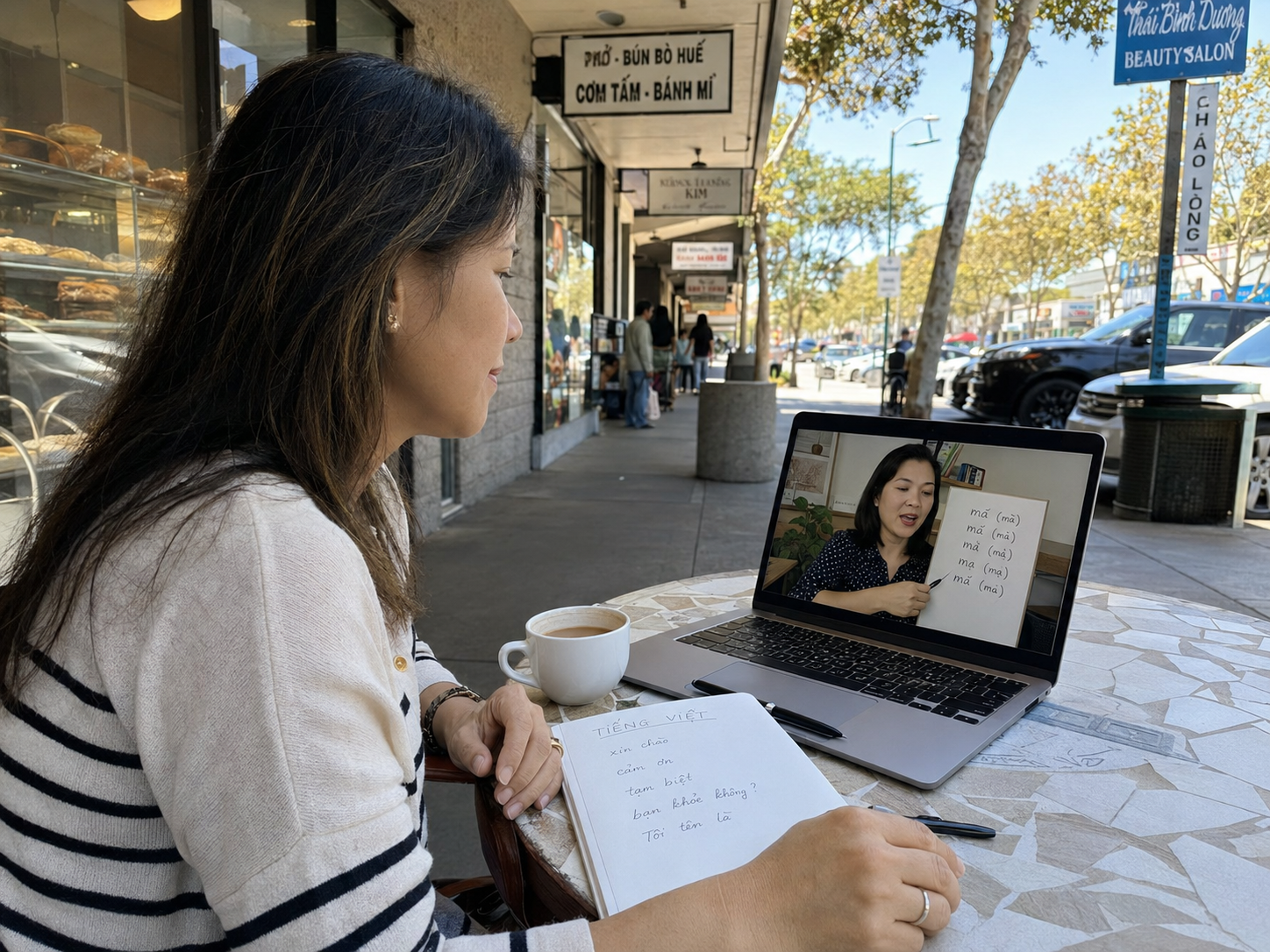
Spend an afternoon around San Jose’s Little Saigon and Vietnamese does not feel like a distant language. You hear it in restaurants and shops, see it on menus and storefronts, and encounter it as part of everyday life. For someone who wants to learn Vietnamese, that local presence can be encouraging. It can also create an odd contrast: a person may recognize a handful of Vietnamese words, hear the language regularly, and still have no idea how to respond when somebody actually speaks to them.
That gap is common. Someone may know that cảm ơn means “thank you,” recognize a few dishes on a menu, or have worked through months of vocabulary exercises on an app. A heritage learner may understand a parent or grandparent surprisingly well but answer almost entirely in English. None of that necessarily means the person can hold a conversation.
For many adult learners, the real challenge is not learning isolated Vietnamese words. It is turning what they recognize into language they can understand and produce quickly enough to use with another person. Live online lessons can help because they give students regular practice doing exactly that: listening, answering, being corrected, and trying again.
Vietnamese Is Familiar in San Jose, but Exposure Alone Is Not Enough
San Jose has one of the most visible Vietnamese communities in the United States, with Vietnamese restaurants, markets, businesses, cultural organizations, and community life concentrated particularly around Little Saigon. For a learner, this means Vietnamese is not confined to a textbook. Once you begin studying, words from lessons start appearing in places you already know.
That can make learning more interesting. Food vocabulary suddenly appears on menus. Numbers become useful in ordinary transactions. A phrase that looked abstract in a lesson becomes recognizable when you hear someone use it naturally.
Still, passive exposure has limits. Adults can spend years around a language without learning to separate what they hear into individual words. Unless you begin connecting sounds with meaning, Vietnamese may remain a continuous stream of speech even when you encounter it regularly.
This is one reason beginners sometimes overestimate how much progress they should be making simply because Vietnamese is around them. Hearing a language frequently is useful, but it becomes much more valuable once you have enough structure to notice what you are hearing.
Why Vietnamese Pronunciation Needs Attention From the Beginning
Vietnamese initially looks reassuring to English speakers because it uses a Latin-based writing system. You do not have to learn a completely new alphabet before recognizing words.
The problem is that familiar letters invite familiar English pronunciation habits, and Vietnamese does not use those letters in the same way English does. Its vowel system contains distinctions that English speakers may not hear easily at first, and some consonants and letter combinations behave differently from what a beginner expects. Pronunciation also varies by region, so the Vietnamese someone hears from one speaker may not sound exactly like the Vietnamese used by another.
Tones add another layer. Vietnamese is tonal, which means pitch patterns help distinguish words. A learner cannot simply pronounce the consonants and vowels correctly and treat tone as an optional finishing touch.
This sounds intimidating when it is explained abstractly, but in practice the difficulty is usually more manageable when pronunciation is taught gradually. Students learn to hear contrasts, imitate them, and then reproduce them in increasingly natural speech.
The hardest part is often not producing a tone in isolation. A beginner may pronounce one syllable accurately when concentrating on it and then lose the tone as soon as the word appears inside a sentence. Once attention shifts to vocabulary, grammar, and remembering what to say next, pronunciation habits tend to reappear.
This is why feedback matters. A learner cannot always hear their own error, especially during the first months of study. A teacher can identify which differences are affecting comprehension and which imperfections are simply part of having a foreign accent.
The goal does not need to be native-like pronunciation. For most adult learners, the more useful goal is to speak clearly enough that Vietnamese speakers can understand the intended words without having to reconstruct the meaning from context.
Vietnamese Conversation Also Depends on Relationships
Pronunciation gets much of the attention in discussions of Vietnamese, but beginners soon discover another feature that can feel unfamiliar: forms of address.
English lets speakers rely heavily on “I” and “you.” Vietnamese uses a much richer system in which the appropriate form can depend on age, relationship, familiarity, family position, and social context. Terms associated with family relationships are used far beyond the family itself.
A beginner may learn words such as tôi, bạn, anh, chị, and em, but knowing a dictionary definition is not the same as choosing naturally among them in conversation. A student soon starts asking practical questions. How old does someone need to be before a different form sounds more appropriate? What if you do not know their age? What should you call yourself in relation to that person?
These questions are not minor details. They show how closely Vietnamese language and social relationships can be connected.
For an English-speaking learner, this is a good example of why vocabulary lists alone are insufficient. The student needs to see forms of address used in actual situations and gradually develop a feel for the choices speakers make.
Knowing Vietnamese Words Is Different From Using Vietnamese
Language apps can be useful for vocabulary review and repetition. They are especially good at making it easy to study for ten or fifteen minutes when a learner might otherwise do nothing.
The problem comes when recognition exercises become the main form of study.
An app may show a Vietnamese sentence and ask you to choose the correct English translation. In a conversation, nobody provides four possible answers. You have to understand what was said, decide what it means, retrieve the language you need, and respond.
That process often reveals gaps that are invisible during self-study.
A learner might recognize a phrase immediately on the screen but fail to identify it when someone says it at normal speed. Another may know exactly what they want to say but spend so long constructing the sentence that the conversation becomes awkward. Someone else may have memorized a perfectly correct expression but pronounce one part of it unclearly enough that the listener does not recognize it.
Live instruction is useful because the teacher can respond to what the learner is actually doing rather than to a predetermined exercise. A teacher can repeat a question in another way, slow down when necessary, correct a recurring pronunciation problem, or notice that the student has memorized an answer without really understanding the question.
Real conversation is unpredictable, and students need some practice dealing with that unpredictability before speaking starts to feel natural.
What Good Online Vietnamese Lessons Should Actually Do
An online class should involve much more than listening to someone explain Vietnamese grammar through a screen.
At the beginning, speaking practice may be simple. Students might answer basic questions, practice difficult sounds, repeat phrases, or use new vocabulary in short exchanges. Those activities may look modest, but they are important because beginners need time to make basic language easier to retrieve.
As students learn more, the conversations should become less scripted. Instead of simply repeating a sentence about liking coffee, for example, a learner might explain what they usually drink, ask someone else the same question, understand the response, and continue the exchange.
Listening needs the same kind of attention. Some students become considerably better at reading Vietnamese than at understanding it when spoken. They know a word when they see it but cannot recognize it inside a sentence.
A good course keeps reconnecting these abilities. Students see a word, hear it, understand it in context, and eventually learn to respond to it without having to translate every step consciously.
Grammar is most useful when it enters that same process. Rules matter, but students also need to find out what happens when they try to use those rules while speaking. That is where recurring mistakes become visible and where knowledge starts to become usable.
Why Online Lessons Can Work Well for San Jose Adults
For adults in San Jose and the broader South Bay, the main advantage of an online Vietnamese class may be consistency rather than convenience in the abstract.
A one-hour evening class can take considerably more than an hour once driving, traffic, parking, and travel time are included. For someone already balancing work and family responsibilities, that extra time can determine whether a class remains realistic after the first few weeks.
With live online instruction, the logistical part disappears. A student can finish work, open a computer, and join the lesson from home.
That does not mean learning becomes passive. In a well-run online class, students still have to speak, listen, answer questions, and react to other people. The instructor can still hear pronunciation problems and correct them. Students can still practice conversation and ask questions as they occur.
Online lessons work best when students treat them as real classes rather than something happening in the background. Keeping the camera and microphone available, participating actively, and reviewing material between lessons matters far more than whether the teacher and student happen to be in the same physical room.
Heritage Vietnamese Learners Often Need a Different Starting Point
San Jose’s large Vietnamese community also means that some students arrive with knowledge that does not fit neatly into a standard beginner level.
A heritage learner may understand parents or grandparents quite well but speak very little. Another may speak naturally about food and family but lack vocabulary for work, education, travel, or adult life. Someone may pronounce Vietnamese beautifully while struggling to read it. Others can read reasonably well but find spontaneous conversation difficult.
Family language can also be highly specific. A learner who understands one parent easily may struggle much more with unfamiliar Vietnamese speakers.
For that reason, heritage learners should not automatically be treated as complete beginners simply because they cannot explain grammar rules. At the same time, family exposure alone does not necessarily mean someone belongs in an intermediate or advanced course.
Placement is more useful when it considers what the person can actually do: how much unfamiliar speech they understand, how comfortably they respond, how well they read, and how broad their vocabulary is outside familiar family situations.
Structured lessons can then fill the gaps rather than starting from the assumption that everything is either already known or completely new.
Which Variety of Vietnamese Should You Learn?
Vietnamese has meaningful regional differences, particularly among Northern, Central, and Southern varieties. Pronunciation varies, and some everyday vocabulary and expressions differ as well.
For most beginners, this does not mean learning several systems simultaneously.
If you are studying Vietnamese to communicate with family or a partner, the variety they speak is a sensible place to begin. Someone preparing to spend considerable time in a particular region of Vietnam may make the same decision based on travel plans.
If you have no strong regional connection, consistency is more important than mastering every variation at the beginning. Learn from a clear model first, then gradually listen to speakers from different regions as your comprehension improves.
Over time, that exposure matters. A learner who understands only one teacher speaking slowly may have trouble outside the classroom. The eventual goal is to become comfortable with some of the variation that naturally exists among Vietnamese speakers.
Speaking With Confidence Is Mostly About Familiarity
Adult students sometimes describe speaking confidence as though it were something they either possess or lack. In practice, much of it develops through repetition.
Ordering food becomes easier after you have practiced similar exchanges many times. Answering basic questions becomes faster after you have heard several different versions of them. Pronunciation becomes less stressful when you have received enough feedback to know that the words you are producing are understandable.
Learners also gradually become better at coping when something goes wrong. At first, an unfamiliar word may stop the conversation completely. Later, students learn how to ask someone to repeat themselves, clarify what they heard, admit that they do not understand, or answer using simpler language.
That is a more realistic definition of confidence than speaking without mistakes. A confident beginner is still a beginner. The difference is that they can remain in the conversation even when they do not understand every word or produce every sentence perfectly.
Learning Vietnamese Online From San Jose
For adults in San Jose who want more structure than independent study provides, Polyglottist Language Academy offers live online Vietnamese instruction for adult learners. Online lessons give students regular opportunities to practice listening and speaking while receiving feedback on pronunciation, vocabulary, and sentence construction, without requiring another trip across the South Bay.
San Jose also gives learners something useful that online study alone cannot provide: plenty of opportunities to notice Vietnamese outside class. As your listening improves, words that once blended into the background start becoming recognizable. You may understand part of a conversation you would previously have missed, recognize an expression while ordering food, or realize that a sign you have passed dozens of times now makes sense.
Eventually, the more important change is that you can respond. The sentence may be simple and your pronunciation may still need work, but you are no longer limited to recognizing Vietnamese from the outside. You are beginning to participate in it.