
Russian Cartoons for Adults Learning Russian: The Surprising Secret Weapon
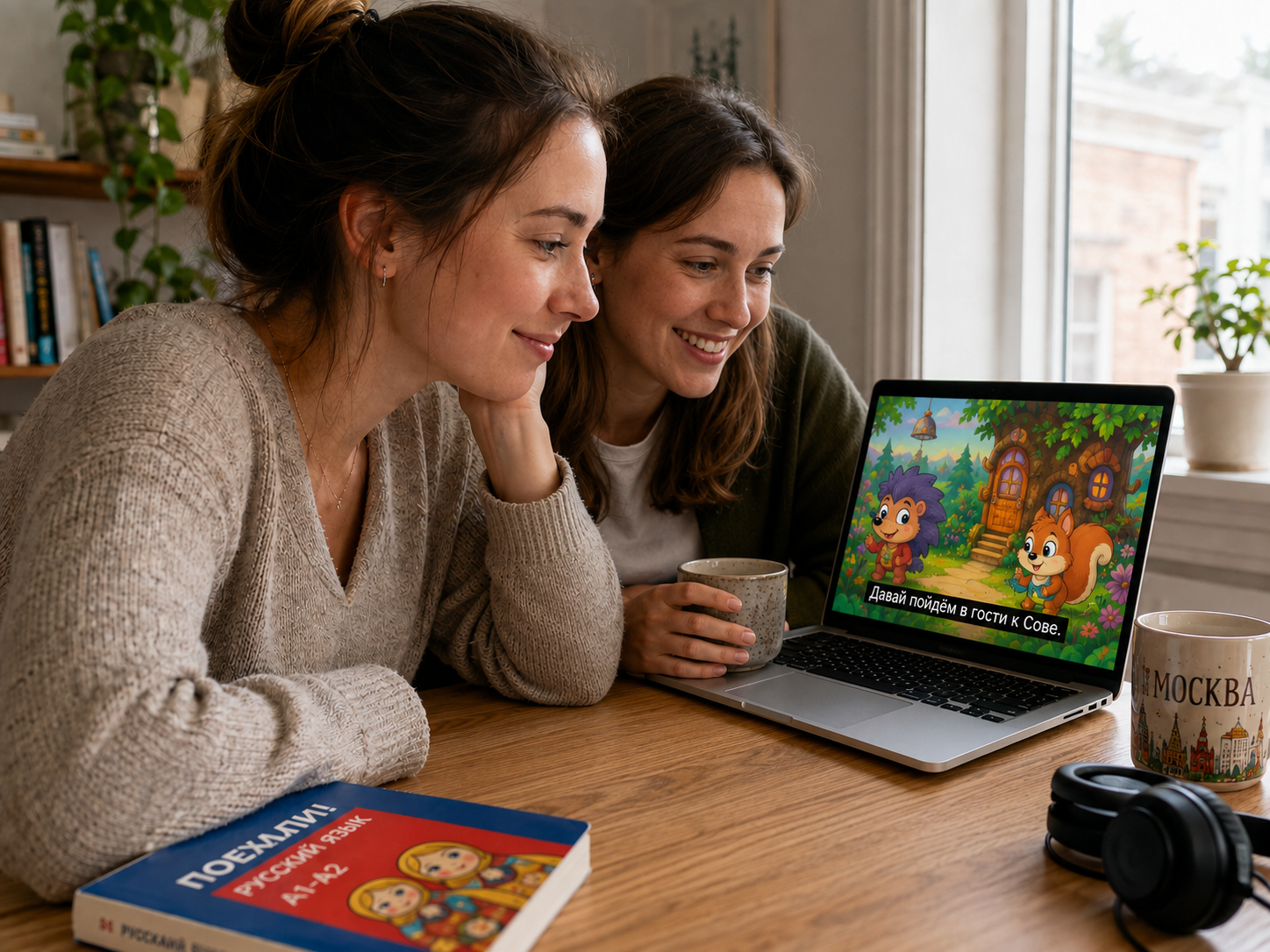
There is a stage in learning Russian that can be surprisingly discouraging. You may be able to read a textbook dialogue comfortably, recognize a respectable amount of vocabulary, and understand why a noun has changed its ending, yet the moment two native speakers start talking on screen, almost everything seems to disappear.
You catch хорошо (khorosho, “good” or “okay”), perhaps давай (davay, “come on” or “let’s”), and then several seconds of speech blur together before another recognizable word appears. It can feel as though the Russian you have spent months learning exists perfectly well on the page but vanishes as soon as someone actually speaks it.
Many adult learners respond by deciding that they need more “real Russian,” so they turn on a film or television series. The idea is sensible, but the result is not always encouraging. Following an hour-long drama when you understand only fragments of the dialogue is tiring, and English subtitles can easily take over to the point where you are no longer listening very closely to the Russian at all.
This is where cartoons can be unexpectedly useful. Not because adults need to learn Russian like children, and certainly not because every cartoon contains easy language. What animation often gives you, however, is an unusually clear context for the Russian you are hearing. Characters are doing things, reacting visibly, arguing, losing objects, asking for help, refusing to cooperate, getting frightened, or trying to solve a problem. Even when you miss many of the words, you can often understand what is happening.
For an adult learner trying to bridge the gap between textbook Russian and ordinary spoken Russian, that visual support can make an enormous difference.
Why Familiar Russian Becomes Difficult to Hear
Listening comprehension often develops more slowly than reading comprehension, especially for adults who have learned primarily through textbooks, apps, written exercises, or carefully paced classroom dialogues.
Part of the difficulty comes from Russian pronunciation itself. Unstressed vowels do not always sound the way a learner expects from the spelling, and words that were memorized visually can be surprisingly difficult to recognize when they appear in normal speech. Native speakers also do not pronounce every word as an isolated unit. Sounds run together, familiar grammatical endings pass quickly, and the listener has to process several kinds of information at once.
Take a very ordinary sentence:
Что ты делаешь?
Chto ty delayesh?
What are you doing?
It looks easy enough once you know the vocabulary. Hearing it naturally in the middle of a conversation is different. The speaker may be irritated or surprised, the sentence may come immediately after another phrase, and before you have consciously identified every word, the conversation has already moved on.
Grammar adds another layer. Russian endings carry a great deal of information, and beginners are often still analyzing them consciously. If part of your attention is occupied with figuring out why a noun is in the accusative case or whether a verb is perfective, there is less attention available for everything that comes next.
This is why a learner can know far more Russian than they seem to understand when listening. The missing skill is often not vocabulary itself, but the ability to recognize familiar language quickly enough for it to function in real time.
Why Cartoons Help More Than You Might Expect
The main advantage of cartoons is context. A character opens an empty refrigerator and reacts with horror; another character warns someone just before a disaster; somebody runs after a friend shouting for them to wait. The scene gives you information before you have decoded every word.
Suppose a character walks into a room, sees a mess, and asks:
Что случилось?
Chto sluchilos'?
What happened?
Even if the expression is new, the situation makes its meaning fairly easy to infer. Later you hear it again, perhaps in another episode. Eventually, you no longer need to translate it consciously because the sound itself has become associated with the situation.
That kind of recognition is one of the most important changes in listening comprehension. The goal is not to become extraordinarily fast at translating Russian into English. It is to reach a point where more and more Russian simply means something when you hear it.
Animation can help because it offers repeated actions, strong facial expressions, recurring characters, and situations that are often visually obvious. Short episodes are another advantage. Rewatching six or ten minutes of animation is realistic in a way that rewatching a two-hour film usually is not, and repetition is especially valuable when your listening skills are still developing.
Adults Do Not Need “Adult” Media at Every Stage
Some learners resist cartoons because they feel childish. An adult may be perfectly comfortable reading history, literature, or complicated nonfiction in English and find it strange to spend study time watching animated animals argue about a broken appliance.
But intellectual maturity and language proficiency are two different things. A highly educated adult can still have beginner-level Russian listening comprehension, while a Russian-speaking child understands thousands of everyday phrases that the adult has never encountered.
Choosing a difficult Russian drama because it feels more sophisticated does not necessarily make the listening practice better. If almost all of the language remains incomprehensible, there is very little for the learner to work with.
At the other extreme, something designed for very young children may be linguistically accessible but too repetitive or uninteresting to hold an adult's attention. The most useful material tends to sit somewhere between those two points: enough Russian is understandable that you can follow what is happening, but there is still plenty of unfamiliar language to notice.
This is also why the “easiest” cartoon is not necessarily the best one. Some programs with extremely simple stories contain little dialogue, while others with more complex plots provide far richer listening practice.
A Few Russian Cartoons Worth Trying
There is no need to work through a huge list. A few series offer quite different kinds of listening practice, and it is worth trying several before deciding what suits your level.
Маша и Медведь — Masha i Medved — Masha and the Bear
Masha and the Bear is an obvious starting point because so much of the storytelling is visual. Masha is constantly creating problems, wanting something, making plans, annoying other characters, or reacting dramatically to whatever is happening around her. You can usually follow the broad situation without understanding every sentence.
That makes the series approachable for beginners, although it is not necessarily easy listening. Masha often speaks quickly, and the Bear himself communicates largely through actions rather than extended conversation. For this reason, I would think of it less as a source of long stretches of everyday dialogue and more as a way for beginners to practice staying oriented while Russian is being spoken around them.
If you are still at the stage where recognizing even a handful of familiar words in a scene feels like an achievement, that can be very useful.
Фиксики — Fiksiki — The Fixies
The Fixies offers a different kind of experience. Many episodes are built around explaining how an object, device, or everyday phenomenon works, so there is usually a clear problem or subject organizing the story.
The technical vocabulary can occasionally be more specialized than an early learner really needs. You probably do not need to memorize every Russian word connected with electrical equipment during your first few months of study. The surrounding language, however, can be very useful: questions, instructions, warnings, explanations, reactions, and ordinary verbs appear constantly.
Because the episodes follow a recognizable pattern, it is often possible to understand the general logic of what is happening before you understand all of the Russian.
Смешарики — Smeshariki
Smeshariki is particularly interesting once you are past the earliest beginner stage. Its round, colorful characters can make it look like very simple children's programming, but the dialogue is often more sophisticated than the visual style suggests.
Some episodes deal with friendship, misunderstandings, jealousy, creativity, fear, responsibility, or more abstract ideas, and the humor is not necessarily aimed only at small children. This makes the series more watchable for many adults, but also more challenging linguistically.
A high beginner or intermediate learner may find that they understand the main plot but miss jokes, idiomatic expressions, or the subtler parts of conversations. That partial comprehension is useful. You have enough context to remain engaged while still being exposed to Russian that stretches your listening ability.
Простоквашино — Prostokvashino
Prostokvashino is worth watching for somewhat different reasons. The classic Soviet stories and characters have a strong cultural presence, and the conversations themselves contain a good amount of interaction: family disagreements, plans, complaints, negotiations, and ordinary domestic problems.
For an intermediate learner, this can be an enjoyable introduction to an older layer of Russian popular culture as well as a source of listening practice. You may encounter expressions or styles of speech that feel somewhat different from what you hear in contemporary learning materials, which is not necessarily a disadvantage. It teaches you that Russian, like any language, changes according to period, generation, and context.
You do not need to imitate everything you hear simply because it appears in a famous cartoon. Part of becoming a more sophisticated learner is beginning to notice not only what a phrase means, but who might say it and in what kind of situation.
Ну, погоди! — Nu, pogodi! — Well, Just You Wait!
Nu, pogodi! is one of the most famous Soviet cartoons and is certainly worth knowing if you are interested in Russian cultural references. The recurring chase between the Wolf and the Hare is easy to follow even with very little Russian.
That is both its strength and its weakness for a language learner. Much of the comedy is physical, and long stretches of the story can be understood without much dialogue at all. A beginner may enjoy it as low-pressure exposure to Russian culture and sound, but I would not choose it as a primary source of listening practice.
This is a useful reminder that a cartoon can be culturally important without being the most efficient material for developing conversational comprehension.
What Should a Beginner Actually Listen For?
Complete beginners often make the mistake of judging listening practice by how much of the entire episode they understood. At the beginning, that is not a particularly useful measure.
Instead, listen for small pieces of language you already know or are beginning to recognize:
Давай!
Davay!
Come on! / Let's!
Подожди!
Podozhdi!
Wait!
Пойдём!
Poydyom!
Let's go!
Нельзя!
Nel'zya!
You can't / It's not allowed.
Осторожно!
Ostorozhno!
Careful!
Что случилось?
Chto sluchilos'?
What happened?
The advantage of encountering expressions like these in a cartoon is that the meaning is usually visible. Someone says подожди while another character is walking away. Someone shouts осторожно just before an accident. The words are no longer floating on a flashcard; they belong to a situation.
If you understand the general plot of an episode and recognize four or five expressions you have studied before, that is productive listening practice. You do not need to understand the remaining dialogue before the exercise becomes worthwhile.
For many learners, cartoons become especially interesting around the high beginner or lower intermediate stage. You already know enough Russian for grammatical forms and familiar vocabulary to appear everywhere, but normal adult television still feels fast. At this level, you begin hearing things that previously existed only in exercises.
You may notice an imperative you recently studied, recognize a familiar noun despite its changed case ending, or finally hear how often a word like давай appears in conversation. The English translation of давай depends heavily on the situation: it can introduce a suggestion, encourage someone, urge them forward, or appear in expressions that would be translated very differently in English. Repeated exposure teaches you something a dictionary definition cannot fully convey.
How to Watch Without Turning It Into Homework
The temptation to stop after every unknown word is strong, especially for conscientious adult learners. It is also one of the easiest ways to make a short cartoon exhausting.
For the first viewing, try to watch without stopping. Concentrate on the story. Who wants something? What is the problem? Why is one character upset? What changes by the end?
On the second viewing, listen more carefully for familiar words and repeated expressions. If one phrase seems important to the scene, look it up. If an obscure noun appears once because someone is discussing a particular machine, you can probably let it go.
Russian subtitles can be very helpful because they connect sounds with words you may already recognize on the page. They also reveal an interesting problem: sometimes you discover that you knew the word perfectly well and simply failed to recognize it when you heard it.
Subtitles can become a crutch, however. If you spend the entire episode reading, your reading comprehension is doing most of the work. One useful approach is to watch once without subtitles and then use Russian subtitles on a second viewing to check what you missed.
English subtitles are not forbidden either. If the episode is completely incomprehensible, understanding the story first can make another viewing far more useful. The problem comes when English subtitles remain on permanently. It is very easy to believe that you are following Russian when, in reality, your attention has shifted almost entirely to the English at the bottom of the screen.
Rewatching familiar episodes is also worth doing. Once you already know the story, your attention is freed up to notice more language. On the first viewing you understand that two characters are arguing. On the second, you understand what the disagreement is about. Later you begin to notice the phrases each character uses. This kind of repetition can be more valuable than constantly moving on to new material.
Listening to Emotion, Not Just Words
Another benefit of animation is that emotions tend to be clearly expressed. Characters sound impatient, surprised, affectionate, frightened, annoyed, or excited, and their voices usually match what is happening on screen.
This gives learners a chance to hear the shape of spoken Russian. A textbook can tell you where the stress falls in подожди, but hearing the word in several emotional situations teaches you much more about how it behaves in conversation.
Russian learners often focus so heavily on individual sounds, stress patterns, cases, and endings that intonation receives less attention. Yet a grammatically correct sentence can still sound strangely unnatural when spoken with the rhythm of English.
The point is not to imitate exaggerated cartoon voices. It is to start noticing how a whole Russian phrase changes according to the speaker's attitude.
Soviet Cartoons and Cultural Memory
Classic animation can also introduce learners to a side of Russian culture that is difficult to encounter through ordinary language exercises.
Characters from Soviet cartoons, familiar songs, and well-known scenes form part of the cultural memory of many Russian speakers. Depending on age and background, someone may recognize a reference immediately even though a foreign learner has no idea where it comes from.
This does not mean cartoons should be treated as documentaries about Russian life or Russian personality. They belong to particular historical periods and artistic traditions, and different generations do not relate to them in exactly the same way.
Still, knowing characters from Prostokvashino or recognizing Nu, pogodi! gives you a small piece of shared cultural vocabulary. For someone studying Russian partly because of an interest in history, literature, travel, or Russian-speaking communities, that can make the language feel much less detached from the culture surrounding it.
Heritage learners may experience this even more strongly. Someone who grew up hearing Russian at home may suddenly recognize a command, an affectionate form, a familiar intonation, or an expression used by parents or grandparents. They may understand it instantly despite being unable to explain the grammar.
This is common with heritage language ability, which is often uneven. A person may understand family conversation quite well while struggling to read, write, or discuss topics outside the home. Cartoons sometimes activate vocabulary that feels half remembered rather than completely new.
Where Cartoons Stop Helping
Cartoons are most useful as one part of a larger learning process. They cannot replace systematic work on grammar, pronunciation, speaking, reading, or writing, and watching hundreds of episodes does not automatically teach you how to use cases or verbal aspect accurately in your own sentences.
At the same time, grammar study alone does not solve the listening problem. A learner can perform very well on written exercises and still struggle when a native speaker asks an unexpected question.
The two types of learning support each other. Structured study gives you a framework for understanding the language, while listening gradually makes that knowledge faster and more automatic. One of the most satisfying experiences for a learner is hearing a construction in a cartoon that was recently studied in class. At first you recognize it a second too late. Later you hear it immediately, and eventually you simply understand it without thinking about the grammar at all.
For adults who prefer to combine independent listening with structured instruction, Polyglottist Language Academy offers Russian classes for adults at different levels, with an emphasis on building grammar and speaking skills that can then be reinforced through real-world listening practice.
There is also no particular point at which you have to “graduate” from cartoons. As your Russian improves, you can simply add other kinds of media: interviews, YouTube channels, travel programs, films, podcasts, or television series. Some cartoons may become too easy, while others remain interesting because the language, humor, or cultural references are more sophisticated than you first realized.
What changes most is not the material itself but your experience of listening to it. At first, you may understand the scene mainly because you can see what the characters are doing. After a while, familiar words begin appearing inside the stream of speech. Then you start catching whole expressions, and eventually you understand some of them before you have had time to translate them into English.
That gradual change is why cartoons can be so useful. They give spoken Russian enough context that the language has a chance to become familiar by ear, not only on the page.