
Tagalog Classes in Daly City: A Guide for Adult and Heritage Learners
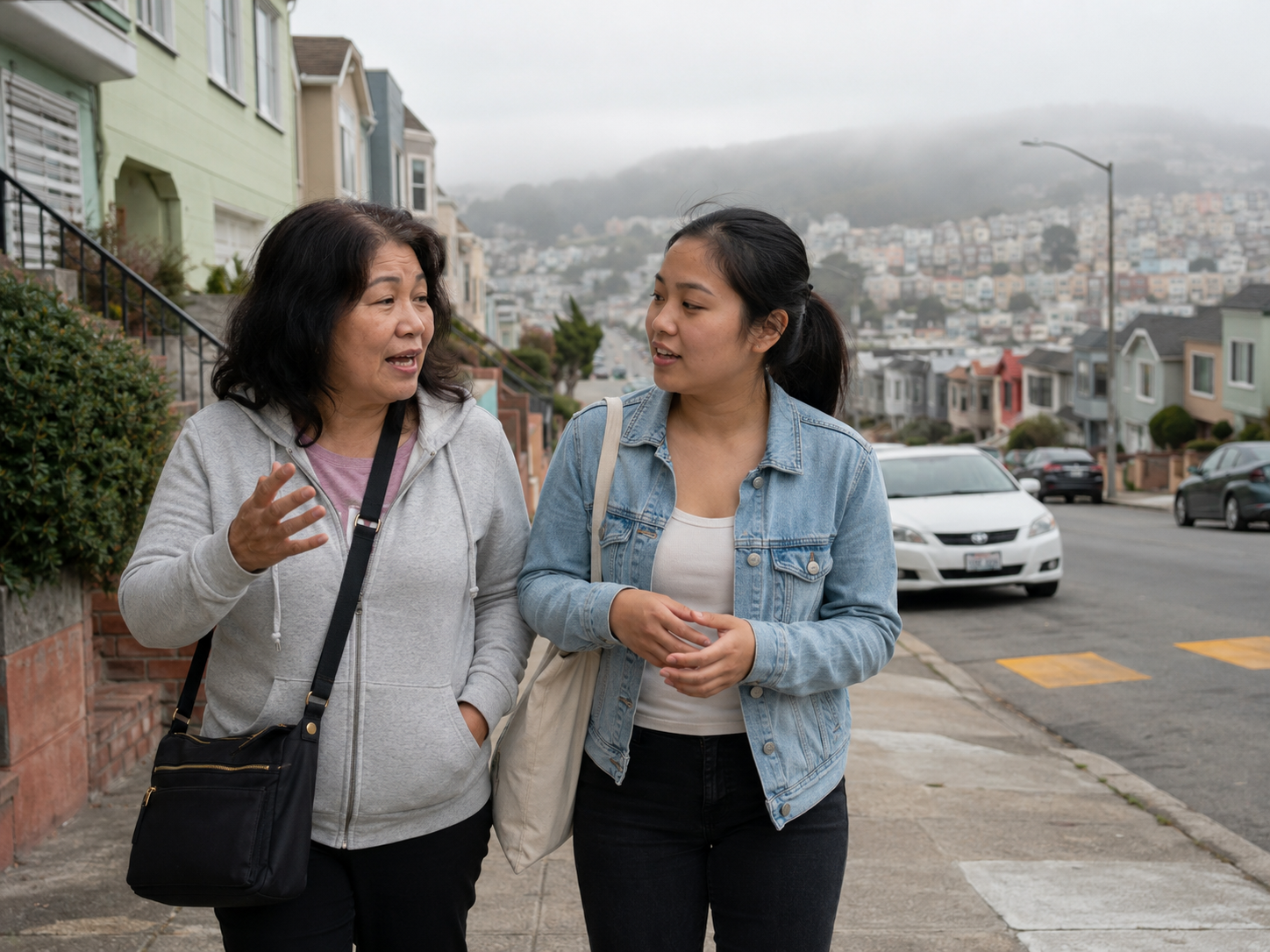
In Daly City, it is entirely possible to grow up hearing Tagalog without ever becoming comfortable speaking it yourself. You may understand what your parents are saying across the dinner table, recognize expressions your grandparents have used for years, and follow much of a family conversation, only to answer almost automatically in English when someone speaks directly to you.
Other adults come to Tagalog from a completely different direction. Perhaps your spouse or partner is Filipino, you are planning more frequent trips to the Philippines, or you have simply reached a point where you want to understand and speak the language rather than recognize a handful of familiar words.
Both people might search for Tagalog classes in Daly City, but their starting points are very different.
Daly City is an unusual place to be learning Tagalog because Filipino American life is so visible there. The city's 2010 Census profile counted more than 33,000 Filipino residents, and Filipino businesses, community organizations, family networks, and cultural events have long been part of the local landscape. For some learners, this means Tagalog has been around them for years even if they have rarely spoken it themselves.
So before choosing a class, it is worth figuring out what you actually know.
Not Everyone Looking for a Tagalog Class Is a Beginner
A true complete beginner may come to Tagalog with very little prior knowledge. Someone with a Filipino spouse might recognize the names of certain foods or family terms but have no idea how a Tagalog sentence works. Another learner may be preparing for travel and want to get beyond greetings and memorized expressions.
For this person, starting from the beginning makes sense. Pronunciation, common sentence patterns, pronouns, basic verbs, questions, and everyday vocabulary need to be introduced systematically so the learner can begin creating original sentences.
A heritage learner may describe themselves as a beginner even when that is only partly true.
Someone who grew up in a Filipino American household might understand a surprising amount of conversation between relatives. Familiar words may come with natural pronunciation, and certain expressions may be so deeply embedded that they require no conscious translation. Yet when it is time to answer, the words do not come nearly as easily.
That kind of learner does not necessarily need the same starting point as someone encountering Tagalog for the first time.
“I Understand Tagalog, but I Can't Speak It”
This is one of the most familiar heritage-language experiences.
If your parents spoke Tagalog while you usually answered in English, you spent years practicing comprehension without receiving the same amount of speaking practice. Listening and speaking draw on some of the same knowledge, but speaking asks you to retrieve vocabulary, choose grammatical forms, and assemble a sentence quickly enough to keep a conversation moving.
That explains the strange situation in which you can understand a fairly detailed story from your mother and then struggle to give more than a short response.
You may also understand your own family much better than unfamiliar Tagalog speakers. Years of listening have taught you your father's rhythm, your grandmother's favorite expressions, your mother's pronunciation, and even the kinds of things each person is likely to say. Some of your comprehension comes from Tagalog itself, while some comes from knowing the speakers extremely well.
For a heritage learner, simply hearing more Tagalog is therefore not always enough. You need opportunities to produce it.
The Tagalog You Know May Be Closely Tied to Home
Heritage learners often have vocabulary that reflects where they learned the language.
You may know plenty of words connected with food, eating, clothing, relatives, household routines, affection, childhood commands, and family gatherings. Certain questions or expressions can feel completely natural because you have heard them thousands of times.
Then someone asks you to explain a disagreement at work, a medical appointment, something you studied in college, an insurance problem, or your plans for an international trip, and your Tagalog suddenly becomes much less reliable.
Your English continued expanding through school, jobs, relationships, technology, travel, and adult responsibilities. If Tagalog remained mostly a language of home and family, it may never have developed alongside those parts of your life.
A useful class for a heritage learner should help expand the language beyond childhood subjects rather than spending months reviewing vocabulary that is already familiar.
Taglish Is Part of the Picture
For many Filipino American learners, Tagalog and English have never existed in completely separate compartments.
A conversation may move back and forth between the two languages, sometimes within the same sentence. English nouns or expressions may appear naturally without anyone treating the switch as unusual.
There is nothing inherently wrong with that. The more useful question for a learner is why the switch happened.
Sometimes English appears because that is simply how people around you speak. At other times, you switch because you have reached the edge of your Tagalog vocabulary and cannot finish the thought any other way.
Imagine describing your weekend. You can talk easily about food and family plans, but the moment you begin explaining a complicated problem at work, nearly every important word comes out in English. That gives you a very practical clue about what to study next.
The aim does not have to be an artificially “pure” form of Tagalog. It is more useful to build enough vocabulary and grammatical control that English is not your only option when the subject becomes more complicated.
What Actually Matters in an Adult Tagalog Class
The class title tells you less than the way the class is taught.
Adults need opportunities to speak, not simply memorize vocabulary. Knowing twenty new verbs on paper is useful, but conversation requires you to retrieve them while another person is waiting for an answer. That skill develops through repeated use.
This is especially important for heritage learners. If comprehension is already your strongest skill, spending most of a lesson listening to explanations will not necessarily address the problem that brought you to class.
A good beginner course should also have a clear progression. Students need to understand how vocabulary and grammar work together rather than memorizing disconnected phrases for introductions, restaurants, and travel.
Small classes can help because each student gets more time to speak, ask questions, and receive feedback. They also allow an instructor to notice that two people who technically belong at the same “level” may have very different weaknesses.
For heritage learners, that last point matters a great deal.
Heritage Learners Don't Fit Neatly Into Levels
Consider someone who understands everyday Tagalog quite well, has natural pronunciation, but cannot explain basic grammar and struggles to build original sentences.
Now consider someone who has studied Tagalog independently for a year. That person understands grammar terminology and can read simple texts, but following a fast family conversation is difficult.
Putting either learner into a simple category such as “beginner” or “intermediate” leaves out a lot of information.
Heritage learners may have strong listening skills but weak reading, good pronunciation but limited active vocabulary, or comfortable conversational instincts alongside gaps in grammar. Another learner may speak with relatives regularly but depend heavily on English whenever the topic changes.
This is why it is worth paying attention to your individual skills rather than deciding your level based only on family background. Understanding your parents does not automatically make you intermediate, but neither does difficulty speaking necessarily make you a complete beginner.
Tagalog Grammar May Finally Explain What You Have Been Hearing
Complete beginners often find Tagalog grammar unfamiliar because it organizes information differently from English. Students encounter markers such as ang, ng, and sa, different pronoun patterns, particles used constantly in conversation, and a verb system that requires more attention than simply learning an English-style subject-verb-object sentence.
Heritage learners often meet the same grammar from the opposite direction.
You may have heard these structures throughout childhood and know instinctively that one sentence sounds natural while another sounds odd. What you may not know is why.
Tagalog verbs are a particularly good example. A heritage learner might recognize several forms of the same verb because relatives have used them for years, yet struggle to choose the correct form when creating a new sentence independently.
Formal study can turn that vague familiarity into something much more useful. Once you understand the pattern, you are no longer limited to reproducing sentences you remember hearing at home.
Apps Are Useful, but They May Miss the Gap You Need to Fill
Language apps can be helpful for vocabulary review, repetition, and maintaining a regular study routine. Beginners may also appreciate having a low-pressure way to become familiar with common words before or alongside a class.
For heritage learners, the experience can be uneven. Early lessons may feel ridiculously easy because basic greetings, food vocabulary, and family words are already familiar. Then you reach grammar you have never consciously studied, while still getting very little practice answering another person spontaneously.
An app can still be useful in that situation, but it serves a different purpose from a live class. Independent study is excellent for review and repetition. Conversation practice is where you learn whether you can actually retrieve the language when you need it.
Using both can work well: study vocabulary and patterns independently, then bring them into conversation where they have to function in real time.
When an Online Class Makes More Sense Than a Local One
Searching for Tagalog classes in Daly City does not necessarily mean the classroom itself has to be located within the city.
Tagalog is a specialized language offering compared with Spanish or French, so limiting yourself to whatever happens to be available within a few miles can also limit your choice of levels and instructors.
Some learners prefer in-person classes because they like going somewhere each week, interacting face-to-face, and having a regular classroom routine. Those are real advantages.
For someone in Daly City, South San Francisco, San Bruno, Pacifica, or San Francisco, however, an online small-group class can make it easier to choose based on level rather than geography. There is no commute, and a heritage learner has a better chance of finding a class suited to their particular combination of strengths and gaps.
The format matters less than what actually happens during the lesson. An online course with frequent speaking practice and appropriate placement may be more useful than a nearby class that spends most of its time on material you already know.
Daly City Gives You Opportunities to Keep Tagalog in Your Life
One advantage of learning Tagalog in Daly City is that the language does not have to disappear when the lesson ends.
The city has a long-established Filipino American community and continues to recognize that history through local cultural programming and events such as Filipino American History Month activities and the Philippine Flag Raising Ceremony. Filipino businesses, restaurants, community connections, and extended family networks are also part of everyday life for many residents.
For a heritage learner, though, some of the best practice opportunities may be much less formal.
You can begin answering a parent in Tagalog instead of automatically replying in English. Send a short voice message to a relative. Ask what an unfamiliar expression means instead of letting it pass. If you have family members who are willing to help, try keeping part of a familiar conversation in Tagalog before switching back to English.
Listening outside your own family also matters. Filipino films, television, interviews, podcasts, and videos expose you to speakers whose voices and habits you have not known since childhood.
If you are a complete beginner, there is no reason to turn every interaction into a language lesson or approach strangers just to practice. It is enough to notice where Tagalog already appears naturally in your life and gradually understand more of it.
Reading May Be a Completely Different Skill
Some heritage learners discover that their spoken comprehension is far ahead of their reading.
If Tagalog entered your life mainly through parents and grandparents, you may understand a sentence instantly when you hear it and then need considerably more time to read the same idea on a page. Another learner may speak comfortably in familiar situations but rarely have written more than a short message.
Reading helps expose you to vocabulary that does not regularly appear in family conversation and makes grammatical patterns easier to notice because the sentence remains visible.
There is no need to begin with difficult literature. Text messages, captions, short dialogues, social media posts, and simple articles can gradually connect the written language with the Tagalog you already recognize by sound.
Tagalog Classes for Daly City Adults
Polyglottist Language Academy offers online Tagalog classes for adults, including learners at different levels. Because the classes are online, students in Daly City and elsewhere in the Bay Area can participate without commuting to Berkeley while still receiving structured instruction and live conversation practice.
Heritage learners in particular should think carefully about placement. If you grew up hearing Tagalog, you may already have strengths that a traditional complete beginner does not have, even if speaking still feels difficult. At the same time, gaps in grammar or active vocabulary may make a more advanced course frustrating.
You can explore Polyglottist Language Academy's Tagalog classes here and compare the available levels to find the most sensible starting point.
Your Starting Point Matters More Than the Label
Two adults in Daly City may want exactly the same thing from a Tagalog class: to sit down with another person and have a real conversation without constantly searching for words.
One may need to build the language from the beginning. The other may already have years of Tagalog stored in familiar questions, family conversations, pronunciation, food vocabulary, jokes, and expressions that sound right even when the grammar behind them remains unclear.
For that heritage learner, the first useful lesson may not be how to say hello.
It may be learning how to answer.