
Is Dutch Hard to Learn? An Honest Expat’s Journey Through Classes, Self-Study, and Real Progress
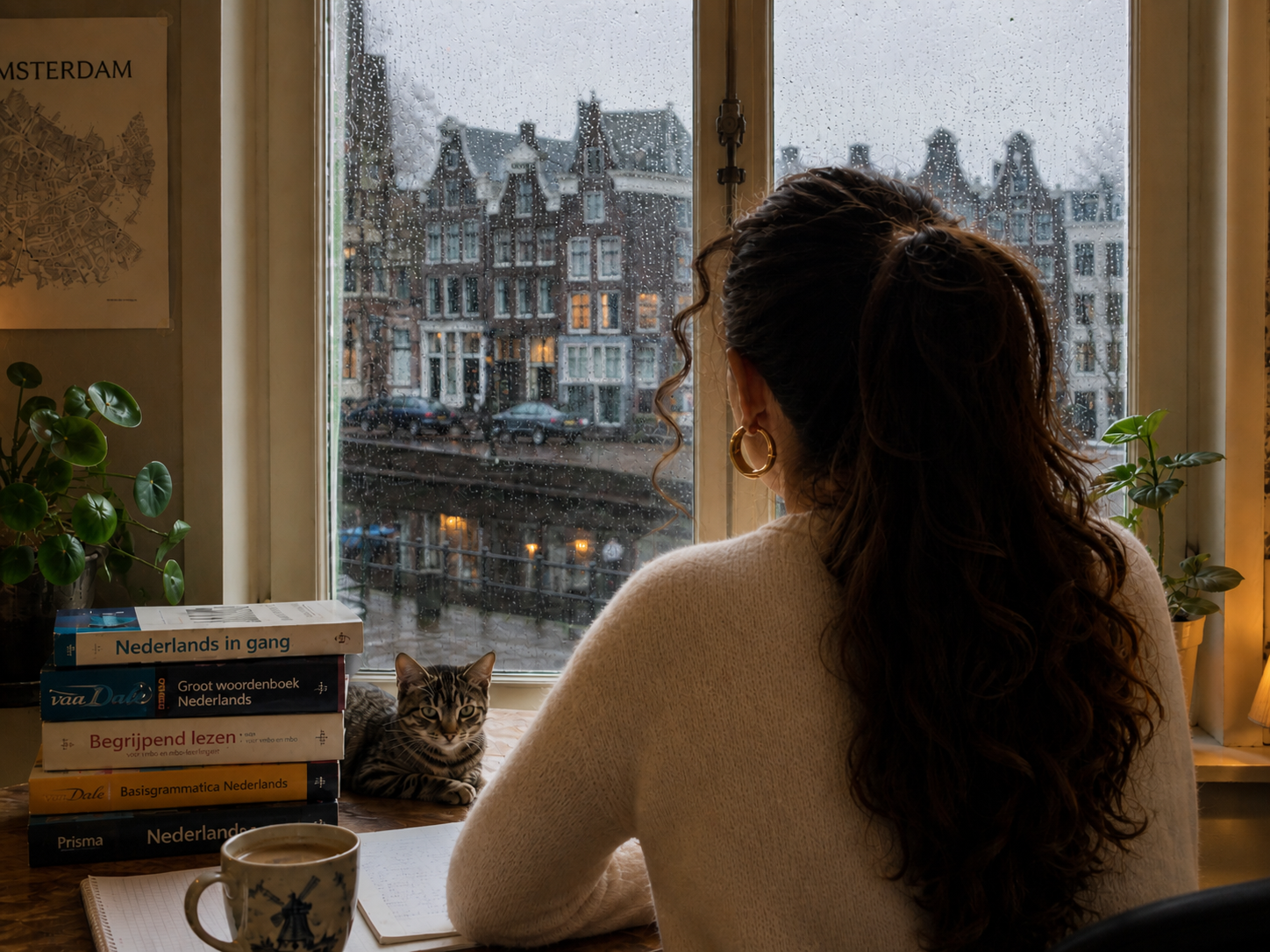
When I first moved to the Netherlands, I had a very naive plan for how quickly I would master Dutch. I told myself, I already speak four languages, three of them fluently. Dutch will not be a problem at all.
That confidence did not last long.
I did not take any Dutch classes before arriving, which was my first mistake. Within a month of moving to the Netherlands, I signed up for a complete beginner course. I walked into the first class expecting a gentle introduction: basic greetings, simple pronunciation, maybe a few useful phrases for everyday life. Instead, the teacher spoke almost entirely in Dutch from the very beginning.
One of the first activities was listening to a long Dutch recording and then answering questions about it. I could not understand what was happening. I looked around the room and wondered whether the other students were confused too, but it was hard to tell. I was panicking.
Then the teacher told us to open the textbook. It was also entirely in Dutch.
I could recognize a few words here and there because they looked similar to English, but most of the material felt inaccessible. The entire two-hour class continued in that same direction, and the homework was no different. Some students did not return for the second class. I did, and I stayed until the end of the course, but I cannot honestly say that I learned very much.
The course lasted two or three months, and by the end I had a certificate. On paper, I had reached a certain level. In reality, I felt that I had survived the course more than I had learned Dutch.
The Problem With “Immersion” When It Is Done Badly
This kind of so-called immersion method is often glorified, but my personal experience was that it can be deeply discouraging when it is not adapted to real beginners. Immersion can be useful when students have enough language to understand the context, participate, and build from what they already know. But when complete beginners are thrown into long recordings, grammar explanations, and textbooks entirely in the target language, the result is often stress, boredom, and shame.
I have been both a language student and a language instructor, and I do not believe that stress and boredom are good foundations for learning. A language class should challenge students, but it should not make them feel stupid. It should expose them to the language, but it should also give them tools to understand what they are hearing and reading.
I also felt judged in class. To protect myself from that feeling, I started preparing all the exercises in advance so that I could answer quickly when called on. But this was not real fluency. It was survival.
After finishing that course, I took another one, and the experience was very similar. I completed both courses and received certificates of completion. According to the certificates, I had reached A2 within the first few months. But I did not feel like an A2 learner. I could not speak at all. I could not function in Dutch in any way.
After those two courses, I could not bring myself to sign up for another Dutch class. The experience had become something that poisoned my week. On the days when I had class, I woke up in a terrible mood.
At first, I blamed myself. I told myself I needed to study harder, do more homework, and be more disciplined. Some of that was true. But looking back now, I only partially blame myself.
As a language professional, I also believe that some of the teaching approaches I encountered reflected a lack of real pedagogy. It does not take much for a native speaker to stand in front of a room and speak their own language. What takes skill is understanding what students are experiencing, adapting materials to their level, creating repetition without boredom, and building confidence step by step.
Good teaching requires structure, creativity, and empathy. It requires carefully designed materials that make students feel, I can do this, not, I am drowning.
My Experience With Italki and Private Dutch Lessons
About a year later, I returned to Dutch through individual lessons on Italki. My experience there was mixed.
Some teachers were very similar to the ones I had encountered in Dutch language schools. They talked nonstop in Dutch even after I explained that my level was supposedly A2, though I did not feel that was accurate. I eventually started booking only 30-minute trial lessons because listening to someone speak at me in Dutch for an entire hour felt painful.
Finally, I found one tutor who was different. She was not a professional teacher in the traditional sense, but she was studying several difficult languages herself. Because of that, she understood how hard it is to learn a new language from the inside. She explained the basics clearly. She repeated things often. She used her own materials. Most importantly, she did not make me feel stupid.
She also confirmed something I had already started to suspect: truly beginner-friendly Dutch materials are surprisingly hard to find.
Later, when I researched different Dutch textbooks and learning resources, I came to the same conclusion. Many materials seem to assume that students already know a lot of vocabulary and grammar before they begin. It sometimes feels as if complete beginners are not expected to exist in the Netherlands.
I continued studying with this tutor for a few months. We met twice a week for two hours. She gave me a useful foundation, and I am grateful for that. But eventually, I started to feel frustration from her side too.
When I said I did not remember a word, she might respond, “I already told you that twice,” or “I gave you that vocabulary list two weeks ago.”
But language learning does not work that way for most people.
Research on vocabulary acquisition shows that learners usually need repeated encounters with a word before they truly know it. Some studies suggest six, eight, ten, or even more than twenty encounters may be needed, depending on the word, the learner, and the quality of the context. Stuart Webb’s research also emphasizes that the quality of the context matters: learners remember words better when the surrounding context helps them understand meaning clearly.
That matched my experience exactly. Seeing a word once or twice on a list was not enough. I needed to meet it in sentences, hear it in videos, use it in speech, forget it, meet it again, and slowly make it part of my memory.
Many of her students were young university students. I am not at that stage of life anymore. My memory is not what it was at twenty, and Dutch was not the only thing I had to do in life. I had work, responsibilities, personal stress, and other priorities.
Eventually, the lessons became less pleasant, and I decided to continue on my own. Still, I do credit that tutor with giving me the foundation that made self-study possible.
What Finally Helped Me Make Progress
When I began studying on my own, I started watched NOS Journaal in Makkelijke Taal. I listened to Easy Dutch videos. I practiced grammar separately. I built vocabulary on my own. I tried to commit to one or two hours of Dutch most days, and I even kept records of my study time.
That is when I finally started to feel real progress.
I began to understand more and more in Dutch videos. I could express more thoughts in Dutch. I started recognizing sentence patterns. Grammar that had once felt abstract began to make sense because I was seeing it in real use.
However, I also made one big mistake: I kept taking long breaks.
Because of personal issues, I sometimes stopped studying for two or three months at a time. With a new language, especially before you reach a solid intermediate level, this is dangerous. In my experience, you need to reach at least a low intermediate level, around B1 in the European system, before you can pause for a while without losing too much.
Every time I stopped for a few months, I needed one or two months just to return to the level I had previously reached. In that way, I lost a lot of valuable time.
I eventually tried to find another Italki tutor. One teacher from Amsterdam was particularly good. He was a professional Dutch teacher, and our lessons were pleasant. We mostly worked on conversational expressions, which was useful. But his availability became more and more limited, so I had to look for someone else.
After that, I had several disappointing experiences. The most shocking was a lesson with a well-known YouTube teacher. I paid a very high rate because I expected a professional, prepared lesson. Instead, the class was extremely poor. He had not prepared at all and simply asked me what I wanted to do. In his videos, he seemed relaxed and charismatic, but the private lesson did not match that impression.
After that, I decided to stop searching for teachers and focus on self-study with online tools, AI, and my own lesson plans. I created goals for myself. I designed practice exercises. I built my own structure.
That was when I realized I was finally making consistent progress.
I probably reached B1 eventually. I could understand many things in Dutch videos. I could express many everyday ideas. I was no longer completely lost.
But then I decided to leave the Netherlands, and now I will probably never become fully fluent in Dutch.
So, Is Dutch Really Hard to Learn?
Many people say Dutch is one of the easier languages for English speakers. In one sense, that is true. The U.S. Foreign Service Institute classifies Dutch as a Category I language, meaning it is considered closely related to English and generally less time-consuming for English speakers than languages such as Russian, Arabic, Chinese, or Japanese.
But that does not mean Dutch is easy.
For me, Dutch was much harder than expected.
Many learners struggle with Dutch pronunciation and word order. Personally, pronunciation was not my biggest problem. Dutch teachers often complimented my pronunciation, and people in shops and restaurants usually understood me. The rules of reading also did not feel impossible.
Word order was more difficult. Dutch sentence structure can feel surprisingly strict and sometimes very different from English. The position of verbs, subordinate clauses, inversion, and separable verbs all take time to internalize. At times, the logic of Dutch word order reminded me of the difficulty I felt when studying Latin in graduate school. It was not impossible, but it required a lot of attention.
Still, the biggest challenge for me was vocabulary.
Some Dutch words are clearly related to English:
water, hand, winter, land, green/groen, book/boek, house/huis.
Some words also have recognizable French or Latin roots, especially in more formal vocabulary:
restaurant, universiteit, situatie, informatie, probleem, cultuur.
But many common Dutch words did not stick in my memory easily. They did not feel familiar enough to remember automatically, and they were not different enough to feel exotic or memorable. They occupied an uncomfortable middle ground: close enough to confuse me, but different enough to require real effort.
Listening comprehension was also very difficult. This is true in most languages, but Dutch presents its own challenges. Native speakers connect words quickly. Everyday Dutch can sound very different from textbook Dutch. And in the Netherlands, many people switch to English the moment they sense you are struggling, which makes practice harder.
The Hidden Difficulty: Materials and Teaching Methods
After everything I experienced, I do not think the biggest problem with Dutch is the language itself.
The biggest problem is often the way Dutch is taught.
There is a strange gap in the learning ecosystem. Dutch is considered an “easy” language for English speakers, so some materials and teachers seem to assume students will simply absorb it. But adults do not learn well by being overwhelmed. Beginners need structure. They need repetition. They need clear explanations. They need useful phrases. They need materials that are simple without being childish.
A good beginner Dutch course should not begin by drowning students in long recordings and unexplained grammar. It should help them build confidence with everyday language: greetings, introductions, signs, menus, shopping, transportation, appointments, and basic conversations.
It should also give them a realistic path. Not every learner wants to become fluent. Some people simply want to understand signs, read menus, greet neighbors, or feel less helpless in daily life. Others want to pass integration exams. Others want to work professionally in Dutch. These are different goals, and they require different kinds of materials.
That is one of the lessons I took from my own experience: language learning should be humane. It should be challenging, but not humiliating. It should be structured, but not mechanical. It should expose students to real language, but not abandon them in confusion.
What I Would Do Differently
If I could start Dutch again, I would do several things differently.
First, I would begin before moving to the Netherlands. Even one or two months of preparation would have made a difference. I would have learned pronunciation, basic sentence structure, and survival vocabulary before arriving.
Second, I would not rely only on formal classes. I would combine classes with self-study from the beginning.
Third, I would focus much more on vocabulary repetition. I would not expect myself to remember a word because I saw it once in a list. I would create repeated exposure through listening, reading, speaking, flashcards, and simple writing.
Fourth, I would avoid long breaks. Even twenty minutes a day would have been better than stopping completely for months.
Finally, I would be much more careful in choosing teachers. A native speaker is not automatically a good teacher. A charismatic YouTuber is not automatically a good private tutor. A good teacher understands the learner’s level, prepares lessons, explains clearly, and knows how to build confidence.
Final Thoughts
So, is Dutch hard to learn?
My honest answer is: yes, but not always for the reasons people think.
Dutch is not hard in the same way Russian, Arabic, or Japanese may be hard for English speakers. It does not have a new alphabet. It does not have cases like Russian. It does not require thousands of characters. It shares many roots with English.
But Dutch can still be hard because the word order takes time, the listening comprehension is challenging, the vocabulary is not always as familiar as people claim, and many learning materials are not designed with true beginners in mind.
Most of all, Dutch can be hard because adult learners need encouragement, structure, and repetition. When those are missing, even a supposedly “easy” language can become frustrating.
At Polyglottist Language Academy, this is exactly the kind of experience we want to learn from. Language classes should not make adults feel lost or judged. They should help learners build real confidence step by step, whether they want to become fluent, prepare for travel, understand everyday life, or simply get a taste of a new language.
Dutch may not have become my fluent language, but it taught me something important as both a learner and a language professional: the method matters. The teacher matters. The materials matter.
And most of all, the student’s experience matters.
This article is written by Greta.
Greta is a recurring narrative voice on our blog—a traveler whose observations connect language learning with lived experience, sharing first-person observations on language, culture, and everyday life as she moves from city to city. Her travel diaries focus on atmosphere, psychology, and the subtle ways places influence how we think, walk, and speak.
Learn Dutch with Polyglottist Language Academy
At Polyglottist Language Academy, Dutch isn’t taught as just grammar and vocabulary. It’s taught as a living, breathing system of habits, values, and unspoken rules.
Learn more and join Dutch classes at Polyglottist Language Academy: Dutch classes at Polyglottist Language Academy
Other Dutch Blog Articles to Explore
Where To Learn Dutch In San Francisco Before Moving To The Netherlands
Preparing For Life In The Netherlands? Dutch Language Courses In San Jose Explained
Learn Dutch Online In New York: Practical Classes For Busy Professionals
The Dutch Identity: A Culture Shaped By Land, Sea, And Trade
Why Dutch People Rarely Use Curtains (And What It Says About Them)