
100 Most Common Japanese Words Every Beginner Should Learn First
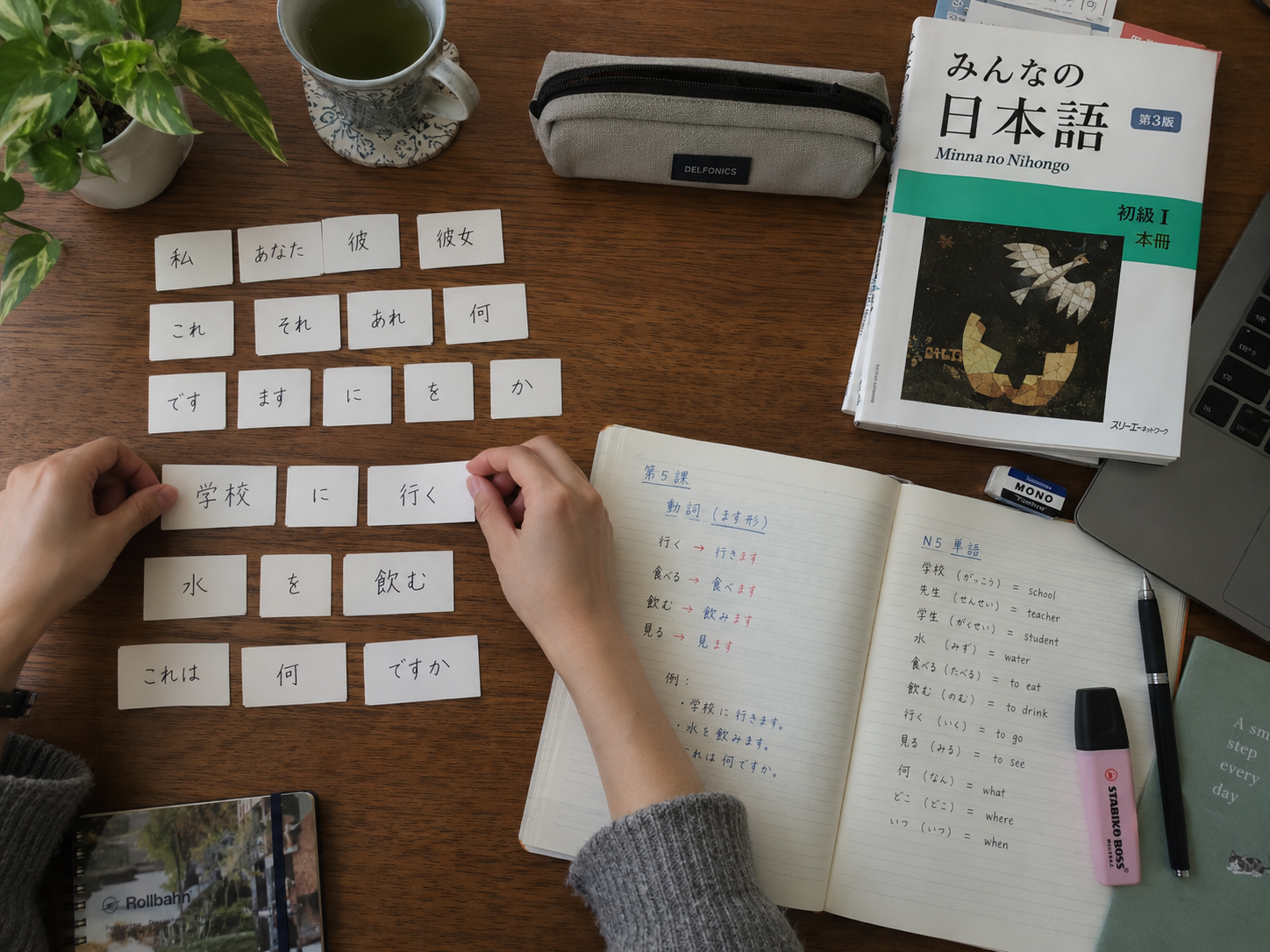
A literal frequency list is a strange way to begin Japanese. The highest-frequency items include particles such as の, に, は, and が—tiny grammatical words that are essential but not very satisfying as a first vocabulary deck. Meanwhile, a word such as 駅 (eki, station) may rank lower in a general written corpus but become indispensable the minute you travel.
So the list below is not pretending to be an exact universal ranking. Japanese frequency changes with spoken versus written language, age, genre, and situation. The National Institute for Japanese Language and Linguistics publishes corpus-based frequency resources, but a beginner needs a slightly different question: which common words give me the greatest ability to understand and build ordinary sentences?
The hundred below combine frequency with usefulness.
Greetings and social basics
1. こんにちは (konnichiwa) — hello / good afternoon
2. おはよう (ohayō) — good morning
3. おはようございます (ohayō gozaimasu) — good morning, polite
4. こんばんは (konbanwa) — good evening
5. ありがとう (arigatō) — thank you
6. ありがとうございます (arigatō gozaimasu) — thank you, polite
7. すみません (sumimasen) — excuse me / sorry
8. ごめんなさい (gomennasai) — I’m sorry
9. お願いします (onegaishimasu) — please / I request it
10. どうぞ (dōzo) — please / go ahead
The small words that hold sentences together
11. は (wa, particle) — topic marker
12. が (ga) — subject/focus marker
13. を (o) — object marker
14. に (ni) — destination/time/target marker
15. で (de) — place of action / means
16. の (no) — possession/linking nouns
17. と (to) — and / with / quotation marker
18. も (mo) — also
19. から (kara) — from / because
20. まで (made) — until / as far as
Beginners sometimes postpone particles because they do not feel like “real vocabulary.” That creates a problem: nouns without particles do not teach you how Japanese sentences work. Learn particles in chunks such as 学校に行く (gakkō ni iku, go to school) and 電車で行く (densha de iku, go by train).
Core verbs
21. する (suru) — do
22. ある (aru) — exist / have, inanimate
23. いる (iru) — exist, animate
24. 行く (iku) — go
25. 来る (kuru) — come
26. 帰る (kaeru) — return / go home
27. 見る (miru) — see / watch
28. 聞く (kiku) — hear / listen / ask
29. 言う (iu) — say
30. 話す (hanasu) — speak
31. 食べる (taberu) — eat
32. 飲む (nomu) — drink
33. 買う (kau) — buy
34. 使う (tsukau) — use
35. 読む (yomu) — read
36. 書く (kaku) — write
37. 分かる (wakaru) — understand
38. 思う (omou) — think
39. 知る (shiru) — know / find out
40. できる (dekiru) — can / be able / be completed
Question words
41. 何 (nani / nan) — what
42. 誰 (dare) — who
43. どこ (doko) — where
44. いつ (itsu) — when
45. なぜ (naze) — why
46. どう (dō) — how
47. どれ (dore) — which one
48. どの (dono) — which + noun
49. いくら (ikura) — how much
50. いくつ (ikutsu) — how many / how old
Demonstratives and people
51. これ (kore) — this one
52. それ (sore) — that one near you
53. あれ (are) — that one over there
54. ここ (koko) — here
55. そこ (soko) — there
56. あそこ (asoko) — over there
57. 私 (watashi) — I / me
58. 人 (hito) — person
59. 友達 (tomodachi) — friend
60. 先生 (sensei) — teacher / professional title
Time
61. 今 (ima) — now
62. 今日 (kyō) — today
63. 明日 (ashita) — tomorrow
64. 昨日 (kinō) — yesterday
65. 朝 (asa) — morning
66. 昼 (hiru) — daytime / noon
67. 夜 (yoru) — night
68. 時間 (jikan) — time / hours
69. 毎日 (mainichi) — every day
70. あと (ato) — after / later / remaining
High-value nouns
71. 家 (ie / uchi) — house / home
72. 学校 (gakkō) — school
73. 仕事 (shigoto) — work / job
74. 店 (mise) — shop
75. 駅 (eki) — station
76. 電車 (densha) — train
77. 車 (kuruma) — car
78. 水 (mizu) — water
79. 食べ物 (tabemono) — food
80. お金 (okane) — money
Useful adjectives
81. いい / 良い (ii / yoi) — good
82. 悪い (warui) — bad
83. 大きい (ōkii) — big
84. 小さい (chiisai) — small
85. 新しい (atarashii) — new
86. 古い (furui) — old, for things
87. 高い (takai) — expensive / high
88. 安い (yasui) — cheap
89. 早い (hayai) — early / fast
90. 遅い (osoi) — late / slow
Everyday connectors and responses
91. はい (hai) — yes / acknowledgment
92. いいえ (iie) — no
93. でも (demo) — but / however
94. そして (soshite) — and then
95. まだ (mada) — still / not yet
96. もう (mō) — already / more
97. ちょっと (chotto) — a little; also a softening device
98. たくさん (takusan) — a lot / many
99. とても (totemo) — very
100. 大丈夫 (daijōbu) — okay / all right / no thanks depending on context
Do not learn them as one hundred isolated cards
The most efficient unit is usually a short chunk. Instead of memorizing 行く = go, learn 学校に行く (go to school), 電車で行く (go by train), and 明日行く (go tomorrow). Instead of memorizing 大丈夫 = okay, listen for the different meanings it takes from tone and context: “I’m fine,” “That’s okay,” “No thank you,” or “Is it all right?”
This is also why a beginner vocabulary list should include grammar words. Frequency is not just about nouns you can point to. Japanese comprehension improves dramatically when particles, common verbs, demonstratives, and time expressions begin to feel automatic.
A structured Japanese class helps turn this vocabulary into sentences. Polyglottist Language Academy’s Japanese beginner courses emphasize that transition: words become useful when you can retrieve them quickly enough to ask, answer, clarify, and react.