
How to Order Food in Tagalog
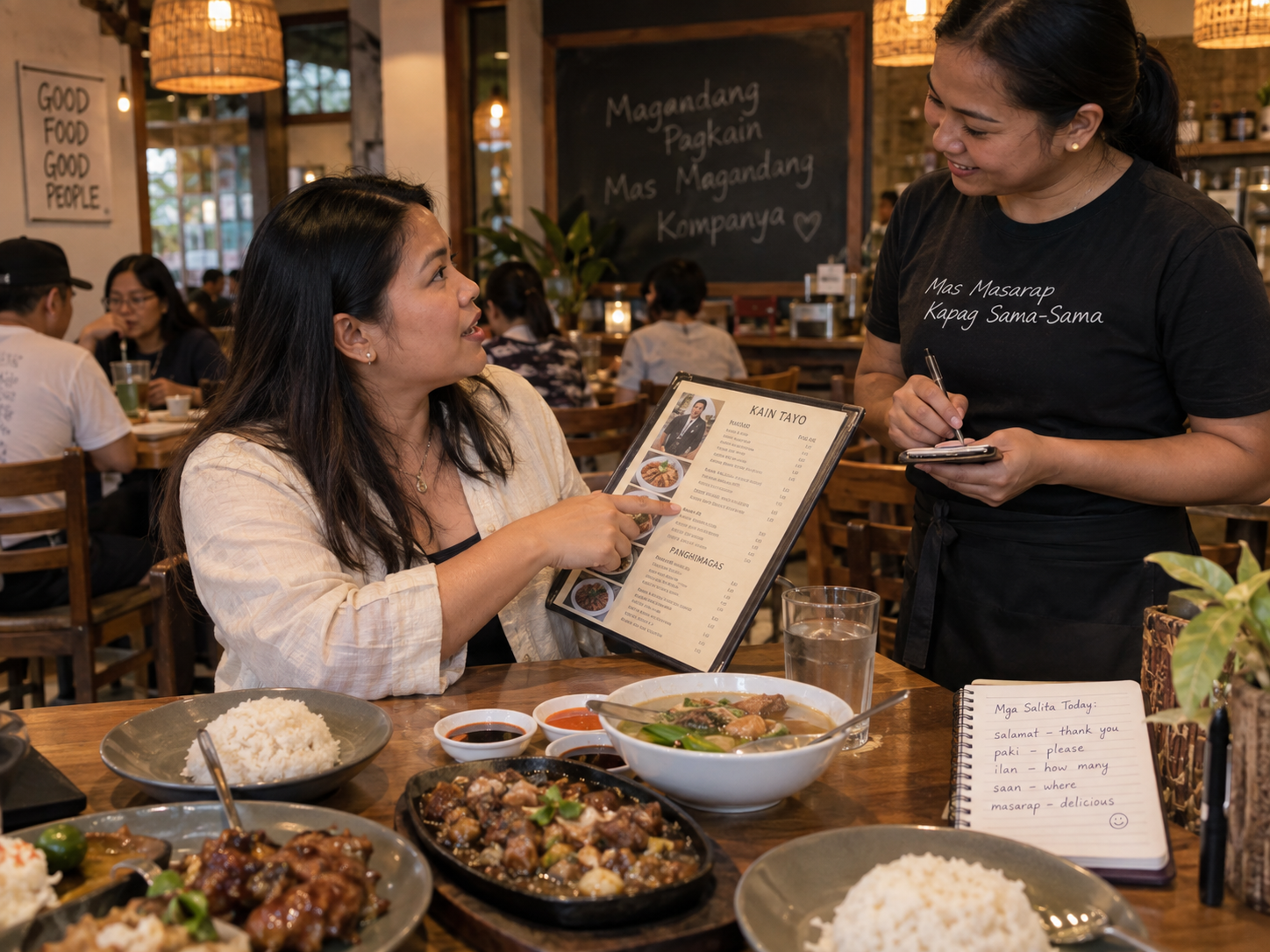
A traveler can eat extremely well in the Philippines without speaking Tagalog. In many restaurants, especially in cities and tourist areas, staff can use English comfortably. That makes food one of the best places to practice Tagalog because the stakes are low. You are not using the language because you have no other option; you are using it because the interaction is predictable enough to try.
You already know the situation. You want a table, a dish, water, perhaps a recommendation, and eventually the bill. Once those few moves become familiar, restaurant Tagalog stops feeling like a memorized performance.
Start with po
For beginners, one of the most useful words is po. It adds politeness and respect, especially when speaking to someone older or in a service interaction.
Salamat po. — Thank you.
Ano po ito? — What is this?
Isa po nito. — One of these, please.
Po does not translate neatly into a single English word. Treat it as part of the social tone of the sentence.
You may also hear opo, a respectful form of “yes.”
Getting someone’s attention
In casual restaurants, you may hear people use Ate or Kuya when addressing a female or male worker who is somewhat older than the speaker or being addressed in a friendly-respectful way. These are kinship terms that literally mean older sister and older brother, but they are widely used beyond literal family relationships.
A beginner should observe local usage rather than force these terms into every interaction. Excuse-me-style English and Tagalog often mix naturally in service settings.
A safe phrase is:
Excuse me po.
Taglish is ordinary. Your goal is not to purify the conversation of English.
Asking what a dish is
Ano po ito? — What is this?
Ano po ’yan? — What is that?
Ano ang laman nito? — What is in this?
The shortened conversational forms ito and ’yan are extremely useful when you can point.
At a buffet or carinderia, pointing plus Isa po nito may be more natural than constructing a complicated sentence around a dish name you have never seen before.
Ordering one or more items
Isa po nito. — One of these, please.
Dalawa po nito. — Two of these, please.
Pabili po ng… — I’d like to buy / May I have…
Pabili is common in buying situations and can be useful at stalls, bakeries, and casual counters.
In a sit-down restaurant, learners also hear and use mixed phrases such as “One adobo po” or “Puwede po bang umorder ng…?” Code-switching is normal, especially when menu items themselves are in English or are treated as fixed names.
Asking for a recommendation
Ano po ang masarap dito? — What is good here?
Ano po ang recommended? — What do you recommend?
The second example is Taglish and completely believable in many modern restaurant settings.
Masarap means delicious or tasty and is one of the highest-value food words a beginner can learn.
Masarap! — Delicious!
Masarap po. — It’s delicious.
Useful food words
kanin — cooked rice
ulam — a dish eaten with rice
tubig — water
sabaw — soup/broth
sawsawan — dipping sauce
maanghang — spicy
matamis — sweet
maasim — sour
maalat — salty
masarap — delicious
Ulam is especially useful because it does not have a perfect one-word English equivalent. In everyday Filipino eating, it refers broadly to the viand or main accompaniment eaten with rice.
Asking for water or something extra
Tubig po, please. — Water, please.
Puwede po bang makahingi ng tubig? — May I ask for some water?
Puwede po bang humingi ng extra rice? — May I ask for extra rice?
Again, do not be surprised by English nouns inside otherwise Tagalog sentences. Restaurant Taglish is not a failure to speak “real Tagalog.” It is part of how many people actually communicate.
Saying “without” something
If you have a preference rather than a serious allergy, you may hear requests built around walang:
Walang sili, please. — No chili, please.
Walang yelo. — No ice.
For allergies, do not rely on a phrase you only half understand. State the allergy clearly, confirm comprehension, and use English if that is the safest shared language. Language practice should not override medical clarity.
Asking how much something costs
Magkano po? — How much?
Magkano po ito? — How much is this?
This is most useful in markets, food stalls, bakeries, and places where prices may not be obvious.
Asking for the bill
Bill po, please.
Puwede po bang makahingi ng bill? — May I have the bill?
A fully Tagalog word for every element is not necessary for natural communication. “Bill po” is short, clear, and consistent with everyday code-switching.
The grammar behind a few useful phrases
English speakers often want one universal pattern equivalent to “I want…” Tagalog offers several ways to express wants, requests, and orders depending on the situation.
Gusto ko ng adobo. literally means “I want adobo,” and it is grammatically useful. In a restaurant, however, a request such as Isa po nito or Pabili po ng… can sound more situationally natural than announcing a desire in the abstract.
This is an important difference between translating and communicating. A sentence can be grammatically correct and still not be the phrase a native speaker reaches for in that setting.
Practice with real menus
One of the best ways to study restaurant Tagalog is to use actual Filipino menus. Pick five dishes and practice asking what they are, how much they cost, whether they are spicy, and which one the server recommends.
Then reverse the exercise. Imagine you are the server and answer in simple Tagalog.
If you want structured practice with everyday situations such as ordering food, Polyglottist Language Academy’s Tagalog beginner curriculum includes practical conversation alongside grammar and culture.
The useful goal is not to deliver a perfect paragraph to a waiter. It is to handle a sequence of tiny interactions: greet, ask, choose, request, thank. Food gives beginners the rare chance to repeat those same moves often enough that they begin to feel automatic.