
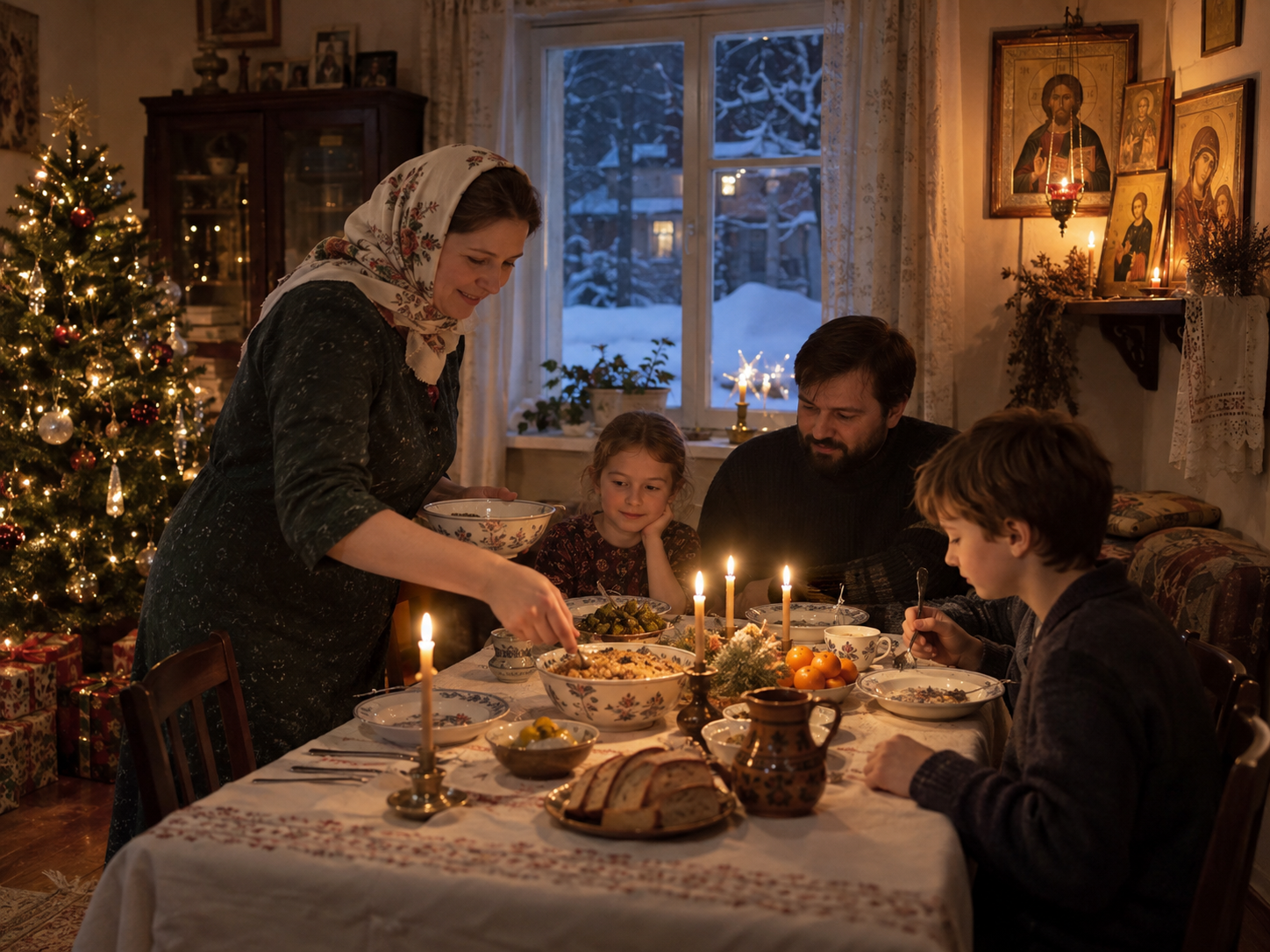
A visitor to Russia in late December may see a decorated tree, lights, gift displays, holiday concerts, and children waiting for a magical bearded figure. It looks like Christmas season. Then December 25 passes without becoming the main family holiday, New Year's Eve arrives with enormous importance, and Orthodox Christmas follows on January 7.
The obvious explanation is “Russia celebrates Christmas thirteen days later.” That is true as far as the calendar goes, but it misses the more interesting difference. Russian winter holiday culture was reorganized by the twentieth century. Many customs that Western Europeans and Americans associate with Christmas became attached to New Year in the Soviet period, while Orthodox Christmas returned later as a religious public holiday.
To understand Russian Christmas, you have to look at both calendars and history.
Why Russian Orthodox Christmas falls on January 7
The Russian Orthodox Church continues to use the Julian calendar for its fixed liturgical feasts. Christmas is celebrated on December 25 according to that calendar. In the twenty-first century, December 25 Julian corresponds to January 7 on the Gregorian civil calendar used in Russia and most of the world.
So Orthodox Russians are not choosing “January 7” as an alternative date for the Nativity. Liturgically, they are celebrating December 25 according to a different calendar system.
This distinction matters because not all Orthodox churches follow exactly the same civil-date practice today. Some Orthodox churches use a revised calendar for fixed feasts and therefore celebrate Christmas on December 25 Gregorian. The Russian Orthodox Church retains the Julian calendar for this purpose.
Western Christmas usually carries the secular and religious holiday at once
In the United States and much of Western Europe, Christmas combines several layers. Christians may attend church and celebrate the Nativity, while millions of people also participate in a largely secular holiday built around family gatherings, gifts, decorated trees, food, music, Santa Claus, and school or workplace breaks.
Even people who are not religious can experience December 25 as the central emotional point of the winter holiday season.
Modern Russia divides those functions differently. For many families, New Year's Eve and New Year's Day carry more of the secular celebration, while January 7 carries a stronger explicitly religious association.
That division did not happen by accident.
The Soviet period moved Christmas customs onto New Year
Before the Soviet period, Christmas had a major place in Russian religious and social life. The Bolshevik state, however, pursued anti-religious policies, and public religious observance was suppressed for much of the twentieth century.
Holiday customs did not simply disappear. Some were transformed and reattached to a secular New Year celebration.
The decorated ёлка, or holiday tree, became strongly associated with New Year rather than Christmas. Gift giving moved with it. Дед Мороз — Grandfather Frost — and his granddaughter Снегурочка, the Snow Maiden, became central New Year figures. Children's performances, family celebrations, television traditions, festive meals, and midnight congratulations developed around December 31.
This historical transfer explains something that can otherwise confuse Western visitors. A Russian family may have a tree, gifts, sparkling wine, elaborate food, and a magical gift-bringer, but the main celebration is Новый год, New Year.
Ded Moroz is not simply the Russian Santa Claus
The comparison is understandable, but it can blur the cultural role.
Дед Мороз is an older folkloric figure reshaped over time into the familiar winter gift-bringer. In contemporary Russian holiday culture, he is associated primarily with New Year. He is often accompanied by Снегурочка, a figure without a direct equivalent in the Santa Claus tradition.
Children may encounter Ded Moroz at school celebrations, public events, theaters, parties, or family gatherings. Gifts traditionally appear as part of New Year festivities rather than as the defining feature of Orthodox Christmas morning.
This is one reason translating Дед Мороз simply as “Santa” can be convenient in a beginner vocabulary list but culturally incomplete.
What happens on Orthodox Christmas Eve?
January 6 is Сочельник, Orthodox Christmas Eve. For observant Orthodox Christians it concludes the Nativity Fast, a period of preparation before Christmas.
Religious families may avoid meat and dairy until the feast according to their level of observance, attend church, pray, or have a simpler meal before the Christmas liturgy. Some traditions are stronger in particular families, regions, or generations than others.
It is tempting to create a universal checklist of “Russian Christmas Eve traditions,” but that usually produces a mixture of regional Slavic customs presented as though every Russian household follows them. Contemporary practice varies widely. Some Russians are deeply observant; some identify culturally with Orthodoxy without following fasting rules; some are secular; some belong to other religions; and others celebrate Christmas very little.
January 7: church, family, and a quieter holiday
Orthodox Christmas Day is a public holiday in Russia. For practicing believers, church services are central, including the Christmas liturgy. Families may gather for a meal after the fasting period, visit relatives, or spend a quieter day together.
Compared with the commercial intensity of Western Christmas, Russian Orthodox Christmas can feel less centered on gifts and more explicitly tied to religious observance. That does not mean every household is solemn or that no gifts are exchanged. It means the cultural center of gravity is different because the big secular gift holiday has already happened a week earlier.
The contrast is especially clear in families that celebrate both enthusiastically. New Year's Eve may involve the large table, television, countdown, champagne, presents, Ded Moroz, and staying awake late. Christmas may involve church, a meal, relatives, and a more reflective atmosphere.
Russian New Year is the key comparison Westerners often miss
If you compare only December 25 with January 7, Russian Christmas can look strangely understated. If you compare the Western Christmas season with Russian New Year plus Orthodox Christmas, the structure makes much more sense.
Many Western Christmas functions are split across the Russian calendar:
New Year handles much of the secular celebration: the tree, gifts, parties, festive television, midnight congratulations, and Ded Moroz.
Orthodox Christmas carries the Nativity, church observance, the end of the fast, and explicitly Christian meaning.
There is also Старый Новый год, the “Old New Year,” on the night of January 13–14, a curious cultural after-echo created by the calendar difference. It is usually much smaller than New Year itself, but the phrase reminds Russians how deeply two calendar systems have shaped winter traditions.
The food is different because the holiday sequence is different
A Western Christmas meal may be the culinary centerpiece of the season. In many Russian households, the largest and most elaborate table is prepared for New Year's Eve.
Classic New Year dishes often include salads such as Оливье and селёдка под шубой, cold appetizers, fish, meats, pickles, mandarins, sweets, and sparkling wine. Individual families have their own non-negotiable dishes.
Christmas food can overlap with general festive cuisine, especially after the Nativity Fast ends, but it does not have one single menu followed nationwide. Observant practice, region, family history, and modern habits all matter.
That is another reason to be cautious with articles that claim “Russians always eat twelve dishes at Christmas” or present one ritual food as universal. Slavic traditions overlap, but they are not interchangeable.
The greetings are different too
For New Year, the standard greeting is:
С Новым годом! — Happy New Year!
For Christmas:
С Рождеством! — Merry Christmas!
You may also hear the fuller С Рождеством Христовым!, literally “Congratulations on the Nativity of Christ,” especially in explicitly religious contexts.
These phrases help learners notice the different emotional registers. С Новым годом! is everywhere in late December and early January: among friends, coworkers, businesses, television presenters, and strangers. С Рождеством! becomes relevant around Orthodox Christmas and can carry more religious meaning depending on the speaker.
Do Russians celebrate December 25 at all?
Some do. Russia is religiously and culturally diverse. Catholics and Protestants may celebrate December 25, international families may combine traditions, and global commercial culture has made Western Christmas imagery familiar.
Younger urban Russians also encounter December 25 constantly through films, travel, social media, multinational workplaces, and friends abroad.
That does not displace the traditional Russian calendar pattern. It simply means real family life is more varied than a national-holiday chart.
Why New Year is still “bigger” for many Russians
The Soviet state lasted long enough for several generations to experience New Year as the great universal winter holiday. It was secular, public, family-centered, and culturally safe in a period when religious practice could carry serious consequences.
When Orthodox Christmas returned as a public holiday after the Soviet period, New Year did not surrender that role. Instead, the holidays settled into a layered season in which secular and religious traditions coexist.
This is why asking “Why don't Russians celebrate Christmas like Americans?” starts from the wrong assumption. Russians did not simply preserve a Western-style Christmas and move it to January. Their winter holiday culture took a different historical path.
For language learners, that history explains vocabulary that otherwise seems oddly translated: ёлка is not automatically a “Christmas tree,” Дед Мороз is not exactly Santa, and праздники in early January may refer to an entire stretch of winter holidays rather than one day.
Polyglottist Language Academy's Russian classes often connect vocabulary with this kind of cultural context, because understanding when and why a phrase is used is part of understanding the language itself.
The calendar explains January 7. The twentieth century explains why December 31 often feels bigger. You need both facts to understand what Russian Christmas actually looks like today.