
“Head honcho” sounds perfectly at home in an American office. So does the “tech tycoon” in a business headline. Both expressions contain words that reached English from Japanese. Their origins have simply become less obvious with use. Merriam-Webster
Japanese words in English extend well beyond restaurant menus. Some announce their origins, while others blend into a text message, a furniture listing, or a conversation about work. Even when the connection seems obvious, the Japanese meaning can be surprising.
These 20 words turn up in everyday English, though some are more common in particular regions or generations than others. Their histories reveal how much a familiar word can change on its way into another language.
The words that hardly look Japanese anymore
1. Emoji
絵文字 · emoji
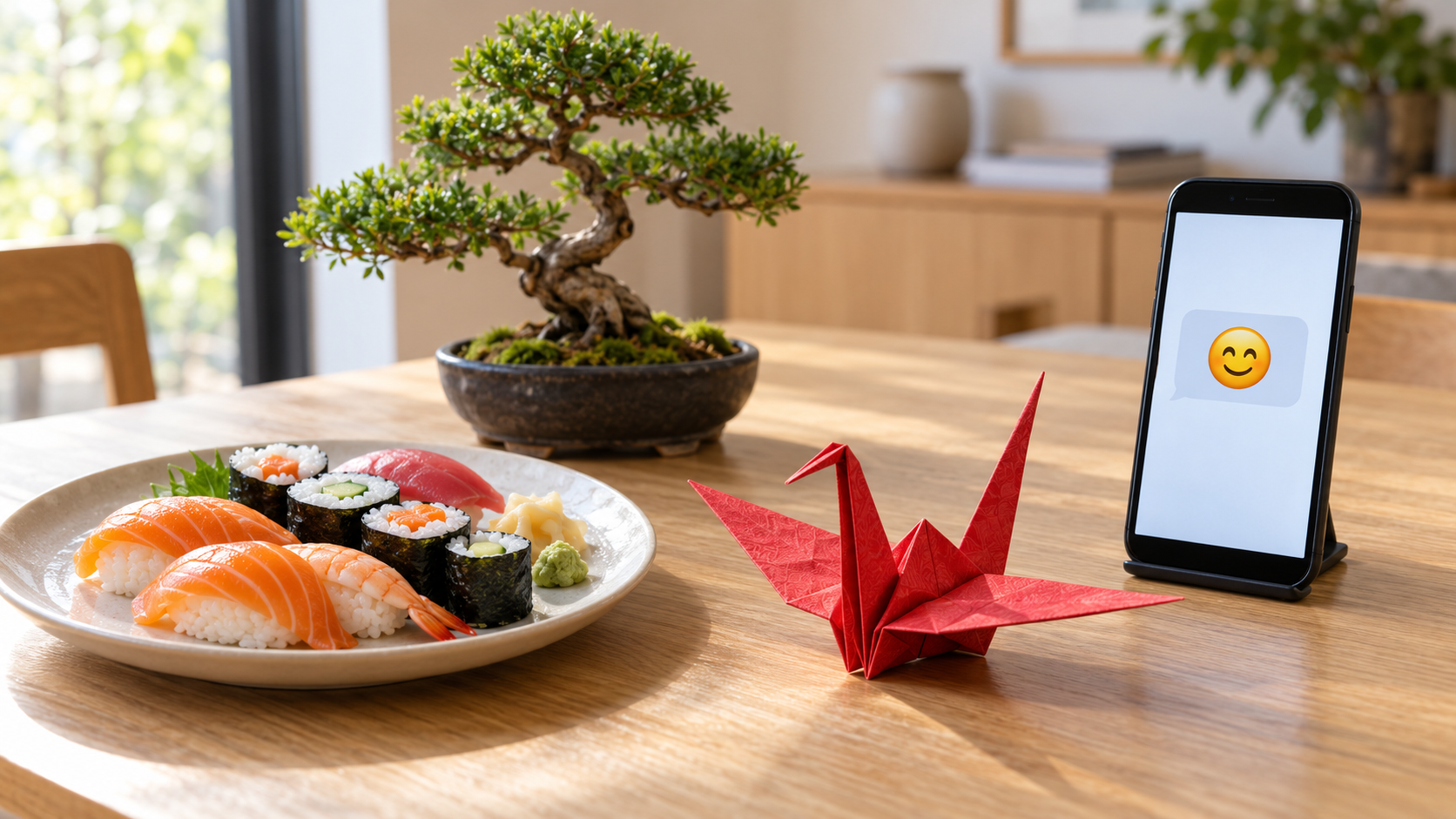
It is tempting to connect emoji with emotion. The resemblance is a coincidence. The Japanese word combines e, meaning “picture,” with moji, meaning “written character.” Merriam-Webster
A train, a slice of pizza, and a calendar qualify just as readily as a smiling face. Once the spelling is separated as e + moji, its origin becomes much easier to remember.
2. Honcho
班長 · hanchō
English honcho comes from a Japanese word for a group or squad leader. Its components are han, a group or squad, and chō, a head or chief. “Head honcho” therefore adds emphasis to a word that already contains the idea of leadership. The Japanese word names a role within a group. English has made it a looser, sometimes slightly comic label for whoever is in charge. Merriam-Webster
3. Tycoon
大君 · taikun
Before English attached it to shipping fortunes and technology companies, taikun was a title used for the Japanese shogun in dealings with foreign countries. Its elements convey the sense of “great lord.” The English word later developed its familiar meaning of a powerful businessperson. A “media tycoon” is therefore carrying a little diplomatic history into a very modern sentence. Merriam-Webster
4. Skosh
少し · sukoshi
“Could you move that chair a skosh?” In informal American English, a skosh is a small amount. It comes from Japanese sukoshi, meaning “a little,” adapted and shortened in English. Merriam-Webster
In Japanese, sukoshi is an ordinary, useful word. Sukoshi dake means “just a little”; mō sukoshi means “a little more.” Those short expressions are worth keeping even if “a skosh” never becomes part of someone’s English.
The Japanese already on the menu
5. Sushi
寿司 · sushi
Raw fish gets most of the attention, but vinegar-seasoned rice is central to the sushi most diners encounter. The accompanying ingredients can include vegetables, cooked seafood, or egg. A cucumber roll can be sushi without containing any fish at all. This distinction changes how a menu reads. Someone who dislikes raw fish may still find plenty of sushi to enjoy. Treating sushi as a synonym for “raw fish” makes a broad category of food seem much narrower than it is. Merriam-Webster
6. Ramen
ラーメン · rāmen
The packet in the cupboard and the bowl served across a restaurant counter share a name, but instant noodles are only one part of the ramen story. Ramen uses wheat noodles, commonly served in broth. The English word covers both the convenient packet and dishes built around carefully prepared noodles, broth, and toppings. The dish has Chinese roots, and its name reached English through Japanese. japan.travel
7. Tempura
天ぷら · tenpura
Tempura refers to seafood or vegetables dipped in batter and deep-fried. The familiar English spelling uses an m; the Japanese spelling can be romanized as tenpura. Both point to the same food. Merriam-Webster
Its earlier word history is less tidy. Several Portuguese derivations have been proposed, but Japanese reference works describe the exact origin as unsettled. コトバンク
8. Tofu
豆腐 · tōfu
Tofu is made by setting soy milk into curds. The English word comes through Japanese tōfu, whose earlier roots are Chinese. Calling it a Japanese loanword describes the route into English, not a claim that Japan invented tofu. ahdictionary.com
9. Teriyaki
照り焼き · teriyaki
On a supermarket shelf, teriyaki often names a sauce. In Japanese cooking, the term describes a method that gives food a glossy finish: teri relates to shine or glaze, while yaki refers to grilling or broiling. A sauce typically containing soy sauce and sweet ingredients produces that sheen. Kikkoman Corporation
So the word on the bottle carries a cooking process inside it. Remembering the glossy surface gives teriyaki a more concrete meaning than simply “a sweet Japanese flavor.”
10. Wasabi
わさび · wasabi
Wasabi names both a plant and the pungent condiment made from its grated rhizome, the thickened stem commonly described as its root. English borrowed the name along with the food. Merriam-Webster
The green paste in a tube may also contain ordinary horseradish. S&B’s prepared wasabi, for example, lists both horseradish and wasabi among its ingredients. Checking the label tells you more about the condiment than its familiar green color does. S&B Foods Global Site
11. Umami
うま味 · umami
Umami gives English a specific word for a savory basic taste associated especially with glutamate. Parmesan, tomatoes, and broth can all provide examples. The term is more precise than a general compliment meaning “rich” or “delicious.” Umami Information Center
The taste itself is familiar far beyond Japanese food. That is part of the word’s appeal: someone may learn umami and realize they already know exactly what it describes. A new word can sharpen attention to something that has been on the plate all along.
12. Sake
酒 · sake
In English, sake usually means the Japanese alcoholic drink brewed from rice. In Japanese, sake can refer to alcohol more generally. Nihonshu (日本酒) identifies Japanese sake more specifically. JAPAN HOUSE
That difference becomes useful in conversation. A question about whether someone drinks osake may concern drinking alcohol at all, rather than a preference for one particular drink. English has selected a narrower meaning from the Japanese word, and a learner needs to allow it to widen again.
Karaoke nights and everyday life
13. Karaoke
カラオケ · karaoke
The usual explanation, “empty orchestra,” makes more sense when its pieces are unpacked. Kara means “empty.” Oke is shortened from ōkesutora, the Japanese borrowing of “orchestra.” You sing over recorded accompaniment. The word contains borrowing in both directions: a foreign word became part of a Japanese abbreviation, and the new expression then entered English. Merriam-Webster
The setting can differ, too. In Japan, many karaoke venues rent private rooms where a group can sing together. An invitation to karaoke does not necessarily mean a solo performance in front of an entire bar. For a hesitant singer, that is useful information to have before deciding whether to go. japan.travel
14. Anime
アニメ · anime
English generally uses anime for Japanese animation. In Japanese, the word can refer to animation more broadly. It is a shortened form of animēshon, itself borrowed from English “animation.” Anime can accommodate a quiet domestic drama as readily as a fantasy adventure. The label alone says little about a story’s subject or intended audience. Animation Studies Journal
15. Manga
漫画 · manga
A similar shift occurs with manga. In Japanese, the word covers comics and cartoons broadly; English usually uses it for Japanese comics and graphic novels. Merriam-Webster
It does not, by itself, specify one genre, age group, or drawing style. For learners choosing something to read, those details matter more than the label. A comic about a familiar everyday subject may offer more useful early vocabulary than one whose plot requires several pages of invented terminology.
16. Futon
布団 · futon
In an American furniture shop, futon may suggest a mattress on a frame that serves as a couch or bed. Traditional Japanese futon bedding includes a mattress and a quilted cover, and can be folded away when it is not being used. Merriam-Webster
That changes what to expect from an accommodation listing. A room with futon bedding may have sleeping arrangements laid out on the floor, with the space available for other uses during the day.
The meanings inside origami, bonsai, karate, and tsunami
17. Origami
折り紙 · origami
The name of paper folding combines ori, “folding,” and kami, “paper.” In the compound, the paper element appears as gami. That small sound change is easy to miss when origami is learned as a single English word. Recognizing kami inside origami is a small, useful step for a beginner. A word that once seemed to be an indivisible label starts to show how it was put together. ahdictionary.com
18. Bonsai
盆栽 · bonsai
Bonsai refers to the cultivation of miniature trees in containers, and to the trees grown this way. Bon refers to a basin or container, and sai to planting. The word describes a way of growing and shaping a tree, not one tree species. A pine and a maple can both be bonsai. Their small scale results from cultivation and care, so the name describes more than simply buying a naturally tiny plant. ahdictionary.com
19. Karate
空手 · karate
In its modern written form, karate combines “empty” and “hand.” The martial art developed in Okinawa, with Chinese influences, before spreading much more widely. JKA 公益社団法人日本空手協会
The kara here is the same “empty” encountered in karaoke. Singing over a backing track and practicing an unarmed martial art have very little else in common, but their names share a meaningful element.
20. Tsunami
津波 · tsunami
The components of tsunami mean “harbor” and “wave.” The word names waves generated by a sudden displacement of water, often associated with an earthquake. The older English expression “tidal wave” is misleading because tides are not the cause. English adopted a Japanese term for a phenomenon that can occur far beyond Japan. ncei.noaa.gov
Put a familiar word into a sentence
Knowing these words does not require changing the way they are normally pronounced in English. When speaking Japanese, however, it helps to listen to them afresh. Familiar spelling can make an English pronunciation especially hard to set aside.
Start with the long vowels. The marks in rāmen, tōfu, and hanchō tell the reader to hold those vowels longer. They indicate duration, not a request to make that syllable louder. Listening and repeating a short recording is more useful here than relying entirely on an English spelling approximation. coelang.tufs.ac.jp
The final e in sake and karaoke is roughly an “eh” sound, rather than “ee.” Try separating karaoke into ka-ra-o-ke before listening to a Japanese recording. English respellings can only approximate the sounds, so use them as a starting point. Japanese also has pitch patterns; making every part equally loud is not the goal. Pay attention to the recording’s shape as well as the individual sounds. coelang.tufs.ac.jp
Then give one familiar noun two different jobs:
ラーメンをください。
Rāmen o kudasai.
“I’d like ramen, please.” jpf.go.jp
ラーメンが好きです。
Rāmen ga suki desu.
“I like ramen.” irodori.jpf.go.jp
The noun stays the same, but the surrounding words turn it into an order or a statement about a preference. Familiar vocabulary becomes much more useful once it has somewhere to go in a sentence.
For adults who would like to work on that next step, Japanese classes at Polyglottist Language Academy combine live instruction with practical communication and attention to how the language is actually used. The academy offers online classes and selected in-person classes in Berkeley, California. Online Courses
A reasonable first ambition is to order something familiar and understand the question that comes back. There is plenty of Japanese to learn in that small exchange.