Filipino Family Vocabulary: More Than Just Nanay and Tatay
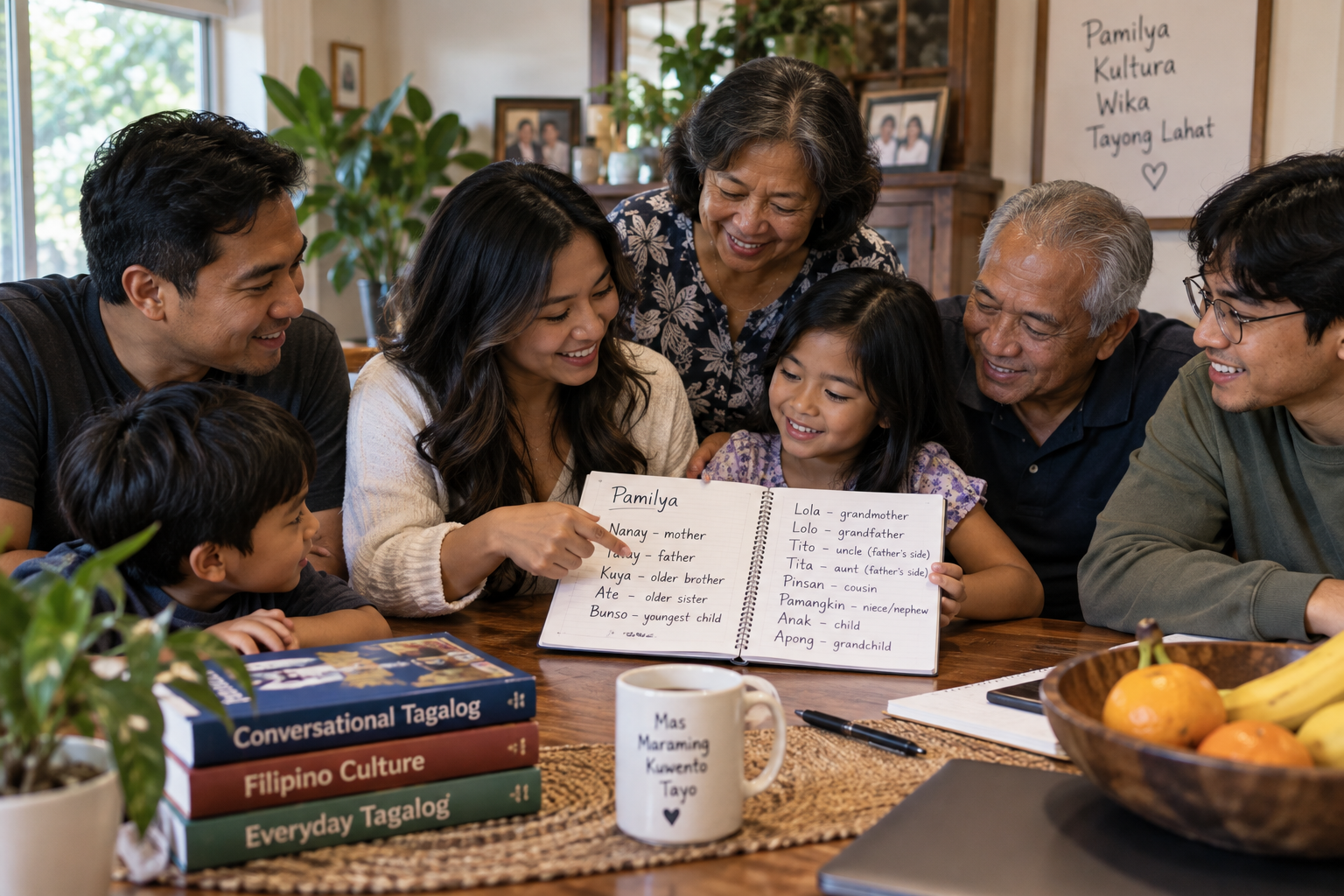
A beginner can learn nanay and tatay in five minutes and still understand very little of how family language works in Tagalog.
The interesting vocabulary begins when the family tree stops behaving like an English family tree.
An older female cousin may be called Ate. A close family friend can become Tita. A godparent may remain a significant social figure for decades. Someone introduced as “Kuya Mark” may not be the speaker’s brother at all.
These are not sloppy uses of literal words. They show how Filipino relationship vocabulary often describes social position as much as biological connection.
Nanay and Tatay are only one set of words for parents
Nanay means mother and Tatay means father. They are common, warm, everyday terms.
You may also hear Inay and Itay, along with Mama, Papa, Mommy, Daddy, and family-specific combinations shaped by region, generation, class, migration, and personal habit.
That variation matters for heritage learners. The “correct” textbook word may not be the word your own family uses.
If you are learning Tagalog primarily to speak with relatives, write down the forms you hear at home even when they differ from the first vocabulary list you encounter.
Ate and Kuya organize age and respect
Ate refers literally to an older sister; Kuya to an older brother.
In everyday social use, both can extend beyond literal siblings. A younger person may address an older cousin, family friend, coworker, service worker, or acquaintance as ate or kuya depending on the relationship and setting.
This is difficult to translate because English does not have a normal equivalent. Saying “older sister” every time sounds biological; saying “ma’am” sounds too formal; using the person’s first name may miss the respectful familiarity of the Tagalog term.
Consider:
Ate, pwede pong magtanong? — Ate, may I ask a question?
The speaker may be talking to an actual sister. They may also be politely addressing a slightly older woman.
Context tells you which.
Panganay and bunso tell you where someone sits among siblings
Panganay is the eldest child or firstborn.
Bunso is the youngest child.
These words often appear in family stories because birth order can be a convenient way of identifying someone:
Siya ang bunso namin. — He/She is the youngest in our family.
Ang panganay namin ay nasa Cebu. — Our eldest is in Cebu.
English can express the same information, but Tagalog has compact everyday labels for it.
Lola, Lolo, and Apo connect generations
Lola — grandmother
Lolo — grandfather
Apo — grandchild
As with ate and kuya, lola and lolo can sometimes be used respectfully for older people outside one’s literal family, though the exact social appropriateness varies.
Apo is especially useful because English speakers sometimes expect “grandchild” to behave like a distant genealogy term. In many family conversations it is ordinary, active vocabulary.
Apo ko siya. — He/She is my grandchild.
Tita and Tito are larger than “aunt” and “uncle”
Tita and Tito mean aunt and uncle in common Filipino usage and come historically through Spanish influence.
But learners quickly discover that the category can expand.
Parents’ close friends may be Tita and Tito. Older family acquaintances may receive the title. Children can grow up with several “titas” who are not related by blood or marriage.
That means the sentence Tita ko siya may require context. The relationship can be literal, affinal, or socially constructed.
For a heritage learner, this is often one of those things they already know intuitively but have never analyzed.
Pinsan and pamangkin cover relationships English divides differently
Pinsan — cousin
Pamangkin — niece or nephew
Tagalog does not require a gender distinction in pamangkin the way English does with niece and nephew.
Pamangkin ko siya. — He/She is my niece/nephew.
That is a recurring pattern in Tagalog: siya itself is also gender-neutral. Context or additional words supply information that English grammar forces you to mark.
In-law vocabulary becomes important surprisingly fast
Adult learners often skip in-law terms because beginner textbooks focus on the nuclear family. Real family conversations do not.
Useful words include:
biyenan — parent-in-law
manugang — son-in-law or daughter-in-law
bayaw — brother-in-law
hipag — sister-in-law
asawa — spouse / husband / wife
The exact relationship covered by bayaw and hipag can become more complex across extended family networks, and speakers may use terms with some flexibility. Beginners do not need to memorize every genealogical possibility at once. Start with the common core and learn the rest from context.
Anak is simple; family reference is not always
Anak means child or son/daughter.
Anak ko siya. — He/She is my child.
Because siya is gender-neutral, the sentence does not tell you whether the child is male or female.
This can surprise English speakers who expect family vocabulary to encode gender everywhere. Tagalog often leaves gender unmarked where English insists on it.
Ninong, Ninang, and Inaanak create another kind of family
Ninong — godfather
Ninang — godmother
Inaanak — godchild
These terms are particularly important in Filipino social life because godparent relationships can extend beyond the ceremony that created them. A ninong or ninang may remain part of family gatherings, milestone celebrations, gift-giving, and long-term social networks.
At Christmas, for example, inaanak may visit godparents for pamasko, a Christmas gift or money.
Again, families vary widely. Not every godparent relationship is close, and not every household treats the role in the same way. The language simply gives the relationship social visibility.
Family terms can function as forms of address
This is the point that vocabulary lists often miss.
If you learn ate only as “older sister,” you will be confused when a customer says Ate to a woman behind a counter.
If you learn tita only as “aunt,” you may wonder why children are calling their mother’s best friend Tita.
These words can reduce social distance while preserving respect.
They are part of a broader Tagalog system that includes po, opo, respectful kayo, and the frequent choice to call someone by a relationship title rather than a bare pronoun.
A few useful family sentences
May kapatid ka ba? — Do you have siblings?
Dalawa ang kapatid ko. — I have two siblings.
Siya ang ate ko. — She is my older sister.
Ako ang bunso. — I am the youngest.
Kasama ko ang mga pinsan ko. — I am with my cousins.
Nasa bahay si Lola. — Grandma is at home.
May dalawang anak sila. — They have two children.
Ninang ko siya. — She is my godmother.
Notice how much relationship information can appear without gendered pronouns.
Heritage learners should build a family-specific vocabulary list
If your goal is reconnecting with family, make your vocabulary personal.
Draw your actual family network. Label the people in Tagalog. Write the terms your relatives use, not only the ones a textbook prefers. Add regional or non-Tagalog words when they are part of your household.
You may discover that some of what you thought was “Tagalog family vocabulary” is Ilokano, Cebuano, Kapampangan, Hiligaynon, or another Philippine language. Keep it. Heritage language learning is not improved by deleting the language your family actually used.
A good Tagalog class can then help you distinguish which forms are broadly Tagalog and which belong to your family’s multilingual history.
Family vocabulary is therefore not simply a chapter of nouns. It teaches you how speakers locate one another by generation, age, inclusion, ritual relationship, and social closeness. Once you understand that, Ate and Tita stop looking like loose translations of “sister” and “aunt.” They become what they are in conversation: relationship words.