
How Many Kanji Do You Actually Need? The Honest Answer by Level
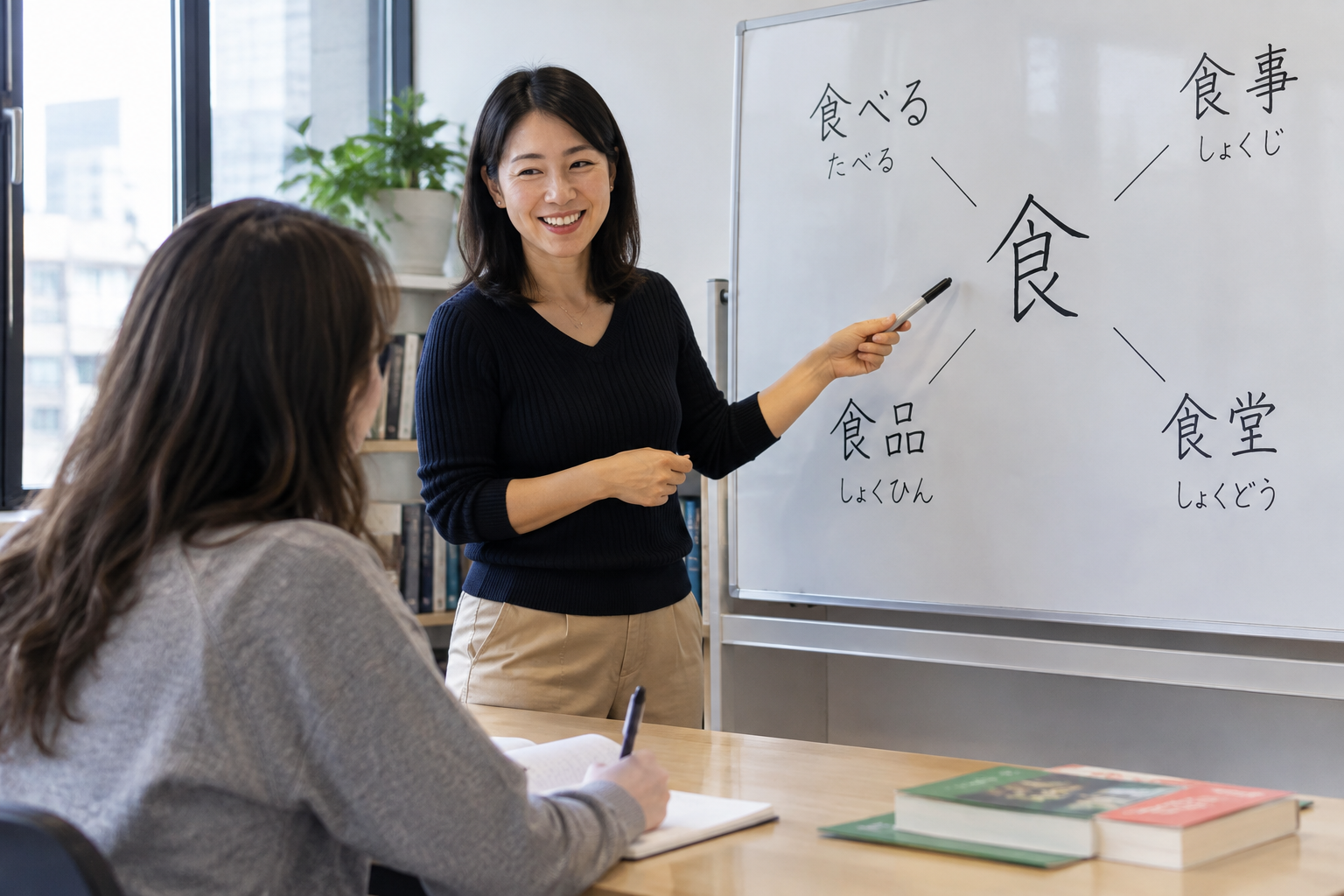
How Many Kanji Do You Actually Need? The Honest Answer by Level
Ask three Japanese learners how many kanji you need for N3 and you may get three confident answers: 600, 650, or 700. Search long enough and you will find neat charts assigning a precise number to every JLPT level.
There is one problem with those charts: the current JLPT does not publish an official kanji list for N5, N4, N3, N2, or N1. Since the test was revised in 2010, the organizers have intentionally avoided a fixed “test content specification” of vocabulary, kanji, and grammar items. Their stated reason is that the exam is meant to evaluate the ability to use language knowledge, not simply memorize a list.
So the honest answer is not one perfect number. It is a set of practical ranges, and the number you need depends on what you want to read.
First, decide what “know a kanji” means
Imagine that you recognize 食 and know that it is connected with eating. Do you “know” it?
Maybe. But can you read 食べる (*taberu*, to eat), 食事 (*shokuji*, meal), 食品 (*shokuhin*, food products), and 食堂 (*shokudō*, dining hall)? Can you recognize it quickly inside a sentence? Can you write it from memory?
These are different skills.
Beginners often count kanji as if each character were a vocabulary item. Japanese literacy does not work that way. A character carries meanings and readings that combine differently across words. Knowing the character 学 is useful, but your reading ability grows through words such as 学生, 学校, 大学, and 学ぶ.
That is why 500 kanji learned through 1,500 real words can be much more useful than 800 isolated flashcards.
N5: roughly 80–120 kanji is a sensible working range
You will often see “about 100 kanji” attached to N5. Treat that as a study estimate, not an official JLPT requirement.
At this stage, the useful characters are extremely common ones tied to numbers, days, people, basic movement, places, and everyday nouns: 日, 月, 人, 山, 川, 上, 下, 中, 大, 小, 学, 生, and so on.
The goal is not to become a miniature calligrapher. It is to stop being helpless when basic Japanese is written normally rather than entirely in hiragana.
Officially, N5 reading ability is described in terms of understanding typical phrases and sentences written in hiragana, katakana, and basic kanji used in daily life. That description is more useful than obsessing over whether your deck contains exactly 103 characters.
N4: roughly 250–350 cumulative kanji
By N4, many study programs aim for around 300 characters in total. Again, there is no official fixed list.
This is the stage where kanji begin to feel less like special symbols and more like the normal texture of Japanese. You can recognize common verbs and adjectives in their usual written forms, read simple notices, and follow short passages on familiar topics with less reliance on furigana.
The transition from N5 to N4 also teaches an important lesson: character count alone no longer predicts reading comfort. If you know 生 only as sei but freeze when it appears in 生まれる or 生きる, your nominal kanji total exaggerates what you can actually read.
N3: roughly 600–700 cumulative kanji
This is where the numbers begin to become psychologically significant. Six hundred characters sounds enormous to someone who has just learned hiragana. In practice, they accumulate through vocabulary over time.
N3 sits between basic classroom Japanese and the broader reading expected at N2 and N1. Learners at this stage encounter more abstract vocabulary, more compound words, and more kanji that share similar meanings or readings.
If your goal is to read everyday websites, messages, menus, transport information, and relatively accessible articles, the N3 range can make a dramatic difference. You will still look things up, but written Japanese stops feeling like an almost solid wall of unknown symbols.
N2: roughly 1,000 kanji
“About 1,000” is one of the most widely used unofficial N2 benchmarks. At this stage, however, reading speed and vocabulary depth matter at least as much as the count.
A learner who knows the visual form of 1,000 kanji but has weak vocabulary may still struggle with a newspaper paragraph. Another learner with the same rough character inventory and much stronger knowledge of compounds can read efficiently.
N2-level reading includes a broader range of everyday and general-interest material. The official JLPT description focuses on understanding Japanese used in everyday situations and in a variety of circumstances, not on checking off a character list.
For many adult learners, reaching the neighborhood of 1,000 well-learned kanji is the point when Japanese becomes genuinely readable in ordinary life, even though advanced texts remain demanding.
N1: roughly 2,000 kanji is a common estimate
You will often see 2,000–2,100 associated with N1. That estimate overlaps with another famous number: Japan’s Jōyō Kanji list, the official list of kanji in common use, contains 2,136 characters.
The Jōyō list is important, but it is not a foreign-learner graduation requirement. Native adult literacy also includes names, specialist terminology, uncommon characters, variant forms, and vocabulary that cannot be reduced to a single list.
Likewise, passing N1 does not mean you can handwrite 2,000 kanji flawlessly from memory. The JLPT tests recognition in vocabulary and reading contexts. It does not contain a handwriting section.
How many kanji do you need to live in Japan?
Much fewer than 2,000 to function, but more than zero if you want independence.
With several hundred high-frequency kanji, you can begin recognizing station names, basic signs, store categories, dates, forms, addresses, and common instructions. Around the intermediate range, everyday reading becomes much less exhausting. Greater literacy gives you access to notices from city hall, school correspondence, workplace documents, medical information, contracts, news, and the written texture of ordinary adult life.
Phones make lookup easier, but lookup is not the same as reading. If every second word requires a camera translation, even a short document becomes slow and uncertain.
Should you learn to write every kanji by hand?
Not necessarily to the same standard.
Recognition is essential for reading. Handwriting can help memory and is useful for forms, notes, and understanding stroke structure, but most adult learners will type far more Japanese than they handwrite.
A sensible approach is to learn basic stroke order and write new characters enough to understand their components, while devoting most long-term energy to recognition and vocabulary. If handwriting is personally important to you, you can develop it further without making it the gatekeeper for reading progress.
Learn kanji through words, not as museum objects
When you learn 電, attach it immediately to words such as 電車, 電話, and 電気. When you learn 会, connect it to 会社, 会う, and 会話. Kanji become memorable when they participate in language.
Teachers often notice that students who chase a large kanji number can recognize characters in a flashcard app but stumble when those same characters appear in compounds. The problem is not memory. It is that the learner practiced the wrong task.
If you use spaced repetition, make vocabulary the center of the card. Include pronunciation and a meaningful sentence. Learn the character’s useful readings through the words where they actually occur.
A better way to measure your level
Instead of asking only “How many kanji do I know?”, ask:
Can I read a graded reader without checking every line? Can I understand a restaurant menu? Can I read messages from a Japanese friend? Can I follow an NHK Easy article? Can I understand ordinary notices? Can I read a novel page with lookups that feel manageable rather than constant?
Those questions reveal the skill you actually want.
If you are studying Japanese in a structured class, kanji progression should grow alongside vocabulary, grammar, listening, and speaking. Polyglottist Language Academy’s Japanese classes integrate reading with the rest of the language rather than treating character accumulation as a separate contest.
There is nothing wrong with celebrating your 100th, 500th, or 1,000th kanji. Just remember that Japanese is not waiting for you at the end of a character list. The point of the characters is that they let you read the language already in front of you.