
Best Ways to Practice Vietnamese in the San Francisco Bay Area
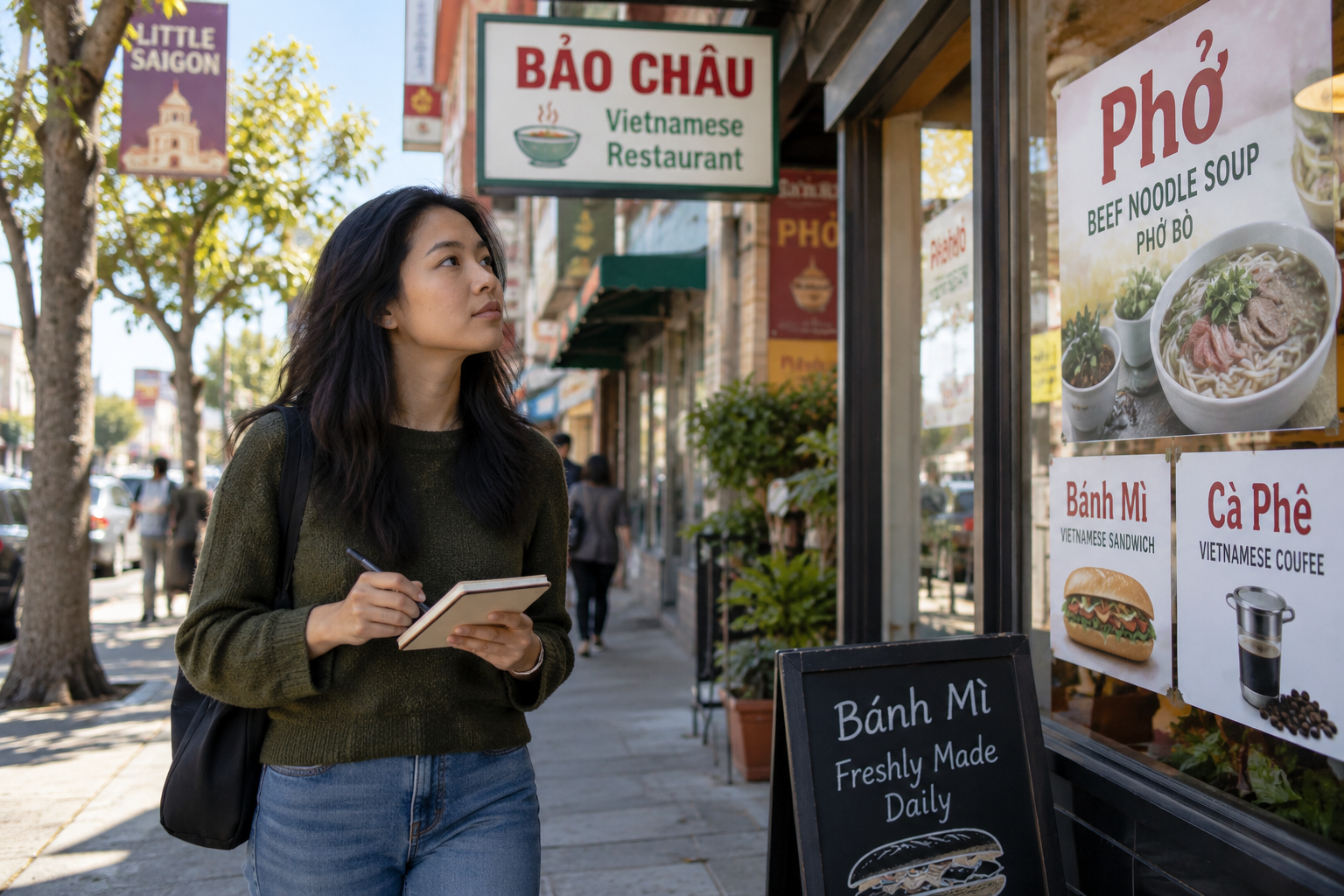
A Vietnamese learner in the Bay Area has an advantage that someone in many American cities does not: the language is part of local life. You can study tones in a lesson and then, on the same weekend, hear Vietnamese in Oakland, San Jose, a cultural event, a market, or a family gathering.
The difficult part is knowing how to turn proximity into useful practice without making every Vietnamese-speaking stranger responsible for your language education.
The best practice is usually prepared, specific, and modest. Instead of going somewhere with the vague goal of “speaking Vietnamese,” decide what you are trying to hear or say before you leave.
Use Oakland’s Little Saigon as a listening environment
Oakland’s Vietnamese community has deep roots around Eastlake and International Boulevard, and the city formally recognized Little Saigon as a cultural and economic center in 2025. The neighborhood includes Vietnamese businesses, restaurants, community organizations, and annual cultural programming.
A beginner can learn a surprising amount simply by noticing language in context. Look at shop signs. Identify food words you already know. Listen for greetings, kinship terms, numbers, or polite particles. Read a menu first without translating every line and see what you can infer.
If you decide to order in Vietnamese, keep the interaction appropriate to the situation. A short greeting, the name of a dish, a number, and cảm ơn can be good practice. Holding up a line while asking a busy employee for an impromptu pronunciation lesson is not.
San Jose offers the Bay Area’s densest Vietnamese cultural environment
San Jose’s Little Saigon and the commercial areas around Vietnam Town and Grand Century Mall make Vietnamese highly visible in everyday public space. For learners, the value is not only restaurants. You see naming conventions, advertisements, service vocabulary, community notices, and a much wider range of written Vietnamese than a textbook chapter can provide.
The Việt Museum at History Park adds a different kind of exposure. Its focus on Vietnamese refugee and Vietnamese American history gives language learners cultural and historical context for the community they encounter in the Bay Area.
That context matters. A learner who studies only contemporary tourist Vietnamese may miss how migration history, generation, region, and politics shape word choice and identity in diaspora communities.
Go to festivals with a language goal, not just a camera
The Bay Area has recurring Vietnamese and broader Lunar New Year and Mid-Autumn events. Oakland’s Little Saigon held a Tết Festival in February 2026, while San Jose continues to host Vietnamese Mid-Autumn programming in September.
Festivals are excellent listening environments because the same culturally important vocabulary appears repeatedly: family, food, performances, greetings, holidays, children, elders, community, and traditional arts.
Before attending, learn ten words connected to the event. At Tết, that might include Tết, năm mới (new year), chúc mừng năm mới (happy new year), lì xì (lucky money), and food names you expect to see. At a Mid-Autumn festival, learn Tết Trung Thu, đèn lồng (lantern), and bánh trung thu (mooncake).
Afterward, write five sentences about what you saw. This turns an outing into a complete learning cycle: preparation, listening, recognition, and output.
Use restaurants for menu literacy before conversation practice
Food is one of the easiest entry points because Vietnamese menu vocabulary repeats. Once you recognize phở, bún, cơm, bánh, gà, bò, and heo, a menu becomes less mysterious.
A useful exercise is to preview a menu online, identify five words, and then order using the language you actually know. Do not memorize an elaborate script you cannot understand. A short, accurate exchange is more valuable than a long performance.
Over time, restaurant practice also reveals regional vocabulary and pronunciation. Bay Area Vietnamese communities include speakers and families from different parts of Vietnam. What you learned from a northern teacher may not sound identical to what you hear from a southern speaker, and that is not evidence that one person is “wrong.”
Build a language exchange around mutual benefit
Language exchanges work best when both people are learning. If you find a Vietnamese speaker who wants to practice English, agree on a simple structure: 20 or 30 minutes in one language, then switch.
Bring a topic. “Let’s talk about our jobs” is more productive than “teach me Vietnamese.” Ask your partner to correct only a few high-priority errors at a time, especially tones or word choices that interfere with meaning. Constant correction can make conversation collapse into explanation.
For heritage learners, an exchange with someone outside the family can be especially useful. You may discover that you understand your mother perfectly but find an unfamiliar speaker much harder. That is a normal listening gap, not proof that your Vietnamese is poor.
Treat family conversation as a skill of its own
Heritage learners sometimes feel that “practice with family” should be easy because the language is familiar. In reality, family can be the hardest place to practice. The emotional stakes are higher, relatives may switch to English immediately, and corrections can come with years of family history attached.
Set a small goal. Have coffee with one relative and keep the first ten minutes in Vietnamese. Ask about a familiar topic such as a recipe, childhood, work, or a family member. Record new words afterward rather than interrupting every sentence to ask for grammar explanations.
If your family speaks a southern, central, or mixed diaspora variety, preserve that knowledge. Formal classes can add literacy and broader standard vocabulary without requiring you to replace the language of your home.
Use structured classes to make local exposure comprehensible
Immersion is powerful only when enough of what you hear is becoming understandable. Otherwise, a busy conversation can remain undifferentiated sound.
That is where a live class helps. Pronunciation work gives you categories for the sounds you hear. Grammar lets you notice recurring sentence patterns. Vocabulary makes signs and menus readable. Then local exposure reinforces the class rather than replacing it.
Polyglottist Language Academy offers small live online Vietnamese classes for Bay Area adults. Because the classes are live, learners can bring in questions from real life: a phrase heard at a family dinner, a word on a menu, or a pronunciation difference noticed in San Jose.
A simple Bay Area practice routine
One week, choose a listening task: watch a short Vietnamese video and note five words you hear repeatedly. The next week, visit a Vietnamese neighborhood or cultural event and look for those words in real life. During class or a language exchange, use two or three of them in conversation. Then write a few sentences afterward.
This is slower than collecting hundreds of words in an app, but the words become attached to people, places, sounds, and experiences. They are much easier to retrieve later.
The Bay Area cannot practice Vietnamese for you. What it can do is make the language visible enough that your study no longer ends when class does.