
Japan's Economic Miracle: How Japan Became a Global Powerhouse After WWII
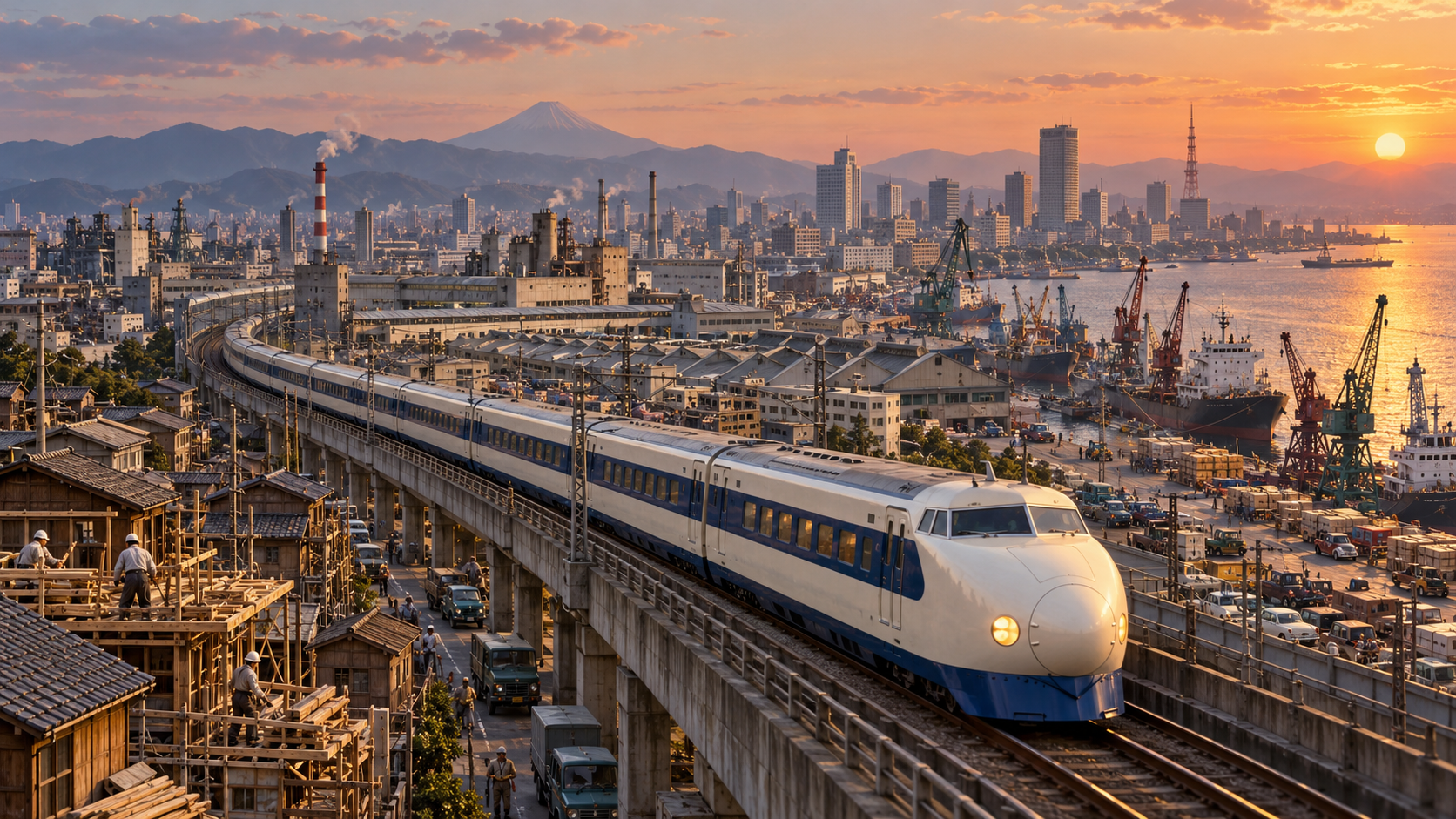
In the summer of 1945, Tokyo was a city of ashes. Firebombing had reduced swathes of the capital to rubble, and across the country, factories stood silent, their machinery stripped or destroyed. A Japanese official surveying the damage that autumn estimated that the nation's industrial capacity had fallen back to roughly the level of the early 1930s. By 1968—just twenty-three years later—Japan's gross national product ranked second in the world, behind only the United States. By the 1980s, its automobiles and electronics dominated global markets, and commentators in the West were publishing anxious books about how Japan had "won."
How does a country climb from total defeat to economic superpower in a single generation? The standard answer—that Japan's "miracle" was the result of a unique culture of hard work and harmony—is not so much wrong as incomplete. The more interesting story involves a collision of Cold War geopolitics, deliberate institutional design, and a global trading order that happened to open at precisely the right moment. Understanding that story matters, not because it offers a replicable formula (it doesn't), but because it illuminates how much of what we call "national success" depends on circumstances that no nation fully controls.
The Cold War Rewrites the Occupation
The American occupation of Japan began with punitive intentions. The initial plans called for dismantling the zaibatsu—the massive family-controlled conglomerates that had fueled Japan's wartime economy—breaking up large agricultural estates, and ensuring that Japan would never again threaten its neighbors militarily. Reparations were to be extracted, and Japanese industry was to be restricted to a level that could not support rearmament.
That agenda collapsed under the weight of a new strategic reality. The Chinese Revolution of 1949 and the onset of the Korean War in 1950 transformed Japan's position in American thinking. Suddenly, the United States needed a stable, prosperous Japan as a bulwark against communism in Asia. Secretary of State Dean Acheson famously described Germany and Japan as "the workshops of Europe and Asia," signaling that American policy had shifted from punishment to partnership.
The Korean War provided the immediate catalyst. Japan became the primary staging ground and supply base for American forces, and the resulting "special procurement" (特需, toku-ju) orders—for everything from trucks and uniforms to steel and construction services—pumped roughly $1 billion into the Japanese economy between 1950 and 1952. Industrial production, which had been stumbling under the Dodge Line's austerity measures, surged past pre-war levels by 1953. Japanese firms also absorbed American manufacturing techniques and quality-control methods during this period, laying groundwork for later competitiveness in automobiles and electronics.
The Architecture of Growth: Money, Banks, and the Government's Invisible Hand
Much of the debate about Japan's postwar success focuses on the role of the Ministry of International Trade and Industry (MITI). The popular image—that MITI bureaucrats carefully planned Japan's industrial ascent—is both overstated and not entirely wrong. MITI did wield considerable power, but its most effective tools were financial and regulatory rather than directive.
The government's primary lever was the allocation of foreign exchange. During the early postwar decades, Japan suffered from a chronic shortage of foreign currency. The government collected all foreign exchange earned through exports and then allocated it according to a semiannual "foreign exchange budget." MITI used this system to protect emerging industries—particularly automobiles—by deliberately limiting foreign exchange for imports that would compete with domestic production, while directing scarce currency toward technology imports and equipment purchases that would upgrade domestic industry.
This protection was paired with aggressive promotion of exports. The Export-Import Bank of Japan, established in 1950, provided low-interest loans to exporters, and export income received favorable tax treatment until the system was phased out under GATT pressure in the mid-1960s. Perhaps most striking to modern eyes, the government established a Supreme Export Council in 1954, chaired by the Prime Minister and including the governor of the Bank of Japan and major industry figures. The Council set export targets and coordinated what was explicitly framed as a "national movement" to promote exports.
The banking system completed the picture. Japan's postwar financial structure was designed to channel household savings into industrial investment through "indirect financing"—that is, through banks rather than stock markets. Long-term credit banks, established by the Long-Term Credit Bank Law of 1952, issued bank debentures to fund equipment investment in priority industries. Ordinary commercial banks, meanwhile, typically ran "overloans"—lending out more than they held in deposits—and relied on borrowing from the Bank of Japan to cover the gap. This structure was deliberately maintained through interest-rate regulations and administrative guidance, ensuring that cheap credit flowed to industries the government deemed strategic.
The Income Doubling Plan and the Politics of Prosperity
The year 1960 marked a turning point. A bitter coal miners' strike at Mitsui Miike had ended in defeat for the union, and massive protests against the renewal of the U.S.-Japan Security Treaty had forced the resignation of Prime Minister Kishi Nobusuke. His successor, Ikeda Hayato, made a deliberate pivot: he announced an "Income Doubling Plan" that promised to double Japan's GNP within ten years, requiring an average annual growth rate of 7.2 percent.
The plan was partly a political gambit—shifting national attention from ideological confrontation to economic advancement—but it also reflected a genuine conviction that growth could resolve the tensions that had nearly torn the country apart. It worked beyond anyone's expectations. Japan achieved Ikeda's goal in six to seven years, and from 1955 to 1970, manufacturing productivity rose by 10 percent annually while wages at both large and small firms rose at similar rates. Virtually everyone felt they were entering the middle class, and political radicalism gradually lost its mass appeal.
The international context was essential. Japan joined the IMF and the World Bank in 1952, the General Agreement on Tariffs and Trade (GATT) in 1955, and the United Nations in 1956. It became an Article 8 member of the IMF—committing to currency convertibility for current transactions—in 1964, and joined the OECD the same year. The postwar liberal trading order, built largely on American initiative, gave Japanese exporters access to markets that would have been unimaginable in the 1930s.
What the Miracle Actually Looked Like
By the late 1960s, the economic transformation was visible in everyday life. Japan became the world's second-largest economy in terms of GNP in 1968. Its steel industry, rebuilt with strip mills and other new technology, became the most efficient in the world. Its shipbuilding industry dominated global markets. Its automobile industry, which MITI had actually tried to consolidate in the 1950s (a plan rejected by the Diet after industry opposition), grew into a ferocious competitor.
The 1973 oil crisis marked the end of the "high growth" era—the roughly 10 percent annual growth rates that had characterized the late 1950s and 1960s. But Japan adapted with surprising speed, shifting toward energy-efficient manufacturing and becoming the world leader in automobiles, electronics, numerically controlled machine tools, and semiconductors. By the 1980s, its trade surpluses had become so large that they triggered the "trade frictions" (貿易摩擦, bōeki masatsu) that would strain relations with the United States for decades.
It is worth pausing on what Japan did not have. It lacked raw materials, importing virtually all its oil, iron ore, and coking coal. It had no military spending to speak of—the "small government" of the postwar constitution meant that resources flowed into civilian investment rather than defense. Its population was highly educated and its savings rate was high, but those advantages required institutions capable of mobilizing them. The miracle was not a matter of culture alone; it was a matter of a particular set of institutions meeting a particular set of historical opportunities.
The Fragility Behind the Achievement
There is a less triumphal side to this story. The same financial system that channeled savings into growth also generated chronic weaknesses. The overloan structure of city banks made them dependent on Bank of Japan credit and discouraged the development of market-based finance. The "convoy system" of financial regulation—in which the Ministry of Finance protected weak institutions rather than letting them fail—created incentives for risk-taking that would eventually produce the bubble economy of the late 1980s.
When that bubble burst in 1991, the mechanisms that had driven high growth became obstacles to recovery. Banks burdened with bad loans cut back on lending; corporations that had overinvested during the bubble reduced capital spending; and consumers, worried about employment, saved rather than spent. The "lost decade" that followed was not a failure of Japanese culture or work ethic, but the working-out of institutional contradictions that had been present all along.
This matters for how we understand the miracle itself. The postwar Japanese economy was not a single, stable system that produced growth indefinitely. It was a set of arrangements well-suited to the conditions of the 1950s and 1960s—catch-up industrialization, protected domestic markets, abundant cheap energy, and an open American-led trading order—that became progressively less suited to the conditions that followed. The same MITI that successfully protected the automobile industry in the 1950s also tried, and failed, to prevent the industry's consolidation and eventual success. The same banks that fueled investment in the 1960s fueled the bubble in the 1980s.
What the Miracle Leaves Behind
For anyone interested in how societies change, the Japanese case offers something more useful than a success formula. It suggests that economic transformation is rarely the result of a single factor—not culture, not policy, not geopolitics alone, but the interaction of all three. It also suggests that the institutions that create growth are not the same institutions that can sustain it, and that the transition from one to the other is politically difficult and historically contingent.
The language of that transformation is revealing. Japanese economists and officials of the high-growth era spoke of "rationalization" (合理化, gōrika)—a term that referred to eliminating waste and upgrading technology, but that carried connotations of making something more logical, more reasoned, more deliberate. The word appears constantly in policy documents of the 1950s and 1960s. It suggests a mindset that saw economic development not as an automatic process but as something that required conscious effort and institutional design.
That mindset is not uniquely Japanese. But the particular way it combined with American strategic needs, a favorable global trading environment, and a population willing to invest savings in banks and accept the discipline of export competition produced a result that no one had predicted in 1945. The miracle, if it was one, lay in the confluence.
Polyglottist Language Academy offers live language classes for adults, including online classes and selected in-person classes in Berkeley, California. Our approach emphasizes practical communication and an understanding of how the language is actually used—not just in textbooks, but in the contexts where it matters. If Japan's economic history has sparked an interest in understanding the country and its language more deeply, exploring Japanese classes might be a natural next step.
Frequently Asked Questions
Did the American occupation cause Japan's economic recovery?
Not directly. The occupation's early economic policies were punitive and, by most accounts, counterproductive. Recovery began in earnest after 1949, when the occupation shifted toward economic stabilization and the Cold War created demand for Japanese production. Some historians argue that the occupation's most important economic legacy was the dissolution of the zaibatsu and land reform, which created a more competitive domestic economy—but even this is debated.
What was the Korean War's role in Japan's recovery?
The Korean War (1950–1953) was a windfall. Japan served as the primary supply base for U.S. forces, and special procurement orders injected roughly $1 billion into the economy over three years. This demand pulled Japan out of the deflationary Dodge Line recession and restored industrial production to pre-war levels by 1953.
Was MITI really responsible for Japan's success?
MITI was important, but its power is often exaggerated. Its most effective tools were financial (foreign exchange allocation) and regulatory (protection of infant industries). Its attempts at direct industrial planning sometimes failed—most notably its 1950s proposal to consolidate Japanese automakers, which the Diet rejected. The industry's subsequent success owed more to competition among firms than to MITI's direction.
Why did Japan's economy stagnate after 1991?
The bubble economy of the late 1980s, fueled by easy credit and inflated asset prices, burst in 1991. The resulting bad debts crippled banks, overinvestment discouraged corporate spending, and the institutional structures that had channeled savings into growth became obstacles to adjustment. The stagnation was not a sudden failure but the gradual working-out of contradictions built into the postwar system.
What was the "Income Doubling Plan"?
Announced by Prime Minister Ikeda Hayato in 1960, the plan promised to double Japan's GNP within ten years—requiring 7.2 percent annual growth. The actual growth rate exceeded 10 percent, and the goal was achieved in six to seven years. The plan was as much political as economic, designed to shift national attention from ideological conflict to material improvement.
When did Japan become the world's second-largest economy?
Japan's GNP surpassed West Germany's in 1968, making it the second-largest economy after the United States. It held that position until 2010, when China overtook it.