
Geisha: Who They Are, What They Do, and How the Role Has Changed
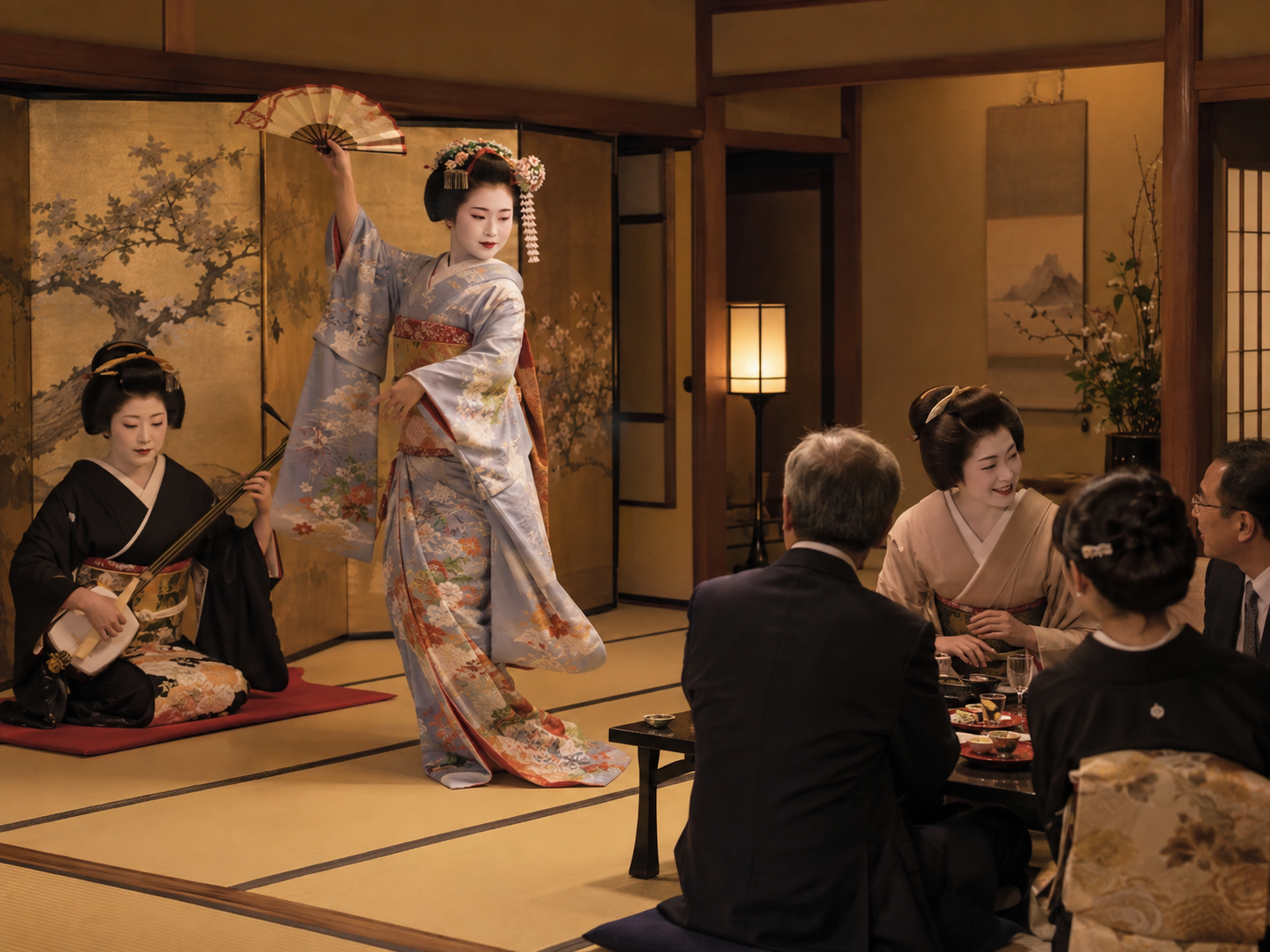
There is a peculiar problem with the word geisha: almost everyone has heard it, yet many people are imagining the wrong profession.
The familiar image is easy to summon. White makeup. Elaborate hair ornaments. A silk kimono. A paper umbrella somewhere in the background.
Then come the assumptions.
Some people imagine a highly formal hostess. Others a dancer. Others, thanks to more than a century of Western novels, films, wartime encounters, and general confusion about Japan’s old pleasure districts, assume that “geisha” was essentially an elegant name for a prostitute.
That last idea is persistent. It is also a poor description of what geisha historically specialized in and an entirely inaccurate description of the modern profession.
A geisha is, fundamentally, a professional entertainer trained in traditional arts. Music, dance, song, conversation, etiquette, and the ability to manage the atmosphere of a social gathering are central to the work. In Kyoto, where the tradition remains particularly visible, full professionals are generally called geiko — 芸妓, while their apprentices are maiko — 舞妓. Kyoto’s official tourism organization describes them as working performers who sing, dance, and entertain guests in the city’s traditional entertainment districts. (Kyoto Travel)
But that definition only gets us part of the way.
The geisha profession emerged inside the complicated urban entertainment culture of Edo-period Japan. It changed with fashion, business, law, war, modernization, and tourism. At different moments, geisha have been musical specialists, arbiters of style, banquet entertainers, cultural celebrities, business-world fixtures, and—increasingly today—guardians and public performers of arts that fewer Japanese people encounter in ordinary life.
Even the iconic appearance has changed.
To understand who geisha are, it helps to begin with what the word actually says.
“Geisha” Means an Arts Person
The Japanese word 芸者 — geisha combines 芸 — gei, meaning art or artistic accomplishment, with 者 — sha, meaning person.
An “arts person” is a remarkably straightforward name for a profession that later accumulated so much exotic mythology.
The arts involved were not hobbies.
Historically, geisha trained to provide sophisticated entertainment at banquets and social gatherings. Music was especially important. The shamisen — 三味線, the three-stringed instrument with its immediately recognizable percussive sound, became closely associated with the profession. Singing, traditional dance, knowledge of seasonal songs, and conversational skill also mattered.
Nippon.com’s history of the profession emphasizes something easily lost today: geisha helped preserve and transmit shamisen music and contributed to the development of Japanese dance.
A competent geisha therefore was not simply someone who put on a beautiful kimono and poured sake.
She had a repertoire.
She had teachers.
She practiced.
And she was expected to know how to perform when the room demanded it—and when not to.
The First Geisha Were Men
This is usually the first detail that overturns the popular picture.
The predecessors of female geisha were male entertainers.
Men known by terms such as hōkan and taikomochi entertained guests with music, storytelling, humor, conversation, and social performance. Their role had something in common with a professional master of ceremonies, musician, comedian, and companion combined.
Female geisha emerged in the eighteenth century and became increasingly popular. As their numbers grew, male practitioners increasingly needed labels that distinguished them from the women who had come to dominate the profession.
This origin helps explain something important.
A geisha’s traditional job was never simply to look elegant.
It was to make a gathering work.
There are arts that can be displayed on a stage, and then there are social arts that become apparent only when other people are present: sensing when a guest is uncomfortable, drawing a quiet person into conversation, changing the mood when a dinner becomes stiff, knowing when a song would be welcome, handling humor without becoming crude, and making hospitality appear effortless.
Those abilities are much harder to photograph than a kimono.
Consequently, they tend to disappear from the international stereotype.
Geisha and Courtesans Were Not the Same Thing
Here we reach the misunderstanding that has followed the profession for generations.
Edo Japan contained licensed pleasure quarters such as Yoshiwara in Edo, present-day Tokyo. These districts included professional courtesans whose work could involve sex and whose appearance, fashions, and social position belonged to a system different from that of geisha. High-ranking courtesans became celebrities in their own right and were frequently depicted in ukiyo-e prints.
Geisha emerged within this broader entertainment environment, and the worlds were not completely separate. In eighteenth-century Yoshiwara, for example, geisha entertained customers musically and socially alongside the commercial system surrounding courtesans. Female geisha could also act as intermediaries between customers and courtesans.
But their principal professional specialty was entertainment.
That distinction became increasingly formalized. In the nineteenth century, Japanese authorities themselves made legal distinctions between geisha and licensed prostitutes.
History becomes misleading, however, if we clean it up too much.
There were places and periods where the boundaries became blurred. Some women registered as geisha also sold sexual services, voluntarily or under economic coercion, and local systems varied considerably. Before the postwar Prostitution Prevention Law, some regional arrangements permitted forms of overlap that would not fit a neat modern definition.
So two simplistic statements are both unhelpful:
“Geisha were prostitutes.”
And:
“Geisha and sex work had absolutely nothing to do with each other historically.”
The truth is more interesting. Geisha developed in the same urban entertainment world as courtesans and prostitution, sometimes worked physically and economically alongside that world, and occasionally crossed its boundaries—but they constituted a distinct profession centered on arts and entertainment.
Why Did the Misconception Become So Strong in the West?
Part of the answer lies in the Allied Occupation after World War II.
Foreign servicemen arriving in Japan often had little understanding of the complicated distinctions among geisha, bar hostesses, nightclub workers, courtesans of the recent past, and women engaged in prostitution.
Some women in the postwar sex and nightlife industries marketed themselves to foreign soldiers using the phrase “geisha girl,” even though they were not trained geisha. The label became a convenient catch-all among foreigners and helped cement a sexualized image of the geisha in Western popular culture. Archival accounts of occupied Japan explicitly note that many women whom foreign servicemen called geisha had not actually been trained in the profession.
The misunderstanding survived the occupation.
Western novels and films often preferred a more dramatic version of the geisha: beautiful, sexually available, mysterious, submissive, and trapped inside an exotic hidden world.
Actual geisha culture was harder to package.
Years spent practicing shamisen do not make quite as sensational a screenplay.
Geisha, Geiko, and Maiko: What Is the Difference?
The vocabulary changes depending on where in Japan one is talking about.
Geisha — 芸者 is the term most familiar internationally and is commonly used in Tokyo and elsewhere.
In Kyoto, a fully qualified professional is generally called a geiko — 芸妓.
A maiko — 舞妓 is an apprentice in Kyoto’s geiko tradition.
This distinction matters because many of the images foreigners label “geisha” are actually maiko.
Maiko generally wear the more elaborate appearance: colorful long-sleeved kimono, striking hair ornaments, distinctive obi, and hairstyles created from their own hair. Their appearance changes as they progress through apprenticeship and according to season and occasion.
Geiko tend to dress more subtly.
That difference is logical once one understands the system. The apprentice is visually announcing her status. Her elaborate appearance is part of a recognizable stage of training.
The senior professional does not need quite so much visual signaling.
This is almost the reverse of what outsiders sometimes assume. The woman with the most spectacular hair ornaments may be the junior person in the room.
Becoming a Maiko Is Not Primarily a Makeover
Popular accounts naturally focus on the visual transformation.
The training matters more.
In Kyoto, a young woman entering the profession normally begins with a preparatory period known as shikomi. She learns the rhythms and etiquette of the flower district while beginning or intensifying training in traditional arts.
After further preparation, she may debut as a maiko.
The years that follow involve continued lessons in dance, music, song, etiquette, the Kyoto dialect and speech conventions, and the complicated practical knowledge of entertaining professionally. A Japanese government profile of one Kyoto geiko describes her studying singing, dancing, Kyoto speech, kagai etiquette, and protocol before debuting as a maiko, and later completing erikae, the transition from maiko to full geiko.
The word erikae — 襟替え literally refers to “changing the collar.”
It sounds almost modest for what it signifies: graduation from apprenticeship into professional status.
The transformation is visible in clothing and hairstyle.
The more important transformation is competence.
The World of the Hanamachi
Geisha do not traditionally operate as isolated freelance performers booking random restaurant tables.
They belong to established entertainment communities.
These are commonly called hanamachi — 花街, literally “flower towns,” or kagai — 花街, another reading of the same characters used especially in Kyoto.
Kyoto currently has five well-known active districts: Gion Kobu, Gion Higashi, Miyagawachō, Pontochō, and Kamishichiken. (Kyoto Travel)
Historically, an apprentice or geiko may be associated with an okiya — 置屋, the house through which her professional life is organized.
Entertainment often takes place in an ochaya — お茶屋, literally a “teahouse,” although the English word can be misleading. An ochaya in this context is not simply a café where someone walks in for tea. It is a highly traditional hospitality establishment that organizes private entertainment.
The banquet room itself is often referred to as an ozashiki — お座敷.
And this world traditionally worked through relationships.
Prestigious Kyoto teahouses historically operated according to the principle known as ichigen-san okotowari—roughly, declining first-time customers without an introduction. Existing patrons effectively vouched for newcomers.
This can sound unnecessarily secretive until one remembers how much the business depended on trust and deferred billing. The teahouse might organize food, alcohol, performers, and other arrangements for a guest whose relationship with the establishment mattered more than an immediate credit-card transaction.
Today, the system is somewhat more accessible. Hotels, cultural organizations, restaurants, and specialist operators can arrange legitimate encounters with geiko and maiko, and public performances provide another route for visitors who have no traditional introduction. Kyoto's tourism authorities now explicitly list organized opportunities for visitors to attend performances and cultural experiences.
What Does a Geisha Actually Do at a Party?
Imagine an elegant private dinner.
The geiko and maiko enter. There may be introductions and conversation. Drinks are poured. At some point, one performer may play shamisen while another sings or dances.
Later the atmosphere can become far less solemn.
Traditional banquet entertainment includes humorous conversation and ozashiki asobi—parlor games played with guests. These can be playful, competitive, and deliberately silly.
That contrast is important.
Western photography often presents geisha as silent, remote, almost ceremonial figures.
Professional entertainment requires precisely the opposite skill.
A successful geisha has to read people.
The Japanese government profile of Kyoto geiko Tomitsuyu emphasizes this flexibility: different gatherings may require performance, conversation, business hospitality, or interaction with foreign visitors, and the entertainer adjusts accordingly. (Gov Online)
The work therefore sits in an interesting space between performing artist and expert host.
A musician can master a composition.
A geisha has to master the composition while simultaneously noticing whether the person at the far end of the room is bored.
Conversation Is Part of the Art
This may be the least understood skill.
Traditional geisha entertainment is not a recital interrupted by dinner.
Conversation itself matters.
Historically, geisha entertained politicians, merchants, artists, intellectuals, businessmen, and other elites. They moved through social settings where wit, discretion, cultural knowledge, and the ability to speak comfortably with very different personalities had practical value.
Nippon.com notes that older banquet culture could involve serious conversation and intellectual exchange as well as music, dancing, drinking, and amusement. It also argues that this conversational dimension has weakened as the social world that once sustained traditional banquets has declined. (Nippon)
This makes “hostess” technically understandable as an English translation but inadequate.
It sounds passive.
The job is closer to managing the social rhythm of the room.
The Profession Was Once Much Larger
Modern visitors can easily assume that geisha were always rare.
They were not.
Through the late nineteenth and early twentieth centuries, geisha formed a much larger part of urban entertainment culture. Traditional restaurants and entertainment quarters existed throughout Japan, not only in Kyoto.
For many business and social gatherings, arranging geisha entertainment was conventional rather than exotic.
That began to change dramatically after World War II.
Hotels expanded.
Nightclubs became fashionable.
Modern bars offered a different kind of nightlife.
Corporate entertaining changed.
Younger generations increasingly viewed traditional banquet culture as old-fashioned or expensive.
Nippon.com traces a particularly sharp decline from the 1970s onward, as hotels and nightclubs displaced traditional restaurants as preferred venues and many regional geisha districts disappeared.
Something unexpected happened as the profession contracted.
Geisha stopped being ordinary enough to be fashionable.
They became rare enough to symbolize tradition.
War Changed the Geisha World Too
World War II severely disrupted the profession.
In 1944, Japan ordered geisha districts closed as labor and resources were redirected toward the war effort. Women who had worked in the districts took other jobs, including factory work. In Kyoto, even the Gion Kaburenjō—the theater associated with training and the famous Miyako Odori performances—was repurposed during wartime.
The profession revived afterward, but Japan itself was changing too quickly for the old system simply to reappear unchanged.
Education expanded.
Employment possibilities for women grew.
Urban lifestyles changed.
The idea that a girl would enter a traditional entertainment house at a very young age became incompatible with modern expectations and schooling.
Recruitment therefore changed. Training increasingly began later, and women entering the profession were more likely to make the decision themselves rather than being placed into it through older family and debt arrangements.
Modern geisha culture may preserve Edo and Meiji artistic forms, but the women entering it are not living under Edo-period social conditions.
That distinction matters.
From Fashion Leaders to Guardians of Tradition
There is another historical reversal hiding in the familiar image.
Today, geisha often seem like embodiments of an ancient Japan deliberately protected from change.
Historically, they could be trendsetters.
Their kimono, hairstyles, accessories, music, and manners were watched and imitated. Geisha existed at the center of urban popular culture rather than outside it. Their spending also supported networks of musicians, kimono makers, craftspeople, dance teachers, restaurants, and other specialists.
In other words, what we now categorize as “traditional culture” was once simply culture.
No one living in the eighteenth century woke up thinking: Today I shall preserve an important intangible heritage for tourists in 2026.
They were working.
Fashion changed because customers liked something new.
Songs became popular.
Performers competed.
Styles evolved.
The transformation of geisha from contemporary entertainers into perceived guardians of tradition happened largely because the rest of Japanese entertainment moved elsewhere.
The profession stayed.
The surrounding world changed.
Why Kyoto Became the International Center of the Image
Geisha traditions continue elsewhere in Japan, including Tokyo and several regional centers.
Yet Kyoto dominates international imagination.
There are practical reasons.
Kyoto preserved several active traditional entertainment districts. Its architecture, temples, machiya townhouses, kimono industries, tea culture, and other traditional arts create an environment in which geiko and maiko appear to belong naturally.
Kyoto also maintains highly visible public dance traditions.
The Miyako Odori, performed by the geiko and maiko of Gion Kobu, began in 1872 and remains an annual spring event. Other Kyoto districts stage their own seasonal dances. In 2026, Kyoto’s official calendar continues to list spring and autumn public performances involving the city's geiko and maiko. (Kyoto Travel)
These performances have become important because they allow something once embedded mainly in private banquet culture to reach a public audience.
The private profession is becoming, in part, a public cultural institution.
Tourism Has Created a New Problem
Visibility has advantages.
It also produces behavior that would have seemed bizarre to earlier generations.
Some visitors to Kyoto now encounter a maiko walking to work and treat her as though she were a costumed street performer placed there for photographs.
She is not.
Kyoto currently asks visitors explicitly not to stop, touch, follow, or photograph geiko and maiko without permission. The city notes that harassment and unauthorized photography have become serious enough to require dedicated visitor guidance.
This is a revealing modern contradiction.
Tourism helps sustain interest in geiko culture.
Tourism can also reduce working professionals to scenery.
A useful rule is extremely simple: if a maiko is walking down a street, assume she is going somewhere.
Because she probably is.
Are Geisha Still Relevant in Modern Japan?
In one sense, much less than they once were.
Most Japanese people do not regularly attend geisha banquets. Many have never attended one at all. notes that even many Japanese people now have only a vague understanding of what geisha actually do.
In another sense, their role has become more culturally significant.
Traditional Japanese dance survives without geisha.
Shamisen music survives without geisha.
Kimono survive without geisha.
Tea culture survives without geisha.
But geisha culture brings several of these traditions together in one living professional environment.
The techniques are not merely demonstrated for a museum display.
They are used.
A dance has to be rehearsed because there is a performance next month.
A shamisen piece has to be mastered because someone will request it.
A kimono has to be worn correctly because someone is actually going to work in it.
That practical continuity may be one of the profession's most important modern functions.
A Few Japanese Words Change the Picture
Even a small amount of Japanese makes the culture easier to understand.
芸者 — geisha literally centers the idea of artistic accomplishment.
芸妓 — geiko is the Kyoto term for a fully trained professional.
舞妓 — maiko contains 舞, associated with dancing, and refers to the Kyoto apprentice.
花街 — hanamachi / kagai, literally “flower town,” refers to a traditional entertainment district.
お茶屋 — ochaya literally looks like “tea house,” but in this world it refers to a specialized establishment arranging traditional hospitality and entertainment.
お座敷 — ozashiki literally refers to a tatami room but can also mean the banquet or entertainment held there.
The translations are possible.
They are just incomplete.
That is one of the recurring pleasures of learning Japanese: familiar English labels suddenly start looking much less precise.
The Geisha Who Survived Is Not the Geisha Who Began
The profession began inside the commercial entertainment world of early modern Japan.
It was never frozen.
Male entertainers were gradually eclipsed by women.
Musical styles changed.
Fashion changed.
The relationship between geisha and pleasure districts changed.
The Meiji era changed their social environment.
War temporarily closed their districts.
Postwar modernization shrank their customer base.
Nightclubs and hotels replaced traditional banquet venues.
Tourism opened parts of a formerly private world to outsiders.
And the profession that once helped define contemporary urban fashion became associated with preserving the past.
Yet the central idea remains surprisingly consistent.
A geisha is someone paid for cultivated skill.
At Polyglottist Language Academy, Japanese classes for adults naturally focus on communication, but cultural terms such as geisha, maiko, senpai, omotenashi, or keigo are good reminders that translations rarely carry the entire social world contained inside a Japanese word.
Polyglottist offers live online Japanese classes for adults as well as selected in-person classes in Berkeley, California, with attention not only to vocabulary and grammar but also to how Japanese is actually used and understood within its cultural context.
The word geisha is an unusually good example.
In English, it became shorthand for an image.
In Japanese history, it describes a profession.
And once the profession itself comes into focus—the rehearsals, music lessons, conversation, business relationships, changing fashions, apprenticeships, declining districts, public performances, and ordinary evenings spent going from one engagement to another—the woman behind the white makeup becomes much more interesting than the stereotype.
Frequently Asked Questions About Geisha
Are geisha prostitutes?
No. Modern geisha are professional entertainers trained in traditional arts and hospitality. Historically, geisha worked within entertainment districts that could also contain licensed prostitution, and in some times and regions boundaries could blur. But geisha and professional courtesans were distinct occupational categories.
What is the difference between a geisha and a maiko?
In Kyoto, a maiko is an apprentice, while a fully qualified professional is generally called a geiko. “Geisha” is the better-known general term and is commonly used in other parts of Japan.
Why do geisha wear white makeup?
The distinctive makeup belongs to older traditions of Japanese performance and formal entertainment. It is especially associated today with maiko. Full geiko may wear the traditional white makeup for formal performances and engagements but do not necessarily wear it in every professional context.
What do geisha learn?
Training can include Japanese dance, shamisen, singing, etiquette, conversation, regional speech and customs, seasonal traditions, and the practical skills required to entertain guests professionally. Kyoto's apprenticeship system involves years of learning and performance experience.
Can tourists meet a real geisha or maiko?
Yes, but the appropriate route is through legitimate performances or organized experiences—not by stopping someone in the street. Kyoto offers public seasonal dances and authorized cultural programs where visitors can see geiko and maiko perform.
Do geisha still exist today?
Yes. The profession is much smaller than it once was, but active geisha or geiko communities continue in Kyoto, Tokyo, and several other parts of Japan. Kyoto's five traditional kagai remain particularly visible.
Are all women dressed like maiko in Kyoto genuine maiko?
No. Kyoto has numerous kimono and maiko-style makeover experiences for tourists. Elaborate dress alone does not indicate that someone is a working apprentice geiko.