
Who Were the Samurai? Japan's Warrior Class — History, Code, and Legacy
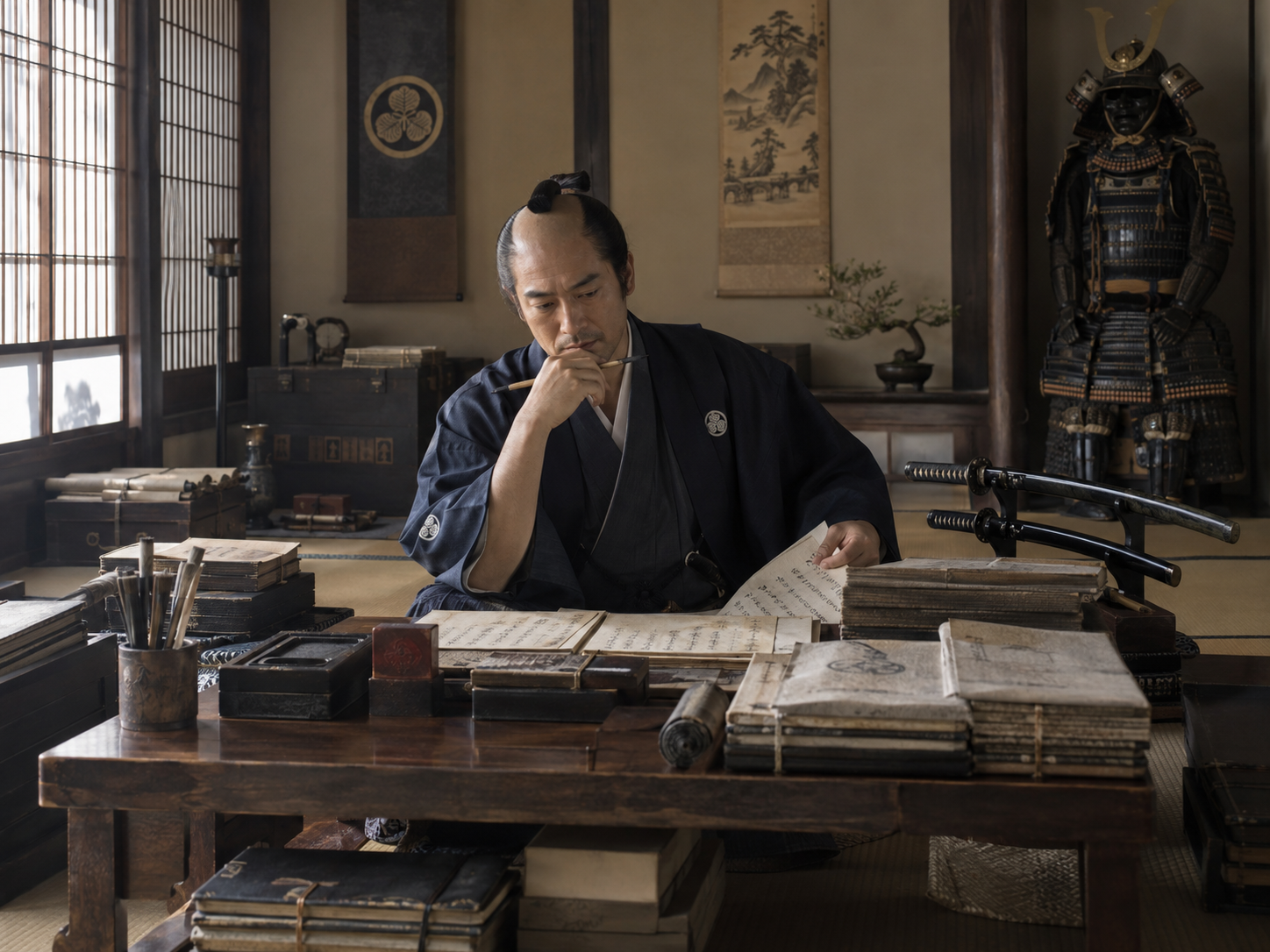
The samurai most people recognize today is almost too perfect.
He wears elaborate armor. A curved sword hangs at his side. He serves his lord with absolute loyalty, follows an ancient code called bushidō, and would rather die than live dishonorably.
There is history in that image. There is also a great deal of later storytelling.
The real samurai existed for close to a thousand years, and their world changed so dramatically during that time that a mounted archer fighting in the 1100s would have had surprisingly little in common with an eighteenth-century samurai administrator balancing accounts in a castle town. The British Museum rather neatly describes the problem: the familiar modern samurai grew out of medieval reality, but much of what we now associate with them is "invented tradition" shaped long after their earliest battles.
Understanding the samurai therefore requires putting aside, at least temporarily, the cinematic figure with the katana.
The story begins with people who served.
“Samurai” Originally Meant Someone Who Served
The word samurai — 侍 is connected to the older Japanese verb saburau, meaning "to serve" or "to attend upon someone." Early samurai were armed retainers who served powerful landowners, provincial governors, and aristocratic families. Other historical terms—including bushi — 武士, essentially "warrior," and musha—were also widely used.
They were not originally a romantic brotherhood with a single written code.
Beginning around the tenth century, regional warriors became increasingly important as the imperial court in Kyoto depended on provincial military families to protect estates, enforce authority, and settle disputes. Military power gradually accumulated outside the court.
By the twelfth century, these warrior families were powerful enough to fight one another for control of Japan itself.
The decisive struggle came during the Genpei War (1180–1185) between the Taira and Minamoto clans. The victorious Minamoto no Yoritomo established a warrior government centered at Kamakura, beginning a political order in which military elites would dominate Japan for centuries. The emperor and imperial court remained, but much practical political power shifted toward warrior governments headed by a shōgun — 将軍. The Met dates the rise of samurai political dominance to this broad late-Heian and medieval transition.
This is the point at which the samurai cease to be merely hired muscle on the edge of aristocratic society.
They become rulers.
The First Samurai Were Not Primarily Swordsmen
If Hollywood sent a medieval samurai into battle, it would probably place a katana in his hand.
A warrior from the early samurai centuries might find that choice peculiar.
Early elite samurai warfare centered heavily on mounted archery. Warriors trained to shoot long bows from horseback, and their armor was designed partly around that style of fighting. Swords certainly mattered, especially once combat became close, but they were not yet the all-defining weapon of samurai identity. The British Museum explicitly notes that the curved Japanese sword so closely associated with samurai today was not their principal weapon during their earliest centuries.
The famous armor of the period was itself a remarkable piece of engineering.
A surviving fourteenth-century yoroi associated with Ashikaga Takauji, for example, weighs roughly 17 kilograms and is constructed from hundreds of small lacquered iron and leather pieces connected with silk cords. Such armor was flexible enough for mounted warfare while offering substantial protection.
The samurai's weapons changed as warfare changed.
Large armies became increasingly important. Fighting shifted toward infantry. Spears gained prominence. And after firearms reached Japan in the sixteenth century, guns were incorporated rapidly into warfare.
The historical samurai was not a warrior stubbornly refusing technology in the name of tradition. Successful warlords generally used whatever worked.
That point alone makes the real samurai considerably more interesting than the stereotype.
Samurai Society Was a Hierarchy, Not a Single Type of Warrior
"Samurai" can sound as though it described one occupation.
In practice, warrior society contained dramatic differences in rank, wealth, power, and responsibility.
At the top stood great territorial lords known as daimyō — 大名. Above them, when a shogunate was functioning effectively, stood the shogun.
Below the great lords were layers of retainers. Some controlled substantial incomes and commanded other warriors. Others lived much more modestly. Rank influenced where a person lived, what duties he performed, how he dressed, whom he could address directly, and what opportunities were available to his family. The British Museum describes samurai society as an explicit hierarchy in which relatively few households occupied the highest positions and much larger numbers filled the lower ranks.
This matters because phrases such as "the samurai believed…" can become misleading very quickly.
A powerful thirteenth-century landholder, a sixteenth-century battlefield commander, and a nineteenth-century low-ranking domain official all belonged to the warrior order.
Their lives could be remarkably different.
Then Japan Entered Its Age of Civil War
The samurai reached perhaps their most familiar battlefield form during the violent centuries leading up to Japan's reunification.
By the fifteenth and sixteenth centuries, central political authority had weakened badly. The Sengoku period, often translated as the "Warring States period," saw competing daimyō struggle for territory and power.
This was not a world of elegant one-on-one sword duels.
Armies could contain enormous numbers of infantry soldiers. Castles became increasingly sophisticated. Political alliances shifted constantly. Betrayal was hardly unknown. Commanders used bows, spears, swords, siege tactics, and eventually large numbers of firearms.
The romantic idea that samurai considered guns dishonorable does not fit comfortably with this history.
Three particularly famous leaders—Oda Nobunaga, Toyotomi Hideyoshi, and Tokugawa Ieyasu—gradually brought the fractured country back under centralized control.
Tokugawa Ieyasu's victory at the Battle of Sekigahara in 1600 paved the way for the Tokugawa shogunate. By the early seventeenth century, after generations of instability, Japan entered a remarkable period of political peace. (The Metropolitan Museum of Art)
And this created an unexpected problem.
What happens to a warrior class when there is almost no war?
The Samurai Became Bureaucrats
The Edo period, lasting from the early seventeenth century until 1868, transformed samurai life.
The Tokugawa government imposed a highly regulated social and political order. Daimyō continued to control domains, and samurai remained their retainers. But the prolonged peace meant that many samurai no longer spent their lives campaigning.
They administered.
They kept records.
They managed finances.
They served in castle governments.
They studied.
They taught.
Some became scholars, artists, officials, intellectuals, or cultural patrons. The Met emphasizes that military skill had never been enough for successful samurai elites—political, financial, and cultural abilities mattered too—and under Tokugawa peace, that nonmilitary side became increasingly prominent.
This is one of the most useful corrections to the popular image.
For a large portion of samurai history, many samurai were not spending their mornings fighting enemies.
They were going to work.
A sword might still hang at the waist, but it increasingly functioned as a marker of status and authority as well as a weapon. The fittings and accessories surrounding swords became elaborate expressions of taste because Tokugawa society tightly regulated the ways elites could display themselves publicly.
An eighteenth-century samurai might therefore spend considerably more time worrying about money, paperwork, etiquette, and obligations than about sword fights.
This does not look as spectacular on a movie poster.
It is probably closer to everyday life.
So What Was Bushidō?
Here we arrive at one of the most misunderstood words associated with Japan:
武士道 — bushidō — “the way of the warrior.”
Popular culture often treats bushidō as though an ancient rulebook had been handed to the first samurai and faithfully followed for the next seven hundred years.
There was no single timeless Samurai Code.
Warrior traditions certainly placed value on ideas such as loyalty, courage, reputation, martial ability, and willingness to face death. Medieval literature contains powerful ideals of warrior conduct. Individual houses had rules. Buddhist, Confucian, and other intellectual traditions influenced warrior thinking.
But these values changed across periods and circumstances.
The paradox is important: bushidō became more systematically articulated precisely when samurai were fighting less.
Under the long Tokugawa peace, thinkers increasingly debated what it meant to be a warrior in a society where warriors rarely went to war. The Met describes the Edo period as the era in which an idealized warrior ethic emphasizing honor and fidelity to one's lord became formalized.
Modern scholarship goes further. Historian Saeki Shin'ichi has argued that the modern idea of bushidō was substantially reconstructed in the nineteenth century, when samurai were recast as the Japanese equivalent of European knights and warrior ethics became useful in narratives about national identity.
So did bushidō exist?
Yes—but not as one unchanging instruction manual followed uniformly by every samurai since medieval times.
It is better understood as a collection of warrior ideals that evolved, competed, and were repeatedly reinterpreted.
That makes it less tidy.
It also makes it history.
Honor Was Real, but Samurai Were Still Human
This distinction helps with another misconception: samurai did not always behave according to the ideals later associated with them.
History is full of warriors changing allegiance, negotiating, surrendering, plotting against rivals, protecting family interests, seeking wealth, and making pragmatic political decisions.
They were human beings operating inside a violent political system.
Loyalty mattered enormously—but loyalty could become complicated when obligations to one's lord, family, clan, allies, and personal survival conflicted.
Even famous warrior stories often became idealized precisely because reality was less straightforward.
The gap between ideal behavior and actual behavior is not uniquely Japanese. Medieval European knights had chivalric ideals without every knight behaving chivalrously.
Codes tell us what societies admired.
They do not necessarily tell us what everyone did.
What About Seppuku?
No discussion of samurai mythology gets very far before reaching seppuku — 切腹, ritual suicide by abdominal cutting.
It was real.
But again, modern representations can make it appear far more universal than it was.
The practice developed within medieval warrior culture and could occur in several circumstances: to avoid capture after defeat, as a form of punishment, as an expression of protest, or under particular expectations surrounding honor and responsibility. Over time it became increasingly ritualized.
The existence of seppuku tells us something significant about the warrior culture surrounding reputation, status, and death.
It does not mean that samurai spent their lives eagerly searching for opportunities to die.
The very fact that elaborate ideals had to be taught, praised, dramatized, and memorialized should remind us that fear, ambition, love, self-preservation, and uncertainty remained as human in samurai Japan as anywhere else.
Samurai Culture Wasn't Only About War
One of the most striking aspects of elite samurai culture is the coexistence of violence and refinement.
Warrior leaders patronized temples.
They practiced calligraphy.
They composed poetry.
They collected art.
They participated in the tea ceremony.
They studied literature and philosophy.
The Met describes this as the relationship between bu and bun—the martial and cultural arts—and notes that highly accomplished warriors could simultaneously be patrons of Buddhism, poets, and calligraphers.
This is not really a contradiction once we stop imagining "samurai" as a profession equivalent to "soldier."
They were a ruling class.
A ruling elite needed to fight, certainly, but also to govern, negotiate, display sophistication, arrange marriages, maintain alliances, educate heirs, and demonstrate cultural legitimacy.
A sword and a poetry brush could belong to the same person without either one being decorative.
Were There Female Samurai?
The simplest answer is: women were unquestionably part of the warrior class, and some fought—but the familiar phrase "female samurai" needs a little care.
Women born into samurai households participated in the political, economic, and social world of warrior families. They managed households and estates, raised heirs, arranged or entered politically significant marriages, preserved family property, and in some circumstances defended homes and fortifications.
Some women trained with weapons, particularly the naginata, a polearm that later became strongly associated with women of the warrior class. Historical and literary traditions also preserve women who participated directly in combat.
The British Museum notes both women's membership in samurai-class society and documented traditions of women defending domains and taking part in warfare, although martial expectations varied considerably between families and periods.
One of the best-known figures is Tomoe Gozen, celebrated in The Tale of the Heike as a formidable warrior associated with Minamoto no Yoshinaka during the Genpei War. Separating the historical woman from her later literary legend is difficult—which is itself typical of samurai history.
The important correction is not to replace the old myth of an exclusively male warrior society with a new myth in which female samurai routinely fought alongside men.
Most did not.
But women were not spectators standing outside the samurai world either.
Ronin: Samurai Without Masters
Another familiar Japanese word is rōnin — 浪人.
A rōnin was a warrior who no longer had a lord.
This could happen because his lord died, lost his domain, dismissed him, or because political events disrupted the relationship.
The condition could be financially and socially precarious. Samurai status was deeply connected to service, income, and household affiliation. Losing one's lord could therefore mean losing much more than an employer.
Popular culture often turns the rōnin into a wandering swordsman—a Japanese gunslinger moving from town to town.
Such men existed, but once again the historical category was broader.
Some sought new service. Some taught. Some became scholars or martial instructors. Some found other ways to survive.
And occasionally they became legends.
The most famous example is the story of the Forty-Seven Rōnin, whose early-eighteenth-century vendetta became one of Japan's enduring narratives about loyalty, duty, law, and moral conflict.
Its popularity tells us something revealing: Edo audiences living in a peaceful society were fascinated by stories about what ideal warrior loyalty was supposed to mean.
The End of the Samurai Came Remarkably Quickly
For centuries, the warrior class had seemed inseparable from Japanese government.
Then, within a few decades, it disappeared.
The Meiji Restoration of 1868 overthrew the Tokugawa shogunate and restored political authority in the emperor's name. The new government was determined to build a centralized modern state capable of competing with Western powers.
A hereditary warrior class no longer fit easily into that project.
Feudal domains were abolished.
A national conscript military replaced the old dependence on hereditary warriors.
Samurai stipends and privileges were progressively dismantled.
Restrictions on wearing swords followed.
The social order that had defined Japan for generations was being taken apart. The resulting resentment contributed to several rebellions, culminating famously in the Satsuma Rebellion of 1877, in which former samurai led by Saigō Takamori fought government forces. The rebellion failed; the old military elite had been defeated by the new conscript army.
The samurai did not vanish as people, of course.
Former samurai entered business, education, government, journalism, the military, and other professions within modern Japan.
Their legal class disappeared.
Their cultural afterlife was only beginning.
The Samurai Became More Perfect After They Were Gone
There is an irony in the history.
Actual samurai disappeared during Japan's modernization.
The ideal samurai became increasingly powerful afterward.
Writers, educators, artists, politicians, and later filmmakers looked back at the warrior past and selected particular qualities—loyalty, discipline, self-control, sacrifice, courage—and assembled them into increasingly coherent images of samurai identity.
Some of that memory drew from genuine warrior traditions.
Some simplified them.
Some reinvented them.
By the twentieth century, the samurai had become a symbol flexible enough to serve radically different purposes: national identity, military ideology, literature, historical drama, martial arts philosophy, commercial branding, cinema, manga, anime, and video games.
Then the image traveled abroad.
Akira Kurosawa's samurai films influenced Western filmmakers. The wandering rōnin found a natural cousin in the American gunslinger. Samurai aesthetics entered everything from Star Wars to video games.
And eventually the international image became so familiar that it began flowing back into Japanese popular culture itself.
The result is one of history's more interesting feedback loops: medieval warriors inspired later Japanese legends, those legends shaped modern nationalism and entertainment, international audiences reinterpreted them again, and contemporary creators inherited all of those versions at once.
A Few Samurai Terms Worth Knowing
Japanese vocabulary preserves distinctions that English translations often flatten:
侍 — samurai
A warrior-retainer; the word derives from the idea of serving.
武士 — bushi
Warrior; historically one of the broadest terms for members of the warrior class.
将軍 — shōgun
The military ruler who headed a shogunate.
大名 — daimyō
A powerful territorial lord.
浪人 — rōnin
A warrior without a lord.
武士道 — bushidō
Literally "the way of the warrior"; warrior ethical traditions that evolved significantly over time.
刀 — katana
The curved sword now strongly associated with samurai.
鎧 — yoroi
Armor.
弓 — yumi
Bow—far more central to early samurai warfare than popular imagery sometimes suggests.
Learning these words in Japanese is useful because the translations are never quite perfect. Bushi, samurai, and "warrior" overlap, but they emerged from different historical and linguistic contexts.
That is a small example of something language learners encounter constantly: vocabulary carries the assumptions of the culture that created it.
Why the Samurai Still Matter
The most interesting samurai are not the flawless ones.
They are the contradictory ones.
A warrior who studies poetry.
A bureaucrat carrying a sword he is unlikely ever to draw.
A military class that develops some of its most elaborate ideas about warrior identity during two and a half centuries of peace.
A society that abolishes the samurai and then spends the next century making them immortal.
Once the mythology is stripped away, the samurai do not become less impressive. They become more recognizable—and much more interesting.
At Polyglottist Language Academy, Japanese classes for adults focus primarily on the language itself, but history and culture matter because Japanese words rarely exist in isolation from the society that produced them. Terms such as samurai, bushidō, shōgun, and rōnin are good examples: English has borrowed all four, yet each carries considerably more historical baggage than its English shorthand suggests.
Polyglottist offers live online Japanese classes for adults as well as selected in-person classes in Berkeley, California, with an emphasis on practical communication alongside an understanding of how Japanese is actually used.
The samurai are a particularly good reminder of why that cultural context matters.
The word 侍 began with the idea of serving.
Nearly a thousand years later, it evokes swords, armor, discipline, honor, films, games, national mythology, and an entire imagined version of Japan.
The history between those two meanings is the interesting part.
Frequently Asked Questions About the Samurai
When did the samurai exist?
Warrior retainers recognizable as samurai emerged around the tenth century. Warrior governments dominated much of Japanese political life from the late twelfth century until the Meiji Restoration in 1868.
Did samurai really follow bushidō?
Samurai cultures developed ideals concerning loyalty, courage, honor, duty, and conduct, but there was no single immutable bushidō code followed in the same form throughout samurai history. The more systematic and idealized concept developed especially during the peaceful Edo period and was further reinterpreted in modern Japan.
Was the katana the samurai's main weapon?
Not throughout samurai history. Early samurai were particularly associated with mounted archery. Spears, bows, swords, and later firearms all played important roles depending on the period.
Were all samurai wealthy?
No. Samurai society was highly stratified. Powerful daimyō and senior retainers could be extremely wealthy, while lower-ranking samurai sometimes faced serious financial difficulties, particularly during the Edo period.
Were there female samurai?
Women belonged to warrior-class households and could hold important economic, political, and defensive responsibilities. Some trained with weapons and some fought. Calling all such women "female samurai" can oversimplify the historical terminology, but women were unquestionably part of samurai society.
Why did the samurai disappear?
The Meiji government dismantled Japan's hereditary class order after 1868, created a national conscript army, abolished many samurai privileges and stipends, and restricted sword-wearing. By the late nineteenth century, samurai no longer existed as a legally privileged warrior class.