Learning Tagalog in San Diego and Chula Vista: Classes, Culture, and Community
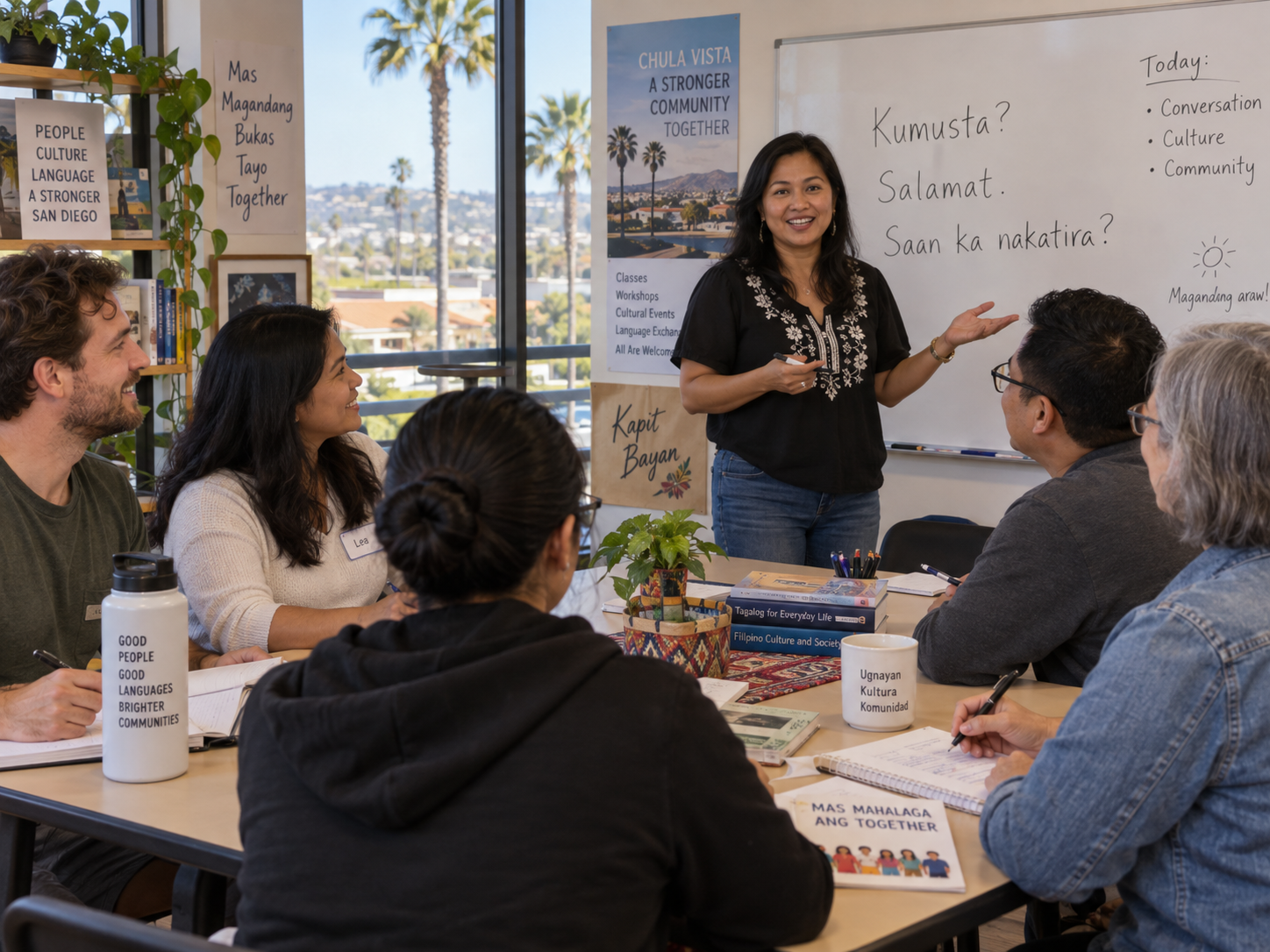
San Diego County is unusually good territory for learning Filipino language and culture, but the options are spread across different kinds of institutions. A Chula Vista resident can find formal college-level Filipino courses nearby, a heritage speaker can find advanced university study in La Jolla, and community organizations periodically host informal Tagalog or Taglish practice.
The challenge is that these options are not interchangeable.
A complete beginner needs a different classroom from a heritage learner who has spoken with family for twenty years. An adult who wants a weekly evening course may not be able to enroll in the same program as a full-time university student. Before choosing a class, it helps to understand what each local resource was actually designed to do.
Southwestern College is the strongest South Bay starting point
For adults in Chula Vista, National City, Bonita, and the surrounding South Bay, Southwestern College is the clearest local institution to investigate first.
Its current catalog lists a Filipino language sequence including:
FIL 101 Elementary Filipino I
FIL 102 Elementary Filipino II
FIL 201 Intermediate Filipino I
FIL 101 is designed for students with little or no previous knowledge. It focuses on beginning interpersonal communication, everyday activities, core vocabulary and structures, and Filipino culture. FIL 102 continues the sequence with greater emphasis on oral proficiency. FIL 201 moves into more sustained interpersonal communication and reading connected to Filipino society, food, art, and culture.
This is a real progression, not a one-off workshop.
Southwestern College also has a broader Filipino American academic environment. Its catalog includes Filipino-American history and culture courses, and the Bayan Learning Community provides a dedicated academic space centered on Filipino/a American issues.
For a heritage learner, that combination can matter. Language becomes easier to sustain when it is connected to history, community, and identity rather than treated as an isolated skill.
As always with college catalogs, verify the current semester schedule before assuming a particular section is running at the time you need it.
UC San Diego serves heritage speakers rather than complete beginners
UC San Diego’s Heritage Filipino program is excellent, but prospective learners need to read the eligibility description carefully.
The program is specifically designed for students who can already speak and comprehend Filipino with family and community and want to improve reading, writing, communicative competence, and sociocultural understanding. It offers multiple proficiency levels and thematic courses.
That makes it a strong resource for the kind of learner who says, “I understand my parents, but I cannot explain grammar,” or “I speak casually, but I never learned to write.”
It is not the obvious starting point for someone who has never studied or heard Filipino before.
This distinction is important because heritage learners are often mislabeled as ordinary beginners. They may have excellent pronunciation and listening, weak literacy, and large gaps in formal grammar. A class designed for true beginners may repeat material they already control while failing to address those gaps.
SDSU also maintains Filipino/Tagalog language resources
San Diego State University has Filipino/Tagalog language resources through its Language Acquisition Resource Center and Asian/Pacific academic programming. Its materials describe communicative Filipino instruction and situate Tagalog among the Asian-language options available through the university.
For a member of the general public, the practical issue is access. University programs operate on academic calendars and may be intended primarily for enrolled students or specific institutional programs. It is worth contacting the department rather than assuming that a course page functions like an open-enrollment adult language school.
Community conversation fills a different need
San Diego’s Filipino organizations also create opportunities that are less formal but socially valuable. In 2026, for example, Silayan Filipina hosted an informal Taglish conversation workshop over coffee, explicitly welcoming people from fluent speakers to beginners.
That kind of event will not replace a structured course. It may not teach verb focus systematically or give you weekly homework. Its value is different: you hear how people mix Tagalog and English naturally, practice without a test hanging over you, and meet people who use the language for reasons beyond the classroom.
For adult learners, that social layer is often what keeps study alive.
San Diego heritage learners should identify the language used at home
One of the most useful questions a prospective Tagalog learner can ask is also one of the most basic: what language did my family actually speak?
Filipino families in Southern California may have roots in Tagalog-speaking regions, but they may also use Ilokano, Cebuano, Kapampangan, Pangasinan, Hiligaynon, or another Philippine language. A learner may remember that relatives spoke “Filipino” and later discover that much of the home language was not Tagalog.
That does not mean learning Tagalog is the wrong choice. Filipino, the national language, is based largely on Tagalog and is widely used across the Philippines and in media. It simply means heritage goals should be specific.
If your main goal is to speak with one grandparent, find out what that grandparent prefers.
What to choose if you work full time
A college course can be excellent, but academic schedules are not built around every adult work shift. San Diego and Chula Vista also have traffic and commuting patterns that can turn a class into a much larger weekly commitment.
Live online instruction can therefore be the most practical option for adults who want the accountability of a teacher without traveling across the county. It is also useful when a learner needs a level that is not running locally that semester.
The strongest online courses are not prerecorded content. They give students real-time conversation, correction, and continuity. Tagalog especially benefits from that because its pronouns, particles, and verb system become much clearer when used in interaction rather than memorized from a chart.
Polyglottist Language Academy offers live online Tagalog classes for adults, including true beginners and learners with previous family exposure.
San Diego County’s advantage is not that there is one perfect Tagalog school. It is that several pieces already exist: formal Filipino coursework in Chula Vista, heritage-language study at UC San Diego, university language resources, and active Filipino community life. A learner who combines the right two or three can get something more useful than a generic language class: structured study plus an actual community in which the language has a reason to be spoken.