
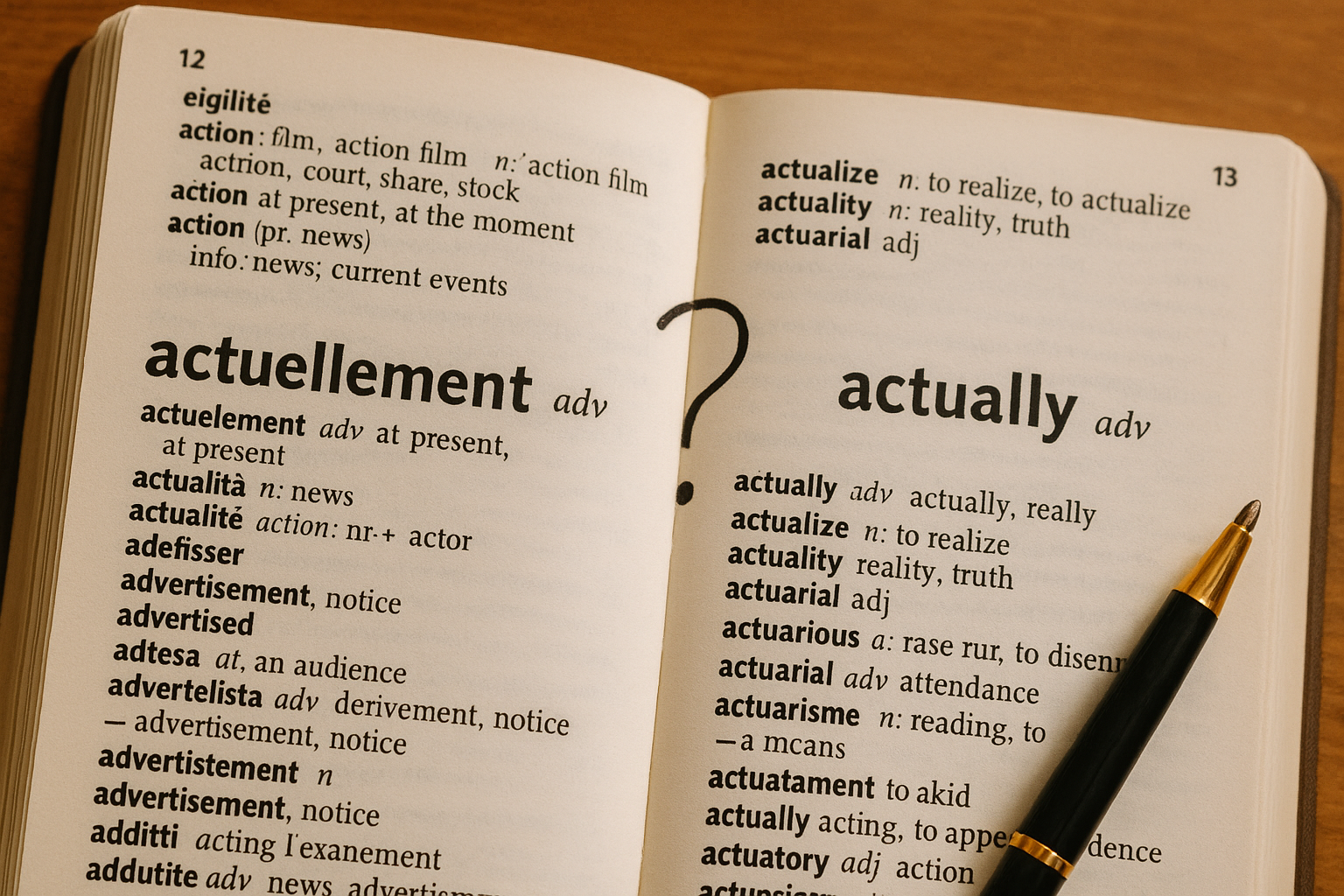
There’s a delicious thrill that comes with learning French—the elegant sounds, the rich culture, the romantic vocabulary that seems to promise sophistication at every turn. For English speakers, French often feels tantalizingly close, filled with words that look familiar and appear easy to decipher. But beneath this seemingly friendly façade lies one of the most treacherous traps for learners: false friends, or faux amis. These are words that look nearly identical in French and English but mean entirely different things, sometimes hilariously so.
These mischievous twins have led to awkward conversations, accidental insults, and more than a few comedic travel stories. Because there’s nothing quite like confidently declaring “Je suis pleine” after a big French dinner—only to discover you’ve just announced that you’re pregnant, not full. Or telling your colleague “Je vais assister la réunion,”thinking you’re about to attend the meeting, when you’ve actually just offered to help run it.
While false friends may be one of the biggest frustrations for learners, they’re also a fascinating window into the history of how English and French have evolved together—and apart. The two languages share thousands of cognates thanks to centuries of cultural and political entanglement. But in many cases, words that once meant the same thing drifted into new meanings over time, leaving modern speakers to navigate a linguistic minefield.
The good news is that false friends are entirely learnable. Once you know them, they become less like traps and more like secret passwords into the deeper nuances of both languages. Learning these differences will help you avoid embarrassing slip-ups, sound more fluent, and build confidence in conversations.
In this article, we’re diving deep into 15 of the most common—and commonly misunderstood—false friends between English and French. We’ll explain what each word really means, how to use it properly, and how to remember the difference. Whether you’re a beginner or a seasoned Francophile, these insights will save you from some of the classic pitfalls of learning French.
Because sometimes, knowing just one word can make the difference between a polite conversation and a very awkward misunderstanding.
What Are False Friends, Exactly?
False friends, or faux amis, are words in two languages that look or sound alike but have different meanings. For example:
Library (English) ≠ Librairie (French)
Both come from Latin librarium, but their meanings have shifted over centuries.
False friends can be:
Identical in spelling but different in meaning
Similar in spelling with subtle changes
Misleading because they’re partial cognates
Why False Friends Matter
Learning false friends helps you:
✅ Avoid embarrassing mistakes
✅ Understand native conversations
✅ Write accurately in emails and essays
✅ Sound more fluent and confident
15 False Friends You Absolutely Need to Know
Let’s explore the words that fool even advanced learners.
1. Actuellement
French meaning: Currently, at the moment
❌ Actually
✅ Currently
Example:
Je suis actuellement en vacances.
I’m currently on vacation.
2. Assister
French meaning: To attend
❌ To assist
✅ To attend
Example:
Je vais assister à la réunion.
I’m going to attend the meeting.
If you mean “to help,” use aider.
Peux-tu m’aider ?
Can you help me?
3. Blesser
French meaning: To wound, to injure
❌ To bless
✅ To injure
Example:
Il a été blessé dans l’accident.
He was injured in the accident.
If you mean “to bless,” use bénir.
Le prêtre a béni l’enfant.
The priest blessed the child.
4. Bras
French meaning: Arm (body part)
❌ Bra
✅ Arm
Example:
J’ai mal au bras.
My arm hurts.
A “bra” in French is a soutien-gorge.
5. Compréhensif
French meaning: Understanding (as in empathic)
❌ Comprehensive
✅ Understanding
Example:
Il est très compréhensif.
He’s very understanding.
If you mean “comprehensive,” use complet or exhaustif.
Un guide complet.
A comprehensive guide.
6. Demander
French meaning: To ask
❌ To demand
✅ To ask
Example:
Je vais lui demander son numéro.
I’m going to ask him for his number.
If you mean “to demand,” use exiger.
Elle exige une explication.
She demands an explanation.
7. Éventuellement
French meaning: Possibly, maybe
❌ Eventually
✅ Possibly
Example:
Je viendrai éventuellement.
I might come.
If you mean “eventually,” use finalement or en fin de compte.
8. Fabrique
French meaning: Factory
❌ Fabric
✅ Factory
Example:
Il travaille dans une fabrique.
He works in a factory.
If you mean “fabric,” use tissu.
J’adore ce tissu.
I love this fabric.
9. Lecture
French meaning: Reading
❌ Lecture
✅ Reading
Example:
J’adore la lecture.
I love reading.
If you mean a speech, use conférence.
Elle donne une conférence.
She’s giving a lecture.
10. Librarie
French meaning: Bookstore
❌ Library
✅ Bookstore
Example:
Je vais à la librairie.
I’m going to the bookstore.
A library is a bibliothèque.
11. Monnaie
French meaning: Change (money)
❌ Money
✅ Change / coins
Example:
Vous avez de la monnaie ?
Do you have any change?
Money in general is argent.
12. Passer un examen
French meaning: To take an exam
❌ To pass an exam
✅ To take an exam
Example:
Je dois passer un examen demain.
I have to take an exam tomorrow.
If you mean “to pass,” say réussir à un examen.
J’ai réussi à mon examen.
I passed my exam.
13. Prétendre
French meaning: To claim
❌ To pretend
✅ To claim
Example:
Il prétend qu’il est malade.
He claims he’s sick.
If you mean “to pretend,” use faire semblant.
Elle fait semblant de dormir.
She’s pretending to sleep.
14. Rester
French meaning: To stay
❌ To rest
✅ To stay
Example:
Je vais rester ici.
I’m going to stay here.
If you mean “to rest,” use se reposer.
Je vais me reposer.
I’m going to rest.
15. Sensible
French meaning: Sensitive
❌ Sensible
✅ Sensitive
Example:
Elle est très sensible.
She’s very sensitive.
If you mean “sensible,” use raisonnable or prudent.
C’est une décision raisonnable.
That’s a sensible decision.
Memory Tricks to Remember False Friends
Actuellement vs. Actually
Actuellement = “at this current moment.”
Assister vs. Assist
Think: Attend the party, not assist it!
Demander vs. Demand
“Demander” is gentle, like asking.
Prétendre vs. Pretend
“Prétendre” claims truth. “Pretend” means acting fake.
How to Avoid Falling for False Friends
✅ Learn words in phrases, not isolation.
✅ Check a dictionary when unsure.
✅ Listen to native speakers for real usage.
✅ Keep a list of false friends to review.
✅ Laugh at mistakes—they’re part of learning!
Funny False Friend Stories
The “Full” Confession
An American student, after a huge French dinner, proudly said:
“Je suis pleine.”
Instead of saying “I’m full,” she’d said, “I’m pregnant.” Laughter erupted.
The correct phrase:
J’ai trop mangé.
I’ve eaten too much.
Or:
Je n’ai plus faim.
I’m not hungry anymore.
The Helper at the Meeting
A professional wanted to say:
“I’ll attend the meeting.”
Instead, they said:
“Je vais assister la réunion.”
Meaning they’d help run the meeting. The boss was quite surprised!
Why It’s Worth Learning False Friends
Learning false friends:
Makes conversations smoother.
Helps avoid embarrassing mistakes.
Shows deeper fluency.
Makes you a more confident speaker.
FAQs
Q: Are false friends only between English and French?
A: No. Many language pairs have false friends—like Spanish-English or German-English.
Q: Are all similar-looking words false friends?
A: No. Many are true cognates, like information or nation.
Q: How many false friends exist between English and French?
A: Dozens, if not hundreds. Start with the most common.
Q: Is it rude to mix them up?
A: Not at all. Mistakes are part of learning, and most French speakers will help correct you kindly.
Q: How can I practice spotting false friends?
A: Read French articles, note suspicious words, and look them up.
Q: Are false friends more common in writing or speech?
A: Both, but they often sneak into writing because learners trust visual similarity.
Q: Should I memorize lists of false friends?
A: Lists help, but context and practice are key.
Q: Will native speakers understand me if I mix them up?
A: Often, yes. But it can lead to funny or confusing situations.
At Polyglottist Language Academy, we believe French isn’t just a collection of words—it’s a world of culture, nuance, and human connection. Our courses go beyond textbooks to teach you the real language, including those tricky false friends that can make or break a conversation. Whether you’re learning for travel, work, or pure love of the language, we’re here to help you speak confidently and authentically.
Ready to master French, false friends and all? Sign up for French classes!
Check Out Our Other Blog Articles
Keep exploring French and boost your skills with these great reads:
How Learning French Changes Your Personality And Way Of Thinking
Is Parisian French The “Best” French? A Deep Dive Into Regional Accents And Attitudes
How To Keep Your French Alive If You’re Not In A Francophone Country
When French Gets Philosophical: How To Talk About Life, Love, And Meaning
The Secret French Grammar Structures That Sound Instantly Native
French For Abstract Thinkers: Expressing Complex Ideas Like A Native
Why Fluent French Isn’t Perfect French—And Why That’s A Good Thing
A Crash Course In “French Filler Words” (Eh Bien, Tu Vois, Genre...)
What Learning French Teaches You About English (Yes, Really!)