
Introduction: The Language of Food, the Heart of Italy
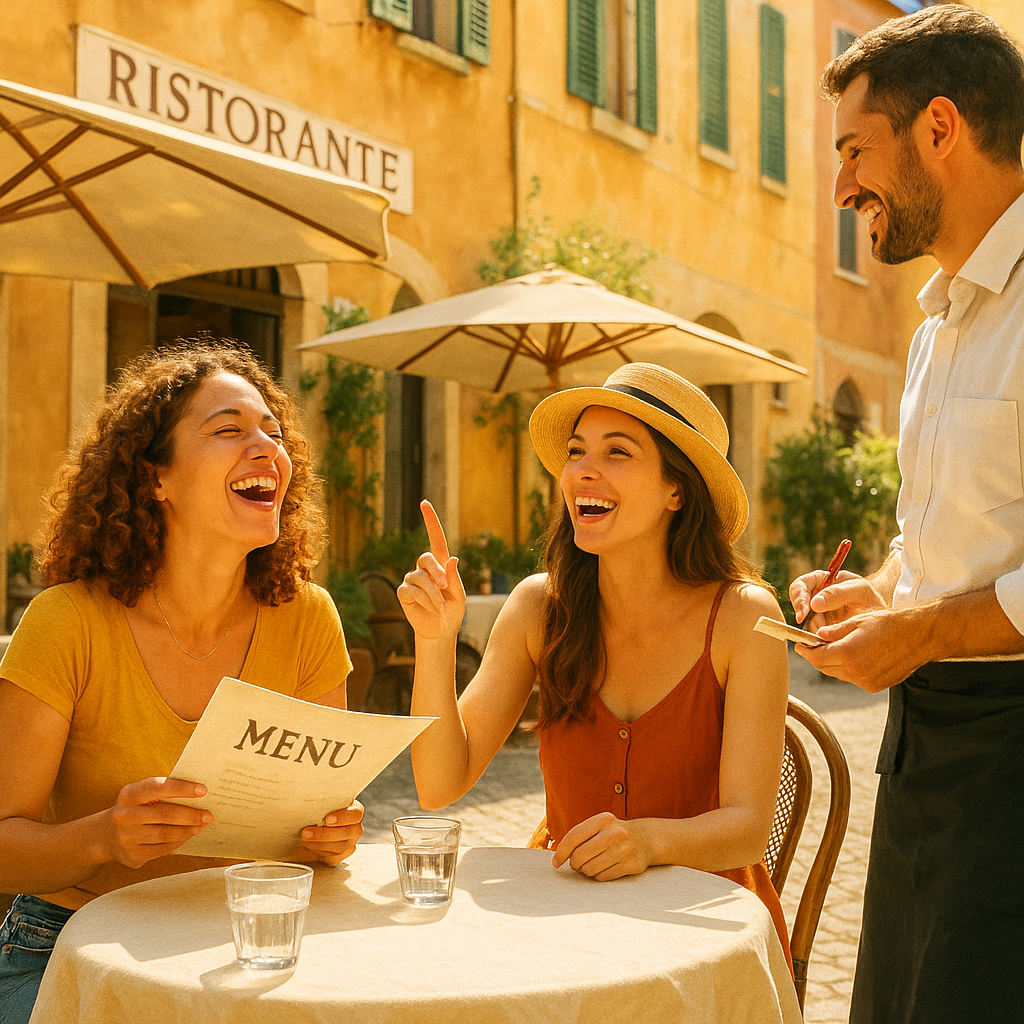
You’re sitting at a sun-drenched table on a quiet side street in Florence. The scent of garlic, tomatoes, and herbs floats through the air. A cheerful waiter appears with a menu and says something in Italian, fast and melodic. You smile nervously, clutch the menu like a lifeline, and respond with… “Umm… spaghetti?” Maybe you add “per favore” at the end and hope for the best.
Sound familiar?
For many travelers and Italian learners, ordering food in Italy is one of the most exciting and terrifying parts of the trip. You’re not just practicing your language skills—you’re also navigating unfamiliar social rules, regional quirks, and the unspoken etiquette of a culture that takes food very seriously. And unlike a grammar mistake in the classroom, getting it wrong at the restaurant feels personal. Embarrassing. Awkward.
But it doesn’t have to be.
In fact, ordering food in Italian is one of the most rewarding—and manageable—ways to start speaking like a local. It connects you to daily life, gives you practical vocabulary you’ll use constantly, and helps you build real confidence. Even a few well-chosen phrases can transform you from another tourist into a curious, respectful guest who gets smiles instead of sighs.
And here’s the secret: You don’t have to be fluent. You just have to know what to say, when to say it, and how to say it with confidence.
In this article, we’ll guide you step-by-step through the Italian restaurant experience: from choosing your table and reading the menu, to ordering drinks, customizing your meal, and paying the bill. We’ll cover essential phrases, insider tips, cultural don’ts, and what to expect—so you can sit down to eat in Italy without panic, confusion, or that all-too-common phrase: “Do you speak English?”
Part I: Getting Seated – What to Expect When You Arrive
Unlike the U.S., where you're often seated by a host, in Italy things can feel more casual—or more chaotic.
✅ What to Do:
Wait at the entrance until someone acknowledges you.
If no one comes, try politely asking:
“Possiamo sederci?” – Can we sit down?
“È libero questo tavolo?” – Is this table free?
🗣 Useful Phrases:
Un tavolo per due, per favore. – A table for two, please.
Vorremmo sederci fuori, se possibile. – We’d like to sit outside, if possible.
Pro tip: Don’t seat yourself unless it’s clear that’s the custom (especially in casual cafes). In a trattoria or ristorante, wait to be guided.
Part II: Reading the Menu Without Panic
Menus in Italy can be long and full of surprises. Here’s the basic structure:
Antipasti – Appetizers
Primi – First course (usually pasta, risotto, or soup)
Secondi – Second course (meat or fish)
Contorni – Side dishes (vegetables, potatoes)
Dolci – Desserts
Bevande – Beverages
Vini – Wines
Note: Italians often order multiple courses, but you’re not required to. One primo or secondo with a contorno is totally fine.
🗣 Menu Survival Vocabulary:
Senza – without (e.g., senza formaggio – without cheese)
Con – with (e.g., con funghi – with mushrooms)
Alla griglia – grilled
Fritto – fried
Al forno – oven-baked
Cotto / crudo – cooked / raw
Piccante – spicy
Vegetariano – vegetarian
Part III: Ordering Like a Local (Without the Stage Fright)
When the waiter arrives, it’s your moment. Here’s how to shine:
🗣 How to Start:
Vorrei… – I’d like…
Prendo… – I’ll take…
Per me… – For me…
Use these to start your sentence, then add what you want. Example:
“Vorrei gli gnocchi al pesto, per favore.”
Tip: Italians don’t usually say “please” after every sentence, but adding per favore or grazie at the end is always polite.
🧀 Customizing Your Meal
If you have allergies, preferences, or requests:
Sono allergico/a a… – I’m allergic to…
Non mangio carne. – I don’t eat meat.
È possibile avere… senza…? – Is it possible to have… without…?
Examples:
“È possibile avere la pasta senza aglio?”
“Non posso mangiare latticini.” – I can’t eat dairy.
Part IV: Drinks and Wine Without Guesswork
Water is not automatically served.
🗣 Ask for:
Una bottiglia d’acqua naturale / frizzante. – Still / sparkling water
Un bicchiere di vino rosso / bianco. – A glass of red / white wine
Un caffè, per favore. – A coffee, please (note: this means espresso)
🍷 Wine Tips:
Ask for the vino della casa (house wine). It’s often excellent and affordable.
To ask for a recommendation:
“Cosa mi consiglia?” – What do you recommend?
Part V: Handling the Bill Gracefully
In Italy, you must ask for the check—it won’t be dropped off automatically.
🗣 Ask for the check:
Il conto, per favore. – The bill, please.
Possiamo pagare? – Can we pay?
💳 Tips on Tipping:
Service is usually included (coperto).
You can leave small change or round up if service was excellent, but tipping is minimal.
Example: If your bill is €27, you might leave €30.
Part VI: Situational Scripts
Here’s how a whole meal might play out in Italian—with confidence.
You walk into a restaurant:
“Buonasera. Un tavolo per due, per favore.”
You get seated and look at the menu.
You call the waiter politely:
“Siamo pronti per ordinare.” – We’re ready to order.
You order:
“Per me, i ravioli al tartufo. E da bere, un bicchiere di vino rosso.”
When the food arrives:
“Grazie!” (A simple thank you works wonders.)
When you're done:
“Il conto, per favore.”
“Teni pure il resto.” – Keep the change.
Voilà. You just ordered like a pro.
FAQs About Ordering Food in Italian
Q: What if I don’t understand the menu?
A: Don’t panic. Ask politely:
“Cosa significa…?” – What does … mean?
Or: “Cos’è questo piatto?” – What is this dish?
Q: Do I need to order multiple courses?
A: Not at all. Ordering just a primo or secondo is perfectly fine.
Q: Will the staff speak English?
A: Sometimes, yes—but don’t count on it, especially outside tourist areas. A few Italian phrases go a long way in earning goodwill.
Q: Can I ask to split the bill?
A: Yes, but do it clearly:
“Possiamo pagare separatamente?” – Can we pay separately?
Q: What’s “coperto” on the bill?
A: It’s a standard charge (often €1–3 per person) for bread and table service. It’s not a tip.
Ready to Feel at Home in Italian Restaurants?
At Polyglottist Language Academy, we don’t just teach you textbook Italian. We prepare you to walk into a trattoria in Rome, a café in Florence, or a seaside restaurant in Naples—and order with confidence, ease, and joy.
Our Italian courses, both online and in person in Berkeley, Oakland, San Francisco, and San Jose, are designed to help you speak naturally, understand culture deeply, and thrive in real-life situations—whether you're chatting with a waiter or making conversation over pasta.
👉 Explore our Italian classes and sign up today.
Want More Italy-Inspired Language Tips?
Explore our other articles to level up your Italian:
Oakland Loves Italian: Why This Language Is Trending In The East Bay
From Ciao To Arrivederci: How To Master Italian Greetings And Goodbyes
Using “Piacere” Correctly In Italian (It’s Not Just ‘To Like’)
Aperitivo, Passeggiata & More: Everyday Italian Culture Through Language
Valle D’Aosta: Castles, Mountains, And The Taste Of Fontina Cheese
Top 10 Must-Read Italian Novels To Understand The Italian Mindset
From Opera To Espresso: Explore Italian With Classes In Oakland