
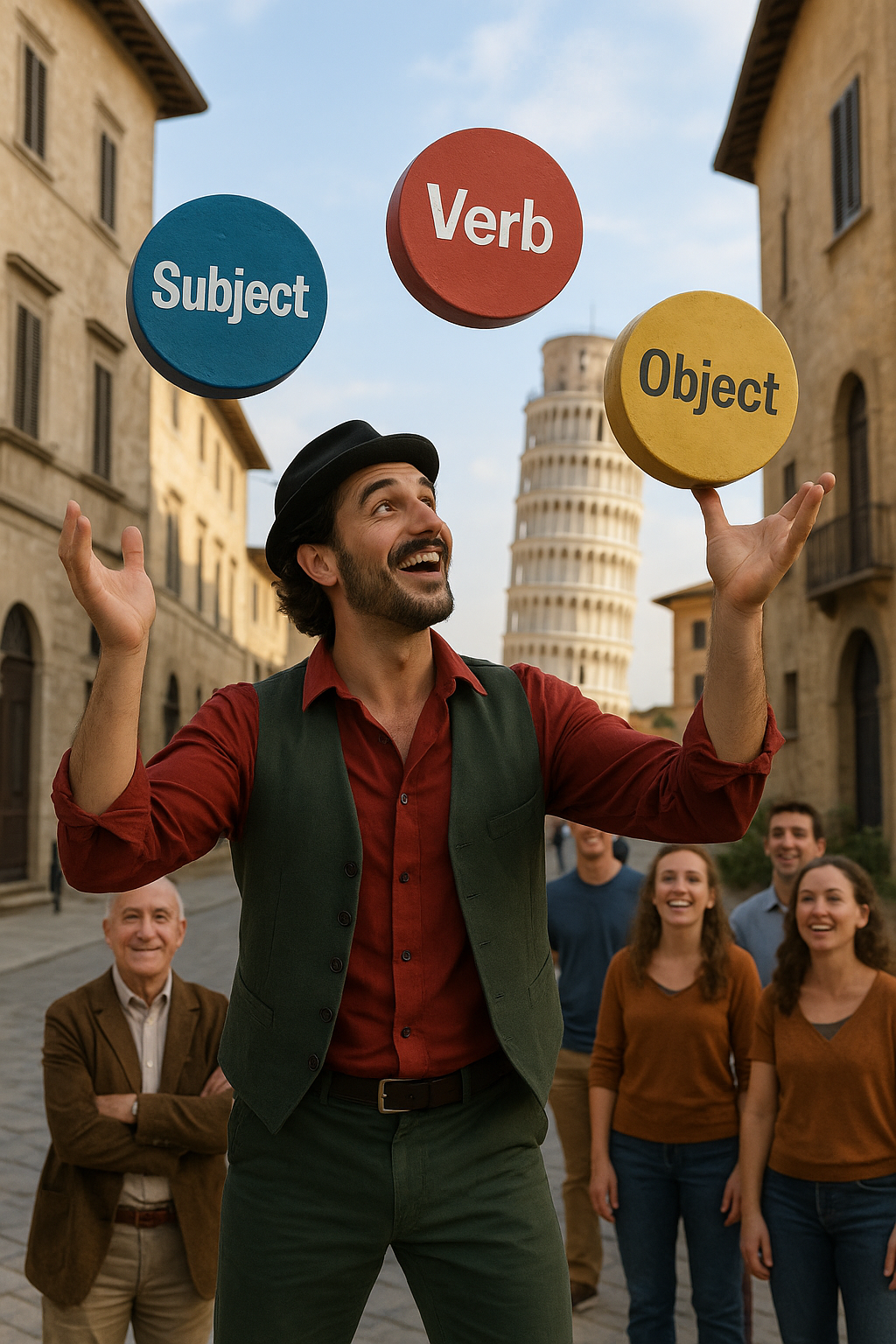
One of the beautiful—and sometimes maddening—aspects of learning Italian is discovering how sentences can dance. Words shift positions, elements slide forward or backward, and emphasis transforms with just a simple rearrangement, creating a language that feels as lyrical and expressive as the culture it reflects. For many learners who come from more rigidly structured languages, Italian’s flexibility is at once a gift and a mystery. How do native speakers know when to put the subject at the end of the sentence? Why does the object sometimes sneak ahead of the verb? And how can you, as a learner, master this rhythm so that you don’t just speak Italian—you sound Italian?
While textbooks often teach a straightforward Subject-Verb-Object (SVO) structure, the reality is that Italian offers far greater freedom in how sentences are built, especially in spoken language. This isn’t randomness; it’s a deliberate play of meaning, style, and emotion. Italians rearrange sentences to emphasize certain words, to express subtle shades of feeling, or simply because it sounds better. Understanding how and why to shift words around is one of the great secrets to speaking Italian naturally and fluently.
In this article, we’re going to dive into the fascinating world of Italian sentence structure. We’ll look at why flexibility exists in the first place, explore the rules and patterns that underlie word order, and share practical tips for rearranging sentences like a native. Because the goal isn’t just grammatical correctness—it’s capturing the music of the language and speaking Italian with the confidence and flair that makes it so irresistibly alive.
Why Italian Word Order is So Flexible
1. Subject Pronouns Are Often Dropped
Unlike English, Italian doesn’t always need explicit subject pronouns because verb endings carry the subject information.
Parlo italiano. → I speak Italian.
Mangia troppo. → He/She eats too much.
This opens the door for rearrangement without confusion about who’s doing what.
2. Emphasis and Focus
Italians rearrange sentences to emphasize:
New information
Emotional weight
Contrast
Example:
Ho visto Maria. → I saw Maria.
Maria l’ho vista. → Maria I saw.
Same meaning, different focus.
3. Rhythm and Euphony
Sometimes Italians change word order simply because it sounds smoother. Italian values musicality and rhythm in speech.
4. Old vs. New Information
In Italian, known information often goes earlier; new information comes later—or vice versa, depending on the context.
Example:
Il libro l’ho letto. → The book, I read it.
Core Italian Sentence Structure: SVO
The default structure in Italian, especially in neutral or formal contexts, is Subject-Verb-Object:
Luca mangia la pizza. → Luca eats the pizza.
However, this is just the beginning.
How Italians Rearrange Sentences Like Natives
1. Fronting the Object for Emphasis
Moving the object to the front emphasizes it:
La pizza, Luca la mangia. → The pizza, Luca eats it.
Used to:
Highlight what you’re talking about.
Contrast different pieces of information.
2. Dislocating Elements
Italian often “dislocates” elements for clarity or emphasis, repeating them later as pronouns.
Example:
Il film, l’ho visto ieri. → The film, I saw it yesterday.
Dislocation helps keep sentences flowing while highlighting key details.
3. Inverting Verb and Subject
Especially common in:
Questions
Literary or formal writing
Expressive statements
Example:
Viene Marco. → Marco is coming.
In spoken Italian, this inversion can create drama or surprise.
4. Postponing the Subject
Italian often places the subject after the verb when introducing new information.
Example:
È arrivato Gianni. → Gianni has arrived.
Here, the focus is on the arrival, not the person.
5. Placing Adverbs and Time Expressions
Adverbs can move around, changing emphasis:
Domani parto. → Tomorrow I leave.
Parto domani. → I leave tomorrow.
Both correct; context decides placement.
6. Clitic Pronouns and Word Order
Clitic pronouns (like lo, la, mi, ti, ci, vi) create special word-order rules:
Lo vedo. → I see him/it.
Non lo vedo. → I don’t see him/it.
Voglio vederlo. → I want to see him/it.
Pronouns can’t stand alone and often squeeze between other elements.
7. Negation and Word Order
Negation generally follows:
Non + verb + object.
Example:
Non mangio carne. → I don’t eat meat.
With pronouns:
Non la mangio. → I don’t eat it.
8. “Ci” and “Ne”
These tiny words frequently shift sentence elements:
Ce ne sono molti. → There are many of them.
Ne voglio uno. → I want one of them.
These particles often appear before the verb, shifting focus and meaning.
Practical Tips for Rearranging Sentences
Listen to Native Speech
Pay attention to:
How questions are structured
Where subjects appear
Use of dislocation
Start Simple
Experiment by moving:
Time expressions:
Ieri ho studiato. → Ho studiato ieri.
Objects:
Il pane, l’ho comprato stamattina.
Repeat and Shadow
Mimic native speakers. Shadowing helps you feel natural word orders.
Use Short Sentences
Long sentences make rearrangement harder. Keep sentences manageable until confident.
Don’t Overdo Inversion
Overusing inverted structures can sound theatrical. Keep it natural.
Examples of Rearranged Sentences
Basic SVO
Carlo legge il giornale.
Carlo reads the newspaper.
Fronted Object
Il giornale, Carlo lo legge.
The newspaper, Carlo reads it.
Subject After Verb
Ha telefonato Lucia.
Lucia called.
Dislocation
Il libro, l’ho finito ieri.
The book, I finished it yesterday.
Adverb Placement
Spesso vado al cinema.
Often I go to the cinema.
Or:
Vado spesso al cinema.
I often go to the cinema.
How Rearrangement Changes Meaning
Example 1
Ho visto Maria. → Neutral statement.
Maria l’ho vista. → Emphasizes Maria specifically.
Example 2
Gianni ha comprato il vino. → Gianni bought the wine.
Il vino l’ha comprato Gianni. → It was Gianni who bought the wine.
Common Mistakes
🚫 Literal Translation from English
“I like pizza” → Mi piace la pizza.
Not: Io piace la pizza.
🚫 Forgetting Pronouns
Correct: La vedo. → I see her.
Incorrect: Vedo la. (not used this way)
🚫 Misplacing “ne” or “ci”
Correct: Ne ho bisogno. → I need it.
Incorrect: Ho bisogno ne.
Advanced Rearrangement: Subordinate Clauses
Italian allows flexibility even in complex sentences:
Penso che lui venga. → I think that he’s coming.
Che venga lui, non ci credo. → That he’s coming, I don’t believe it.
Such structures appear in writing and dramatic speech.
Why Rearranging Sentences Helps You Sound Native
Rearranging sentences:
Adds emphasis
Mimics natural rhythm
Prevents your Italian from sounding robotic
Helps you express emotion and nuance
Even small changes create significant stylistic effects.
How to Practice Rearrangement
Take simple sentences and move elements around.
Read Italian dialogues aloud, noticing where words shift.
Record yourself experimenting with different orders.
Learn set phrases with unusual structures.
The Musicality of Italian
Italian isn’t just about words—it’s about rhythm and melody. Rearranging sentences helps your speech:
Flow smoothly
Sound emotionally expressive
Feel authentically Italian
FAQs
Q: Is Italian word order really free?
A: It’s flexible, not free. Changes affect emphasis and meaning. Grammar still limits possibilities.
Q: Should beginners try rearranging sentences?
A: Start simple. Focus on clarity first, then add stylistic rearrangements.
Q: Is fronting the object common in everyday speech?
A: Yes, especially to emphasize new or important information.
Q: Why does Italian often drop the subject?
A: Verb endings make the subject clear, so pronouns aren’t always needed.
Q: Can I always put adverbs anywhere in a sentence?
A: Often, yes—but context and clarity matter. Some placements sound more natural.
Q: Are inverted sentences more formal?
A: Yes. Inversion can sound literary or dramatic. Use sparingly in casual speech.
Q: Do rearrangements exist in written and spoken Italian?
A: Yes. They’re used for stylistic effect in writing and for natural flow in speech.
Q: Is it wrong to stick to SVO?
A: No. SVO is always correct—but native speakers often rearrange for nuance.
At Polyglottist Language Academy, we believe that learning a language isn’t just about memorizing words—it’s about capturing the unique rhythm and expressive possibilities that make each language special. Our Italian courses go beyond grammar rules to help you speak with real fluency, flexibility, and confidence. Whether you’re a beginner or refining advanced skills, we’re here to help you discover the music of Italian and speak it like a native.
Ready to bring your Italian to life with authentic, natural sentence structures? Sign up for our Italian classes and let’s make your Italian vibrant and expressive!
Check Out Our Other Blog Articles
Explore more secrets to mastering Italian:
From Ciao To Arrivederci: How To Master Italian Greetings And Goodbyes
Using “Piacere” Correctly In Italian (It’s Not Just ‘To Like’)
Aperitivo, Passeggiata & More: Everyday Italian Culture Through Language
Valle D’Aosta: Castles, Mountains, And The Taste Of Fontina Cheese
From Opera To Espresso: Explore Italian With Classes In Oakland
How To Ask Questions In Italian: Grammar, Tone, And Intuition