
Where Do People Speak English in China? Tips for Language-Savvy Travelers
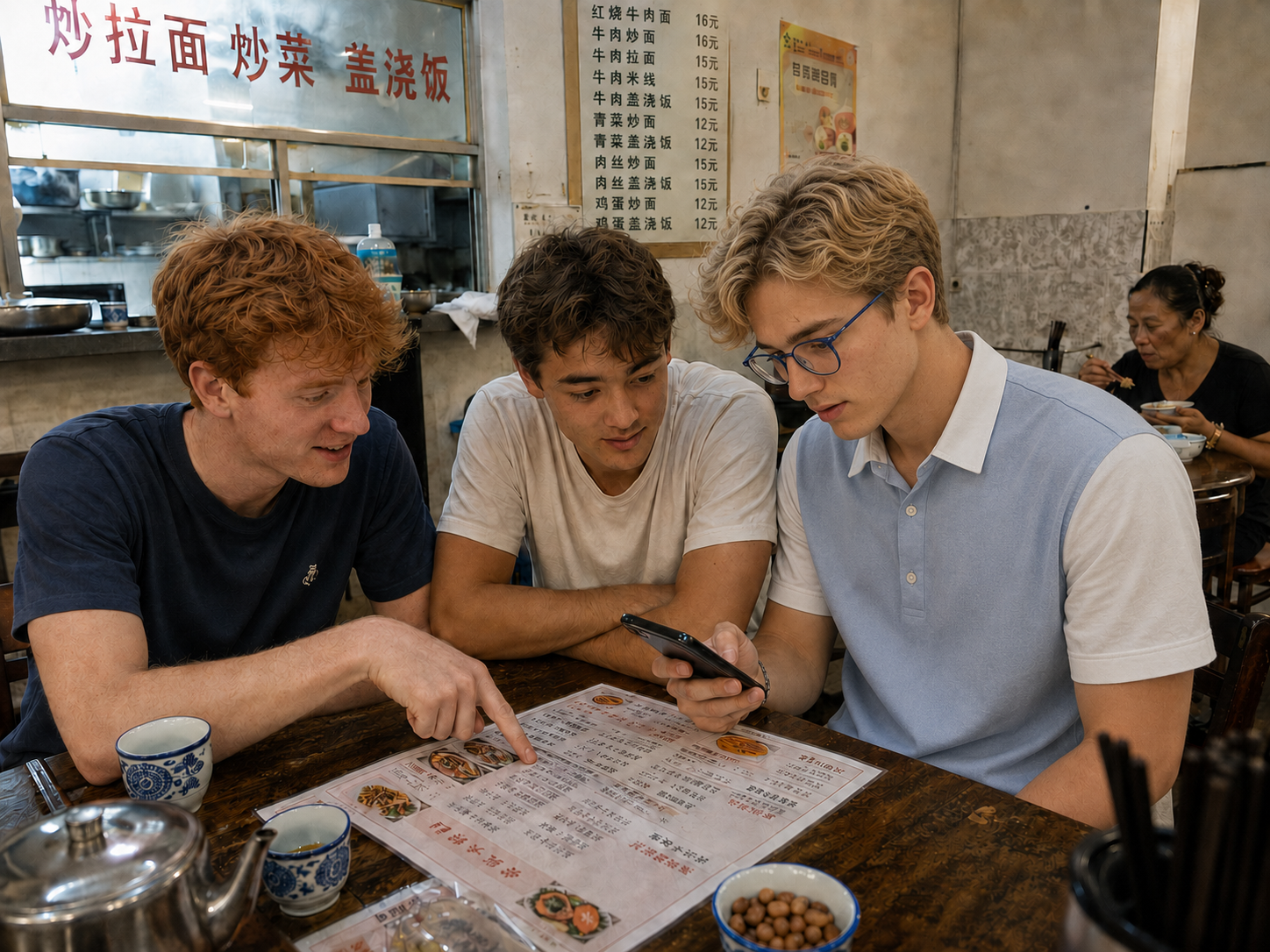
Before my first trip to China, I had a very basic question that turned out to have a surprisingly complicated answer: how much English would we actually be able to use? I was traveling with two of my friends, all three of us American guys in our mid-twenties, and none of us spoke Mandarin. Before the trip, I spent some time on language apps learning the things that seemed most useful, such as nǐ hǎo for hello, xièxie for thank you, duōshao qián for how much, and a few other expressions I thought might help in a restaurant, shop, or train station. I definitely wasn't under the illusion that I had “learned Chinese.” Mostly, I wanted to be able to say something other than English when we needed someone's help.
What surprised me once we got there was how unpredictable English could be. We could spend an entire morning without having any real communication problems and then walk into a restaurant a few blocks away and suddenly find ourselves relying on screenshots, gestures, and my extremely limited Mandarin. I had imagined there would be a simple pattern—lots of English in big cities, much less elsewhere—but that wasn't really how it worked.
Our first impression: this might be easier than we expected
Arriving in one of China's major cities can give you a lot of confidence very quickly. At the airport, there were English signs, transportation information was relatively easy to follow, and checking into our hotel was straightforward. We could ask basic questions, figure out where we needed to go, and move through the first few hours without feeling particularly lost. For three guys visiting China for the first time, that was reassuring because we had prepared ourselves for a much more immediate language barrier.
Things changed once we started spending more time outside places designed for international visitors. A hotel employee might speak very good English, while someone working at a small restaurant down the street spoke almost none. At a large train station, we could often find our way without talking to anyone because the train numbers and signs gave us what we needed. If we suddenly had to explain a problem, though, the situation became more complicated.
After a while, we just got used to the fact that one place might be easy in English and the next one wouldn't be.
Shanghai felt international, until it didn't
Shanghai was one of the places where we could go for relatively long stretches without thinking much about language. In hotels, major shopping areas, well-known attractions, and places that clearly received a lot of international visitors, there was usually enough English around for us to manage. Sometimes an employee spoke English; other times we simply had signs or digital information that made conversation unnecessary.
That gave us a slightly false sense of confidence at first. We would leave a very international part of the city, wander into a smaller restaurant, sit down, and immediately realize that none of us knew what the menu said.
Those were the moments when my tiny amount of Mandarin became surprisingly useful. Saying nǐ hǎo when we entered or xièxie when someone helped us obviously wasn't enough to carry on a conversation, but it made the interaction feel less awkward. I wasn't walking in expecting everyone to switch to English just because we were there.
Usually we figured things out somehow. We pointed at pictures, used camera translation, showed something on a phone, or found the one person nearby who knew a few words of English. After the first few times, it stopped feeling like a problem and became part of how we traveled.
Beijing worked much the same way
Beijing reinforced what we had already started noticing in Shanghai. Around famous sights, large hotels, museums, transportation hubs, and other places accustomed to international visitors, we rarely felt stranded. We weren't necessarily speaking English to people all day; often we just didn't need to speak much at all because signs, maps, tickets, and apps were doing most of the work.
Then we would go somewhere completely ordinary and the situation could change within minutes. Before the trip, I had thought that people in major cities would generally speak English and that the real language barrier would begin once we traveled farther away. It wasn't nearly that neat.
What seemed to matter more was whether someone regularly interacted with foreign visitors. We met people who spoke excellent English and others who appeared to understand some of what we were saying but clearly did not feel comfortable answering. Once we stopped expecting a consistent level of English, the whole thing became much less frustrating.
Traveling around China made us rely less on English
We didn't stay only in the most international parts of Shanghai and Beijing. As we moved around and visited other areas, we became much better at traveling without assuming there would always be an English speaker nearby.
Major tourist destinations were often easier than I expected because the basic systems were designed for visitors. Attractions had signs, transportation had numbers and schedules, and there were usually enough visual clues to keep us moving. The more local moments were different. A small restaurant, convenience store, neighborhood, or taxi ride might suddenly require much more improvisation.
I had expected the language barrier to get steadily harder as we moved away from the biggest cities. Instead, it came and went throughout the day. We might have no trouble navigating a huge train station and then spend ten minutes trying to understand what we had ordered for lunch.
That actually made the trip more interesting. We learned pretty quickly not to panic just because an interaction wasn't happening in English.
China's trains were much easier than I expected
Before going, transportation was one of the things I was most nervous about. China's railway network is enormous, and I could easily picture the three of us standing in a huge station surrounded by Chinese characters and somehow ending up on the wrong train.
In reality, the high-speed rail system was much easier to navigate than I expected. Train numbers became our best friends. We didn't need to understand every sign if we could find the number that matched our booking. We kept our reservation information on our phones, checked the departure information carefully, and followed the flow of people once boarding started.
The difficult moments were the ones when something was unclear and we actually needed help. A screen can tell you the platform number, but it can't necessarily explain how to reach the right part of a huge station when you're standing in the wrong place.
That was when screenshots became incredibly useful. Instead of trying to explain everything in English, we could show someone the train number or destination and point. It turns out that three confused Americans holding up a phone is a fairly universal form of communication.
I learned quickly to keep Chinese addresses on my phone
This is probably the single piece of advice I would give someone going to China without Mandarin: don't save important places only in English.
Before the trip, I assumed that if I knew the English name of our hotel or an attraction, that would be enough. It wasn't always. The Chinese name might sound quite different from what I expected, and even when I had the pinyin spelling in front of me, my pronunciation did not necessarily help.
So we started keeping important destinations in Chinese characters. For example:
北京南站 — Běijīng Nánzhàn — Beijing South Railway Station
If my attempt at saying the name went nowhere, I could simply show someone the screen.
Once I started doing that, I worried much less about finding English speakers. If we could show a driver the hotel address, show someone a train ticket, or put a translated sentence on the phone, we usually had another way to communicate. I also kept our hotel address and phone number saved in Chinese, which is something I would absolutely do again.
Restaurants were where we used translation the most
Restaurants were probably where the fact that none of us spoke Chinese became most obvious. Some places were easy because there was an English menu, photographs of the dishes, or enough translation for us to understand the basics. Other times, all three of us would sit down, look at the menu, and immediately reach for our phones.
Camera translation became part of dinner. It was never perfect, especially with regional dishes or names that did not translate neatly, but usually it gave us enough information to understand whether we were looking at noodles, pork, beef, fish, vegetables, or something we had never heard of.
Sometimes pointing was easier than talking, and some of our most memorable meals began with us being only about 70 percent sure what we had ordered.
The one situation where I would not improvise is a serious food allergy. If one of us had needed to avoid an ingredient for medical reasons, I would have prepared a clear explanation in Chinese before leaving the United States instead of trusting a translation app at the table. Ordering the wrong noodles is one thing; misunderstanding a serious allergy is obviously different.
Knowing a few words was more useful than I expected
I learned only a very small amount of Mandarin before the trip, mostly through apps. I wasn't having conversations with anyone, and I was never particularly confident about my tones, but the few words I knew kept coming up.
These were the phrases I found most useful:
MandarinPinyinMeaning你好Nǐ hǎoHello谢谢XièxieThank you请问……Qǐngwèn…Excuse me / May I ask…多少钱?Duōshao qián?How much is it?厕所在哪里?Cèsuǒ zài nǎlǐ?Where is the restroom?我不会说中文。Wǒ bú huì shuō Zhōngwén.I don't speak Chinese你会说英语吗?Nǐ huì shuō Yīngyǔ ma?Do you speak English?
I especially liked knowing qǐngwèn because it gave me a polite way to approach someone before showing them a phone or attempting a very basic question. After several days, I also started recognizing little bits of Mandarin around us. I still couldn't follow conversations, of course, but every once in a while I would hear something I had learned on an app and realize I knew what it meant.
That was probably the point when I started becoming genuinely interested in Mandarin rather than just treating it as something useful for the trip.
Pinyin was not as easy as it looked
Before studying even a little Mandarin, I assumed pinyin would make pronunciation pretty simple because it uses the Roman alphabet. I discovered very quickly that this was not the case.
Some letters and combinations do not sound the way an American English speaker instinctively expects, and then there are the tones. I would sometimes look at the pinyin name of a place, feel reasonably confident that I knew how to say it, try it on someone, and get a completely blank expression.
My friends found this extremely funny.
Eventually, if someone clearly didn't understand me after one or two attempts, I stopped trying to force it and just showed them the Chinese characters. That worked much better than repeating my questionable pronunciation louder.
It also made me realize how useful written language can be when you are traveling. You don't have to turn every interaction into a spoken conversation.
We also learned to make our English simpler
There were times when someone seemed to understand some English but not an entire question, especially if we spoke the way we normally would at home. We got much better at stripping a question down to the useful part.
Instead of asking, “Could you tell us whether this is the correct platform for the 3:42 train to Hangzhou?” we could show the ticket and ask, “Hangzhou? Here?”
That may not be elegant English, but it works.
I also started feeling a little silly about expecting everyone to switch into English for us. We were the ones visiting China, after all. If I could show the address in Chinese, use the few Mandarin words I knew, or make the question easier to understand, that seemed like the least I could do.
Our phones probably did more translating than we did
Going to China without Mandarin would have been a very different experience twenty years ago. Our phones handled an enormous amount of the communication that once would have required another person.
We used them for translation, maps, transportation, hotel information, addresses, train reservations, and menus. Camera translation was particularly useful because Chinese characters give you very few clues if you have never studied them. Screenshots became another habit, and we saved reservations, addresses, train information, and anything else we might need to show someone quickly.
I would definitely set all of this up before arriving. You don't want to be standing on a street in China trying to figure out which translation or transportation app you should have downloaded yesterday. The more we had organized on our phones, the less often a small language problem became a bigger travel problem.
By the end of the trip, I stopped looking for English speakers
This was probably the biggest change in how I thought about the language barrier.
At the beginning of the trip, if we couldn't communicate with someone, my instinct was to wonder whether there was another person nearby who spoke English. Later, I stopped thinking that way.
If we had the address in Chinese, we showed it. If we had a ticket, we pointed to the destination. If there was a menu, we scanned it. If something was more complicated, we typed a short sentence into the translation app.
Once we got used to that, the whole experience became much more relaxed. We weren't constantly testing whether someone spoke English. We were simply trying to communicate, using whatever happened to work.
People were often patient with us, even when my contribution to the conversation consisted of nǐ hǎo, xièxie, and something I had practiced on an app the night before.
So, can you travel in China using only English?
After our first trip, I would say that you can absolutely travel through China without speaking Mandarin, especially if you are visiting major cities and established tourist destinations. We did it, and we traveled around rather than staying inside an international hotel environment the entire time.
But I wouldn't really say we traveled “using only English.” We traveled using English plus translation apps, screenshots, Chinese addresses, train numbers, maps, gestures, photographs, pointing, and the few Mandarin words I had learned beforehand.
That difference matters. I would not go to China assuming there will always be someone nearby who can speak English, but I also wouldn't let the language barrier make me nervous about going.
I'm glad I learned those few words before the trip. They certainly didn't turn me into a Mandarin speaker, but they made everyday interactions a little easier and made me much more curious about the language itself. If you're preparing for China and want to go beyond memorizing a few travel phrases, Polyglottist Language Academy offers online Mandarin classes for adult learners, including beginner instruction in pronunciation, tones, basic sentence patterns, and practical conversation. Explore Mandarin classes at Polyglottist Language Academy
We were three American guys in our twenties visiting China for the first time, and none of us spoke anything close to conversational Mandarin. What helped was realizing fairly quickly that the language barrier wasn't one solid wall. Sometimes English worked perfectly well, sometimes a few words were enough, and sometimes a phone screen did all the talking.
By the end of the trip, pulling out my phone, pointing at a line of Chinese, trying a slightly uncertain qǐngwèn, and somehow getting where we needed to go felt completely normal. It was just part of traveling in China.