
Inside a Chinese Banquet: Traditions, Etiquette, and Must-Try Dishes
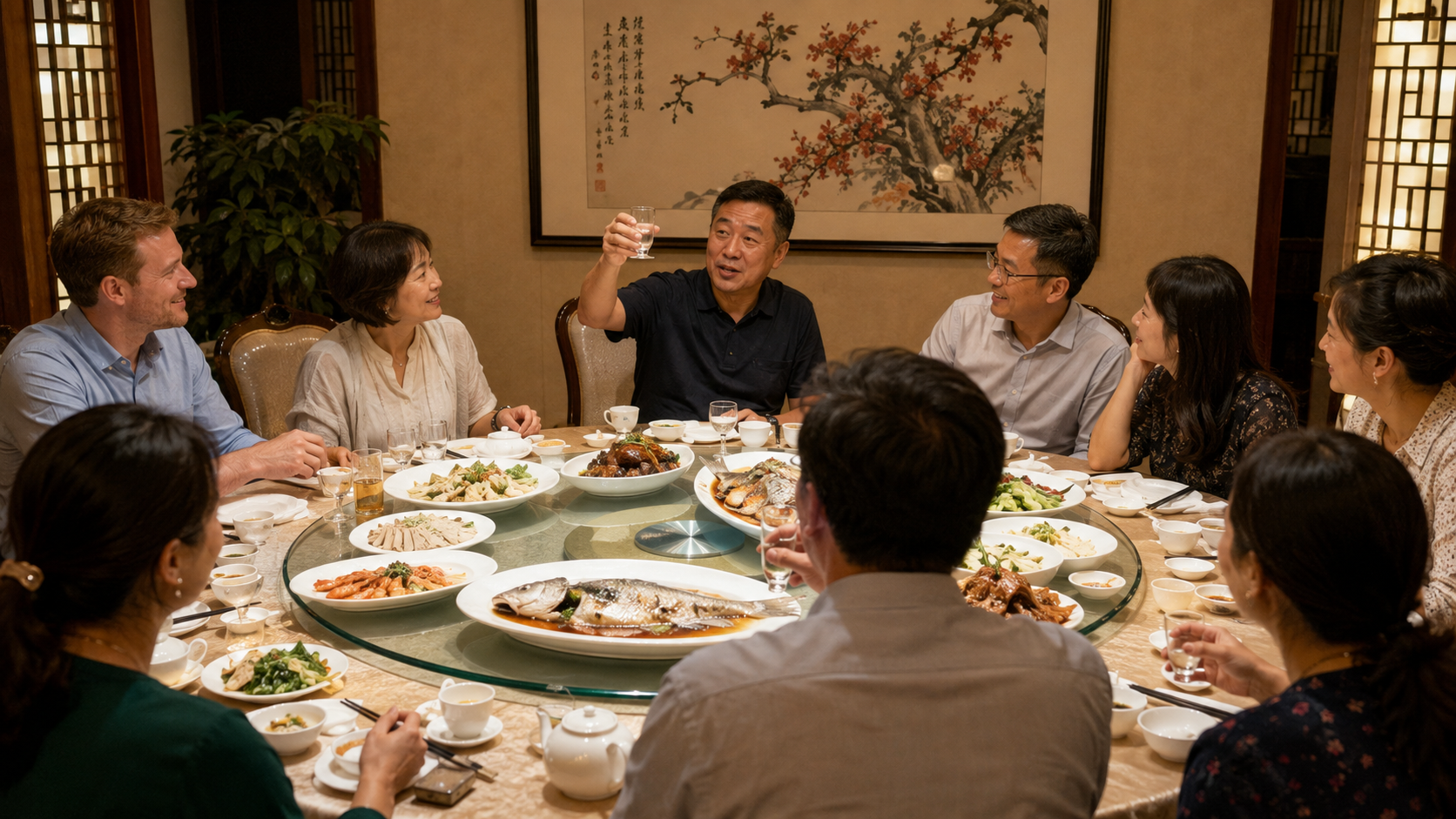
You walk into a private dining room and find a large round table with a glass turntable in the middle. A few cold dishes are already waiting. Tea is being poured, people are still standing, and someone gestures toward a chair without quite telling you whether you should sit there yet.
If you are used to Western restaurant meals, a Chinese banquet can be disorienting at first. You may never see a menu because the host has already ordered. Rice might not appear until surprisingly late. A whole fish arrives with its head and tail intact. Someone puts a piece of food directly into your bowl. Then glasses are raised, another dish appears, and the host seems determined to keep feeding everyone long after the table looks full.
The meal becomes much easier to understand once you stop looking at it only as dinner. At a banquet, food also communicates hospitality, respect, generosity, status, and relationships. You do not need to decode every gesture, but knowing what some of them mean makes the whole experience feel considerably less mysterious.
What Exactly Is a Chinese Banquet?
There is no single banquet format used everywhere in China.
A wedding banquet in Guangdong, a business dinner in Beijing, a birthday meal in Sichuan, and a seafood dinner in Fujian may share certain conventions while serving very different food. Formality varies too. Some meals follow traditional seating and toasting customs closely; others are relaxed enough that the word "banquet" mostly describes the size of the meal.
The Mandarin terms 宴席 (yànxí) and 宴会 (yànhuì) can refer to banquet-style or formal meals, depending on the context.
Banquets are often associated with weddings, birthdays, family reunions, holidays, business entertaining, welcoming guests, and other occasions when the host wants the meal itself to mark the importance of the gathering.
What many of these meals have in common is communal dining. Food is ordered for the whole table rather than by individual diners, and the person hosting the meal usually plays a more visible role than someone organizing an ordinary restaurant dinner in the United States or much of Europe.
Before You Sit Down, Wait a Moment
At a casual dinner with friends, seating may be completely unimportant. At a more formal banquet, it can reflect hierarchy and respect.
Traditionally, the guest of honor and senior diners may be given particular seats, while the host sits in a position that allows them to manage the meal. The layout can depend on the entrance, the room, and the occasion, so trying to memorize a universal seating chart is not especially useful.
The practical rule is simpler: if everyone is still standing, do not immediately claim the most prominent chair. Let the host indicate where you should sit.
You will probably notice fairly quickly whether the dinner is formal enough for seating to matter. At many meals among younger people, it barely does.
Why the Table Is Round
The round table suits the way the meal works. Dishes belong to everyone rather than to one person, and the rotating center—often called a Lazy Susan in English—lets food move around the table without plates constantly being passed from hand to hand.
A Chinese banquet therefore has a different rhythm from a meal where everyone orders an entrée. You take a little from one dish, eat for a while, try something else when it comes around, and continue as more food arrives.
If someone is serving themselves, wait before rotating the table. Take moderate portions rather than loading your bowl with half of one dish. Beyond that, there is little reason to become nervous about Lazy Susan technique.
Cold Dishes First, Then the Meal Keeps Growing
Several cold dishes may already be on the table when you arrive. Depending on the region and restaurant, these might include cucumber, sliced meats, tofu, peanuts, marinated vegetables, jellyfish, or other small dishes.
Then the hot food starts coming out.
One of the easiest mistakes for a first-time visitor is assuming that an impressive dish arriving early must be the main course. There may be no main course in the Western sense. Instead, meat, vegetables, poultry, seafood, soup, and regional specialties appear one after another.
At an elaborate dinner, expensive ingredients may be included partly because the host wants to offer something special. In coastal areas, that might mean crab, lobster, abalone, scallops, or sea cucumber. Elsewhere, the prestigious dishes may look quite different.
It is wise not to fill up on the first two things you like. There may be considerably more food coming.
Why Is There So Much of It?
The amount of food is one of the features visitors notice most.
Traditionally, abundance could reflect good hosting. A table that looked as though it had barely enough for everyone might suggest that the host had not provided generously enough. Having food remaining could therefore signal that the guests had been well taken care of.
That does not mean the goal is to waste food. Attitudes toward unnecessary food waste have changed considerably in China, and public campaigns and regulations have encouraged restaurants and diners to order more reasonably.
This is one reason the familiar travel-guide instruction that you should "always leave food on your plate in China" is misleading.
There is a difference between deliberately leaving half the food you took for yourself and a large banquet ending with some food still on the shared platters. Take what you intend to eat, rather than trying to perform a rule about leftovers.
The Whole Fish
A whole fish is one of the dishes most strongly associated with celebratory Chinese meals.
Part of the significance comes from language. The Mandarin word for fish, 鱼 (yú), sounds the same as 余 (yú), meaning surplus or abundance. This connection appears in the well-known New Year expression:
年年有余 (niánnián yǒuyú)
May there be abundance year after year.
Fish has particularly strong symbolic importance at Lunar New Year, although it appears at many other banquets as well.
Visitors sometimes find elaborate explanations online about where the fish head must point, who is allowed to eat which part, or whether part of the fish should remain untouched. Such customs do exist, but they vary by region and occasion. If the fish seems to be receiving more ceremonial attention than the other dishes, wait and see what the host does before serving yourself.
Whole Chicken, Braised Meats, Seafood, Noodles, and Dumplings
There is no national banquet menu, but certain types of dishes appear frequently.
A whole chicken may be served rather than neat boneless portions, particularly at celebratory meals where wholeness or completeness carries positive associations.
Braised meat dishes are common too, although they vary enormously by region. In eastern China, for example, rich red-braised pork may appear, while other regions have their own slow-cooked specialties.
Seafood can become especially prominent at expensive banquets. Prawns, crab, lobster, whole fish, abalone, and sea cucumber may all appear depending on where you are, what is in season, and how elaborate the meal is meant to be.
Noodles can carry an association with longevity, which is why long noodles often appear at birthday celebrations. Dumplings have particularly strong associations with northern China and Lunar New Year and are sometimes connected symbolically with wealth because their shape resembles historical ingots.
None of these foods should be treated as mandatory banquet courses. The more useful thing to remember is that banquet food reflects regional cuisine. A formal dinner in Guangzhou should not be expected to look like one in Chengdu.
And Where Is the Rice?
Travelers sometimes wait for rice because they assume it has been forgotten.
At an elaborate banquet, rice, noodles, dumplings, buns, or another staple may come fairly late. The dishes themselves are often the focus of the meal, so rice is not necessarily served as the base on which everything else is placed.
If you are hungry for rice, asking for some is hardly a major offense. Still, it is worth waiting long enough to see how the meal is unfolding. What feels "missing" may simply belong to a later stage.
Chopstick Etiquette Is Simpler Than It Sounds
You do not need impressive chopstick skills to be a polite guest.
There are, however, a few habits worth avoiding. The best known is sticking chopsticks vertically into a bowl of rice, because the appearance can resemble incense used in offerings. It is also better not to point at people with chopsticks, play with them, or dig repeatedly through a communal dish searching for your favorite piece.
If communal serving chopsticks or spoons are provided, use them.
Hygiene practices have changed over time, and public serving utensils have become more common in many restaurants. At other tables, people may still serve themselves in ways that feel less familiar to Western visitors.
If your chopstick technique is imperfect, nobody is likely to care. Respectful behavior matters much more than whether you can pick up a slippery mushroom on the first attempt.
When Someone Puts Food in Your Bowl
This can be one of the more unexpected moments for visitors.
A host, older relative, or dining companion may choose a good piece of fish or meat and place it directly in your bowl. From a Western perspective, having someone else reach into a shared plate and decide what you should eat can feel unusually personal. In the context of the meal, however, it may simply be an act of care and hospitality.
The same is true when someone keeps encouraging you to eat.
You may hear:
多吃一点。
Duō chī yìdiǎn.
Have a little more.
or:
请吃。
Qǐng chī.
Please eat / help yourself.
The literal message concerns food, but the social message may be closer to "Please make yourself comfortable" or "I want to take good care of you as my guest."
You do not need to keep eating indefinitely. Thanking the person and clearly enjoying the food usually conveys what matters.
Toasting Can Be the Most Formal Part of the Meal
Toasting is known as 敬酒 (jìngjiǔ) and can be especially noticeable at business dinners and other formal occasions.
Sometimes the host gives a toast to the entire table. At other meals, people toast one another individually. Beer, wine, and 白酒 (báijiǔ)—a strong distilled spirit—may all be involved.
The phrase most foreigners recognize is:
干杯!
Gānbēi!
It is usually translated as "Cheers!" but literally carries the sense of emptying or drying the glass.
In some formal situations, people really do expect the drink to be finished. In others, gānbēi is used much more loosely. The amount in the glass, the type of alcohol, the people present, and the occasion all matter.
Chinese drinking culture also varies far more than stereotypical accounts suggest. Generation, region, profession, family background, and social group all make a difference. A formal corporate banquet involving senior executives may have a much stronger drinking culture than dinner with a group of younger friends.
If you do not drink, it is usually easier to say so plainly:
我不喝酒。
Wǒ bù hē jiǔ.
I don't drink alcohol.
You can still take part in a toast with tea, water, or another drink if that suits the gathering.
At more formal meals, you may also notice someone holding their glass slightly lower when touching glasses with an older or more senior person. The gesture signals deference. You do not need to measure the exact height of your glass; simply recognizing the intention behind it is enough.
Starting to Eat
At casual meals, people often start once the food appears.
At formal dinners, diners may wait briefly for the host, senior person, or honored guest to begin or invite everyone else to eat. This tends to become obvious if you give the table a moment before reaching for the first dish.
The same principle works in many situations at a banquet. If you are unsure, watch what the people around you do before assuming there is a complicated rule you were supposed to know.
Paying the Bill Is Part of Hosting
At the end of the meal, the bill can reveal another difference in expectations.
The useful word here is:
请客 (qǐngkè)
to treat someone or host a meal.
At a formal banquet, paying is often part of the role of the host. Someone who invited the group may see covering the bill as part of the hospitality they intended to provide from the beginning.
That is why immediately proposing to divide the total equally may feel slightly out of place in some situations.
This is changing, particularly among younger diners. Friends may split costs electronically, take turns paying, or transfer money afterward. Customs also vary among families and colleagues.
If someone has clearly invited you as their guest, it is reasonable to offer once rather than turning the end of the evening into an argument over who is allowed to pay.
Everyday Dinner Is Not a State Banquet
One reason Chinese dining etiquette can seem intimidating online is that different situations often get mixed together.
Advice meant for wedding banquets appears next to business etiquette. Regional fish customs are presented as national rules. Older practices are described as if every university student in Shanghai follows them at dinner.
A casual meal with friends is usually much more relaxed than a formal banquet. A business dinner involving senior people may preserve more attention to seating, toasting, ordering, and hosting. A family celebration may have its own traditions.
Even business dinners vary widely. A group from a young technology company may behave very differently from executives in a more traditional organization.
Context tells you much more than a generic list of "Chinese table manners."
A Few Mandarin Phrases Worth Knowing
A small amount of Mandarin can make the meal more enjoyable, particularly because several common phrases appear repeatedly around the table.
谢谢。
Xièxie.
Thank you.
Useful when someone serves you, pours tea, or offers food.
很好吃。
Hěn hǎochī.
It's delicious.
An easy and natural compliment.
多吃一点。
Duō chī yìdiǎn.
Have a little more.
Something guests are likely to hear.
干杯!
Gānbēi!
Cheers! / Bottoms up!
How literally it is meant depends on the situation.
我不喝酒。
Wǒ bù hē jiǔ.
I don't drink alcohol.
Useful if you want to establish that clearly.
我吃饱了。
Wǒ chī bǎo le.
I'm full.
A phrase that becomes increasingly useful as another plate arrives.
For Mandarin learners, these expressions are a good reminder that literal translation only gets you part of the way. Duō chī yìdiǎn is easy to translate, but understanding why someone keeps telling you to eat requires knowing something about hospitality as well.
If you are studying Mandarin and want more structured practice with both everyday language and the cultural situations in which it is used, Polyglottist Language Academy offers Mandarin instruction for adult learners.
What Actually Matters When You Are the Guest
You are unlikely to cause serious offense because you picked up the wrong piece of fish or needed three attempts to grab something with your chopsticks.
Some traditions are meaningful, especially at formal occasions, but most hosts do not expect a foreign guest to arrive with expert knowledge of banquet protocol.
What they are more likely to notice is whether you are respectful, attentive, and gracious about being included. Trying unfamiliar dishes politely matters more than knowing every symbolic association. Waiting when the host is clearly organizing the table matters more than memorizing a diagram of banquet seating. If a toast occurs, acknowledging it is more important than executing every gesture perfectly.
After you have spent an hour at the table, many of the things that seemed strange at the beginning start to make sense. The whole fish is no longer simply an unusually intact dinner. The large number of dishes reflects something about the host's role. Repeated invitations to eat are often less about hunger than hospitality, and the toast says something about the people raising their glasses to one another.
A Chinese banquet is easier to enjoy once you understand that much of the conversation is taking place through the meal itself.