
Why “I Love You” Isn’t Said Often in Chinese Culture
A Mandarin learner usually encounters 我爱你 (wǒ ài nǐ) fairly early. The translation seems simple enough: “I love you.”
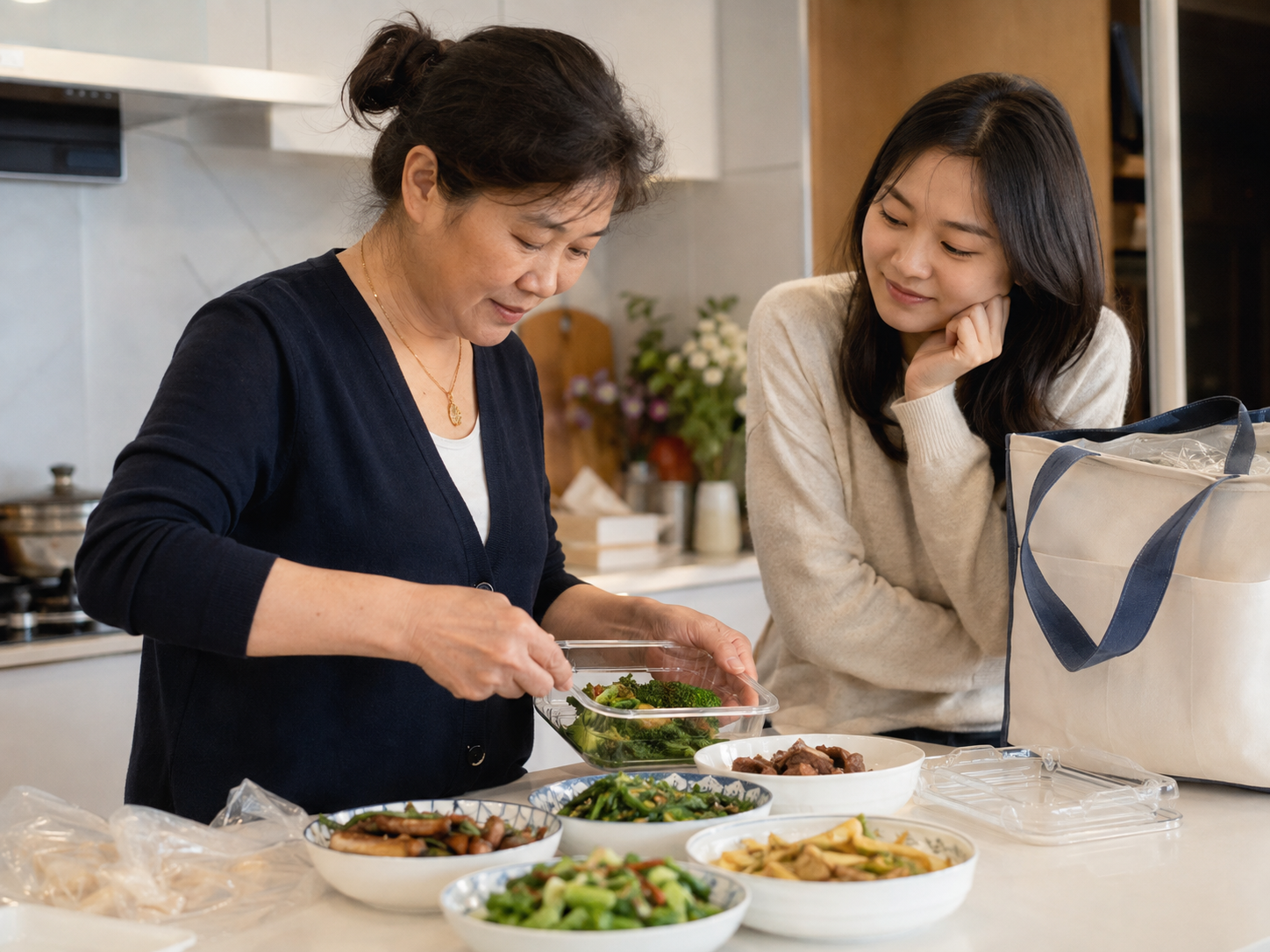
So it can be surprising to discover that some Chinese parents who are obviously devoted to their children may rarely say it. A grandmother may spend an afternoon cooking someone’s favorite dishes, pack leftovers for them to take home, and call later to ask whether they arrived safely without ever saying 我爱你. A parent may remind an adult child to sleep more, wear warmer clothes, or stop skipping meals, while a direct declaration of love feels almost awkward.
The feeling is clearly there. The words may not be.
This is not because 我爱你 is unnatural Mandarin. It is used, especially in romantic relationships and increasingly among younger generations. The interesting part is that it has not traditionally occupied exactly the same everyday role that “I love you” does in some English-speaking families.
To understand that difference, it helps to listen for the wider language of affection that surrounds the phrase.
我爱你 Is Easy to Translate, but Harder to Translate Socially
我爱你 (wǒ ài nǐ) is a perfectly correct translation of “I love you.”
What changes is the emotional weight attached to it.
In English, “I love you” can be remarkably flexible. Parents say it to children. Adult children say it to parents. Couples may say it every day. Siblings use it. Close friends sometimes use it. Someone may end a phone call with “love you” almost automatically.
For some Mandarin speakers, 我爱你 feels more deliberate. It may sound strongly romantic, unusually earnest, or emotionally exposed. Saying it can feel closer to making a declaration than simply repeating an affectionate phrase that everyone already knows.
Many younger couples use 我爱你 comfortably, and some parents now say it regularly to their children. Other people grew up in families where nobody said it at all.
That is why memorizing:
爱 = love
and therefore:
我爱你 = I love you
only takes a learner part of the way.
The grammar is straightforward. Knowing when the phrase feels natural takes more cultural and social context.
What Affection Sounds Like in Everyday Mandarin
One reason foreigners sometimes conclude that affection is not being expressed is that they are listening for the wrong sentence.
Consider some very ordinary Mandarin phrases:
吃饭了吗?
Chīfàn le ma?
“Have you eaten?”
多吃一点。
Duō chī yìdiǎn.
“Eat a little more.”
路上小心。
Lùshang xiǎoxīn.
“Be careful on the way.”
到了告诉我。
Dào le gàosu wǒ.
“Tell me when you arrive.”
别太累了。
Bié tài lèi le.
“Don’t get too tired.”
早点睡。
Zǎodiǎn shuì.
“Go to bed earlier.”
多穿一点。
Duō chuān yìdiǎn.
“Wear a little more.”
None of these literally means “I love you,” and they should not be translated that way.
Online discussions of Chinese culture sometimes romanticize expressions such as 吃饭了吗? and present them as secret substitutes for “I love you.” That makes the language sound more mysterious than it really is. Sometimes “Have you eaten?” is exactly what it appears to be: a question about whether you have eaten.
What gives these expressions emotional weight is the relationship.
When a mother repeatedly asks her adult son whether he is eating properly, the practical question may also communicate attention and concern. When a partner says 到了告诉我 before someone leaves, the literal message is “tell me when you arrive,” but the reason for asking may be equally obvious: they will be thinking about that person until they know they arrived safely.
The affection develops through repetition, familiarity, and the history between the people speaking.
Food Can Carry a Surprising Amount of Emotion
Food is one of the clearest places where affection becomes practical.
A parent may remember which dish a child likes and prepare it when they come home. A grandmother may push the best piece toward someone else. Fruit appears before a visit ends. An adult child leaves a parent’s home carrying enough food for the next several meals.
Nobody necessarily explains what these gestures mean.
Someone simply says:
多吃一点。
Duō chī yìdiǎn.
“Eat a little more.”
In a close relationship, however, the history behind that sentence matters. The person saying it may have been feeding you for twenty years.
This overlaps with Chinese hospitality more generally. A host wants a guest to eat well; a parent wants a child to eat well. The behavior can look similar, although the relationship underneath it is different.
Families all over the world express affection through cooking and feeding people. What is especially noticeable in many Chinese families is how easily food becomes part of everyday care even when direct emotional language remains relatively sparse.
In Many Families, Love Looks a Lot Like Responsibility
Another part of the story is responsibility.
Parents may pay tuition, help with housing, cook, look after grandchildren, save money for their children, solve practical problems, accompany someone to a medical appointment, or worry endlessly about work and health.
Adult children may organize care for aging parents, visit regularly, send money, buy groceries, handle paperwork, or make sure their parents are comfortable.
Within a family, these things can carry enormous emotional meaning without anyone naming them as acts of love.
This can make affection look very practical. Caring for someone often means taking responsibility for things that affect their daily life.
It can also become complicated.
A parent may believe that worrying about a child’s career is part of caring for them. The adult child may experience the same concern as pressure. Advice about marriage, work, weight, money, or health may come from genuine affection and still be exhausting to receive.
Calling every intrusive question or criticism “just how Chinese parents show love” would be too easy. Concern can be sincere and still land badly.
When Love Sounds Like Worry
Someone returns home after a long absence.
Instead of hearing “I missed you so much,” they may hear:
“You look thinner.”
“You’re not sleeping enough.”
“Why are you working so much?”
“You need to eat properly.”
“Put on a jacket.”
To an outsider, this may seem like an odd way to express happiness at seeing someone. Within the family, these comments can be entirely recognizable as care.
Health, food, sleep, clothing, and work are tangible. They give concern somewhere to go.
That does not make every comment harmless. Remarks about weight, marriage, appearance, or career can hurt regardless of the speaker’s intention. A heritage speaker may understand perfectly well that a parent is worried and still wish they would simply say, “I’m happy to see you.”
A familiar communication style does not automatically meet everyone’s emotional needs.
Romantic Relationships Have Their Own Vocabulary
Romantic affection works somewhat differently from family affection.
In romantic relationships, 我爱你 is much more at home. Even there, however, it can feel more serious or declarative to some speakers than the English phrase does.
Another important expression is:
我喜欢你。
Wǒ xǐhuan nǐ.
“I like you.”
English speakers sometimes assume that “I like you” must be much weaker than “I love you.” In Mandarin, 喜欢 (xǐhuan) can sound very natural when someone is expressing romantic interest, especially earlier in a relationship. 我喜欢你 can communicate genuine attraction without carrying quite the same emotional weight as 我爱你.
There is no fixed ladder in which every relationship begins with 喜欢 and eventually graduates to 爱. Real relationships are not vocabulary charts.
Another common expression is:
想你了。
Xiǎng nǐ le.
“I miss you.”
or:
我想你。
Wǒ xiǎng nǐ.
Depending on the relationship and tone, this can feel intimate and affectionate without sounding as formal or declarative as 我爱你.
For learners, this is a useful reminder that Mandarin emotional language does not divide neatly into English categories of “like,” “love,” and “miss.”
Saying 我爱你 to Parents Can Feel Strangely Difficult
One of the clearest generational differences appears between parents and adult children.
A Chinese adult may be perfectly comfortable saying 我爱你 to a romantic partner and still feel deeply awkward saying the same words to their mother or father.
The parents may feel just as uncomfortable hearing it.
From the outside, that can seem puzzling because the family may otherwise be extremely close. But if the phrase was never part of the family’s normal emotional vocabulary, suddenly introducing it can feel almost theatrical. The feeling is familiar; the wording is not.
This helps explain why exercises or social-media challenges that ask people to call their parents and say “I love you” can become unexpectedly emotional. They force something normally expressed indirectly into explicit language.
Some people find that moving. Others find it embarrassing. Others may wonder why something so obvious suddenly needs to be announced.
Those reactions can all exist within contemporary Chinese families.
Younger Generations Are Changing the Habit
The language of affection is not standing still.
Younger Chinese speakers have grown up with romantic films, television, social media, international entertainment, online dating, and much more public discussion of relationships and emotional well-being than many earlier generations encountered.
Many couples say 我爱你 comfortably. Some younger parents deliberately tell their children they love them because they want explicit affection to feel normal from childhood.
What is particularly interesting is that the change does not always move evenly through a family. Someone in their thirties may tell their child “I love you” every night and still feel awkward saying the same thing to their own parents.
Digital communication has also created new ways to be more explicit. Couples use emojis, stickers, voice messages, good-night texts, and frequent check-ins. Sending food delivery or a quick “Did you get home?” message can be practical and affectionate at the same time.
The number 520 (wǔ èr líng) has also become associated online with 我爱你 because of a loose sound resemblance. May 20, written 5/20, is now widely connected with romantic messages and couple culture.
The popularity of something like 520 is a useful reminder that emotional language keeps changing. Contemporary Mandarin speakers are not simply preserving one old communication style.
“Have You Eaten?” Is Still Just “Have You Eaten?”
The phrase deserves another look because it has become such a persistent cultural cliché.
吃饭了吗? can be affectionate.
A parent asking it for the hundredth time may be expressing concern through a familiar practical question.
But Mandarin does not contain a hidden code in which ordinary sentences secretly translate into declarations of love. The same phrase might be casual conversation, a greeting, or a literal question because someone is deciding whether to order food.
Meaning depends on who is speaking, why they are asking, and what that relationship normally sounds like.
That is much more useful than saying, “Chinese people say ‘Have you eaten?’ instead of ‘I love you.’”
What really happens is subtler: ordinary concern can become emotionally meaningful because of who is expressing it and how often.
Heritage Learners Often Notice the Gap Most Clearly
People who grow up between languages can become especially sensitive to these differences.
A Chinese heritage speaker raised in an English-speaking country may hear “I love you” from friends, romantic partners, or other families while rarely hearing it at home.
They may understand perfectly well that their parents show care through food, money, practical help, sacrifice, and constant concern.
Understanding that does not necessarily remove the emotional gap.
Someone can appreciate the way their parents express affection and still wish they would occasionally say, “I’m proud of you,” “I miss you,” or “I love you.”
The reverse can happen in intercultural romantic relationships.
An English-speaking partner may interpret infrequent verbal affection as emotional distance. The Chinese-speaking partner may be confused because, from their perspective, the relationship is obviously affectionate. They are checking in, helping, cooking, remembering details, making plans, and making time for the other person. The affection does not feel absent to them.
Neither person necessarily has a problem with love. They may simply be relying on different evidence for it.
Recognizing that difference is often more useful than deciding whose style is more expressive.
Saying Less Is Not Automatically Deeper
There is a romantic idea that cultures with less verbal affection somehow have deeper love because actions replace words.
That interpretation can be just as simplistic as assuming affection is absent because it is not spoken.
Practical care can be deeply meaningful. So can hearing someone say exactly how they feel.
A parent who spent decades working to support a family may genuinely believe their love is self-evident. Their adult child may understand that sacrifice completely and still want to hear affection expressed directly.
Some people need very little verbal reassurance. Others value it enormously. Many people want both.
Cultural habits help explain why families communicate the way they do, but they do not determine what every individual should find emotionally satisfying.
What Mandarin Learners Should Take From This
Emotional vocabulary is one of the clearest examples of why language learning cannot be reduced to translation.
A student learns:
爱 — love
喜欢 — like
想 — miss / think of
Those translations are useful starting points. Eventually, however, learners need to notice who uses each expression, with whom, and how it sounds in different relationships.
Would a parent say it?
Would a romantic partner?
Does it sound casual, serious, playful, or unexpectedly intense?
Would someone write it in a message but hesitate to say it face-to-face?
These questions are part of learning Mandarin just as much as memorizing vocabulary.
Structured classes can give learners opportunities to explore those differences in actual conversation rather than treating every English phrase as though it has one perfect Chinese equivalent. Polyglottist Language Academy offers Mandarin classes for students interested in developing that kind of practical understanding.
Think again about the parent who rarely says 我爱你.
They may instead ask whether you have eaten, tell you to wear another layer, put fruit in your bag before you leave, and wait for the message saying you arrived safely.
Those actions should not be translated mechanically as “I love you.” They mean what they appear to mean: eat properly, stay warm, take this with you, let me know you are safe.
Inside a close relationship, though, those ordinary acts accumulate history and emotional weight.
The useful lesson is not that Chinese people avoid saying “I love you.” It is that 我爱你 is only one part of a much larger vocabulary of affection, and that vocabulary continues to change from one family and generation to the next.