
Molise: Italy’s Best-Kept Secret with Old Traditions and Wild Landscapes
At Sepino, in the Molise countryside, the boundary between archaeological site and village is unusually hard to draw.
The Roman town of Saepinum still has its theatre, gates, streets, and traces of the public buildings that once defined an important settlement. But centuries after the Roman city declined, people moved back into parts of it. Houses were built into the theatre itself. Families cooked, worked, and kept animals among structures that archaeologists would later carefully uncover.
Today some of those later houses form part of the archaeological museum. You can look at Roman remains and then at fireplaces and ovens belonging to people who lived there many centuries later.
It is a good introduction to Molise because history here rarely feels neatly separated into periods.
This small region between the Apennines and the Adriatic receives only a fraction of the attention given to neighboring parts of Italy. Italians even have a long-running joke about it: Il Molise non esiste — “Molise doesn’t exist.”
Molise does exist, of course. More interestingly, it contains things that have become surprisingly difficult to find together elsewhere: old pastoral routes still visible across the landscape, important Roman and pre-Roman archaeological sites with relatively few visitors, towns where traditional crafts remain working professions, mountain country that becomes sparsely settled very quickly, and an Adriatic coast that feels almost unrelated to the high interior.
You do not go to Molise because nobody else has discovered it. You go because the relationship between the land and the way people have lived on it is still unusually easy to see.
The sheep roads that still explain Molise
Drive through inland Molise and sooner or later you encounter a word that explains much of the region's history: tratturo.
A tratturo is a broad livestock route. For centuries, shepherds used networks of these grassy roads to move sheep between summer grazing grounds in the Apennines and warmer winter pastures farther south, particularly in Puglia.
The seasonal movement is known as transumanza, or transhumance.
These were not narrow mountain trails. Some of the major tratturi functioned almost like pastoral highways, carrying animals, shepherds, traders, and goods across considerable distances. Towns, inns, markets, churches, and local economies developed partly around this movement.
That history survives in the geography.
Sections of the old routes can still be walked, and Molise has made them part of a broader network of cultural and hiking itineraries. Transhumance itself has been recognized by UNESCO as intangible cultural heritage, but the UNESCO designation is less interesting than what you notice once you understand the system.
The open pasture suddenly has a history. So do the cheeses, sheep dishes, isolated churches, and routes linking seemingly small inland settlements.
Contemporary transhumance still takes place in particular communities and at particular times of year, although visitors should not imagine enormous herds permanently roaming the countryside for their benefit. Most of the time, it is the landscape rather than the spectacle that tells the story.
High in the mountains, before Rome
Italy's ancient history is so often told through Rome that it becomes easy to treat everything before Roman rule as a preface.
Molise makes that difficult.
The territory was at the heart of the Samnite world, and the Samnites were among the peoples who resisted Roman expansion most successfully before eventually being absorbed into Roman Italy.
At Pietrabbondante, their presence is impossible to reduce to a footnote.
The archaeological sanctuary sits at roughly 1,000 metres above sea level, with the mountains spreading around it. The surviving complex includes temples and a remarkably sophisticated theatre. It was not simply a rural shrine but an important religious and political centre associated with the Pentri Samnites.
The location changes how the site feels.
Instead of looking at objects removed from their landscape and placed in a museum case, you stand in the mountain territory that this society actually occupied. The valleys, ridges, and distances between settlements become part of the archaeology.
Pietrabbondante is substantial enough that in a more famous Italian region it would probably be far better known internationally.
Here it remains possible to visit without the feeling that the entire surrounding town has been organized around the archaeological site.
That quietness is one of Molise's pleasures, but it comes with a practical consequence: opening times at smaller sites can be limited or seasonal. It is worth checking before setting off, particularly when the journey involves mountain roads.
In Agnone, bells are still being made
Agnone is usually described as the town of bells.
The description is accurate, but what makes it interesting is not a collection of old bells. It is the fact that the craft is still alive.
The Pontificia Fonderia Marinelli continues a bell-casting tradition associated with Agnone for centuries. Visitors can learn how a bell progresses from design and mould to casting and eventually to the testing of its sound.
It is an unexpectedly complex process.
A church bell has to be shaped precisely enough to produce the intended tone, while inscriptions, religious imagery, ornament, alloy, thickness, and scale all have to be incorporated before the molten metal is poured.
Historically, these bells also did far more than announce church services. Their sound marked funerals, celebrations, emergencies, and the rhythm of community life. Before phones, loudspeakers, or public warning systems, people could identify what was happening partly through what the bells were doing.
Agnone has other metalworking traditions as well, including copper work, but the bell foundry remains the most striking example of an old craft continuing because people still know how to do it.
Visits to the foundry and museum are generally organized as guided visits rather than as an attraction where you simply wander in at any moment, so it is worth arranging the timing before arriving.
That kind of planning comes up frequently in Molise. Something can be genuinely exceptional without being open from nine to five every day.
Scapoli and the sound of the shepherds
In Scapoli, in the Mainarde mountains, the traditional object is musical rather than metallic.
The zampogna is an Italian bagpipe with particularly strong associations with pastoral culture and Christmas traditions in central and southern Italy. Shepherd musicians historically played variations of the instrument, and its sound still appears in religious and seasonal music.
Scapoli is one of the communities where people continue to make zampogne by hand.
The town has a museum dedicated to the instrument, with examples from Molise and beyond, and an international zampogna festival draws musicians and instrument makers to the village each year.
Outside festival dates, Scapoli is much quieter.
That is worth saying because travel writing has a habit of turning a tradition into something visitors expect to encounter continuously. You are unlikely to arrive on an ordinary weekday and find a group of shepherd bagpipers conveniently performing in the street.
What remains interesting is that the knowledge has not disappeared. There are still makers, players, instruments, and a community that identifies strongly with the tradition.
Bell casting in Agnone and zampogna making in Scapoli reveal a side of Molise that is easy to romanticize badly. These are not towns preserved outside modern life. They are modern communities in which certain kinds of specialized knowledge have managed to survive.
The mountains are not just scenery
Much of the appeal of inland Molise comes from what happens between its towns.
To the northwest, the Mainarde form the Molisan portion of the Abruzzo, Lazio and Molise National Park. The landscape includes high ridges, extensive beech forest, pasture, small settlements, and habitat for some of the wildlife associated with the central Apennines.
The Matese rises farther southeast, another landscape of limestone mountains, forests, open meadows, caves, and mountain roads.
There are places where the transition from settlement to forest feels remarkably quick.
Around Castel San Vincenzo, the mountains rise behind a vivid blue reservoir created for hydroelectric power in the twentieth century. The lake is not some untouched natural relic, but that does little to diminish the setting. The combination of water, forest, and Mainarde peaks makes it one of the region's most memorable landscapes.
Hiking, cycling, riding, and other outdoor activities are possible across different parts of Molise, although this is a region where good planning matters more than it does in a heavily organized alpine resort. Trail information, transport, seasonal conditions, and available services can vary considerably.
The landscape is also not empty wilderness. Shepherding, agriculture, forestry, settlement, and movement have shaped it for centuries.
That long human use is part of what makes walking through Molise interesting. A grassy route may also be a former livestock road. A seemingly isolated settlement may exist where it does for reasons that reach back hundreds or thousands of years.
Then you reach Termoli
After spending several days in the mountainous interior, Termoli can be a surprise.
The old town sits above the Adriatic, enclosed by its defensive walls and dominated by a medieval castle. Narrow streets lead toward the cathedral, while below the historic centre are beaches, fishing activity, restaurants, and the marina.
It is Molise's main coastal town and its only port.
In summer, it is far busier than many of the inland communities. Families come for the beaches, restaurants fill up, and the atmosphere becomes recognizably that of an Adriatic holiday town.
Traditional wooden fishing structures known as trabucchi also survive along this part of the coast, linking Molise to fishing traditions found elsewhere on the central Adriatic.
Termoli is useful partly because it disrupts the image you may have formed of the region after several days among Samnite ruins, forests, bells, and shepherd culture.
Molise has only a short coastline, but it matters. The food changes. The light changes. The architecture changes. The rhythm of summer changes.
You can drive from landscapes shaped by grazing animals and mountain winters to the Adriatic without ever leaving one of Italy's smallest regions.
The food follows the terrain
Once you have traveled through Molise, its food becomes easier to understand.
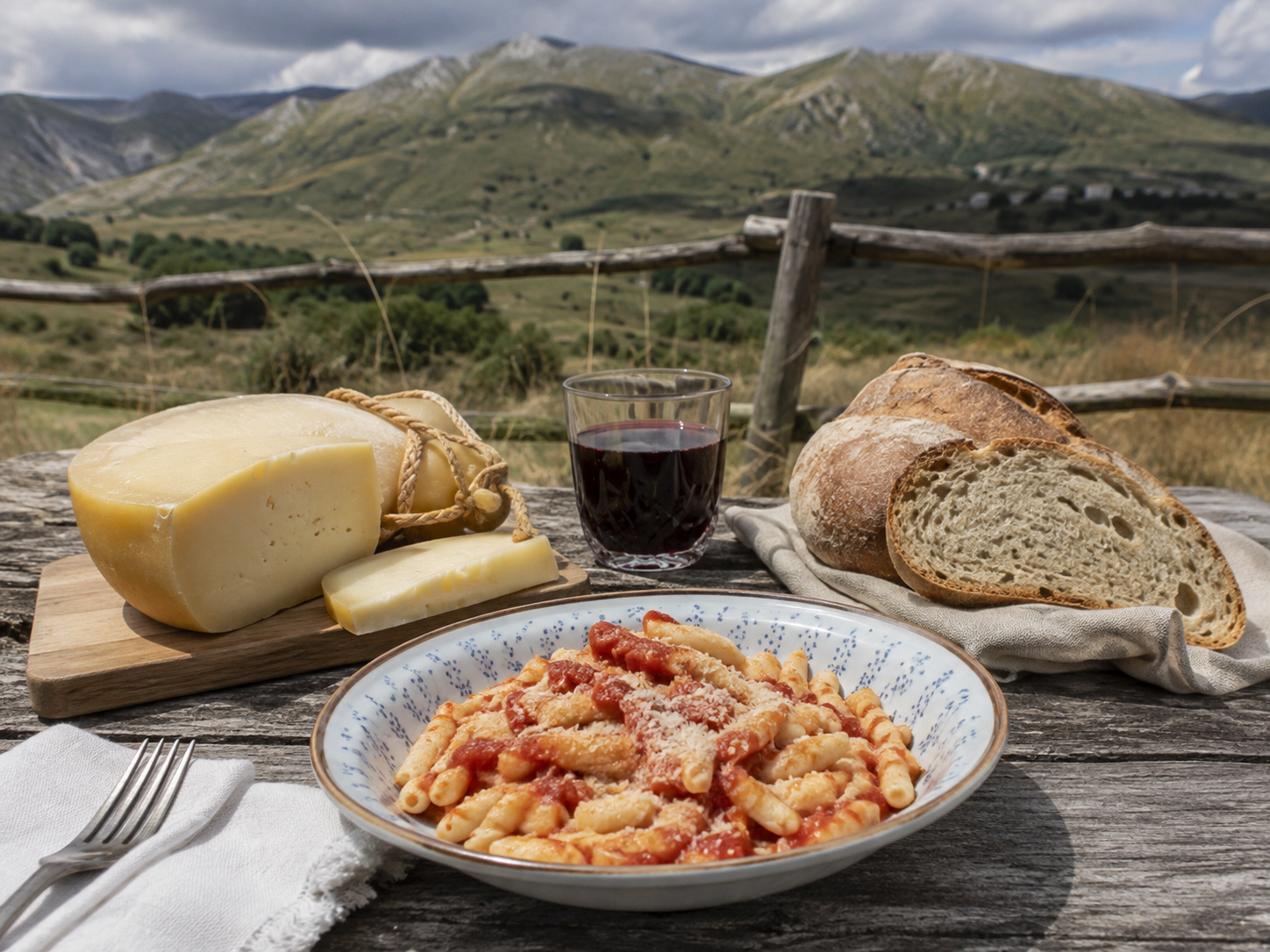
The pastoral history of the interior appears in cheeses such as caciocavallo and pecorino and in dishes based on lamb or sheep. In Capracotta, pezzata is traditionally made by slowly cooking sheep meat, a dish closely connected with pastoral life.
Handmade cavatelli are among the pasta shapes most strongly associated with Molise. Their small, hollowed form works with a wide range of sauces and appears throughout local cooking.
There are cured meats, legumes, mushrooms, truffles, local olive oil, and bread traditions that vary from one part of the region to another. Pampanella, associated particularly with San Martino in Pensilis, takes pork and seasons it heavily with red pepper before cooking.
Reach Termoli and fish naturally becomes much more prominent.
Wine has its own regional marker in Tintilia, a dark-skinned grape strongly associated with Molise and now protected through the Tintilia del Molise designation.
None of this needs to be declared the best cheese, pasta, pork, or wine in Italy.
It is more interesting to eat something and understand why it belongs where you are.
Traveling here takes a little more planning
Molise is not inaccessible, but exploring it properly is considerably easier with a car.
Termoli lies on the main Adriatic railway line, while Campobasso and Isernia have bus and rail connections to other parts of Italy. Public transportation can get you to the region and between some of its larger towns.
It becomes much less convenient when you want to combine places such as Pietrabbondante, Agnone, Scapoli, Sepino, Castel San Vincenzo, mountain walking areas, and smaller villages.
The distances may look modest on a map, but mountain roads change the calculation. A drive of relatively few kilometres can take much longer than expected.
A car also allows for the kind of unplanned stops that suit Molise well: a viewpoint, an almost empty archaeological site, lunch in a town you had not originally planned to visit, or a road that follows the landscape rather than the itinerary.
Accommodation outside the larger towns tends to be small-scale: B&Bs, agriturismi, independent hotels, and apartments rather than an extensive network of international chains.
English is certainly spoken, particularly by people working with visitors, but there is less reason for everyday life in small Molisan towns to operate in English than there is in Florence or central Rome. Even modest Italian can be useful when checking opening hours, speaking with a B&B owner, asking about a local dish, or figuring out where you are supposed to park.
Travelers who would like to prepare for those kinds of conversations can find Italian classes for adults at Polyglottist Language Academy, including courses focused on building practical speaking ability.
Molise rewards a slower kind of trip
Molise is probably not the right region for someone who wants famous monuments every hour, extensive nightlife, luxury resorts, or trains connecting every place worth seeing.
It works much better for travelers who enjoy driving, archaeology, hiking, small museums, local food, old crafts, and towns where the main activity may simply be sitting in the piazza in the evening.
Spring and autumn are especially appealing for exploring archaeological sites and the interior on foot. Summer brings more activity to Termoli and a fuller calendar of festivals in the villages. Winter can transform the mountain areas completely, with snow and a quieter tourism season.
A week here does not need fifteen stops.
A much better trip might combine the coast at Termoli with Sepino, the mountains around the Mainarde or Matese, Pietrabbondante, Agnone, and one or two smaller places chosen because something about them genuinely interests you.
Molise becomes less rewarding when approached as a hunt for attractions and more rewarding when there is enough time to notice why the attractions are where they are.
The old sheep tracks explain part of the countryside. The countryside helps explain the food. The mountain territory gives the Samnite sites a context. Agnone and Scapoli show what happens when particular kinds of knowledge survive within small communities. Sepino demonstrates how easily one historical period can settle directly on top of another.
Then, after all of that, the road eventually reaches the Adriatic.
The old joke says Molise does not exist. Its real distinction is almost the opposite: once you are there, layers of the place that have disappeared or become difficult to see elsewhere are still remarkably visible.
Molise is not a region where time stopped.
It is a region where time left a lot behind.