
The Portuguese language is a fascinating paradox: on paper, it looks unified, elegant, and global—spoken by more than 260 million people across four continents. But the moment you switch from a Lisbon news broadcast to a Brazilian telenovela, the illusion of uniformity shatters. The same sentence can sound like two completely different languages. One flows like music, every syllable pronounced with an open clarity that makes Brazilian Portuguese famous for its sensuality. The other, quick and clipped, drops vowels like a secret code, as if European Portuguese is whispering in your ear.
Why such stark differences? After all, both varieties share the same grammar, the same spelling system (mostly), and centuries of common history. The answer lies in time, geography, and cultural evolution. The Portuguese that crossed the Atlantic in the early 1500s didn’t stay frozen in time—it absorbed indigenous sounds, African rhythms, and later Italian melodic patterns through immigration. Meanwhile, in Portugal, speech continued to evolve under the influence of French-tinged aristocracy, contact with Spanish, and internal phonetic tendencies that favored contraction and vowel reduction.
The result? Two dominant standards—European Portuguese (EP) and Brazilian Portuguese (BP)—that are mutually intelligible in writing but diverge dramatically in speech. For language learners, these differences aren’t just curious trivia—they define your listening experience, your accent, and even the cultural identity you project.
In this guide, we’ll unpack the biggest pronunciation differences between Portugal and Brazil. We’ll explain what causes them, illustrate them with real examples, and give you tips to understand and speak confidently in either variety. Whether you dream of exploring Lisbon’s cobbled streets or dancing samba in Rio, this article will help you choose your path—and train your ear to appreciate both.
Why Pronunciation Differences Developed
To understand today’s accents, you need to understand yesterday’s history:
1. The Colonial Divide
When Portuguese navigators established Brazil as a colony in 1500, they brought a European language into a landscape dominated by indigenous tongues like Tupi-Guarani. Over three centuries, Portuguese in Brazil absorbed vocabulary, rhythms, and sounds from these languages—and later from millions of enslaved Africans who brought Bantu and Yoruba linguistic features.
2. Isolation and Internal Change
Atlantic separation meant minimal cross-pollination. Portugal’s elite speech shifted toward French-influenced pronunciation in the 18th century, accelerating vowel reduction and a “softer” articulation of consonants. Brazil, more open to Italian and German immigrants in the south, maintained wide-open vowels and a syllable-timed rhythm closer to Latin.
3. Cultural Influences
Brazil’s culture of music and performance—samba, bossa nova—reinforced a melodic intonation pattern. Portugal, shaped by Fado and centuries-old oratory traditions, developed a more reserved, compressed sound.
The 8 Biggest Pronunciation Differences
Below, we break down the contrasts with IPA, real examples, and tips.
1. Vowel Reduction vs. Full Pronunciation
European Portuguese: Unstressed vowels often reduce to a schwa [ɐ] or disappear.
pequeno → [pɨˈkenu] or even [p'kɨn].
estamos → [ʃˈtamʊʃ].
Brazilian Portuguese: All vowels pronounced clearly.
pequeno → [peˈkenu].
estamos → [isˈtamʊs].
Effect: EP sounds faster, harder for beginners; BP feels slower and more “open.”
2. The Letter R
EP: Strong guttural [ʁ] in word-initial and double-R.
Rua → [ʁu.ɐ].
BP: Regional variation: Rio uses guttural [ʁ], São Paulo uses softer [h], rural areas roll [r].
Rua → [hu.a] or [ʁu.a].
Tip: If you want to sound European, go throaty; for Brazil, lighten or aspirate.
3. S at the End of Syllables
EP: Often [ʃ].
dois → [doiʃ].
BP: Usually [s], except Rio ([ʃ]).
dois → [dois].
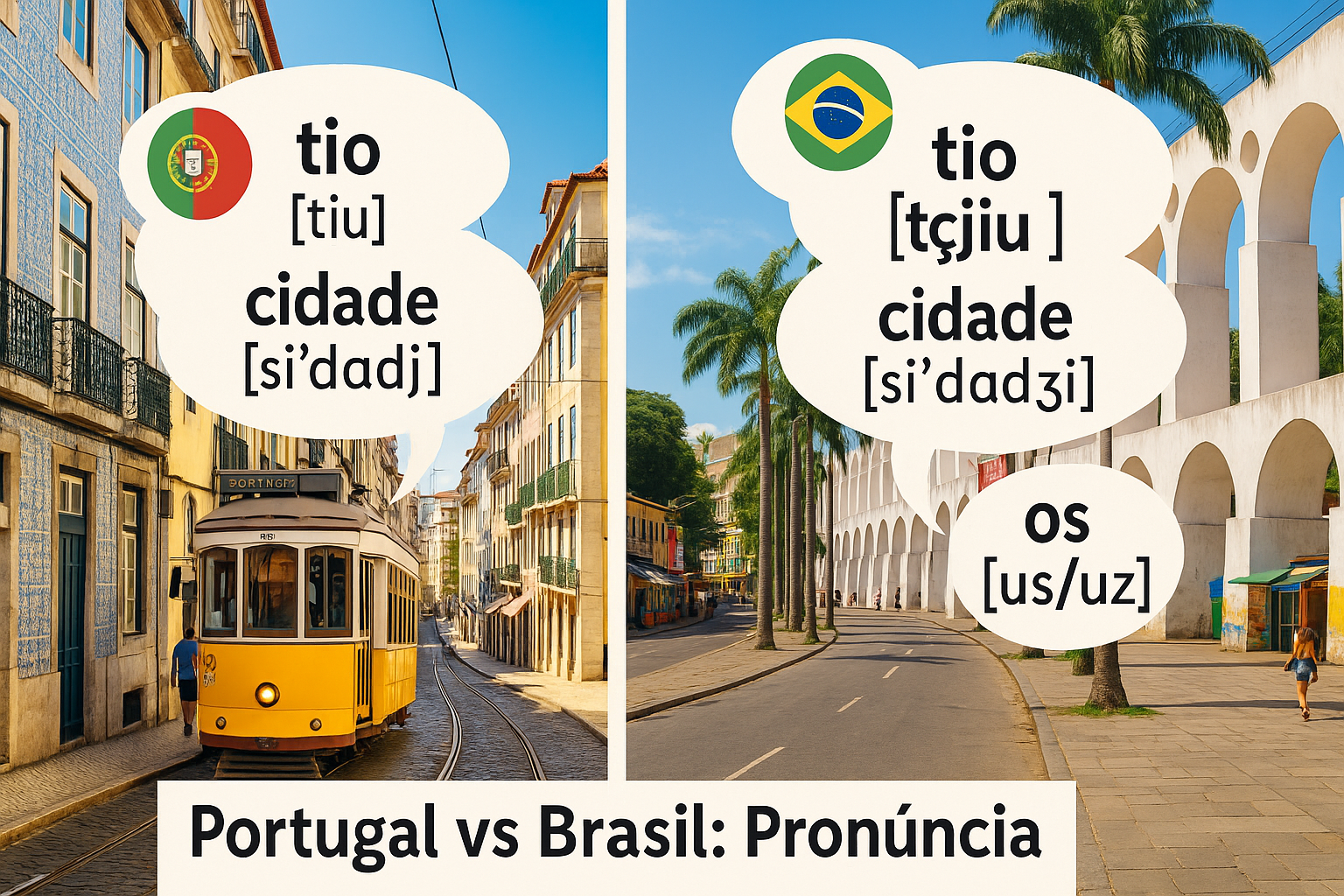
4. D and T Before “i”
BP: Palatalization creates a “che” or “jee” sound.
tio → [ˈtʃiu], dia → [ˈdʒia].
EP: Retains hard [ti], [di].
tio → [ˈtiu], dia → [ˈdiɐ].
Learner note: This single feature instantly signals “Brazilian.”
5. Unstressed E and O
EP: Often closes or drops:
telefone → [tlɨˈfɔn].
BP: Full sound:
telefone → [teleˈfoni].
6. Elision of Final Syllables
EP: Loves shortcuts:
está bem → [ʃtɐˈbẽj̃].
BP: Keeps clarity:
está bem → [isˈta bẽj̃].
7. Melody and Rhythm
EP: Stress-timed; compressed.
BP: Syllable-timed; musical, with wider pitch variation.
Cultural echo: Compare a Fado song to Bossa Nova—you’ll hear the language difference.
8. Nasalization
Both use nasal vowels, but BP tends to sustain them longer:
bom → [bõ] (BP drawn out, EP tighter).
How Brazilians and Portuguese Perceive Each Other
Brazilians often say EP sounds “closed” or “mumbled.”
Portuguese sometimes joke that BP sounds like “singing” or “slow.”
Reality: Both find each other clear after a week of listening. For learners, BP usually feels friendlier because of open vowels and syllable-timed rhythm.
Which Pronunciation Should You Learn?
Choose EP if: You plan to live in Portugal, work in Europe, or explore Lusophone Africa.
Choose BP if: Your business, travel, or cultural interests focus on Brazil (music, media, companies).
Ultimate goal: Learn one deeply, then train your ear for the other.
10 Tips to Train Your Ear and Accent
Pick one standard first. Avoid mixing early on.
Shadow native audio daily (repeat immediately after hearing).
Watch news anchors—they articulate clearly.
Listen to regional music (Fado vs. Bossa Nova).
Record yourself and compare to native speech.
Use IPA charts to map sounds.
Slow down podcasts—then speed them back up.
Practice minimal pairs (tio vs. dia in both accents).
Join conversation groups—exposure is everything.
Switch content weekly (Portugal TV vs. Brazilian YouTube).
Extended FAQs
1. Is European Portuguese harder to understand than Brazilian?
For most beginners, yes—due to vowel reduction and elision.
2. Which is more useful globally?
Brazilian Portuguese, given Brazil’s population and cultural export.
3. Are grammar differences big?
Pronunciation is the biggest gap; grammar differences exist but are manageable.
4. Will Portuguese people understand me if I speak Brazilian?
Yes—both standards are mutually intelligible.
5. Can I blend accents?
Try to keep one consistent style for clarity, then adapt later.
6. Do Africans speak like Portugal or Brazil?
Closer to Portugal, but with unique local phonetics.
7. Is spelling the same?
Mostly—thanks to the Orthographic Agreement (1990), with minor differences.
8. How long to master both?
After mastering one, 6–12 months of exposure is enough to adjust.
9. Which sounds more formal?
EP is perceived as more formal; BP more relaxed.
10. Will apps prepare me for EP pronunciation?
Most apps teach BP; supplement with RTP videos for EP.