
Why Portuguese Is Spoken in Nine Countries Around the World
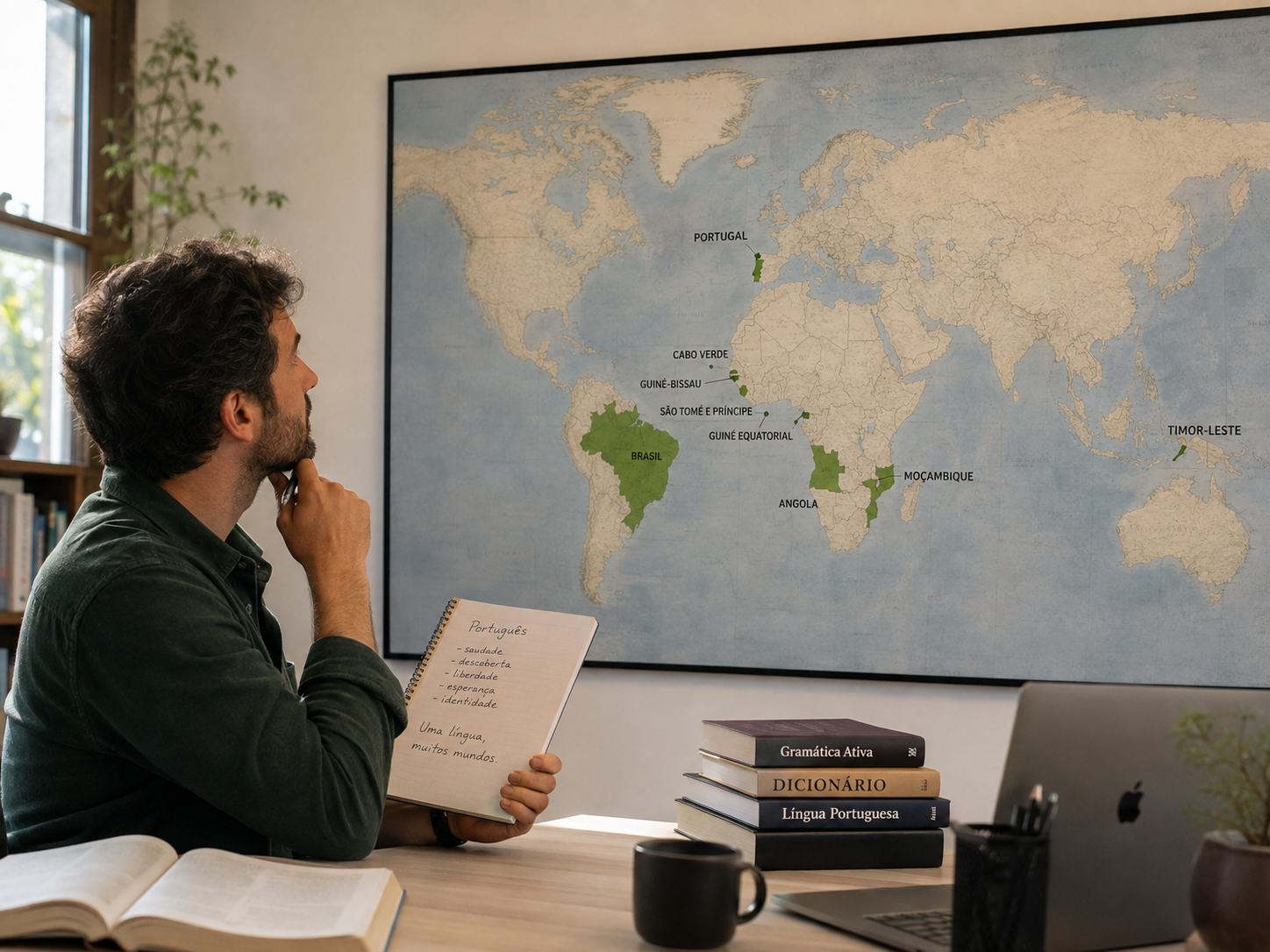
Look at the nine countries where Portuguese has official status, and the geography is rather strange.
Portugal sits on the western edge of Europe. Brazil occupies almost half of South America. Angola and Mozambique are on opposite sides of southern Africa. Cape Verde is an Atlantic archipelago off the coast of West Africa, while São Tomé and Príncipe lies in the Gulf of Guinea. Guinea-Bissau is farther north on the mainland. Timor-Leste is in Southeast Asia, close to Australia. Equatorial Guinea, meanwhile, has Portuguese as an official language even though Spanish has historically played a much larger role there.
The nine countries are Portugal, Brazil, Angola, Mozambique, Cape Verde, Guinea-Bissau, São Tomé and Príncipe, Timor-Leste, and Equatorial Guinea. They are also the nine member states of the Community of Portuguese Language Countries, or CPLP.
On a map, they look like fragments scattered across four continents. Portuguese maritime expansion explains how the language first reached these places, but it does not explain why it remained important in some of them, why it developed so differently from one country to another, or why people thousands of kilometers from Portugal eventually came to regard Portuguese as part of their own national and cultural life.
How Portuguese Left Portugal
Beginning in the fifteenth century, Portuguese ships established increasingly extensive routes along the coast of Africa and later across the Indian Ocean and into Asia. Portuguese merchants, missionaries, soldiers, administrators, settlers, and enslaved people moved through networks that eventually connected Europe, Africa, Brazil, India, and Southeast Asia.
Language traveled with them.
In some places, Portuguese remained largely a language of trade and coastal settlements. Elsewhere, Portuguese political control became deeper and lasted for centuries. Government administration, Christian missions, settlement, schooling, military power, forced labor, and slavery all played a role in spreading the language.
Portuguese did not arrive in empty linguistic spaces. Everywhere it went, people were already speaking other languages, often many of them. The consequences depended on local history. In some societies Portuguese gradually became dominant. In others it remained a language of administration or education alongside widely spoken local languages. Elsewhere, contact between Portuguese and African or Asian languages contributed to the development of Creole languages.
Portugal also controlled or maintained settlements in places where Portuguese never became the main language. Traces of it can still be found in parts of India and Asia, but those places did not become Portuguese-speaking countries in the same sense as Brazil, Angola, or Mozambique.
Brazil Changed the Scale of Portuguese
No country transformed the global position of Portuguese more than Brazil.
When the Portuguese arrived in 1500, the territory that became Brazil was already home to numerous Indigenous peoples speaking many different languages. Portuguese did not immediately become the language of everyday life everywhere. Indigenous languages remained important, and in parts of colonial Brazil, línguas gerais based largely on Tupi varieties were widely used for generations.
Portuguese expanded gradually through settlement, missionary activity, government administration, population movement, urbanization, and later formal education. This process took centuries rather than decades.
African languages were also fundamental to the formation of Brazilian society. Millions of enslaved Africans were forcibly transported to Brazil during the Atlantic slave trade, bringing languages from West and Central Africa into sustained contact with Portuguese. Their influence can still be seen in Brazilian vocabulary, religion, food, music, and many aspects of everyday culture.
Later immigration from Europe, the Middle East, and Asia added still more linguistic influences.
By the time Brazil became independent from Portugal in 1822, Portuguese was firmly established, although Brazil remained far more linguistically diverse than the phrase “Portuguese-speaking country” might suggest.
Brazil eventually became by far the largest Portuguese-speaking country in the world. As a result, many people outside the Portuguese-speaking world encounter Brazilian Portuguese before they ever hear European Portuguese, whether through music, television, social media, travel, or language-learning apps.
It also explains a question students ask surprisingly often: Why does Brazil speak Portuguese when almost every neighboring country speaks Spanish?
Brazil developed under Portuguese colonial rule, while most of the surrounding territory was colonized by Spain. By the time the countries of South America gained independence, these linguistic divisions had already been established over several centuries.
Portuguese in Africa Followed Several Different Paths
Five African countries inherited Portuguese as an official language after independence: Angola, Mozambique, Cape Verde, Guinea-Bissau, and São Tomé and Príncipe. Equatorial Guinea added Portuguese much later and has a very different linguistic history.
Even among the former Portuguese colonies, there is no single African Portuguese story.
Angola and Mozambique
Angola and Mozambique are especially interesting because Portuguese became more widely used in some contexts after independence, not only during colonial rule.
Both countries became independent from Portugal in 1975. Their populations spoke many African languages, but Portuguese was retained as the official language and continued to be used in government, education, national media, and other institutions.
For a multilingual state, there was a practical reason for this. Citizens in different parts of the country did not necessarily share the same mother tongue. Portuguese could function as a common language across regions without making one large indigenous language the official language of everyone else.
That did not make African languages less important.
In Angola, Portuguese exists alongside languages such as Umbundu, Kimbundu, and Kikongo. Mozambique has its own highly multilingual landscape, including languages such as Makhuwa, Sena, and Tsonga varieties, among many others. Which language people use may depend on region, family background, education, generation, and setting.
Portuguese also developed locally. The Portuguese heard in Luanda or Maputo is not simply Lisbon Portuguese spoken somewhere else. Pronunciation, vocabulary, rhythm, and patterns of everyday use have continued to evolve within Angolan and Mozambican society.
Cape Verde and Guinea-Bissau Complicate the Label “Portuguese-Speaking”
Cape Verde is a good example of why an official-language list does not necessarily tell you what language people use at home.
Portuguese is the country's official language, but Cape Verdean Creole, often called Kriolu, is central to everyday communication and cultural identity. It developed historically through contact between Portuguese and African languages.
Kriolu should not be understood as badly spoken Portuguese or simply as a Portuguese accent. It is a language with its own grammar, varieties, history, and literary and cultural traditions.
Guinea-Bissau has a somewhat comparable situation. Portuguese has official status, while Guinea-Bissau Creole, or Kriol, has long served as an important lingua franca among people from different linguistic communities.
A visitor can therefore arrive in a country officially classified as Portuguese-speaking and hear another language constantly in homes, markets, taxis, and conversations among friends.
São Tomé and Príncipe adds another variation to the picture. Portuguese is very prominent there today, but the islands also have their own Portuguese-based Creole languages that developed through centuries of contact between Europeans and Africans.
These countries make it difficult to talk about “the Portuguese-speaking world” as though Portuguese plays the same role everywhere.
Why Portuguese Remained After Independence
At first glance, it might seem surprising that countries emerging from Portuguese colonial rule would keep the language of the former colonial state.
In practice, replacing Portuguese was not necessarily simple.
Portuguese was already used in government, law, formal schooling, universities, newspapers, and international communication. In multilingual countries, it could also serve as a common language among citizens whose mother tongues were different.
That did not make the decision culturally neutral. Colonial languages carried enormous historical and political weight, and questions about schooling, social class, access to government, and the status of indigenous languages did not disappear with independence.
Once Portuguese was embedded in national institutions, however, it began serving purposes that had little to do with maintaining Portuguese political control. Writers produced national literatures in Portuguese. Journalists used it to discuss domestic politics. Governments used it to communicate across regions, and children learned it in the school systems of newly independent states.
The language had arrived through colonial rule, but its later development increasingly belonged to the societies that continued using it.
Timor-Leste: Portuguese in Southeast Asia
Timor-Leste is probably the most geographically surprising member of the Portuguese-speaking group.
Portugal ruled East Timor for centuries. After Portuguese withdrawal in 1975, Indonesia occupied the territory, and Indonesian became especially important among generations educated during that period.
When Timor-Leste regained independence in 2002, its constitution established Tetum and Portuguese as official languages.
Tetum occupies a particularly important place in everyday communication and national identity. Portuguese has historical and institutional significance and connects Timor-Leste with other Portuguese-speaking states.
The result is a multilingual society in which people may have very different relationships with Portuguese. Age and education matter. Someone educated during Indonesian rule may have a quite different linguistic background from someone who went through school after independence.
For language learners, Timor-Leste is a useful reminder that the expression “Portuguese-speaking country” does not mean that everyone speaks Portuguese at home or uses it equally often.
Equatorial Guinea Is a Very Different Case
Equatorial Guinea makes the list of nine particularly interesting because its connection with Portuguese is much more recent.
Unlike Angola or Mozambique, Equatorial Guinea was primarily a Spanish colony in the modern colonial period. Spanish remains the country's dominant European language, while indigenous languages are also widely used.
Portuguese was granted official status much later as Equatorial Guinea strengthened its relationship with Portuguese-speaking states. The country became a full member of the CPLP in 2014.
That official status should not be confused with widespread everyday use. Portuguese does not play the same social role in Equatorial Guinea that it does in Brazil, Portugal, Angola, or São Tomé and Príncipe.
A language can be legally official without being the first language, or even a regular daily language, for most of the population. Equatorial Guinea is perhaps the clearest example of that distinction among the nine countries.
And What About Macau?
Macau often appears in discussions of the Portuguese-speaking world because Portuguese remains an official language there alongside Chinese.
Its history explains why.
Macau was administered by Portugal for centuries before sovereignty was transferred to China in 1999. It is now a Special Administrative Region of the People's Republic of China.
Portuguese remains visible in government, law, street names, architecture, and certain institutions, but Cantonese is far more commonly heard in everyday life.
Macau therefore belongs to the wider history of Portuguese around the world, but it is not an independent country. That is why it does not make the total ten.
Portuguese Did Not Stay the Same Everywhere
The history becomes especially obvious once you start learning the language.
A student who has studied Brazilian Portuguese may arrive in Lisbon, read signs and menus without much difficulty, and then be surprised by how challenging ordinary conversation sounds.
The written varieties are highly mutually intelligible, but pronunciation and rhythm can differ considerably. European Portuguese often reduces unstressed vowels much more strongly than Brazilian Portuguese, which can make words sound compressed to learners accustomed to Brazilian speech.
Vocabulary differs too. A bus is usually an autocarro in Portugal and an ônibus in Brazil. A cell phone is a telemóvel in Portugal and a celular in Brazil. Ice cream is commonly gelado in Portugal and sorvete in Brazil.
Forms of address, pronoun use, object-pronoun placement, and some everyday grammatical patterns differ as well.
Teachers sometimes find that beginners expect Brazilian and European Portuguese to differ roughly as American and British English do. The surprise usually comes when listening. A learner may read both varieties reasonably comfortably while needing considerable time to adjust to fast conversation in the variety they have studied less.
And Portugal and Brazil are only the most internationally visible examples. Angola, Mozambique, Cape Verde, São Tomé and Príncipe, Guinea-Bissau, and Timor-Leste have their own accents, vocabulary, speech patterns, and relationships with the standard written language.
There is no reason to think of these varieties as imperfect attempts to reproduce the Portuguese of Lisbon.
The Places Portuguese Reached Also Changed the Language
Portuguese spread outward from Europe, but linguistic influence never moved in only one direction.
Brazilian Portuguese carries extensive vocabulary connected with Indigenous and African languages. Portuguese varieties in Africa have developed through continuous contact with local languages. In Cape Verde and Guinea-Bissau, Portuguese coexists with Creoles that emerged from earlier periods of language contact.
Food provides some obvious examples of how words can travel along with cultural practices, but the influence extends much further than individual loanwords. Pronunciation, rhythm, expressions, meanings, and conversational habits can all develop differently when a language is used for generations in a new linguistic environment.
The Portuguese spoken in Brazil did not develop entirely in Portugal and then get shipped across the Atlantic fully formed. Brazilian society created Brazilian Portuguese over centuries. Angolans, Mozambicans, Cape Verdeans, Timorese, and other communities have likewise shaped the varieties they use.
The result is a language that remains recognizably Portuguese across countries while sounding unmistakably local in each of them.
What Does This Mean If You Are Learning Portuguese?
Beginners do not need to learn nine varieties at once.
It usually makes much more sense to choose a primary model—most commonly Brazilian or European Portuguese—and develop a solid foundation in its pronunciation, grammar, listening, and everyday vocabulary.
Learning European Portuguese does not prevent you from communicating with Brazilians, and learning Brazilian Portuguese does not make Portugal inaccessible. They are varieties of the same language, and speakers encounter one another through travel, migration, media, music, literature, and family connections.
At higher levels, exposure to other varieties becomes much more useful.
Someone who has learned mainly Brazilian Portuguese may need time to become comfortable with spontaneous conversation in Lisbon. A learner trained entirely on European Portuguese may encounter unfamiliar Brazilian expressions or conversational patterns. Both may need another period of adjustment when listening to speakers from Angola or Mozambique.
This is normal. As listening skills develop, learners gradually become better at separating differences of accent and vocabulary from differences in meaning.
At Polyglottist Language Academy, we offer European Portuguese instruction for adults. Structured lessons can help learners develop pronunciation, grammar, listening, and conversation while understanding which features belong specifically to European Portuguese and which are shared more broadly across the language.
One Language, Nine Different Histories
The map of Portuguese-speaking countries still reflects the routes of a former empire. It explains why Portuguese appears in South America, on both sides of Africa, and more than 12,000 kilometers from Lisbon in Timor-Leste.
But a map of colonial expansion can only explain where the language went. It cannot show what happened to Portuguese after people in those places began using it for their own families, schools, literature, politics, music, media, and everyday lives.
That is why Portuguese sounds so different from Lisbon to Rio de Janeiro, Luanda, Maputo, Praia, and Dili. The language carried traces of Portugal with it, but it also absorbed the histories of the societies in which it took root.
The map still shows the route Portuguese traveled. The language spoken in those places today tells the much longer story of what happened after it arrived.