
Learning Tagalog in Vallejo: Classes and Resources for Adults
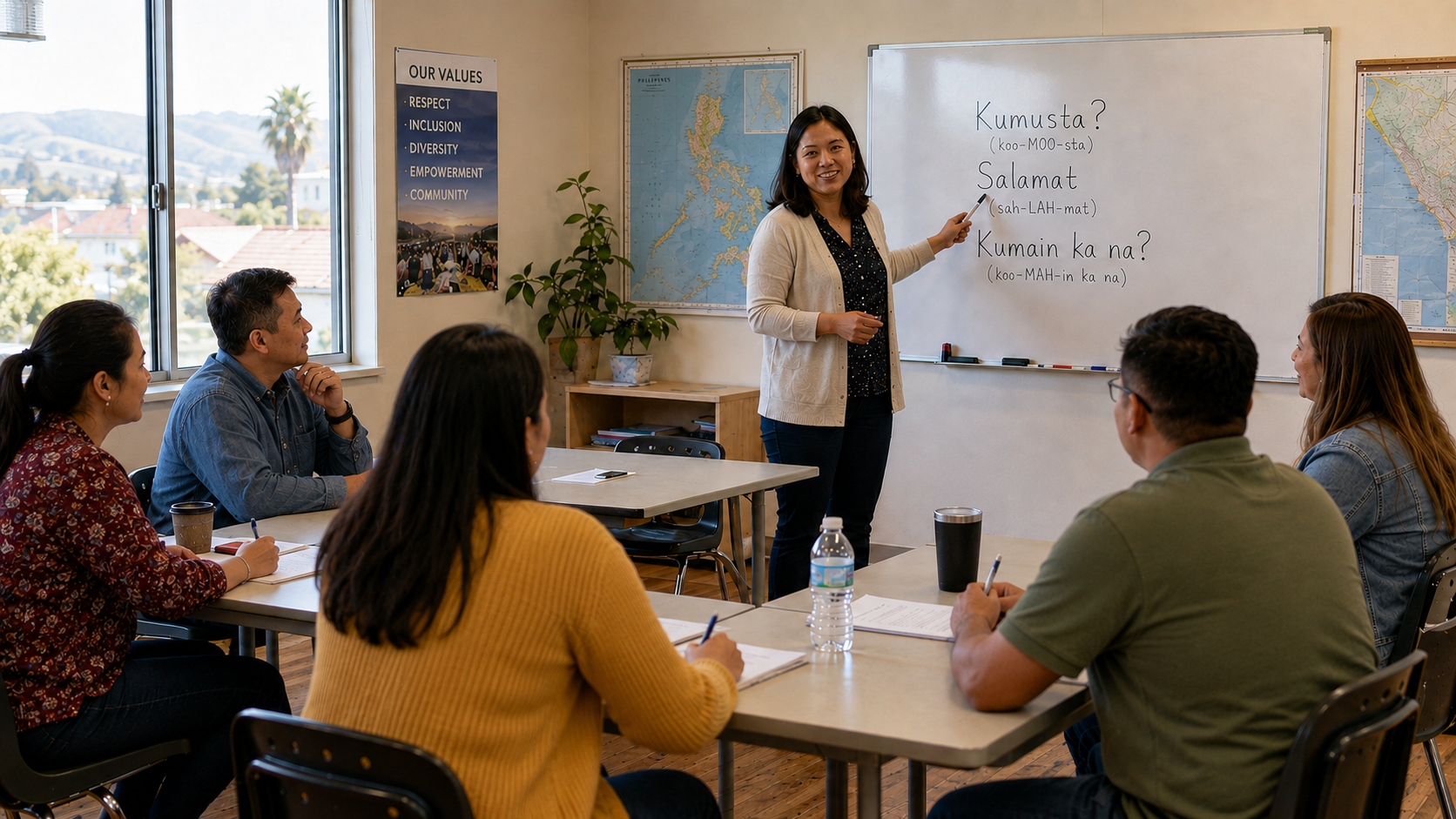
Vallejo is an interesting place to decide you want to learn Tagalog. Filipino culture is hardly hidden here. Filipino families have been part of the city for generations, community organizations are well established, and events such as Pista Sa Nayon make that history visible. But start looking for a weekly Tagalog class for adults and the choices narrow surprisingly quickly.
That creates a situation that is probably familiar to many people searching for Tagalog classes in Vallejo. The language feels locally relevant, yet finding somewhere to study it in a structured way takes more effort than expected.
The people doing that searching are also a mixed group. Some are complete beginners with Filipino spouses, partners, or friends. Some are preparing for travel or longer stays in the Philippines. Others grew up in Filipino American families and have heard Tagalog for most of their lives without ever becoming comfortable speaking it.
For all of them, Vallejo offers something useful: even when formal instruction has to happen online or outside the city, the language does not have to remain confined to a textbook or computer screen.
Why Tagalog feels particularly local in Vallejo
Vallejo's Filipino community has deep roots. Filipino immigrants were settling in the area by the early twentieth century, and Mare Island Naval Shipyard became an important source of employment for many Filipino families. The Filipino Community of Solano County was formally established in 1946 and remains active today.
That history still shows up in the city's cultural life. Filipino organizations, businesses, family networks, food, festivals, and community events are part of Vallejo in a way that makes learning Tagalog feel less abstract than it might in many other American cities.
There is an important qualification, though: Filipino does not automatically mean Tagalog-speaking.
The Philippines is highly multilingual. Families in Vallejo may have roots in Ilocano-, Cebuano-, Pangasinan-, Kapampangan-, Hiligaynon-, or other language-speaking communities. Some Filipino Americans speak Tagalog fluently, some understand only a little, and some grew up with another Philippine language instead.
You will also see both Tagalog and Filipino used when looking for courses. Filipino is the national language of the Philippines and developed primarily from Tagalog. In everyday language-learning contexts, however, schools and learners often use the two terms somewhat interchangeably.
For someone simply trying to find a class, searching under both names is worthwhile.
If you grew up hearing Tagalog, “beginner” may not describe you very well
Vallejo's large Filipino American community means that many prospective students are not starting from zero.
Perhaps your parents spoke Tagalog to each other but mostly English to you. Maybe your grandmother always spoke Tagalog and you answered her in English. You may understand a question like:
Kumain ka na?
Have you eaten?
without needing a translation.
You might recognize family terms, food vocabulary, familiar commands, jokes, or expressions almost instantly. Your pronunciation of words you have heard since childhood may sound very natural.
Then someone expects you to answer in Tagalog for more than a sentence or two, and everything slows down.
This is extremely common among heritage speakers. Years of listening can create strong comprehension without equally strong speaking ability. If everyone in the family understands your English response, there was never much practical pressure to search for the Tagalog words yourself.
That makes class placement tricky. A complete beginner class may contain a great deal you already know, while an intermediate course may assume grammar and active vocabulary you never formally learned.
Heritage learners should therefore look beyond the question “How much Tagalog do I understand?” It is worth thinking separately about how easily you can speak, understand unfamiliar speakers, construct sentences, read, and use grammar consistently.
Complete beginners have a different problem
For someone with no Tagalog background, the challenge is not retrieving language heard in childhood. It is getting used to a language that organizes information quite differently from English.
Verbs give beginners an early glimpse of this.
Take the root kain, connected with eating. As you progress, you encounter forms such as kumain, kumakain, and kakain. They are related, but Tagalog does not express verbal meaning by simply following the patterns an English speaker expects.
You can, of course, begin with useful expressions:
Kumusta? — How are you?
Salamat. — Thank you.
Kaunti lang. — Just a little.
That is a perfectly good way to start speaking. The problem comes when learning stops at memorized phrases.
At some point you need to understand enough of the system to create sentences you have never memorized before. This is where a structured beginner class becomes much more useful than accumulating vocabulary through an app or phrasebook.
Finding an actual adult Tagalog class in Vallejo
At the time of writing, a regularly scheduled in-person adult Tagalog course in Vallejo itself is difficult to verify through the city's obvious educational institutions.
That can be confusing because older information online suggests more options than the current schedules actually provide.
Solano Community College is a good example.
Older college catalogs list TAG 101: Conversational Tagalog and TAG 102: Conversational Tagalog. These were genuine courses covering basic conversation, pronunciation, vocabulary, sentence patterns, grammar, and Philippine culture.
But finding a course in an old catalog is not the same as finding one you can register for now.
The college's current language offerings focus on other languages, and a currently scheduled Tagalog course could not be verified when this article was researched. Anyone interested in studying there should check the live schedule rather than relying on older pages that still appear in Google searches.
Vallejo Adult School is another place someone might reasonably investigate. Its current programs include areas such as ESL, citizenship preparation, high school completion, basic education, digital literacy, and career training, but Tagalog is not among its listed language courses.
This does not mean local Tagalog classes will never appear again. Community college offerings in less commonly taught languages can come and go depending on instructors, demand, and semester schedules. Solano Community College is therefore worth checking periodically, particularly since it has taught the language in the past.
For someone who wants to begin now, however, waiting for the right local course may not be the most practical plan.
Why online Tagalog can make sense from Vallejo
“Online” sometimes sounds like the second-best solution to not having a nearby class. With Tagalog in the Bay Area, it can actually be the more sensible one.
A one-hour class in another city may require much more than an hour once Bay Area traffic, parking, and travel time are included. And because fewer schools offer Tagalog than Spanish, French, or Japanese, you may have little choice about where or when an in-person course meets.
A live online class removes the geographical problem without removing the teacher.
You still have a scheduled class, opportunities to ask questions, correction, conversation with other students, and material that progresses from week to week. That is quite different from working alone through prerecorded lessons.
Polyglottist Language Academy offers live online Tagalog instruction for adults, including group classes at different levels and individual lessons. For a Vallejo resident who wants regular instruction without commuting across the Bay Area, this can be a practical fit.
Heritage speakers should ask about placement rather than automatically choosing Complete Beginner. Someone who understands a great deal of Tagalog may need very different work from someone encountering the language for the first time.
What Vallejo can add to a language class
This is where living in Vallejo becomes an advantage.
Formal instruction can teach you why a sentence works, correct your pronunciation, and make you produce language rather than merely recognize it. Local Filipino cultural life gives all of that material somewhere to land.
One of Vallejo's best-known examples is Pista Sa Nayon, a long-running celebration of Filipino culture. The festival has included performances, food, vendors, parades, exhibits, and community organizations. Its 2026 theme, kwentuhan, drew on a Tagalog word associated with storytelling and conversation.
For a beginner, an event like this can produce small but satisfying moments of recognition. A word on a sign suddenly looks familiar. A phrase you practiced in class appears in a different setting. Food vocabulary stops being an abstract list because you already know the dishes.
A heritage learner gets something slightly different. Hearing Tagalog outside the voices of parents and grandparents can reveal how dependent comprehension sometimes becomes on familiar speakers. Someone who follows a grandmother easily may discover that another Tagalog speaker requires much more concentration.
None of this turns a festival into an immersion course. Much of the conversation at a Filipino American event in California will naturally be in English, and attendees may speak many different Philippine languages. That is fine. The value is in giving the language a wider context.
The Filipino Community of Solano County is worth knowing
The Filipino Community of Solano County has been part of local community life since 1946 and operates from its center on Amador Street in Vallejo. Its activities include cultural, educational, social, and community programs.
It is not, based on the current information available, a regular adult Tagalog language school. It is still a useful organization for a learner to know about.
Language becomes easier to understand when you also understand some of the community in which it is used. Events and cultural programs can expose learners to names, traditions, history, food, music, and ways of speaking that do not appear in a beginner textbook.
There is also a basic matter of etiquette here. A large Filipino community does not mean that every Filipino person you meet has volunteered to help you practice Tagalog. A restaurant employee or someone attending a community event is not automatically a free conversation tutor.
If relationships develop naturally and someone is happy to speak Tagalog with you, that is different. Those exchanges can become some of the most useful practice you get.
Don't overlook the library
Solano County Library has added Filipino and Tagalog materials to its collections and has hosted Filipino cultural programming, including Tagalog-related events.
Some programming is designed for children, including bilingual storytimes. That may not sound relevant to an adult learner at first, but simple bilingual books can actually be useful when your reading ability is well below your listening ability.
This happens frequently with heritage speakers. Someone may understand spoken Tagalog at home yet have done almost no reading in the language.
For complete beginners, simpler texts also give you a chance to encounter the same words repeatedly in context instead of trying to work through material that is far beyond your level.
Library collections can therefore complement a class even when the library itself is not offering adult Tagalog lessons.
Work on the Tagalog you actually want to use
The most useful practice depends heavily on why you are learning.
Someone studying Tagalog because of a spouse has a different vocabulary priority from someone preparing to spend several months in Manila. A Filipino American trying to speak more with grandparents has yet another set of needs.
For heritage learners especially, it helps to notice where your family Tagalog ends.
You may know a surprising amount about food, relatives, household routines, and family gatherings but have almost no vocabulary for your profession, healthcare, hobbies, finances, or the details of your adult life.
Those gaps are worth targeting deliberately.
Try explaining what you do at work in Tagalog. Tell someone what happened during your day. Describe a trip. Give an opinion about a film. If you keep switching to English at the same points, you have found vocabulary that is actually useful to learn.
Relatives can be enormously helpful here, especially if you ask specific questions:
“How would you say this naturally?”
“Would you actually use this word?”
“Does this sound too formal?”
Just remember that speaking a language and teaching its grammar are different skills. A relative may know immediately that something sounds wrong without being able to explain why. That is one reason family practice and formal instruction complement each other so well.
For complete beginners, the equivalent is to move beyond isolated words as soon as possible. Learn phrases, certainly, but keep asking how the pieces fit together. The goal is eventually to say something you were never specifically taught to memorize.
The useful combination Vallejo offers
A learner in Vallejo is in an slightly unusual position.
There may not be a convenient in-person Tagalog class running five minutes from home. At the same time, Filipino culture has been part of Vallejo for generations, and there are local organizations, events, families, foods, and community histories that give the language an immediate context.
That makes a mixed approach particularly sensible: use a structured class to learn the language itself, then pay attention to the Tagalog you encounter around you.
Eventually you start noticing things that would once have passed by unnoticed: a familiar word at a community event, the structure inside an expression a relative has used for years, or a sentence you suddenly realize you can answer in Tagalog instead of English.
In Vallejo, the language may not always be easy to find in a classroom. Outside the classroom, however, it is considerably closer than it first appears.