
Where to Learn Tagalog in San Francisco: A Guide for Adults
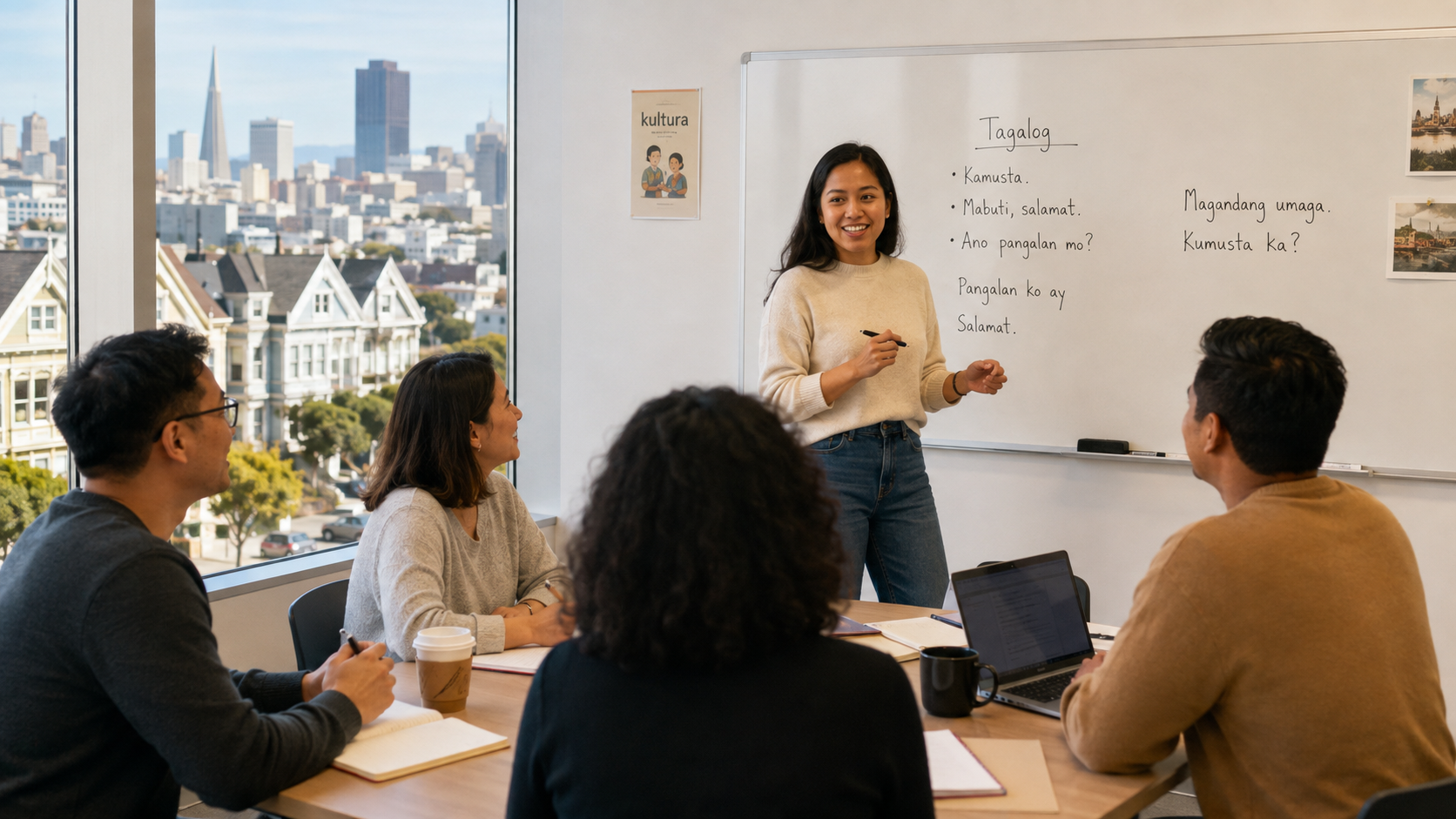
You may already know more Tagalog than you think.
Maybe you grew up hearing it at family gatherings. You know when someone is joking, you recognize salamat, kumusta, and sige, and you can usually tell when your relatives are talking about food, plans, or somebody’s love life.
But when someone turns to you and says something directly in Tagalog, you answer in English.
That gap—between understanding pieces of a language and being able to use it—is one of the most common reasons adults decide to study Tagalog.
For others, the motivation is completely different. Maybe your partner is Filipino. Maybe you are planning a trip to the Philippines. Maybe you live in San Francisco or elsewhere in the Bay Area and simply want to learn a language that is present in the communities around you.
Whatever the reason, the question is not only where to learn Tagalog in San Francisco.
It is also what kind of class will actually help you speak, how to choose the right level, and whether an in-person or online course makes more sense for your life.
You May Know More Tagalog Than You Think
Adults often underestimate what they already know.
Heritage learners especially may arrive in class saying, “I don’t speak Tagalog,” and then recognize dozens of words, understand basic commands, follow parts of a conversation, or know exactly when their relatives are teasing them.
That is real knowledge.
But it is different from being able to build sentences confidently.
Someone who grew up hearing Tagalog may have strong listening comprehension but weak grammar. Another learner may know family vocabulary very well but struggle with verb forms. Someone else may understand ordinary speech but be unable to read or write comfortably.
This is why heritage learners do not always fit neatly into the same beginner categories as students who are encountering Tagalog for the first time.
A good course should take that into account.
If you are choosing among Tagalog classes in San Francisco or online, do not describe your level only by saying, “My family speaks it,” or “I took a class years ago.”
Instead, think about what you can actually do.
Can you understand a basic conversation?
Can you introduce yourself?
Can you talk about your family?
Can you form your own sentences?
Do you know how common verb patterns work?
Can you ask and answer questions without switching immediately to English?
Those answers are much more useful than the label “beginner.”
Tagalog or Filipino: Which Class Should You Look For?
One of the first things new learners notice is that some courses are called Tagalog classes, while others use the term Filipino.
For practical purposes, these labels often overlap.
Tagalog is the language that forms the main basis of Filipino, the national language of the Philippines. Filipino has developed as a broader national language and incorporates vocabulary and usage from other Philippine languages as well as English, Spanish, and other sources.
For adult learners choosing a course, the distinction is usually less complicated than it initially sounds.
A class marketed as Tagalog will typically teach the grammatical and conversational foundation you need for everyday communication. A class labeled Filipino may cover essentially the same core language, depending on the program.
The more important question is not the title of the course.
It is what the course teaches.
Does it focus on useful spoken language?
Does it explain grammar clearly?
Will you practice listening?
Will you actually speak?
Those questions matter far more than whether the course page says Tagalog or Filipino.
The Best Tagalog Class Is Not Necessarily the Closest One
If you live in San Francisco, it is easy to start by searching for something within a few neighborhoods.
That makes sense.
But location can be deceptive.
A class that looks close on a map may still be difficult to reach at 6:00 p.m. after work. If you are coming from Daly City, Oakland, Berkeley, South San Francisco, San Mateo, or elsewhere in the Bay Area, a one-hour lesson can turn into a much larger evening commitment.
Commuting is not a small detail.
Consistency matters more in language learning than most people realize.
A very good class that you miss every few weeks because traffic, BART delays, work, or family obligations make attendance difficult may not help you as much as a slightly less convenient-looking course that fits your schedule reliably.
This is one reason live online Tagalog classes can work particularly well for adults.
You still have a teacher.
You still have classmates.
You still practice speaking.
But you do not have to cross San Francisco or the Bay Bridge to do it.
Online or In Person? Think About Your Real Week
There is no correct answer here.
Some adults genuinely learn better in person.
They like having somewhere to go. They focus more easily in a physical classroom. They enjoy chatting with classmates before and after class.
Others prefer online instruction because it fits into an already crowded schedule.
In-person classes may be a good choice if:
you concentrate better away from home
you enjoy face-to-face interaction
you like having a weekly routine outside your home or workplace
you live close enough to the class to attend consistently
you prefer physical textbooks, boards, and classroom activities
Live online classes may be a better fit if:
commuting is difficult
you live outside central San Francisco
your workday ends close to class time
you travel often
you prefer to study from home
you want access to a class that is not available in your neighborhood
The key is whether the class is live and interactive.
Watching prerecorded videos is not the same thing as sitting in a small online group where the instructor asks you questions, corrects your pronunciation, and expects you to respond in Tagalog.
For speaking-focused language study, interaction is what matters.
Understanding Your Family Is Not the Same as Speaking
This is worth emphasizing because it affects a lot of heritage learners.
Passive understanding can create a strange illusion.
You hear Tagalog and understand the topic.
You know what your mother is asking.
You recognize whether your aunt is complaining or joking.
Then someone says, “Okay, answer me in Tagalog.”
And suddenly nothing comes out.
That is normal.
Comprehension and production are different skills.
If most of your exposure happened at home, you may have spent years listening without needing to form complex sentences yourself.
A structured class can help convert that passive knowledge into active use.
This may involve filling in grammatical gaps you never consciously learned.
It may also mean practicing common situations over and over until they stop feeling awkward.
Talking about your family.
Describing what you did yesterday.
Saying what you like.
Asking where someone is going.
Explaining what you want to eat.
These sound simple, but the ability to produce even basic sentences quickly is what begins turning knowledge into conversation.
Tagalog Grammar May Surprise You
English speakers sometimes assume that Tagalog will be easy because the alphabet is familiar and pronunciation is relatively approachable.
Then the verbs arrive.
Tagalog grammar is not built around exactly the same patterns English speakers are used to.
The language uses markers and verb forms that can shift the focus of a sentence. The same basic idea may be expressed differently depending on what the speaker is emphasizing.
This can feel confusing at first.
Students often want a direct one-to-one rule:
“This word means this.”
“This ending always means that.”
Tagalog does not always cooperate.
That does not mean the language is impossibly difficult.
It means students benefit from learning patterns in context rather than memorizing large grammatical charts without using them.
A good instructor should be able to explain why a form is being used and then give students enough practice that it starts to feel natural.
Grammar becomes much less intimidating when it helps you say something you actually want to say.
A Small Class Gives You Somewhere to Actually Speak
One of the most important things to consider when comparing Tagalog lessons is class size.
Imagine two one-hour courses.
One has five students.
The other has twenty-five.
Those are completely different learning experiences.
In a smaller group, you have more opportunities to answer, ask questions, make mistakes, and receive feedback.
And language learning requires mistakes.
You cannot learn to speak Tagalog by waiting until every sentence is perfect before opening your mouth.
A smaller group also makes it easier for the instructor to notice patterns.
Maybe you consistently use the wrong marker.
Maybe your pronunciation of a particular sound needs attention.
Maybe you understand the grammar but hesitate every time you need to form a sentence.
These things are easier to catch in a small class.
When evaluating Tagalog classes for adults, ask how much time students actually spend speaking.
That matters more than a long list of course features.
What Should a Good Adult Tagalog Class Feel Like?
Adults deserve more than a classroom designed like high school.
A good course should be structured without feeling rigid.
It should include grammar, but not endless grammar lectures.
It should give students opportunities to speak, but not put them under so much pressure that they stop wanting to participate.
Ideally, a class should combine:
clear explanations
regular speaking practice
pronunciation correction
listening exercises
useful vocabulary
grammar in context
interaction with classmates
review of earlier material
manageable homework
opportunities to ask questions
There should also be a certain emotional atmosphere.
Adults are used to being competent.
They know how to work, manage families, solve problems, and communicate.
Then they start learning a new language and suddenly need fifteen seconds to say something as simple as, “My brother lives in California.”
That can feel surprisingly uncomfortable.
A good instructor makes it safe to be temporarily clumsy.
That matters.
What Do Beginners Actually Learn?
A complete beginner Tagalog course should not assume that you already know how the language works.
Early topics may include:
greetings
introductions
pronunciation
numbers
family
basic questions
likes and dislikes
everyday activities
food
places
simple descriptions
common verb patterns
markers
polite expressions
But these topics should not be taught as isolated vocabulary lists.
The goal is to start building usable language.
For example, a beginner may first learn to say their name and where they live.
Then they may learn to talk about their family.
Then about work.
Then preferences.
Then everyday activities.
Gradually, these small areas begin connecting.
A learner who could only say salamat and kumusta at the beginning may eventually be able to have a short but real exchange.
That progress is more meaningful than memorizing hundreds of disconnected words.
Speaking Early Matters More Than Speaking Perfectly
Some adults delay speaking because they want to “learn more first.”
They study vocabulary.
They read about grammar.
They watch videos.
They tell themselves that once they know enough, they will start talking.
The problem is that speaking is not simply the final product of studying.
It is a skill in itself.
You have to practice retrieving words quickly.
You have to practice hearing questions.
You have to get used to forming sentences in real time.
You also need to discover what you cannot yet say.
A beginner does not need to have a sophisticated conversation.
Speaking practice may mean:
“Where do you live?”
“What do you like to eat?”
“Do you have siblings?”
“What are you doing this weekend?”
These are simple exchanges.
But each one forces you to move from recognition to production.
That is where confidence begins.
Heritage Learners Need a Different Kind of Honesty
Heritage learners sometimes feel embarrassed about taking a beginner class.
They may think they “should” already know the language.
That is not a useful way to think about it.
Language knowledge is not inherited automatically.
If you heard Tagalog growing up but were educated primarily in English, your skills may be uneven.
You may understand far more than a typical beginner but know less formal grammar.
You may pronounce words naturally but struggle to construct sentences.
You may know vocabulary connected to family and food but not work, travel, or abstract topics.
That does not mean you need to start from zero.
It means placement should reflect your actual skills.
A good school should be able to look at your background and recommend the most appropriate level.
Sometimes the answer is a regular beginner class.
Sometimes it is a higher level.
Sometimes private lessons make more sense because your strengths and weaknesses are too uneven for a standard group.
The right answer depends on what you can do, not what you think you were supposed to learn as a child.
Private Lessons or Group Classes?
Private lessons offer flexibility.
The instructor can move at your pace, focus on specific goals, and spend more time on your weak areas.
This can be especially useful if:
you are a heritage learner with uneven skills
you need Tagalog for a specific trip
your schedule changes constantly
you want to focus heavily on conversation
you are preparing for a family event
you need targeted pronunciation or grammar work
But private instruction is usually more expensive.
And it lacks one of the useful features of a group class: other learners.
In a small group, you hear different people speak.
You learn from their questions.
You practice understanding someone other than the teacher.
You discover that everyone makes mistakes.
For many adults, a small group offers the best balance of structure, affordability, and interaction.
Culture Is Part of the Language
Tagalog is not simply a collection of vocabulary and grammar rules.
Some expressions make more sense when you understand how people actually use them.
Take po and opo.
Beginners often learn that these are polite expressions used to show respect.
That is true.
But the important part is understanding when they appear naturally in conversation, especially when speaking to elders or in more respectful situations.
The same is true of forms of address.
Family relationships.
Humor.
Greetings.
Even food.
A learner who begins speaking with Filipino relatives may quickly realize that knowing the literal meaning of a sentence is not always enough.
Tone matters.
Relationships matter.
Context matters.
This is one reason cultural knowledge belongs inside language instruction rather than being treated as an occasional trivia section.
It helps you understand why people speak the way they do.
The Bay Area Is a Natural Place to Hear Tagalog
Adults learning Tagalog in San Francisco have one advantage that is easy to overlook: the language is not abstract.
You may hear it in restaurants, shops, family gatherings, community events, or conversations around the Bay Area.
That does not replace structured study.
But it creates opportunities.
Once you begin learning, familiar sounds start becoming recognizable.
A word you heard dozens of times suddenly makes sense.
Then another.
Then a phrase.
This changes the experience of studying.
The language stops living only in a textbook.
It begins appearing around you.
That kind of exposure can be especially motivating because it gives learners frequent reminders that the language is alive and socially connected.
How Long Does It Take to Learn Tagalog?
There is no honest universal timeline.
Someone who hears Tagalog regularly at home may progress very differently from someone who has no previous exposure.
A person who studies twenty minutes most days may retain more than someone who attends class but never reviews.
A learner who speaks with family members between lessons may develop confidence more quickly than someone who only uses the language once per week.
Your goals also matter.
Being able to greet relatives, introduce yourself, and follow basic family conversations is one level of achievement.
Holding a comfortable conversation about everyday life is another.
Understanding jokes, films, and fast natural speech is another.
Language learning is not one finish line.
It is a sequence of increasingly useful abilities.
The best approach is to look for steady progress rather than a dramatic moment when you suddenly become “fluent.”
If You Want to Learn Tagalog in San Francisco, Start With Fit
Before choosing a course, ask yourself a few practical questions.
What do I already know?
What do I want to be able to do?
How often can I realistically attend?
Do I prefer online or in person?
Do I want conversation, structure, or both?
Would I be comfortable in a group?
Do I need a complete beginner class, or do I already have some foundation?
These questions are more useful than simply searching for the nearest option.
The best course is the one that fits your actual level and your actual life.
Learning Tagalog From San Francisco Does Not Require Crossing the City
At Polyglottist Language Academy, we offer live small-group Tagalog classes online for adults.
For students in San Francisco, Daly City, Oakland, Berkeley, the Peninsula, and elsewhere in the Bay Area, online instruction can remove the commuting problem while preserving the most important part of language learning: live interaction.
Students meet with an instructor.
They speak.
They listen.
They ask questions.
They practice with classmates.
The format works especially well for adults who want structure but cannot realistically spend additional time traveling to and from a classroom every week.
It is not the right format for everyone.
But for many Bay Area learners, it makes consistency much easier.
And consistency is what eventually changes a language from something you recognize into something you can actually use.
Explore Tagalog classes at Polyglottist Language Academy
One Conversation at a Time
At first, Tagalog may exist only in fragments.
A word from childhood.
A phrase your grandmother uses.
Something your partner says to a relative on the phone.
A song lyric you recognize but do not fully understand.
Then the fragments begin connecting.
You understand why a sentence is formed a certain way.
You answer a question without switching to English.
You notice a polite expression.
You understand a joke before anyone explains it.
For some learners, that moment happens in a classroom.
For others, it happens at dinner with family.
Or in a restaurant.
Or during a trip to the Philippines.
The important part is that the language starts becoming yours—not necessarily in the same way it belongs to someone who grew up speaking it, but in a way that lets you participate more fully.
That is what learning Tagalog can gradually change.
It can turn sounds you have heard for years into meaning, and meaning into conversation.
Frequently Asked Questions About Tagalog Classes in San Francisco
Where can adults learn Tagalog in San Francisco?
Adults can study Tagalog through language schools, private instructors, community programs, university courses, and live online classes.
When comparing options, consider level placement, class size, speaking opportunities, instructor experience, schedule, and whether the format fits your commute and weekly routine.
Are there Tagalog classes for complete beginners?
Yes.
A complete beginner class should assume no prior knowledge and introduce pronunciation, basic vocabulary, sentence structure, common questions, everyday expressions, and introductory grammar.
If you already understand some Tagalog or grew up hearing it, ask whether a beginner or higher-level class would be a better fit.
Are Tagalog and Filipino the same language?
Tagalog forms the main linguistic basis of Filipino, the national language of the Philippines.
In practical language-learning contexts, courses labeled Tagalog and Filipino often teach very similar core material.
The course content and teaching quality matter more than the label alone.
Can I take Tagalog classes online from San Francisco?
Yes.
Live online classes can be particularly convenient for San Francisco and Bay Area adults because they remove commuting while still allowing students to interact with an instructor and classmates.
Look for live instruction rather than a purely self-paced course if speaking practice is important to you.
Is Tagalog difficult for English speakers?
Some parts of Tagalog may feel accessible to English speakers, including the familiar alphabet and many loanwords.
Other aspects, especially verb forms, markers, and sentence focus, can take time to understand.
The language becomes more manageable when grammar is taught gradually and practiced in real sentences.
Should heritage learners take beginner Tagalog?
Sometimes.
A heritage learner may understand a great deal but have limited speaking or grammar skills.
Another may already be far beyond a beginner level.
The best choice depends on what you can actually understand, say, read, and write.
If possible, describe your abilities to the instructor or school before enrolling.
Are private Tagalog lessons better than group classes?
Not necessarily.
Private lessons offer flexibility and personalized attention.
Small-group classes provide interaction with other learners and are usually more affordable.
For many adults, a small group is a good balance between individual feedback and conversation practice.