
A student in Japan is about to take an entrance exam.
A friend gives them a KitKat.
That may sound like an ordinary snack until someone explains that the Japanese pronunciation, Kitto Katto, resembles kitto katsu, “you will surely win.”
Suddenly the candy bar is not just candy.
Japan has a long tradition of lucky objects, unlucky numbers, protective charms, seasonal customs, and small superstitions that sit somewhere between belief, habit, humor, and culture.
Not everyone takes them seriously.
Many Japanese people who would firmly say they are not superstitious still avoid giving gifts in sets of four, buy an omamori before an exam, check a fortune at a shrine, or make sure a hospital room does not have an unfortunate number.
That is part of what makes Japanese superstition interesting.
Belief does not have to be absolute to influence behavior.
Here are ten Japanese superstitions and lucky charms that are still genuinely present in everyday life.
1. The number four is unlucky because it sounds like death
The number four can be pronounced:
四
shi
The problem is that shi also means:
死
death
That homophone has made four one of Japan's best-known unlucky numbers.
You may sometimes notice buildings, hospitals, or apartment complexes avoiding room number 4.
A hospital might skip from room 3 to room 5.
Gift sets may avoid groups of four.
The number itself is not forbidden, of course. Japanese people use four constantly.
It also has another common pronunciation:
yon
which avoids the direct association with death.
That is why learners often hear:
yon
rather than shi in ordinary counting.
Is everyone afraid of the number four?
No.
Most Japanese people are not frightened every time they see the number.
It is more accurate to think of four as culturally inauspicious.
Certain situations make the association more noticeable, especially hospitals, funerals, gifts, and other contexts where death or misfortune already feels close.
The English-speaking world has something similar with 13.
Many people insist they are not superstitious and still notice when a hotel has no 13th floor.
2. Nine can be unlucky too
Four gets most of the international attention, but nine has its own problem.
Nine can be pronounced:
九
ku
The sound ku is associated with:
苦
suffering, hardship, pain
For that reason, nine can also carry an unlucky association.
Again, this does not mean the number is treated as inherently dangerous.
The effect is strongest in contexts where symbolic wording matters.
Hospitals and medical settings may be especially sensitive to numbers such as four and nine.
A gift involving nine items may also feel inappropriate in certain situations.
The broader principle is important for Japanese learners: pronunciation can create cultural meaning that is invisible in translation.
To an English speaker, 4 and “death” have nothing in common.
To a Japanese speaker, the sound connection is immediate.
3. Never stick chopsticks upright in rice
This is one of the few Japanese superstitions visitors really should remember.
During ordinary meals, chopsticks should not be placed vertically into a bowl of rice.
The arrangement resembles rice offered in connection with Buddhist funeral rites.
Because of that association, it carries a strong funerary feeling.
If you need to put your chopsticks down, use the chopstick rest if one is available or place them neatly beside your dish.
This is not merely an obscure piece of etiquette.
Many Japanese people would immediately notice upright chopsticks in rice and find the sight uncomfortable.
The rule makes more sense once the cultural association is known.
Without that context, it appears arbitrary.
4. Do not pass food from chopsticks to chopsticks
Another chopstick taboo has the same funerary origin.
It is considered inappropriate to pass a piece of food directly from one person's chopsticks to another person's chopsticks.
Why?
After cremation in Japan, family members traditionally participate in transferring fragments of bone using chopsticks.
Passing food in the same manner therefore evokes funeral ritual.
If you want to give someone food, place it on their plate instead.
For travelers, this is more than a trivia fact.
It is an example of how Japanese table etiquette can contain cultural meanings that are impossible to infer merely by watching the physical action.
5. Hiding your thumbs near a hearse may protect your parents
This is one of the stranger childhood superstitions still remembered by many Japanese people.
If a hearse or funeral procession passes by, children may be told to hide their thumbs inside their fists.
Why the thumbs?
The Japanese word for thumb is:
親指
oyayubi
Literally, something like “parent finger.”
Because oya means parent, the thumb became symbolically connected with one's parents.
The superstition says that hiding the thumbs protects one's parents from death.
Some versions warn that if a child does not hide their thumbs when a hearse passes, they may not be able to be present at their parents' deathbed.
It is difficult to imagine many adults interpreting this literally.
But as a childhood habit, it has been surprisingly persistent.
People may laugh while doing it.
That does not make the custom culturally meaningless.
Superstitions often survive precisely because they are easy to follow “just in case.”
6. Cutting your nails at night can bring bad luck
A traditional Japanese warning says:
夜に爪を切るな
Yoru ni tsume o kiru na
“Don't cut your nails at night.”
There are several explanations attached to this superstition.
One old saying warns that cutting one's nails at night means:
親の死に目に会えない
oya no shinime ni aenai
that you will not be present when your parents die.
The original practical reason may have been much less mystical.
Before electric lighting, trimming nails at night using blades or other tools was simply more dangerous.
A practical warning can easily acquire a supernatural explanation over generations.
Many Japanese people today cut their nails whenever convenient.
Still, the superstition remains culturally familiar.
This is common with old beliefs everywhere: the behavior disappears more slowly than the explanation.
7. Teru teru bōzu are used to wish for good weather
A small white figure hanging near a window can look slightly ghostlike to someone seeing it for the first time.
It is called:
てるてる坊主
teru teru bōzu
A teru teru bōzu is a handmade charm traditionally used to wish for sunny weather.
Children often make them from tissue paper or cloth before:
school trips
sports days
festivals
picnics
outdoor events
They are hung near windows in the hope that rain will stay away.
The phrase is associated with the verb:
照る
teru
meaning to shine, as in sunlight.
The bōzu part can refer to a Buddhist monk or a bald-headed figure.
Despite the slightly eerie appearance, teru teru bōzu are generally cute rather than frightening in modern Japanese culture.
They appear in children's songs, anime, decorations, and popular imagery.
And yes, people still make them.
Whether anyone believes a tissue-paper doll can control a weather system is almost beside the point.
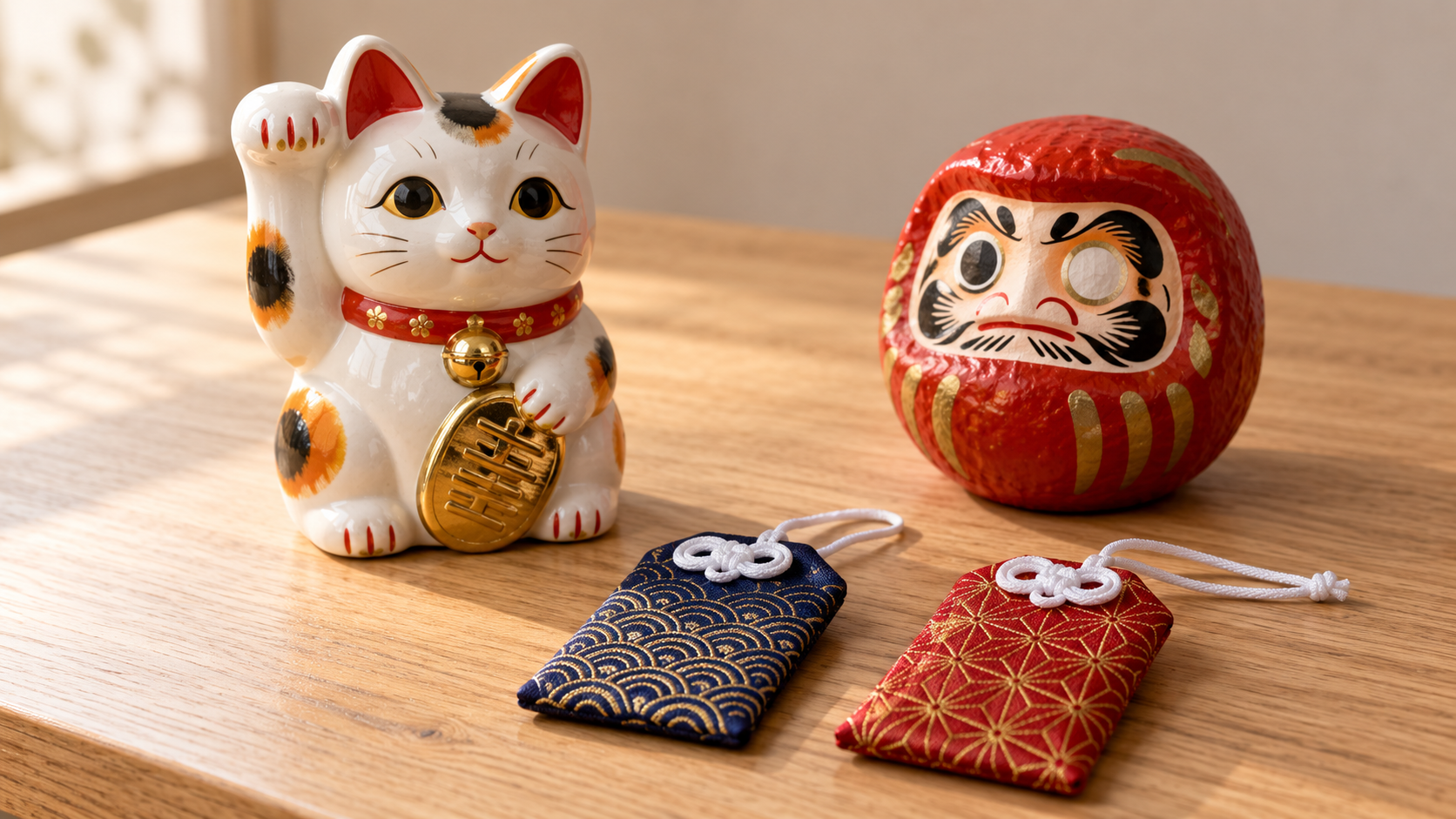
8. Omamori are protective charms for specific problems
One of the most visible forms of Japanese good-luck culture is the:
お守り
omamori
These small protective charms are sold at Shinto shrines and Buddhist temples.
They usually consist of a small cloth pouch containing a sacred object, prayer, or inscription.
Different omamori are associated with different kinds of protection or good fortune.
Common types include charms for:
交通安全
kōtsū anzen
traffic safety
学業成就
gakugyō jōju
academic success
合格祈願
gōkaku kigan
success in examinations
健康
kenkō
health
安産
anzan
safe childbirth
縁結び
enmusubi
romantic relationships or good connections
People attach them to bags, backpacks, cars, wallets, and pencil cases.
Students may carry exam-related omamori during entrance-exam season.
Drivers may keep traffic-safety charms in their vehicles.
Travelers visiting Japan sometimes buy omamori as souvenirs, but within Japan they remain part of ordinary religious and cultural practice.
Should you open an omamori?
Traditionally, no.
The pouch itself is meant to remain closed.
Opening it is sometimes said to release or weaken its protective power.
Even people who do not interpret this literally generally leave the charm intact.
A closed omamori also preserves a little mystery, which is probably part of the appeal.
9. Omikuji fortunes can be tied away if they are bad
At many shrines and temples, visitors can draw a paper fortune called:
おみくじ
omikuji
The fortune may predict luck in areas such as:
health
love
work
travel
money
study
Results range from extremely lucky to distinctly less encouraging.
One famous category is:
大吉
daikichi
“great blessing” or “excellent luck.”
At the opposite end is:
凶
kyō
bad luck.
What happens if you draw an unpleasant fortune?
Traditionally, people may tie it to a designated rack, tree branch, or other place at the shrine or temple rather than taking it home.
The idea is that the bad fortune can be left behind.
Good fortunes may be taken home.
Practices vary, and modern shrines often provide specific places where visitors can tie their omikuji.
This is another Japanese custom where the border between belief and recreation is wonderfully unclear.
A person may laugh at an unlucky prediction and still tie it up before leaving.
10. Maneki-neko invite good fortune and customers
The waving cat may be the most internationally recognizable Japanese lucky charm.
It is called:
招き猫
maneki-neko
literally:
“beckoning cat.”
The raised paw is not actually waving goodbye.
The Japanese beckoning gesture is performed with the palm facing downward and the fingers curling toward oneself.
A maneki-neko therefore appears to be calling luck, customers, or prosperity inward.
You will often see them in:
restaurants
shops
bars
businesses
homes
Different paws can carry different associations.
A raised left paw is often said to attract customers.
A raised right paw is commonly associated with money or good fortune.
There are regional and commercial variations, so these interpretations are not completely fixed.
Color may also matter.
White is common.
Gold is associated with wealth.
Black cats may be used for protection.
Red can be linked with health or protection from illness.
Modern maneki-neko range from traditional ceramic figures to battery-powered plastic cats waving continuously in storefront windows.
The cultural idea has survived technological improvement.
Bonus: KitKats became exam-season lucky charms because of a pun
This is not an ancient superstition.
That is what makes it especially interesting.
The Japanese pronunciation of KitKat is:
キットカット
Kitto Katto
This resembles:
きっと勝つ
kitto katsu
“you will surely win.”
Because of that wordplay, KitKats became associated with encouragement and success, particularly during school entrance-exam season.
Students may receive them from friends, family, or teachers.
The association became strong enough to be used commercially, but it works because Japanese culture already has a rich tradition of word-based good luck.
This kind of pun is called:
語呂合わせ
goroawase
a play on sounds, especially numbers and words.
Lucky language does not have to be ancient to become culturally real.
Sometimes a chocolate company only needs the right pronunciation.
Lucky numbers work through wordplay too
Japanese number symbolism is not limited to unlucky four and nine.
Numbers can become lucky when their pronunciations resemble positive words.
For example:
5 and 9
can sometimes be read together as gōkaku, resembling:
合格
gōkaku
“passing an exam.”
Sound-based associations appear constantly in Japanese advertising, phone numbers, dates, gifts, and popular culture.
Japanese learners often initially find this confusing because numbers have multiple possible readings.
Eventually, the flexibility becomes fun.
Once a language allows several ways to pronounce a number, the opportunities for puns multiply quickly.
Daruma dolls: make a wish, then add the second eye
Another important lucky object is the:
だるま
daruma
Daruma dolls are round, usually red figures modeled on Bodhidharma, the monk traditionally associated with the founding of Zen Buddhism.
Many are sold with blank white eyes.
When making a goal or wish, the owner fills in one eye.
When the goal is achieved, the second eye is filled in.
The daruma therefore becomes less a passive lucky charm than a physical reminder of commitment.
Common goals include:
passing an exam
winning an election
growing a business
achieving a personal objective
The doll's weighted shape also causes it to return upright when pushed over.
That characteristic is associated with the saying:
七転び八起き
nanakorobi yaoki
“Fall seven times, get up eight.”
This is one of the reasons daruma are symbols not only of luck, but of persistence.
Ema: write your wish where the gods can read it
At Shinto shrines, visitors often encounter rows of small wooden plaques.
These are:
絵馬
ema
People write wishes or prayers on them and hang them at the shrine.
The request might involve:
passing an entrance exam
finding a partner
having a healthy baby
recovering from illness
succeeding at work
traveling safely
At shrines popular with students, rows of ema before examination season can be especially striking.
Some messages are careful and formal.
Others are extremely specific.
“Please let me pass the University of Tokyo entrance exam.”
“Please let us get married.”
“Please let my dog recover.”
Religious practice becomes suddenly personal when the wishes are readable.
Why exam season produces so many lucky objects
Japanese entrance examinations can carry enormous emotional weight.
A student's performance may influence which high school or university they enter.
As a result, exam season has accumulated its own culture of luck.
Students may receive:
exam-success omamori
KitKats
daruma dolls
lucky stationery
foods with encouraging names
This is not because students believe studying is unnecessary if the charm is strong enough.
The charm works alongside preparation.
That distinction appears in many Japanese superstitions.
Luck is not necessarily a substitute for effort.
It is something one would prefer to have in addition to effort.
Why words matter so much in Japanese superstition
Several Japanese superstitions make little sense until you hear the language.
Four is unlucky because shi sounds like death.
Nine is unlucky because ku suggests suffering.
KitKats become lucky because kitto katsu sounds like “surely win.”
This reflects the importance of wordplay and homophones in Japanese.
The language contains relatively few possible syllable combinations compared with English, which produces many words that sound alike or nearly alike.
That makes sound symbolism unusually productive.
It also means translation can erase the joke completely.
A learner reading “four is unlucky” receives a fact.
A learner who knows that both four and death can be pronounced shi understands why the association exists.
That is a much more memorable kind of knowledge.
Do Japanese people really believe these things?
This question is harder than it appears.
What does “believe” mean?
Does someone genuinely think cutting their nails at night will cause a parent's death?
Probably not, in most cases.
Would the same person avoid giving a hospital patient four flowers?
Quite possibly.
Would they buy an omamori before an important exam?
Maybe.
Would they check an omikuji at New Year?
Very possibly.
Superstition often operates without full literal belief.
People participate because:
“It can't hurt.”
“It is tradition.”
“My grandmother always said that.”
“Everyone does it.”
“I don't really believe it, but why take the chance?”
That logic is hardly unique to Japan.
People all over the world knock on wood, avoid walking under ladders, carry lucky objects, make wishes before blowing out candles, and notice Friday the 13th.
Human beings are perfectly capable of skepticism and superstition at the same time.
Religion and superstition overlap in complicated ways
Japanese lucky charms are often connected with Shinto shrines and Buddhist temples.
That does not necessarily mean the people buying them identify strongly with a formal religion.
Japan is often described as relatively secular, yet shrine visits, Buddhist funerals, New Year's prayers, omamori, ancestor rituals, and seasonal observances remain deeply embedded in cultural life.
Western categories can make this confusing.
A person may say they are “not religious” and still visit a shrine to pray for exam success.
That is not necessarily experienced as contradictory.
Religious practice, family tradition, seasonal custom, and superstition overlap much more fluidly than a simple believer/nonbeliever distinction suggests.
Superstitions change, but they rarely disappear completely
Some old beliefs fade.
Others become children's customs.
Some survive mainly as etiquette.
Some become commercial.
And occasionally new lucky traditions appear.
The KitKat exam association is a perfect example.
Nothing about it is ancient.
Yet it fits neatly into an older Japanese habit of connecting sounds, objects, and fortune.
That flexibility is probably why superstition survives so well.
It does not have to remain unchanged to remain culturally meaningful.
At Polyglottist Language Academy, our Japanese classes for adults connect vocabulary and grammar with the cultural assumptions that make everyday Japanese easier to understand. Polyglottist offers live online Japanese classes and selected in-person classes in Berkeley, California.
Learning that shi can mean both “four” and “death” takes a few seconds.
Noticing why a hospital skips room four, why someone chooses yon instead, or why a gift set contains five items rather than four is where that vocabulary becomes part of culture.
Frequently asked questions about Japanese superstitions
Why is the number four unlucky in Japan?
One pronunciation of four is shi, which sounds identical to the Japanese word shi, meaning “death.” Because of that association, four can be avoided in hospitals, gifts, and other sensitive contexts.
Is nine unlucky in Japan too?
Yes, sometimes. One pronunciation of nine is ku, which can evoke 苦, meaning suffering or hardship.
Why shouldn't you put chopsticks upright in rice?
The arrangement resembles rice used in Buddhist funeral rituals, so it has a strong association with death and is avoided during ordinary meals.
What is an omamori?
An omamori is a protective charm sold at Shinto shrines and Buddhist temples. Different charms may be associated with health, travel safety, academic success, relationships, childbirth, and other goals.
What should you do with a bad omikuji fortune?
A common practice is to tie it to a designated place at the shrine or temple, symbolically leaving the bad fortune behind.
Why are KitKats considered lucky in Japan?
The Japanese pronunciation Kitto Katto resembles kitto katsu, meaning roughly “you will surely win.” This made KitKats popular as encouragement gifts, especially before school entrance exams.
Do Japanese people really believe in these superstitions?
Belief varies enormously. Some people take certain customs seriously, while others participate out of habit, tradition, humor, or a feeling that there is no harm in doing so.