
Why Italians Talk With Their Hands—and What Each Gesture Means
Introduction: Talking Without Words—The Italian Art of Hand Gestures
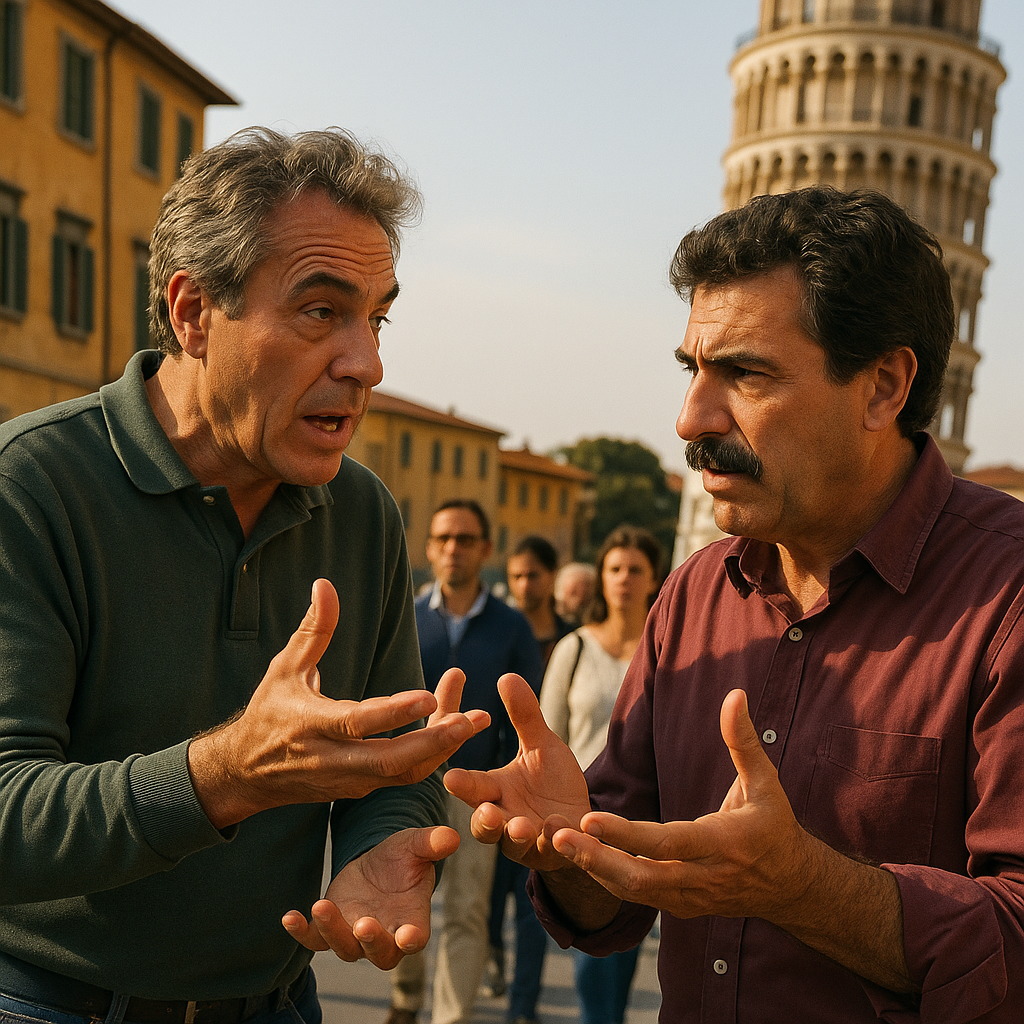
If you've ever strolled through an Italian piazza, lingered at a family dinner in Rome, or simply watched two friends argue joyfully over espresso, you’ve likely seen it: a graceful blur of fingers, palms, and arms moving through the air in perfect rhythm with spoken words.
In Italy, the hands speak just as loudly as the mouth—sometimes louder. A simple “I don’t know” becomes a flick of the fingers under the chin. Disbelief is expressed with a dramatic forehead slap. And when an Italian pinches all five fingertips together and shakes their hand, you know they’re not just asking “What are you doing?”—they’re making a point, demanding clarity, expressing frustration, or even poking fun, all at once.
To outsiders, it might look chaotic. To Italians, it’s second nature. In fact, Italy’s hand gestures form a kind of non-verbal dialect, a rich and time-honored tradition that reflects the country’s history, humor, and intensity.
But here’s the best part: you don’t have to be born Italian to understand it. With a bit of curiosity and practice, you can learn to interpret these gestures—and even use them to sound and feel more Italian yourself.
In this article, we’ll explore why Italians are so famously expressive with their hands, what common gestures mean, how to read them in context, and how this unspoken language complements spoken Italian. Whether you're learning the language, planning a trip, or simply fascinated by human communication, you'll come away seeing Italian conversations in a whole new way.
Part I: Why Do Italians Use So Many Gestures?
1. Cultural Tradition
Gesturing is deeply woven into the fabric of Italian communication. Some theories date it back to ancient Rome, where orators used dramatic hand motions to command crowds. Others point to Italy's history of diverse dialects and foreign occupations—where gestures became a kind of lingua franca when words failed.
2. A Need for Emphasis
Italians are passionate speakers. When words alone aren’t enough to express an emotion, gesture steps in. It’s a way to underline meaning, convey tone, and inject color into conversation.
3. Expressiveness Is Valued
Italian culture celebrates theatricality, emotion, and storytelling. Using gestures is part of that expressive toolkit—it shows engagement, personality, and charm.
4. Conversation = Performance
In Italy, talking isn’t just about exchanging facts. It’s often a performance—complete with rhythm, volume shifts, and dramatic pauses. Gestures are part of that stagecraft.
Part II: 15 Common Italian Hand Gestures—And What They Really Mean
Here are some of the most widely used Italian hand gestures and how to understand (or use!) them in real life.
1. “Ma che vuoi?” – The Classic Pinched Fingers
How: All five fingertips touch, palm up, moved up and down quickly.
Meaning: “What do you want?” / “What are you talking about?” / “Seriously?!”
Tone: Frustration, disbelief, or exasperation.
This is the iconic Italian gesture—often misunderstood as aggressive, but really it’s a dramatic way of asking for clarity.
2. “Non lo so” – I Don’t Know
How: Chin is flicked outward with fingers, often while shrugging.
Meaning: “I don’t know” / “Who knows?”
Tone: Casual, indifferent, or sarcastic.
Often paired with “Boh!” (an informal version of “I dunno”).
3. “Perfetto” – Perfect
How: Thumb and index finger make a small circle, other fingers extended.
Meaning: “Perfect!” / “Just right!”
Tone: Approval, satisfaction.
Often used after tasting good food or when something goes exactly to plan.
4. “Vai via” – Go Away!
How: Sweep hand outward, palm facing the other person.
Meaning: “Go away!” / “Leave me alone!”
Tone: Annoyance, dismissal.
Use with caution. It can be strong depending on facial expression.
5. “Mamma mia” – I Can’t Believe It!
How: Open palm to forehead, like a theatrical facepalm.
Meaning: Shock, disbelief, exasperation.
Tone: Varies. Could be humorous or serious.
It’s drama in a single gesture.
6. “Ti prego” – Please, I’m Begging You
How: Hands clasped together as in prayer.
Meaning: “Please!” / “I’m begging you.”
Tone: Imploring, emotional.
Often used by kids and adults alike when asking for favors.
7. “Così così” – So-so
How: Rock hand side to side, palm down.
Meaning: “So-so” / “It’s okay.”
Tone: Mildly positive or neutral.
🎬 Think of it like giving a film a 3/5.
8. “Furbo” – Clever or Sneaky
How: Tap your cheek with the index finger.
Meaning: “Smart cookie” / “Sneaky, clever.”
Tone: Either admiration or sarcasm.
Used to describe someone crafty—sometimes in a sketchy way.
9. “Andiamo!” – Let’s Go!
How: Arm bent, palm up, hand moving upward in short jerks.
Meaning: “Come on!” / “Let’s go!”
Tone: Urging, energizing.
🏃 Often used when trying to get someone to hurry up.
10. “Mi rompi” – You’re Bothering Me
How: Fingers spread, hand shaken as if wiping off water.
Meaning: “You’re annoying me!” / “Stop it!”
Tone: Annoyed or dismissive.
This one says, “Enough already.”
11. “Chiamami” – Call Me
How: Pinky and thumb out, hand tilted toward the face like a phone.
Meaning: “Call me.”
Tone: Flirty or friendly.
📞 Universally understood thanks to phones—but still very Italian in delivery.
12. “Un attimo” – Just a Moment
How: Index finger held up and wagged slowly.
Meaning: “One second” / “Hold on.”
Tone: Gentle or impatient, depending on speed and expression.
⏳ Great when you’re on the phone or trying to finish something.
13. “Tutto a posto” – Everything’s Good
How: Hand in a flat circle, palm up, gently bobbing.
Meaning: “All good” / “Everything’s fine.”
Tone: Reassuring or calming.
Often used with a smile to smooth over tension.
14. “Ci vediamo” – See You Later
How: Index and middle finger point at your eyes, then toward the person.
Meaning: “I’ll see you” / “Watch out!”
Tone: Friendly or warning, depending on face and tone.
👀 Use with humor or playful threat.
15. “In bocca al lupo” – Good Luck (Literally, “Into the Wolf’s Mouth!”)
How: Fist to the mouth or a mock bite.
Meaning: “Good luck!”
Tone: Encouraging.
To which you respond: “Crepi il lupo!” (“May the wolf die!”)
Part III: How to Use Gestures Without Overdoing It
You don’t need to master every gesture overnight. Start small:
Watch and imitate when appropriate.
Match gestures with tone and conversation.
Avoid using gestures out of cultural context or mockery.
Pair gestures with language—use them to reinforce meaning.
Pro Tip: Facial expressions are key. A gesture with the wrong face won’t land the same.
FAQs: Understanding Italian Hand Gestures
Q: Are Italian gestures universal across Italy?
Mostly—but some regions have unique expressions or variations. Naples and Sicily, for example, are particularly expressive.
Q: Can non-Italians use these gestures?
Yes, but with respect and care. Avoid caricature. Using them sincerely can help you blend in and communicate better.
Q: Do Italians gesture when speaking other languages?
Often, yes! It’s more about cultural expression than language.
Q: Are gestures used more by men or women?
Both! Expressiveness transcends gender in Italy. Everyone gestures—some more dramatically than others.
Q: What’s the best way to learn these?
Observe Italians speaking in real life or in films. Try mimicking with friends or during language practice.
Q: Can gestures replace spoken words?
Sometimes, yes! A flick of the fingers or a shrug can say more than a sentence.
Q: Do gestures have different meanings in other cultures?
Absolutely. Be careful—some gestures may be offensive elsewhere. Always learn the cultural context.
Want to Learn the Language and the Body Language?
At Polyglottist Language Academy, we believe language learning should go beyond vocabulary drills and grammar charts. That’s why our Italian classes include real-life conversation, cultural insights, and yes—even the occasional lesson on hand gestures!
We offer small online and in-person Italian classes (3–6 students) that help you speak confidently and understand the nuances of real Italian communication.
👉 Join us today and bring your Italian to life—hands included.
Explore More of Our Language & Culture Articles:
Using “Piacere” Correctly In Italian (It’s Not Just ‘To Like’)
Aperitivo, Passeggiata & More: Everyday Italian Culture Through Language
From Opera To Espresso: Explore Italian With Classes In Oakland
Grammar Hacks To Learn Italian Faster (With Fewer Flashcards)
How To Ask Questions In Italian: Grammar, Tone, And Intuition