
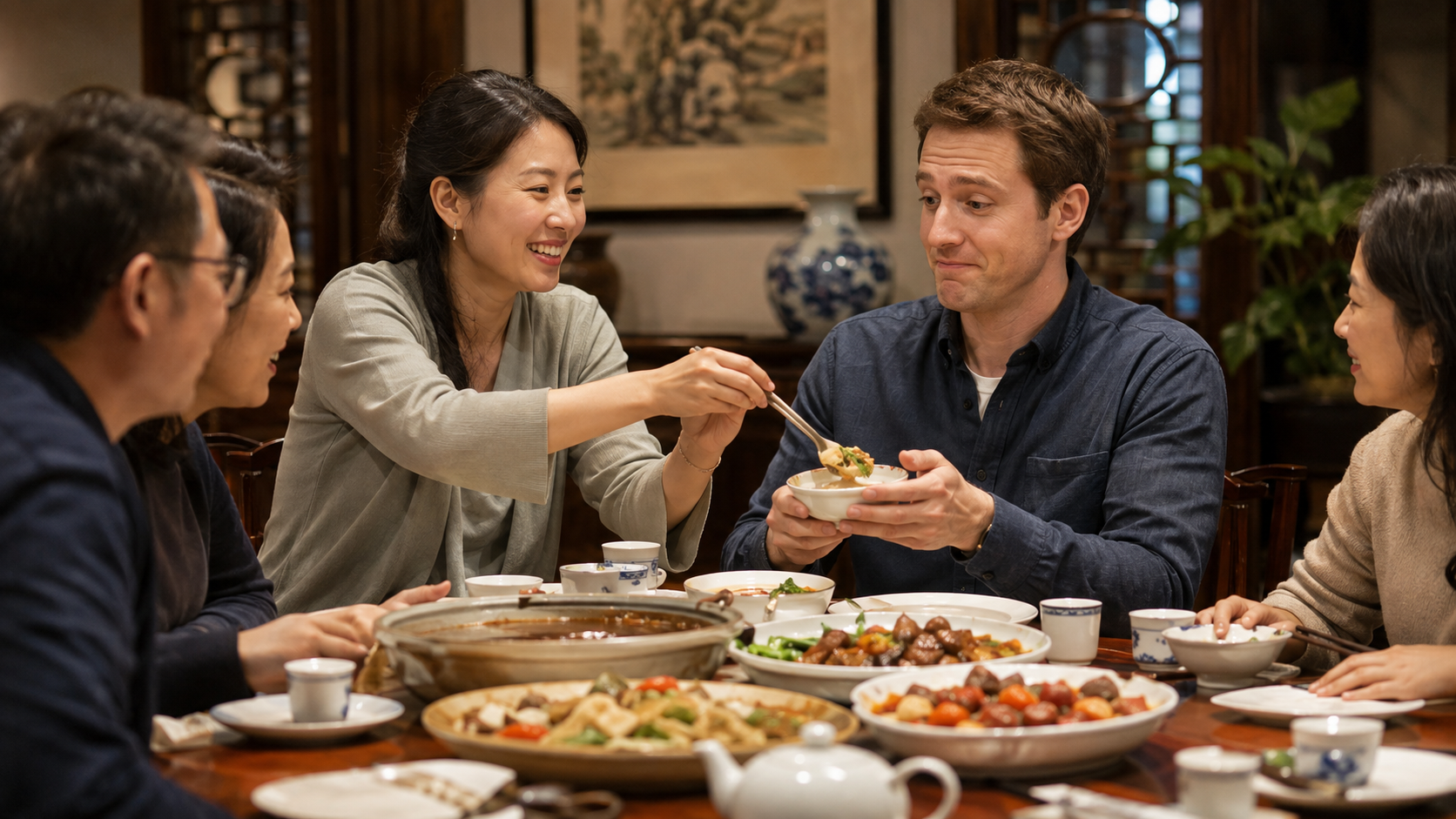
Imagine that you are having dinner in China and your host offers you another serving of food. You are full, so you smile and say no. A minute later, you are offered more. You decline again. Then someone puts another piece of fish in your bowl anyway.
For many Americans, this can be irritating. You already answered the question. Why keep asking?
The host may see the exchange differently. A guest might genuinely be full, but a guest might also refuse because accepting too eagerly can feel awkward. Offering again makes it clear that the invitation was sincere. From the host's perspective, giving up immediately after the first refusal could almost seem ungenerous. The odd part is that both people may believe they are being considerate.
This is one of the reasons Chinese ideas of politeness can be difficult for Americans to read. The problem is usually not that one culture values manners and the other does not. It is that people learn different ways of showing consideration, and those signals are easy to misinterpret when you do not know what to look for.
American politeness often emphasizes not imposing on another person. Chinese politeness, especially in more traditional social situations, may involve doing considerably more: offering again, insisting on helping, ordering for a guest, accompanying someone somewhere, or making sure that another person's needs are taken care of before they have to ask. To an American, that can sometimes feel intrusive. To a Chinese host, American restraint can occasionally look surprisingly indifferent.
Being Polite Can Mean Not Letting Someone Fend for Themselves
A great deal of American social etiquette is connected to personal autonomy. If someone says they do not want something, you generally accept the answer. Guests are often told to “make themselves at home.” Friends split bills. A host may ask what everyone wants to eat rather than deciding for the table. If someone offers help and you decline, they usually do not keep insisting.
Leaving another adult free to make their own decisions is itself a form of respect. In China, particularly in host-guest situations or interactions involving older generations, care may be expressed more actively. A host may decide which dishes you should try, keep putting food on your plate, insist on walking you back to your hotel, or refuse to let you pay for dinner.
An American visitor can easily think, You really don't have to do all this.
The host may be thinking, Of course I do. You're my guest.
Imagine that you are visiting someone's home and say, “Please don't go to any trouble for me.” An American host may take this fairly literally and keep things simple. A Chinese host may hear it as the polite thing a guest is expected to say, not as an actual instruction to stop making an effort.
The result can be a small tug-of-war in which both sides are trying to make the other person comfortable.
This is also why being attentive to other people can matter so much at a meal. Serving an elder first, pouring someone else's drink, offering the best piece of food to a guest, or noticing that someone's bowl is empty may communicate consideration more clearly than saying “please” or “thank you” several times.
American visitors sometimes look for politeness mainly in words. In China, it is often worth paying closer attention to what people are doing for one another.
Why 客气 (Kèqi) Doesn't Quite Mean “Polite”
Mandarin learners usually encounter 客气 (kèqi) very early.
They learn:
不客气 — bú kèqi
as “you're welcome,” and:
别客气 — bié kèqi
as “don't be polite.”
Neither translation is wrong, but neither explains the word particularly well.
Kèqi has to do with politeness, ceremony, consideration, and the social distance that comes with behaving properly toward another person. In some situations, telling someone 别客气 is less like saying “don't be polite” and more like saying, “You don't need to stand on ceremony with me.”
That distinction matters because Chinese politeness contains something that can initially seem contradictory to Americans: it is possible to be too polite with someone you are close to.
There is another useful expression, 见外 (jiànwài), which can describe treating someone as though they were an outsider. If a close friend helps you with something small and you respond with excessive ceremony, the formality itself can suggest distance.
English has something similar, although we rarely describe it as a cultural rule. If your sister hands you a cup of coffee and you respond, “I sincerely appreciate your kindness,” she may wonder what is wrong with you. The sentence is courteous, but the relationship does not require that level of ceremony.
This helps explain why Chinese learners of English and English-speaking learners of Mandarin can both get the vocabulary right while still feeling slightly wrong in conversation. A dictionary can tell you that 谢谢 (xièxie) means “thank you.” It cannot tell you exactly how often a particular family says it to one another, or when saying it very formally makes a relationship feel closer or more distant.
Why Offers, Gifts, and Restaurant Bills Can Turn Into Negotiations
Repeated offering is probably one of the easiest differences for visitors to notice. Food is the obvious example, but the pattern can appear with gifts, help, transportation, and payment. A person offers. The other person refuses. The offer appears again.
The first refusal is not necessarily meaningless. It can show that the recipient is not assuming another person's generosity. At the same time, the person making the offer has an opportunity to demonstrate that they genuinely mean it.
This does not mean foreigners need to memorize a rule such as “refuse three times before accepting.” It is more useful simply to know that a refusal sometimes carries a social meaning in addition to its literal meaning. The same thing can happen when the restaurant bill arrives.Americans sometimes watch several Chinese diners reaching for the check and wonder why everyone is making the process so difficult. Splitting the bill would take thirty seconds.
The problem is that paying may be part of the social interaction rather than merely the financial end of the meal. A person who invited the group may expect to host. Someone else may want to repay an earlier favor. Paying can communicate generosity, gratitude, or status within the relationship.
An American saying, “No, let's just divide it four ways,” may intend to make things easier and fairer. In a different social setting, dividing everything precisely can feel unnecessarily transactional.
Still, anyone who expects every meal in China to end in a theatrical argument over the bill is going to be surprised. Younger friends routinely split expenses, and digital payment has made doing so extremely easy. A formal dinner with an older relative is not the same social event as three university students getting noodles.
Compliments Are a Good Example of How Quickly Culture Changes
For years, foreigners learning Chinese were taught that they should expect compliments to be rejected.
Someone says:
“Your Chinese is very good.”
The supposedly traditional Chinese response is to deny or minimize the compliment rather than simply say thank you. Language textbooks sometimes introduce 哪里哪里 (nǎli nǎli) as the classic modest response.
You may still hear it, but it is a good example of why old etiquette advice can make contemporary Chinese people sound stranger than they actually are.
Studies of compliment responses in Chinese cities have found a clear movement toward accepting compliments, particularly among younger speakers. Saying 谢谢 after someone praises your clothes, English, cooking, or work is hardly culturally shocking in contemporary China.
Modesty has not disappeared. The ways people perform it have changed.
An older person, a younger person, a colleague, and a close friend may all respond differently to the same compliment. Some people accept it directly. Some soften their response. Some joke. Some still deflect.
This is more useful to understand than the old comparison that “Americans accept compliments while Chinese people reject them.” That kind of rule may help a beginner notice a cultural tendency, but it quickly becomes a caricature.
Why Questions That Sound Personal to Americans May Be Ordinary Conversation
Another common surprise involves privacy.
An American meeting someone for the first time may be startled by questions about age, marriage, children, work, housing, or occasionally income. Several of these subjects sit squarely inside the American category of “things you don't ask someone you barely know.”
Those boundaries have not always been drawn in exactly the same place in China.
Age, for example, can help establish how two people relate to one another. Questions about family situation or work can locate someone socially and create conversational familiarity. What sounds like interrogation to an American may be intended as ordinary interest.
That does not mean everyone in China wants to discuss their salary with strangers. Younger urban Chinese people in particular may have ideas about personal boundaries that are quite different from those of older relatives.
Still, Americans sometimes assume that their own categories of “personal” and “public” are universal, and they are not.
Even a simple question such as:
你吃饭了吗? — Nǐ chīfàn le ma? — Have you eaten?
can be misunderstood when textbooks explain it too neatly. It has historically been used in some contexts as a friendly, relationship-oriented question, but it is not simply a Chinese replacement for “How are you?”
A question from an older relative, neighbor, colleague, taxi driver, or stranger does not carry exactly the same meaning just because the words are identical.
“Thank You” Can Sound Different Depending on Who Is Saying It
Americans say “thank you” constantly. We thank cashiers, family members, coworkers, friends, spouses, people opening doors, and someone sitting at the table who passes the salt. Mandarin learners naturally transfer this habit to 谢谢 (xièxie), and much of the time there is nothing wrong with that.
The interesting difference appears in close relationships.
Research comparing Chinese and Western patterns of gratitude has found that explicit verbal thanks can sometimes be less frequent between people who are very close. Help from a family member or close friend may be understood as part of the relationship rather than as an individual favor that needs to be formally acknowledged every time.
If you grow up in a culture where saying “thank you” frequently is a sign of warmth, this can seem strange. Why wouldn't you thank someone you love?
Because in another relationship, formal gratitude may carry a slightly different feeling. Too much acknowledgment can make an ordinary act of mutual care sound like an obligation between people who are not actually close.
Of course Chinese family members say 谢谢. What varies is how much verbal acknowledgment a relationship seems to require.
This is one reason 不客气 is more interesting than “you're welcome.” Underneath it sits an idea that English occasionally expresses too: You don't need to thank me so formally. We're close.
What Americans Call “Direct” Can Sometimes Feel Publicly Uncomfortable
Then there is 面子 (miànzi), or “face,” probably one of the most discussed Chinese cultural concepts. It does not need to be mysterious.
Think about what happens when someone is corrected, contradicted, embarrassed, or made to look incompetent in front of other people.
Americans care about embarrassment too, but American workplaces and classrooms can place a relatively high value on speaking plainly. Someone might openly say, “That's incorrect,” or “I disagree with that approach,” and consider the directness efficient rather than hostile.
In a Chinese setting, particularly where hierarchy or a formal relationship is involved, the manner and location of the disagreement may matter enormously. A private correction gives someone room to adjust without being publicly diminished. A carefully worded refusal may let another person retreat without having to hear a direct “no.”
This does not mean Chinese speakers never argue, criticize, or say exactly what they think. Anyone who spends enough time around Chinese families will quickly discover how implausible that stereotype is.
Directness depends on who is speaking to whom. A grandmother can say something to a granddaughter that would sound astonishing coming from a new colleague. Friends can speak bluntly to each other in ways they would never use with a client. Someone can be highly indirect about a professional disagreement and extraordinarily direct five minutes later about whether you have gained weight.
That apparent inconsistency makes much more sense once you stop looking for a single “Chinese communication style.”
The Relationship Often Tells You More Than the Rule
A guest is not treated like a stranger. An elder is not necessarily treated like a peer. A close friend may not receive the same verbal politeness as an acquaintance because the lack of ceremony itself can demonstrate closeness.
That helps explain something that can puzzle foreigners. A person may be exceptionally attentive to you at dinner and then appear unconcerned about strangers pushing onto a crowded train. An American may instinctively think that politeness should operate more consistently in public.
But cultures do not necessarily distribute social obligations in the same way.
The person who walks you all the way back to your hotel, carries your bag despite your protests, orders too much food, refuses to let you pay, and asks whether you have eaten breakfast may not be following the American model of respecting another adult's independence.
They may simply be expressing: You are with me, so I am responsible for looking after you.
Once you recognize that possibility, behaviors that initially seem contradictory become easier to understand.
Chinese Politeness Is Changing Too
It is also worth remembering how quickly Chinese society has changed.
A large portion of the etiquette advice foreigners encounter online was written as though Chinese social customs had been preserved untouched for generations. Meanwhile, younger Chinese people are navigating digital payments, international workplaces, social media, foreign travel, changing family structures, and different expectations of privacy and independence.
Friends may split restaurant expenses through their phones. Younger people may readily accept compliments. Someone who has worked with foreigners for years may recognize that an American “no, thank you” actually means no and stop asking.
Families differ enormously as well. What happens around one Beijing dinner table may not happen in Chengdu, Guangzhou, Shanghai, or a Chinese-American home in California.
Knowing traditional expectations still helps because contemporary behavior did not appear from nowhere. But cultural knowledge is most useful when it gives you several possible ways to understand an interaction instead of convincing you that you already know how another person will behave.
A Translation Isn't the Whole Meaning
Mandarin students run into the same problem on a smaller scale.
They learn:
谢谢 — xièxie — thank you
不客气 — bú kèqi — you're welcome
请 — qǐng — please
The translations are correct. What is missing is information about relationships.
When does a phrase sound natural? When is it formal? Would a close friend say it? Would a grandmother? What happens when the sentence is grammatically perfect but socially strange?
These are difficult things to learn from vocabulary lists because language does not exist separately from the situations in which people use it.
At Polyglottist Language Academy, our Mandarin classes combine structured language study with speaking practice and cultural context, so students can learn not only what expressions mean but how they are actually used. You can explore our current Mandarin classes here:
The next time someone in China offers you more food after you have already said no, you may still find it annoying. You may still refuse, and they may still insist. The useful change is smaller than that.
Instead of assuming the other person ignored your answer because they were being rude, you have another possible explanation: perhaps they are trying to make sure you know the offer is genuine.
Cultural differences do not mean that every uncomfortable behavior should be excused, and they certainly do not erase personal boundaries. They simply mean that the signals we use to recognize consideration are learned.
Sometimes what one person experiences as pressure is what another person has learned to recognize as hospitality. And sometimes what feels like respectful distance to an American can look, from the other side, like a surprising lack of care.