
Introduction
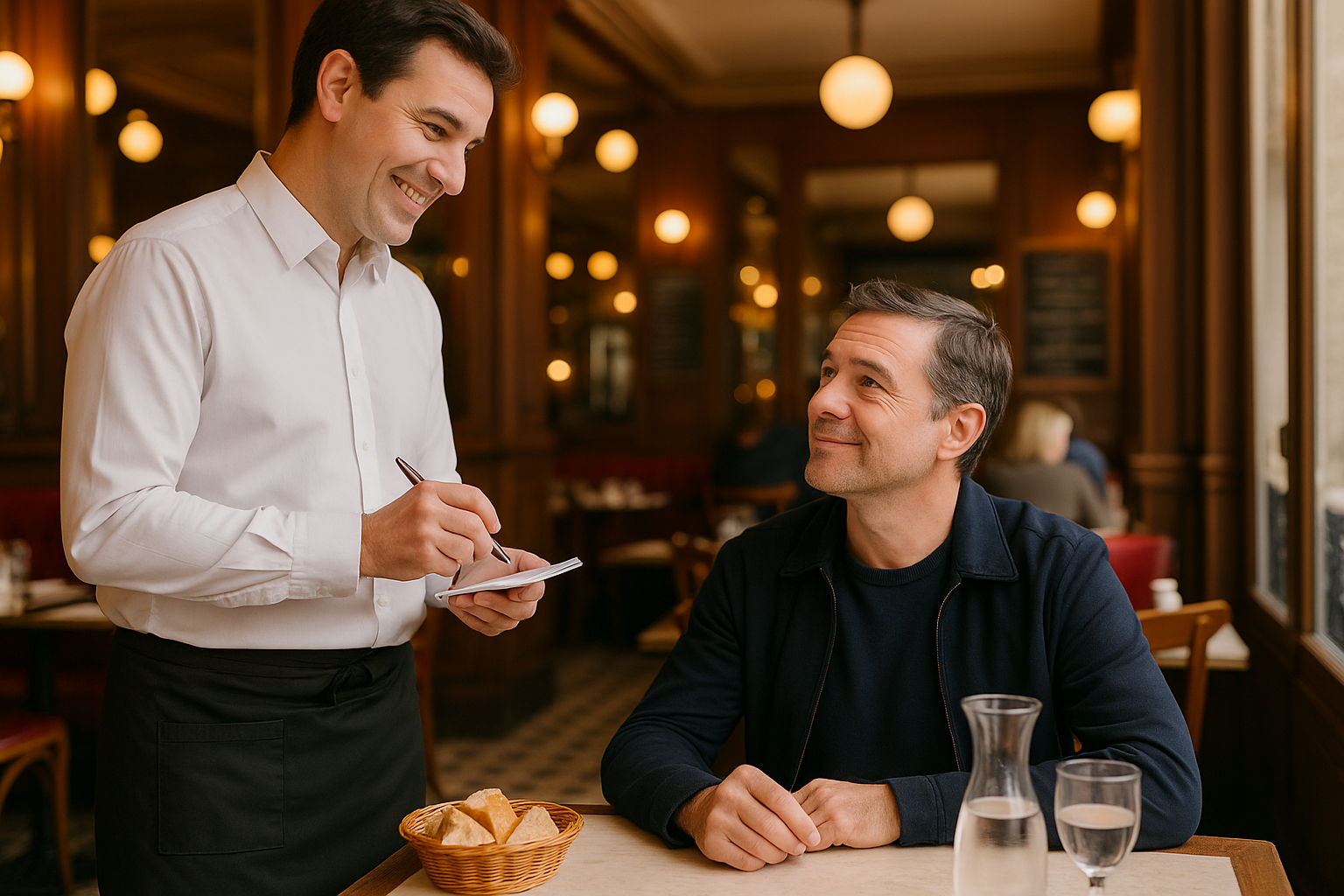
There’s a certain magic in stepping into a French brasserie—a place where time seems to slow, the aroma of butter and garlic fills the air, and conversations buzz like soft music around marble tables. For many visitors to France, it’s the ultimate dream: lingering over a glass of wine, savoring a perfectly cooked steak-frites, and soaking up the authentic atmosphere that makes French dining so legendary. Yet for all its allure, the brasserie can also be a place of quiet anxiety, especially when you’re confronted with rapid-fire French, menus full of unfamiliar terms, and a subtle set of social rules that separate the tourists from the locals. Because in France, ordering at a brasserie isn’t just about getting food on your plate—it’s a delicate social ritual, a dance of polite phrases, cultural signals, and unwritten expectations.
So why is it that even travelers who speak decent French sometimes feel awkward or out of place in a brasserie? Part of the reason lies in the language itself: French dining culture is filled with specific vocabulary, idioms, and polite formulas that rarely appear in textbooks. Another part comes from cultural differences: where diners sit, how they call the waiter, what’s considered rude or respectful, and how to navigate the complex structure of meals from aperitif to digestif. And then there’s the very real intimidation factor of dealing with a no-nonsense serveur who might size you up in an instant and decide whether you’re a clueless foreigner—or someone who knows how things work.
But here’s the good news: ordering like a local at a French brasserie isn’t an impossible task reserved for lifelong Parisians. With a bit of knowledge and confidence, you can blend in seamlessly, earn a smile of respect from your waiter, and enjoy your meal without feeling like you’re performing linguistic acrobatics. In this article, we’ll break down everything you need to know to navigate a brasserie like a pro—from how to read the menu and what to say to the waiter, to the cultural tips that can turn a meal into a delightful, authentically French experience.
Because in the end, a brasserie isn’t just a place to eat—it’s a window into French life, where language, culture, and cuisine come together in the most delicious way possible.
What Exactly Is a Brasserie?
Before diving into the art of ordering, it helps to clarify what a brasserie actually is. Many people think “brasserie” simply means “restaurant,” but there’s nuance:
Originally, brasserie meant a brewery. Many early brasseries served beer alongside simple meals.
Today, a brasserie is a casual yet traditional French establishment serving classic dishes.
Brasseries typically:
Serve food all day (unlike many French restaurants with fixed lunch/dinner hours).
Have a large menu.
Offer both full meals and quick snacks.
Feature a lively atmosphere.
Think of it as a step up from a café but less formal than a fine dining restaurant.
The Anatomy of a French Brasserie Menu
The French brasserie menu has its own structure and vocabulary. Understanding it is half the battle!
L’Apéritif
The pre-meal drink to stimulate your appetite:
Kir → White wine with cassis liqueur
Pastis → Anise-flavored spirit, popular in the south
Champagne → Always classy!
Entrées (Starters)
In French, entrée means starter, not main course:
Soupe à l’oignon → Onion soup
Salade de chèvre chaud → Warm goat cheese salad
Terrine de campagne → Country-style pâté
Plats (Main Courses)
Classic brasserie dishes include:
Steak-frites → Steak with fries
Moules marinières → Mussels in white wine
Confit de canard → Duck leg confit
Choucroute garnie → Sauerkraut with sausages (Alsace specialty)
Fromages (Cheese Plate)
Often offered between main course and dessert.
Desserts
French brasserie desserts are iconic:
Crème brûlée
Tarte Tatin
Mousse au chocolat
Digestif
A post-meal drink to aid digestion:
Cognac
Armagnac
Calvados
Understanding Menu Pricing
Many brasseries offer:
Menu du jour → Set menu with a few choices, often cheaper than à la carte.
Formule → Combo of entrée + plat or plat + dessert for a fixed price.
Locals often choose these for value.
How to Get a Table Like a Local
Unlike in some countries, French brasseries don’t always seat you automatically. Here’s how to handle it:
Look around. If there’s no host, catch a waiter’s eye and ask:
Bonjour, est-ce que je peux m’installer ici ?
(Hello, can I sit here?)Wait for confirmation. Even if tables look empty, they might be reserved.
Mastering the Art of Greeting
Politeness is crucial. Always greet staff:
Bonjour, Madame/Monsieur.
Skipping this is considered rude.
How to Order Drinks
Start with:
Je vais prendre un apéritif, s’il vous plaît.
Or simply:
Un kir, s’il vous plaît.
If you’d prefer water, specify:
Une carafe d’eau, s’il vous plaît.
(A carafe of tap water.)
Don’t feel pressured to order bottled water.
How to Order Food
Asking for the Menu
The menu = la carte.
Set menu = le menu.
Ask:
Je peux voir la carte, s’il vous plaît ?
Ordering Like a Local
Locals often use simple phrases:
Je vais prendre… → I’ll have…
Pour moi, ce sera… → For me, it’ll be…
Comme entrée, je vais prendre… → For starter, I’ll have…
Clarifying the Menu
If you don’t understand an item:
Qu’est-ce que c’est, exactement ? → What exactly is this?
Or:
C’est servi comment ? → How is it served?
French servers generally appreciate curiosity about food.
Choosing the Formule
If you want the set menu, say:
Je vais prendre la formule entrée-plat, s’il vous plaît.
How to Call the Waiter Politely
Don’t shout Garçon!—that’s outdated and rude. Instead:
Raise your hand subtly.
Make eye contact.
Say:
Excusez-moi, Monsieur/Madame.
Patience is part of French dining culture.
During the Meal: Polite Phrases
C’est délicieux ! → It’s delicious!
C’est parfait, merci. → It’s perfect, thanks.
Je peux avoir un peu plus de pain, s’il vous plaît ? → May I have more bread, please?
On peut partager ? → Can we share?
Handling Mistakes Gracefully
If your dish is wrong:
Excusez-moi, mais je crois qu’il y a une erreur.
Most staff will fix it graciously.
Dessert and Coffee
In France, coffee typically comes after dessert, not with it. To order:
Un café, s’il vous plaît.
Or:
Un expresso, s’il vous plaît.
If you want decaf:
Un déca, s’il vous plaît.
Asking for the Check
The check doesn’t arrive automatically. Signal you’re finished, then say:
L’addition, s’il vous plaît.
Or:
On peut régler, s’il vous plaît ?
Tipping Like a Local
Service compris → Service included in prices.
Rounding up or leaving a small tip (5-10%) is appreciated but not mandatory.
Example:
Bill = €23 → Leave €25.
Cultural Tips for Blending In
1. Don’t Rush
Meals are an event. Locals savor the experience.
2. Speak Softly
Loud voices can feel out of place.
3. Don’t Fear Silence
French meals often include quiet moments. It’s normal.
4. Enjoy Seasonal Dishes
Ask:
Quelles sont les spécialités du jour ?
5. Be Ready for Small Portions
Especially compared to American standards.
6. Respect Mealtime Hours
Lunch: roughly 12:00–14:00
Dinner: from 19:30 onward
7. Feel Free to Sit Alone
Solo diners are normal in France.
Phrases Locals Use
Checking Specials:
Qu’est-ce que vous recommandez ?
Ordering Steak:
Bleu → Very rare
Saignant → Rare
À point → Medium
Bien cuit → Well done
Requesting Changes:
Est-ce possible sans fromage ? → Is it possible without cheese?
When Things Get Awkward
If you freeze up, fall back on:
Excusez-moi, mon français n’est pas parfait. Est-ce que vous pouvez parler un peu plus lentement ?
Politeness always wins points.
Enjoying the Experience
Above all, remember:
French dining is about pleasure.
Servers aren’t cold—they’re professional.
Respect the rhythm of the meal.
Don’t be afraid to ask questions!
Ordering like a local transforms a brasserie meal from a simple necessity into a genuine cultural experience—and earns you respect from staff and locals alike.
FAQs
Q: Can I order just drinks at a brasserie?
A: Absolutely. Brasseries double as bars, especially outside mealtimes.
Q: Is it rude to split the check?
A: Not rude, but mention it upfront:
On peut partager l’addition ?
Q: Should I tip if service is included?
A: Not required, but rounding up is appreciated.
Q: Do I need to reserve a table?
A: For brasseries, often not. But during busy times or for large groups, reservations are wise.
Q: Are English menus available?
A: Sometimes in touristy areas, but they may not include all items.
Q: Can I take leftovers home?
A: It’s becoming more common but still less usual than in the US. Politely ask:
Est-ce que je peux emporter le reste ?
Q: Is it okay to just have coffee?
A: Yes, especially at outdoor tables. Many locals linger over coffee.
Q: How long can I stay at my table?
A: As long as you’re consuming. Lingering is part of the culture.
At Polyglottist Language Academy, we believe speaking French is about more than vocabulary—it’s about immersing yourself in the culture, customs, and small rituals that make everyday life uniquely French. Our classes go beyond grammar, teaching you the real-life language you need for authentic experiences—like confidently ordering at a brasserie and blending in like a local. Whether you’re planning a trip, moving to France, or simply dreaming of Parisian cafés, we’re here to help you speak, live, and enjoy French with style.
Ready to turn your French from textbook to true local? Sign up for French classes!
Check Out Our Other Blog Articles
Continue exploring the art of speaking and living French:
How Learning French Changes Your Personality And Way Of Thinking
Is Parisian French The “Best” French? A Deep Dive Into Regional Accents And Attitudes
How To Keep Your French Alive If You’re Not In A Francophone Country
When French Gets Philosophical: How To Talk About Life, Love, And Meaning
The Secret French Grammar Structures That Sound Instantly Native
French For Abstract Thinkers: Expressing Complex Ideas Like A Native
Why Fluent French Isn’t Perfect French—And Why That’s A Good Thing
A Crash Course In “French Filler Words” (Eh Bien, Tu Vois, Genre...)
What Learning French Teaches You About English (Yes, Really!)