
Why Italian Sounds Musical: The Hidden Logic of Its Rhythm and Intonation
Introduction: The Soundtrack of Italy
Close your eyes and picture Italy. What do you hear?
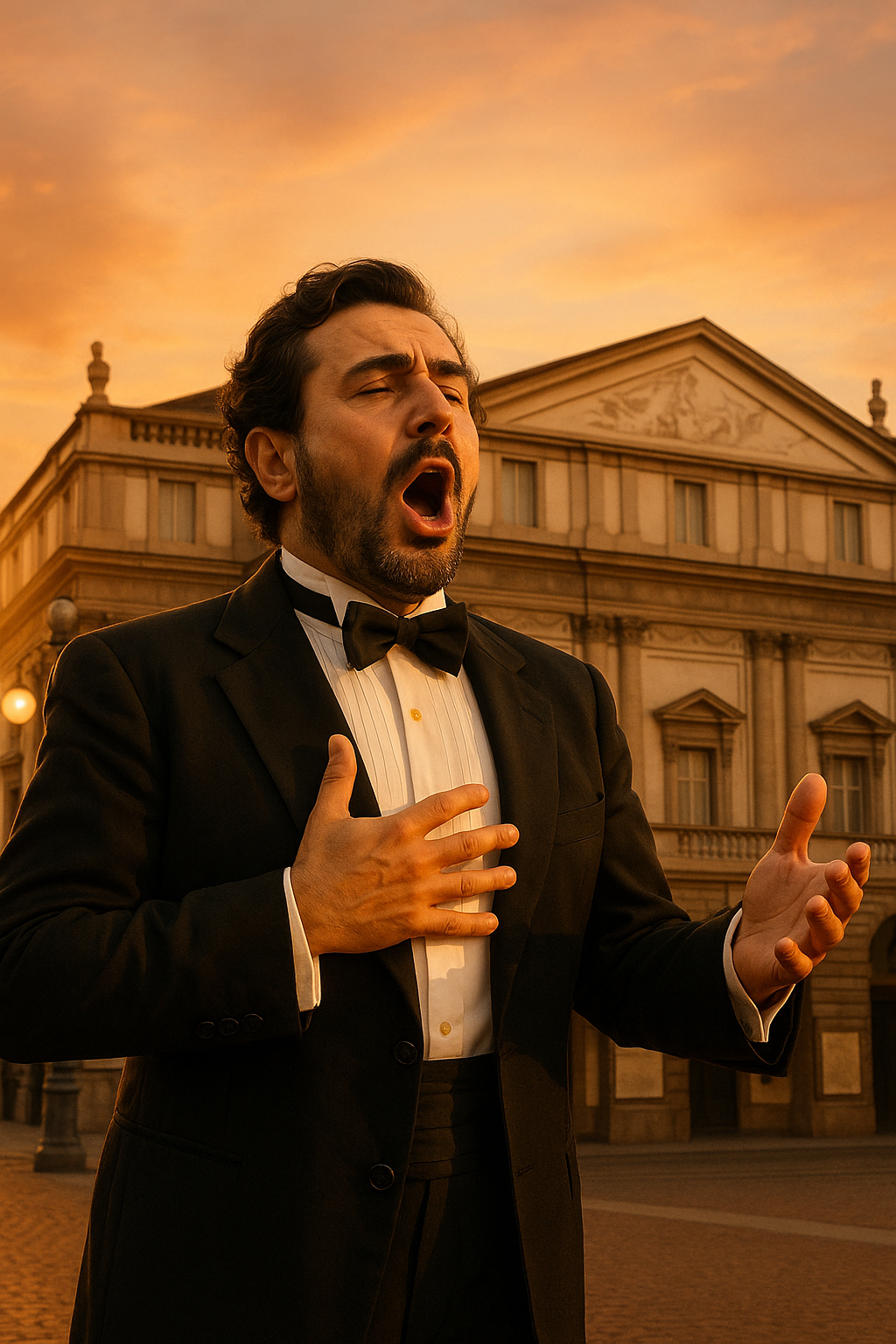
Perhaps it’s an opera aria floating out of La Scala in Milan. Or the passionate rhythm of a street vendor in Naples calling out prices for ripe tomatoes. Or the melodic swirl of “Buongiorno!” echoing through a Roman café.
Even for those who don’t speak it, Italian sounds unmistakably musical.
People describe Italian as:
🎵 lyrical
🎵 lilting
🎵 romantic
🎵 like a song
From opera lovers to tourists returning home, the refrain is the same:
“Italian just sounds so beautiful.”
But why does Italian sound musical to our ears?
Is it the vowels? The gestures that accompany speech? The famous rolling “r”? Or is there a hidden architecture in Italian—a rhythm and intonation system—that makes it feel like music itself?
The answer is: all of the above—and much more.
Because the “musicality” of Italian isn’t just a poetic notion. It’s rooted in real linguistic features:
✅ rhythm patterns
✅ vowel-rich syllables
✅ stress timing
✅ melodic intonation contours
Together, these elements create a language that sings—even in ordinary conversations about groceries, politics, or family gossip.
Whether you’re a language learner, a lover of Italian culture, or simply fascinated by why some languages “sound prettier” than others, this article will take you behind the curtain of Italian’s hidden musical logic.
Let’s discover why the language of Dante, Puccini, and your favorite gelato shop sounds like the most beautiful soundtrack in the world.
Part 1 – The Role of Vowels: A Symphony of Open Sounds
If there’s one sound that defines Italian, it’s vowels.
1.1 Vowel-Rich Language
Italian is what linguists call a vocalic language:
Words rarely end in consonant clusters.
Syllables are built around pure vowel sounds.
Even consonants often lead into bright, open vowels.
Consider:
Ciao → pronounced [ˈtʃa.o] (two syllables)
Amore → [aˈmo.re]
Bellissimo → [belˈlis.si.mo]
Unlike English, where multiple consonants might close a syllable (e.g., “strengths”), Italian flows in open syllables, each ending in a vowel or single consonant.
1.2 Pure, Unstressed Vowels
In English, vowel sounds shift dramatically depending on stress:
“record” (noun) vs. “record” (verb)
In Italian, vowels remain pure even in unstressed positions.
Parola → [paˈro.la]
The “a,” “o,” and “a” remain crisp.
This purity gives Italian a bell-like resonance.
Part 2 – The Rhythm: Syllable-Timed Precision
2.1 Stress-Timed vs. Syllable-Timed Languages
English is stress-timed:
We rush through unstressed syllables.
“INteresting” often sounds like “INtristing.”
Italian is syllable-timed:
Each syllable takes roughly equal time.
This creates a steady, rhythmic “da-da-da-da” feel.
Example:
Voglio andare al mercato.
“VO-glio an-DA-re al mer-CA-to.”
Each syllable is pronounced distinctly, with a rhythmic pulse. It’s why even spoken Italian can sound like chanting.
2.2 Natural Flow
Because syllables are evenly timed:
Italian speech has a natural musical cadence.
There’s less rushing or swallowing of sounds.
This rhythm feels musical—even if you don’t understand the words.
Part 3 – The Magic of Intonation
It’s not just what Italians say. It’s how they say it.
3.1 Melody in Sentences
Italian speakers use broad pitch variations:
Rising and falling intonation.
Dramatic pitch movements to express emotion.
Example:
Davvero? (“Really?”)
Pitch rises sharply, then drops.
Or:
Che bello! (“How beautiful!”)
Starts high, drops slightly, then rises again.
English often stays flatter in pitch. Italian dances up and down the scale.
3.2 Emotional Coloring
Italians:
stretch vowels for emphasis.
Be-e-e-llo!
add singsong patterns to statements.
inflect words to show mood—without needing extra words.
In English, we might say:
“I’m so happy.”
An Italian could say:
Sono felice!
…and make it sound five times happier just through tone.
3.3 Musical Questioning
Questions in Italian often rise significantly at the end.
Sei pronto? (“Are you ready?”)
The rising contour sounds musical—and clearly signals it’s a question.
Part 4 – Consonants That Dance
Italian consonants contribute to musicality too.
4.1 Double Consonants
Known as geminate consonants, doubles are pronounced longer:
pala → shovel
palla → ball
The second has a “held” sound. This extra timing creates rhythm and bounce.
4.2 The Famous “R”
The rolled r:
adds a trill to speech.
creates musical vibration.
is perceived as passionate and lively.
Compare:
English: “Roma” [ˈroʊmə]
Italian: Roma [ˈro.ma], with a rolled “r.”
4.3 Smooth Transitions
Italian avoids harsh consonant clusters. Instead, it:
uses vowel bridges.
creates smooth transitions between sounds.
This fluidity adds to the sense of melody.
Part 5 – Gesture and Voice: A Complete Performance
Italian’s musicality isn’t only in sound. It’s in how Italians speak.
5.1 Speaking with the Body
Gestures:
mirror vocal intonation.
accentuate rhythm.
create a “visual music.”
A shrug, a hand wave, a pinch of the fingers—all sync with melodic speech.
5.2 Expressiveness
Italian speakers:
modulate volume.
pause dramatically.
elongate words for comic or emotional effect.
Even the simplest sentence can become a performance.
Part 6 – Italian in Music: A Natural Fit
Italian’s natural musicality is why:
It became the language of opera.
Musical terms worldwide are Italian:
allegro
forte
crescendo
pianissimo
Composers like Verdi, Puccini, and Rossini composed in Italian because:
✅ vowels project well in singing.
✅ syllable timing suits music.
✅ the language’s natural melody pairs perfectly with orchestration.
Part 7 – Does Italian Really Sound More Musical—or Is It Just Perception?
A fascinating question.
Studies show:
People rate Italian as more musical—even if they don’t understand it.
Its acoustic features (pitch range, vowel clarity) stand out compared to languages like German or English.
So it’s not just romantic myth. There’s scientific backing for why Italian sounds like music.
Part 8 – How to Sound More Musical When Speaking Italian
Want to bring musicality into your Italian?
✅ Emphasize vowel sounds.
✅ Practice syllable timing.
✅ Listen and imitate intonation.
✅ Roll your “r.”
✅ Observe gestures and body rhythm.
Singing along with Italian songs—even pop music—is a fun way to practice!
Part 9 – Why Musicality Matters for Learners
Learning to “sing” in Italian:
improves pronunciation.
helps comprehension.
makes speaking more natural.
connects you to cultural authenticity.
Fluency isn’t just words—it’s rhythm, melody, and emotion.
Conclusion: Italian—the Language That Sings
Italian is more than grammar and vocabulary. It’s an audible culture. Each word flows into the next like notes in a melody.
Its musicality:
✅ enchants listeners.
✅ energizes speakers.
✅ elevates everyday conversation to art.
So next time someone tells you Italian sounds like music—you’ll know exactly why. It’s not only perception. It’s the hidden logic of rhythm, vowels, intonation, and expressiveness that transforms Italian into one of the world’s most beautiful languages.
And when you start speaking it yourself, you’re not just talking—you’re singing.
FAQs: Why Italian Sounds Musical
Q1: Is Italian really the most musical language?
It’s widely considered among the most musical due to vowel clarity, rhythm, and intonation.
Q2: Does every Italian speaker sound melodic?
Mostly, yes. Regional accents vary, but all Italian maintains syllable timing and melodic patterns.
Q3: Is it hard to learn to roll the “r”?
It takes practice but is achievable. Many learners eventually master it with tongue exercises.
Q4: Why is Italian used in music terminology?
Because of Italy’s influence during the Renaissance and Baroque periods—and its natural suitability for singing.
Q5: Are there other musical languages?
Spanish and Portuguese also sound melodic but differ in rhythm and intonation.
Q6: Will speaking Italian make me more expressive?
Yes! Italian encourages gesturing and emotional expression.
Q7: Is Italian hard to pronounce?
Not especially. Italian spelling closely matches pronunciation, which helps learners.
Q8: Can singing help my Italian?
Absolutely! Singing improves intonation, rhythm, and memory.
Ready to Make Your Italian Sing?
At Polyglottist Language Academy, we specialize in teaching Italian not just as a language—but as a musical experience. Our interactive classes help you:
✅ master pronunciation
✅ understand Italian rhythm
✅ speak with natural musicality
➡️ Sign up for our Italian classes today!
Check Out More Articles From Our Blog!
Love Italian? Keep exploring:
From Ciao To Arrivederci: How To Master Italian Greetings And Goodbyes
Using “Piacere” Correctly In Italian (It’s Not Just ‘To Like’)
Aperitivo, Passeggiata & More: Everyday Italian Culture Through Language
Valle D’Aosta: Castles, Mountains, And The Taste Of Fontina Cheese
From Opera To Espresso: Explore Italian With Classes In Oakland
How To Ask Questions In Italian: Grammar, Tone, And Intuition